Exoskeleton robots have long been perceived as bulky, expensive, and primarily used in industrial heavy-duty applications, medical rehabilitation, or military settings. However, with advancements in servo motors, lightweight structures, and AI motion recognition algorithms, consumer-grade wearable assistive robots are beginning to enter the mass sports market. On August 12th, Reudyn, a new wearable robot brand from Leqi Intelligent, officially launched the Hip X26 hip joint AI-assisted exoskeleton, targeting the general public for hiking, long-distance walking, and light exercise, attempting to break down the barriers of exoskeletons as “professional equipment.” This article provides a comprehensive review covering hardware architecture, AI-assisted logic, real-world testing experience, applicable boundaries, and industry value.
Product Positioning
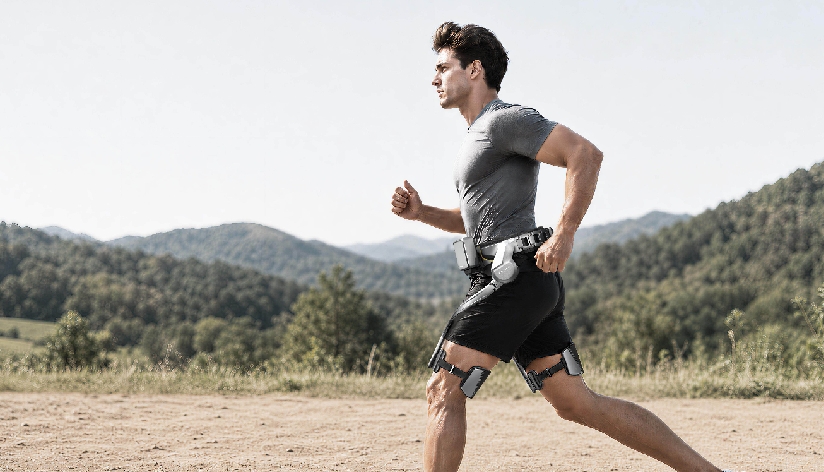
The Reudyn Hip X26 is a consumer-grade flexible hip joint assistive exoskeleton, distinct from rigid medical rehabilitation exoskeletons and heavy-duty industrial assistive devices. The product is aimed at ordinary outdoor enthusiasts, long-distance walkers, and light exercise enthusiasts, and can also be extended to reduce the burden of physical training and protect against lower limb strain.
The core objective of this product is not to replace human effort, but rather to use AI to recognize gait and provide assistive torque at key hip flexion and extension points, reducing the continuous load on the gluteal and leg muscles and alleviating lower limb fatigue caused by prolonged walking or hiking. The device is planned for official launch in September 2026; the current version is a finalized mass-production prototype.
Core Hardware and AI Technology Analysis
On the hardware side, the Hip X26 adopts a dual-hip modular servo drive solution, featuring a lightweight design that eliminates heavy metal frames and extensively uses high-strength composite materials to reduce the wearer’s weight. The entire structure is concentrated in the waist belt and dual hip joint actuators, without rigid leg support, adopting a flexible exoskeleton approach to ensure natural range of motion during walking, strides, and small squats, without restricting joint freedom of movement.
It incorporates a high-precision inertial measurement unit (IMU) and angle sensors to collect real-time data such as trunk tilt angle, hip joint angle, gait cycle, and stride speed; the drive unit’s response speed matches the normal walking rhythm, supporting dynamic adjustment of the assist torque magnitude and timing.
AI algorithms are the core highlight of this product: equipped with a self-developed motion intention recognition model, eliminating the need for complex manual mode switching. After initial wear, the device completes personal gait calibration within a few steps, automatically distinguishing between different movement states such as walking on flat ground, slow uphill walking, and slow adjustment, dynamically matching the assistance curve. Traditional assistive exoskeletons mostly rely on fixed-sequence triggering of assistance, easily leading to asynchronous force application and a dragging sensation. The Hip X26, however, relies on real-time perception of human movement intentions to adaptively output assistance according to gait.
The device supports multiple levels of assistance adjustment. The accompanying mobile app allows users to view gait data, exercise duration, hip force load estimation, and record changes in energy consumption during long-distance hiking, used for reviewing walking posture and assisting in correcting poor gait habits.
Actual Wearing and User Experience: The wearing process uses a quick-release waist belt buckle design, allowing a single person to independently put on and take off the device without assistance. The waist belt has built-in cushioning padding to distribute the device’s weight and reduce pressure on the lower back and abdomen during prolonged wear.
In flat-ground walking tests, after AI completes gait calibration, the assistance focuses on the extension phase of the hip joint during the forward stride, helping to swing the thigh forward and reducing the burden on the gluteus maximus and hamstrings to maintain posture. In uphill scenarios, the system recognizes changes in inclination angle and automatically increases the assist torque, reducing the stress on the lower limbs during ascent.
During the experience, it’s noticeable that the device doesn’t actively “pull” the limbs; the assistance is gentle and supportive, preserving the user’s sense of self-motivation and preventing dependency. After stopping exercise, the servo drive enters follow-up mode with extremely low resistance, without restricting normal turning, side-stepping, or climbing stairs.
The accompanying app provides a complete gait report: cadence, stride length, bilateral hip force balance, and estimated muscle load savings, helping users adjust their walking posture and improve issues such as unilateral compensation and center of gravity shift.
Key Advantages and Highlights
Flexible and Lightweight Solution, Adaptable to Daily Activities
Abandoning rigid lower limb supports, the structure is simpler and easier to wear, suitable for everyday scenarios such as outdoor hiking and long-distance walking, unlike bulky industrial or medical exoskeletons.
AI Adaptive Gait Recognition for More Natural Force Application
Automatically recognizes movement intentions and dynamically adjusts the timing and torque of assistance based on flat ground, uphill, and varying speed walking, reducing the dragging and jerking sensations common in traditional exoskeletons and improving wearing comfort.
Single-Person Quick-Release Design, Low User Barrier
Modular quick-release buckles allow users to wear it independently without professional adjustments, better aligning with consumer hardware usage habits and facilitating outdoor carrying and storage.
Combining Assistance and Gait Assessment
More than just weight reduction assistance, it also collects gait data to monitor exercise load and assess body posture, integrating “assistance + data” to align with the development trend of smart sports hardware.
Consumer Market Pricing Expectations
As a wearable robot product for the general public, unlike professional exoskeletons that cost hundreds of thousands, it is expected to lower the barrier to entry for exoskeleton technology and promote its civilian application.
Existing Shortcomings and Limitations
Defined Assistance Scenarios: Positioned as a lightweight assistive device, it is only suitable for low-intensity, continuous activities such as walking and hiking. It cannot be used for running, jumping, heavy weight training, or high-intensity strength training, and cannot be used as a power-enhancing device for competitive sports.
Battery Life and Weight Balance Need Market Validation: Lightweight design necessitates trade-offs in battery life, which needs to be considered during extended outdoor hiking. Although the overall weight has been optimized, wearing it for several hours continuously can still cause pressure and fatigue in the lower back and abdomen.
Recognition Stability in Complex Road Conditions Needs Long-Term Testing: In complex environments such as unpaved forest roads, frequent speed changes and turns, and alternating steps, whether AI gait recognition will falsely trigger assistance requires extensive outdoor testing.
Lack of Medical Certification, Cannot Be Used as a Rehabilitation Device: The product is designed for healthy individuals seeking exercise relief and lacks medical device certification. It cannot be directly used in clinical scenarios such as stroke, spinal cord injury, or post-operative lower limb rehabilitation.
No Medical Certification, Cannot Be Used as a Rehabilitation Device: Designed for healthy individuals seeking exercise relief, the product lacks medical device certification and cannot be directly used in clinical scenarios such as stroke, spinal cord injury, or post-operative lower limb rehabilitation. Individual Fit Varies
Users with different heights, leg lengths, and pelvic shapes may require fine-tuning of the waist belt and actuator positions. Some users may experience insufficient fit or assistive device misalignment.
Recommended Scenarios
✅ Recommended for: Outdoor long-distance hiking enthusiasts, long walks in scenic areas, daily commuters taking tens of thousands of steps, and those who engage in light exercise and experience lower limb fatigue; also suitable for use in fitness institutions for reducing the burden of long-distance walking training and gait screening.
❌ Not suitable for: Fast running, ball sports with changes of direction, heavy-load lifting, clinical rehabilitation treatment, and high-intensity competitive training.
Review Summary
The greatest significance of the Reudyn Hip X26 hip joint AI-assisted exoskeleton is that it brings exoskeleton robot technology, originally confined to the industrial and medical fields, to the mass consumer sports market. It doesn’t pursue super-strong assistive performance, but rather addresses the pain point of lower limb fatigue during long walks for ordinary people with its flexible, lightweight structure and AI motion intention recognition. It represents a typical attempt at the civilian application of wearable robots.
In the current consumer-grade sports hardware market, the competition among fitness trackers, smartwatches, and smart glasses is fierce, while lower limb wearable assistive devices remain a blue ocean market. The Hip X26 represents a new generation of AI wearable hardware: sensing human intentions, adaptively assisting force exertion, and simultaneously outputting digital motion data.
Of course, this product is still in the pre-market stage, and its long-term outdoor reliability, battery life, and public acceptance remain to be tested by the market. For ordinary users, it won’t become an essential piece of sports equipment in the short term; however, for outdoor enthusiasts and those concerned about lower limb strain protection, this hip-assisted exoskeleton may open up a new branch of smart sports hardware—human motion assistive robots.
Leave a Reply