Exoskeletons are no longer the exclusive gear of sci-fi movies. In the past, most consumer-facing exoskeletons were either bulky and cumbersome—geared more toward industrial lifting or rehabilitation—or offered limited assistance, making them unsuitable for high-intensity outdoor activities like mountaineering or long-distance hiking. At the 2026 World Robot Conference, Kunwei Technology—a company specializing in six-axis force sensors—unveiled the HiiBex lightweight outdoor assistive exoskeleton. By packing industrial-grade force control and AI-driven gait prediction capabilities into a chassis weighing just 2.1kg, the device aims to provide a powered lower-limb augmentation system for outdoor fitness enthusiasts and long-distance hikers.
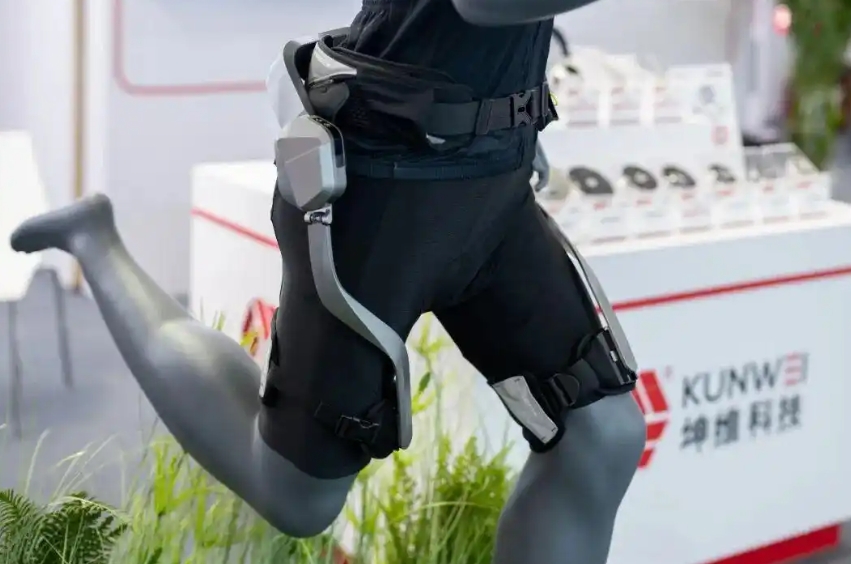
Hardware Design: Minimizing Weight is the Primary Challenge
The entire unit (including the battery and soft padding) weighs less than 2.1kg, making it the product’s most immediate selling point.
The frame is constructed from 80% carbon fiber composite material, significantly reducing its own weight. The lining uses SCF foaming material—the same type found in high-performance running shoes—to ensure breathability, sweat resistance, and shock absorption. This minimizes friction and pressure on the thighs during prolonged activity, solving the common issues of heat buildup and chafing associated with traditional exoskeletons.
The wearable design utilizes quick-release straps; no complex tools are required, and the device can be put on in just a few minutes. Its compact size allows it to fit inside a large outdoor backpack—a stark contrast to the bulky exoskeletons of the past.
At its core lies the AmbiForce motor, developed in-house by Kunwei. Each motor delivers a peak torque of 26Nm, providing sufficient assistive torque to the lower limbs during hill climbing, weighted hiking, or mountain biking, thereby alleviating the load on thigh muscles.
Equipped with a 75.6Wh battery, the device offers over 6 hours of continuous assistance. It supports “charge-while-use” functionality via power banks, allowing users to extend runtime during long outdoor excursions and eliminating range anxiety.
AI Intelligent Core: AmbiCore Adaptive Model—Interpreting Human Movement Intent in Milliseconds
An exoskeleton’s quality isn’t defined solely by torque output; the fluidity of human-machine collaboration is the true differentiator of the user experience. Many early exoskeletons suffered from significant issues: lag in assistance, jerky force application, and a “tug-of-war” between the machine and the human body, ultimately making movement more tiring.
HiiBex is powered by the proprietary AmbiCore AI adaptive model. Its sensor system captures body posture and force signals 200 times per second and anticipates movement intent 5ms in advance. It recognizes various gaits—such as walking, hiking uphill, descending, cycling, and jogging—and dynamically adjusts the level of assistive torque in real-time, rather than simply outputting brute force.
The AI learns the user’s stride length and force application habits, adapting to users of different heights and weights. When hiking uphill and increasing leg effort, the device synchronously boosts assistance; during descents, it automatically reduces output to provide cushioning and protection; and when switching to cycling mode, the algorithm shifts its motion model to suit pedaling actions.
The device tracks work performed, joint stress, and muscle load, generating data that quantifies outdoor fitness activities and transforms “invisible leg exertion” into actionable training insights.
Limitations: The current unit is a trade show prototype; a full mobile interface was not visible, and features such as comprehensive data visualization and customizable assistance levels await refinement in future versions.
Use Cases and Target Audience
✅ Target Audience
- Outdoor hiking and mountaineering enthusiasts: Reduces lower-limb muscle fatigue and extends activity duration during long-distance, weighted treks.
- Mountain biking enthusiasts: Provides lower-limb assistance during climbs, reducing strain on knees and thighs.
- Fitness enthusiasts: Enables high-volume, long-distance aerobic hiking without overtaxing the knees.
- Potential future application: Daily walking assistance for older adults (a market segment officially mentioned in future planning).
❌ Unsuitable Scenarios
- High-intensity running, jumping, or vigorous contact sports;
- Medical rehabilitation; the product is designed for athletic assistance, not as a medical device. ## Key Strengths
- Strong Technical Foundation: Leveraging Kunwei’s expertise in industrial 6-axis force sensors and force control, the AI force control algorithms are entirely self-developed and backed by over a dozen patents, supported by solid underlying hardware technology.
- Lightweight yet High-Performance: Weighing just 2.1kg while maintaining robust torque output, it breaks away from the stereotype of bulky, cumbersome exoskeletons.
- Outdoor-Friendly Battery Life: Supports power bank expansion, addressing the challenge of maintaining power during long-distance excursions.
- AI-Adaptive Motion Modes: Eliminates the need for frequent manual gear switching; the AI automatically recognizes gait dynamics and adjusts assistance levels in real-time.
Current Limitations (Inherent to the Prototype Stage)
- Not Yet in Mass Production: The WRC showcase was purely for technical demonstration; no pricing or launch schedule has been announced, and it is currently unavailable to general consumers. Positioned as a technology exploration project rather than a consumer-facing product aimed primarily at profit, it also supports B2B ODM customization.
- Incomplete Protection and Fit Specifications: Official details regarding IP ratings and user height/weight compatibility are missing; reliability in rainy conditions or on rugged, rocky terrain requires further field testing.
- Software Ecosystem Under Development: Features such as AI-generated activity reports, training plans, and full mobile app/mini-program functionality have not yet been fully implemented.
- Wearability Needs Real-World Validation: While static demonstrations at the exhibition were impressive, factors like chafing, stability, and movement during continuous long-distance hikes (spanning tens of kilometers) require outdoor field testing.
Brief Competitive Analysis
Existing consumer-grade assistive exoskeletons generally fall into two categories: industrial-derived lower-back exoskeletons (optimized for heavy lifting rather than outdoor hiking) and a limited number of consumer-grade lower-limb exoskeletons (which tend to be heavy—2.8–3.5kg—or lack the torque needed for strenuous uphill climbs). HiiBex differentiates itself by integrating industrial-grade force control capabilities into a lightweight frame, specifically targeting the outdoor fitness and hiking market. ## Summary
Kunwei’s HiiBex represents a cross-industry technological experiment: an industrial sensor company has adapted its mature factory-grade force-sensing and AI control technologies for consumer-facing outdoor fitness hardware.
It demonstrates that a lightweight, AI-assisted exoskeleton can weigh as little as 2.1kg and achieve millisecond-level gait prediction, offering a novel hardware solution for outdoor activities like hiking and mountaineering. However, it is important to recognize that this is currently a trade-show prototype; there is still some way to go before it reaches the average consumer with a fully developed software ecosystem.
If it successfully moves into mass production and the wearable experience and software ecosystem are fully fleshed out, it has the potential to redefine the concept of “wearable human augmentation” for outdoor fitness.
Leave a Reply