Author: Gavin

  • DingTalk A1 Doukou Doctor Edition: AI Medical Assistant for $138

    DingTalk A1 Doukou Doctor Edition: AI Medical Assistant for $138

    One-sentence verdict: If DingTalk can prove that a $138 clip-on device plus a vertical medical model can genuinely reduce doctors’ documentation burden without compromising patient privacy, this could be the most practical AI healthcare hardware to watch in 2026.
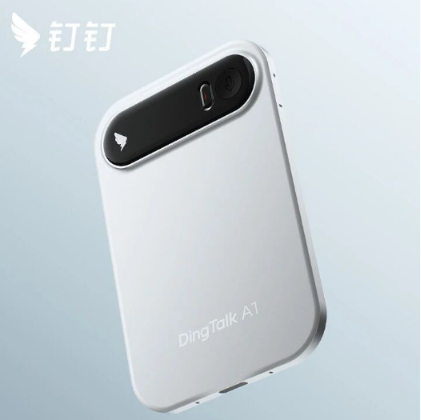
    DingTalk A1 AI device front
    DingTalk A1

    Quick Summary

    On June 12, 2026, DingTalk officially launched the A1 Doukou Doctor Edition, priced at 999 RMB ($138). Rather than creating new hardware, the product reuses the existing DingTalk A1 clip-on AI chassis, deeply integrating Alibaba’s Doukou medical large model to provide full-diagnosis-workflow AI assistance for medical professionals. The device measures 3.8mm thick and weighs 40.8g, attaching magnetically to the back of phones. It packs the BES2800 AI audio chip, a 6-microphone array, and supports 8-meter precise pickup with 45-hour continuous recording. The core differentiation lies in software: the Doukou model, trained on 40 million publications and passing China’s senior gynecologist examination, enables real-time transcription, structured medical record generation, and clinical guideline matching across outpatient, inpatient, conference, and academic scenarios.


    What Happened

    DingTalk’s approach to medical AI hardware is notably restrained. Instead of designing dedicated medical devices from scratch, the company chose “hardware reuse, software deep cultivation”—taking a chassis already validated across sales, legal, and HR professionals, and layering vertical medical capabilities on top.

    The hardware foundation is the DingTalk A1 clip-on design. At 3.8mm thickness and 40.8g weight, it attaches to phone backs via magnets, adding zero carrying burden. The BES2800 AI audio chip (6nm process) powers a 6-microphone array: five omnidirectional mics plus one bone conduction mic for 8-meter precise pickup. The Fun-ASR model reduces hallucination rates from 78.5% to 10.7%. Battery life reaches 45 hours of continuous recording or 60 days standby, with 21-language simultaneous interpretation covering international academic exchange needs.
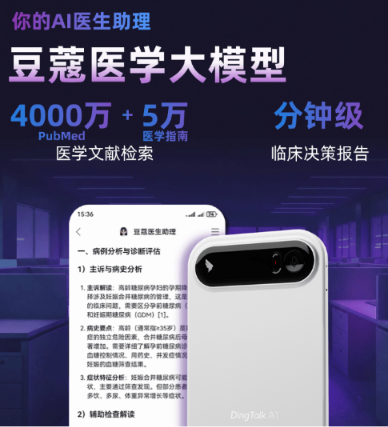
    DingTalk A1 medical AI interface
    DingTalk A1 medical AI assistant display

    Based on this capability, DingTalk A1 Doukou Doctor Edition adapts four core scenarios:

    Outpatient consultation: Real-time transcription generates structured electronic medical records while matching clinical guidelines for auxiliary decision-making.

    Inpatient rounds: Full voice recording automatically produces standardized progress notes and actionable order lists.

    Multidisciplinary conferences: Pre-meeting rapid retrieval of historical cases, in-meeting extraction of core consensus, post-meeting automatic generation of analysis reports with archiving to difficult case libraries.

    Academic meetings: Precise transcription and minute generation with simultaneous matching to relevant guideline literature, building personal academic databases.

    Privacy design addresses medical-grade requirements. Recording files use triple-end encryption, large model calls operate in privacy environments, enterprise administrators can centrally manage devices and data, and full-process traceability meets medical industry compliance standards.


    Why It Matters

    The DingTalk A1 Doukou Doctor Edition represents a pragmatic approach to AI healthcare that contrasts sharply with more ambitious but less grounded competitors.

    Most AI medical products fall into two traps: either they over-promise diagnostic capabilities that regulators will never approve, or they under-deliver on workflow integration, forcing doctors to toggle between multiple systems. DingTalk’s approach avoids both by focusing on what AI can reliably do today—transcription, documentation, and information retrieval—while leaving diagnosis to human physicians.

    DingTalk A1 clinical analysis reports
    DingTalk A1 five clinical scenario reports

    The “hardware reuse” strategy is particularly clever. Developing medical-grade hardware from scratch requires years of regulatory navigation and massive capital investment. By reusing a proven chassis, DingTalk accelerates time-to-market by 12-18 months and avoids the regulatory burden of novel medical devices. The 999 RMB price point becomes achievable precisely because hardware R&D costs are amortized across multiple professional segments.

    The Doukou model’s evidence-based foundation matters more than its exam-passing headline. Medical AI’s critical challenge is hallucination—generating plausible-sounding but clinically dangerous recommendations. Training on 40 million publications and validating against standardized examinations creates a verifiable accuracy baseline that most general-purpose medical AI lacks.


    Impact Analysis

    Market impact: The $138 pricing could democratize AI medical assistants beyond top-tier hospitals to county clinics and private practices. If DingTalk scales this model to other specialties (cardiology, oncology, pediatrics), it could establish a platform play in vertical medical AI.

    Consumer impact: For doctors, the value proposition is time reclaimed. Chinese physicians average 4-6 hours daily on documentation. Automating transcription, record generation, and order list creation could recover 1-2 hours per day—equivalent to seeing 5-10 more patients or reducing overtime by 25%.

    Industry impact: The “general chassis + vertical model” architecture could become the template for professional AI hardware. Rather than building custom devices for every profession, manufacturers may standardize on clip-on or wearable chassis, with software and models defining vertical differentiation. This would dramatically reduce hardware fragmentation and accelerate AI adoption across industries.
  • NoonWake.AI Raises Seed Round: AI Spiritual Companion with Eastern Framework

    NoonWake.AI Raises Seed Round: AI Spiritual Companion with Eastern Framework

    One-sentence verdict: NoonWake.AI’s three-layer funnel—Eastern metaphysics for acquisition, psychology for retention, hardware for lock-in—proves that AI emotional companionship need not follow the orthodox Western counseling path. Sometimes, users prefer to start with horoscopes before discussing their inner selves.

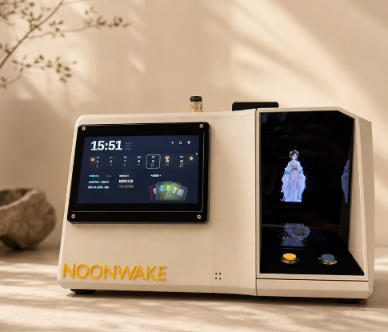
    NoonWake.AI Good Luck Calendar desktop hardware
    NoonWake.AI Good Luck Calendar desktop AI device

    Introduction

    In June 2026, the AI emotional companionship track secured another seed funding round. NoonWake.AI received nearly 10 million RMB from Yunqi Capital and Bianliang Capital, with Duowei Capital serving as exclusive financial advisor. Rather than copying Western psychological counseling chatbot models, the company chose a more localized path: constructing virtual personalities through Yin-Yang Five Elements and Ten Gods systems, allowing users to unconsciously process emotions while “checking their fortune.”

    As of April 2026, its domestic product “Wanxiang Youling” has accumulated hundreds of thousands of users, with the overseas version Starot registering nearly 50,000 monthly users. For a newly founded startup, these numbers indicate genuine market demand for psychological services that “don’t feel like going to the doctor.”


    Company Overview

    NoonWake.AI positions itself as an “AI Native spiritual and personality companionship company.” This positioning deliberately avoids the red ocean of “AI psychological counseling”—which faces triple challenges of regulatory uncertainty, strong user stigma, and low payment willingness.

    Core capabilities are summarized as “conversational interpretation systems” and “long-term connected virtual personalities.” Simply put: the system does not treat users as “patients” to diagnose, but as “confused individuals” to accompany. Through the Ten Gods system, human psychological structures are deconstructed into ten dynamic personality dimensions, each corresponding to a virtual character. When a user feels anxious today, the “Hurt Officer” character may respond; tomorrow when confused, the “Direct Resource” perspective offers advice. The same question receives multiple viewpoints from different characters, avoiding the mechanical feel of single-AI assistants.

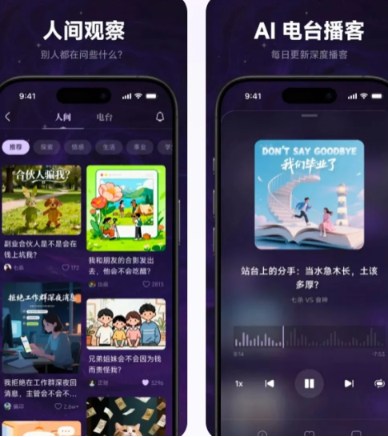
    NoonWake.AI Wanxiang Youling app interface
    NoonWake.AI Wanxiang Youling app AI podcast

    Its technical foundation is the self-developed “Wanxiang Youling Inference Model”, which combines multi-model routing with Multi-Agent collaboration. This means the system does not call a single general-purpose large model to perfunctorily handle all requests. Instead, it activates different specialized agents based on specific scenarios: emotional documentation has a dedicated personality profiling agent, relationship confusion has a communication analysis agent, and career decision-making has a long-term planning agent. These agents share user memory to create a continuous conversational experience.


    Product Matrix: Three-Layer Funnel Design

    ProductMarketCore FunctionPositioning
    Wanxiang YoulingDomesticYin-Yang Five Elements virtual personalities, mood tracking, personality profiling, growth adviceAcquisition entry
    StarotOverseasEmotional support, daily to-dos, relationship sorting, guided reflectionEmotional support
    Good Luck CalendarGlobalDaily fortune timing, AI reflection, printable ritual contentHardware lock-in

    The design logic of this three-layer structure is clear: Wanxiang Youling uses “Five Elements fortune” to lower psychological barriers, getting users to open up; Starot uses Western “self-exploration” narratives to complete deep companionship; the Good Luck Calendar machine materializes virtual experiences, creating “daily visible” ritualistic moments.

    The Good Luck Calendar machine deserves particular attention. This desktop AI hardware won second prize in the Xiaohongshu Hackathon hardware track, transforming daily fortunes, AI reflections, and printable content into a physical world “life entry point.” Hardware not only provides differentiated experiences but creates new monetization scenarios—users’ willingness to pay for “physical ritual” often exceeds that for “app subscriptions.”


    Acquisition Strategy: Why “Astrology” Outperforms “Psychological Counseling”

    NoonWake.AI’s market observations reveal a counterintuitive phenomenon: in C-end markets, “AI astrology/tarot” acquisition efficiency far exceeds “AI psychological counseling.” Three reasons explain this:

    First, psychological barrier differences. Users more easily express real concerns around “fortune” and “tarot” rather than directly admitting “I have psychological problems.” Astrology serves as a “safe metaphor,” making confession less shameful.

    Second, usage habit differences. Daily fortunes and status reminders can form stable usage habits, whereas psychological counseling tends to be one-time. Habit formation means higher retention rates and lifetime value.

    Third, sharing propensity differences. AI-generated fortunes and personality analyses possess inherent sharing desire—”look at my monthly romance analysis” spreads more easily on social media than “look at my psychological counseling report.”

    NoonWake.AI’s strategy essence: use “culturally accepted carriers across different regions” for acquisition, use “psychology” for retention. Domestically, Five Elements and birth charts; overseas, astrology and tarot—the underlying engine is the same personalized AI system.、

    NoonWake.AI virtual personality ten gods analysis
    NoonWake.AI virtual personality deep report view

    Industry Impact

    NoonWake.AI’s funding and product validation offer three insights for the AI emotional companionship industry:

    Cultural frameworks act as product moats. When Western AI-powered psychological counseling products enter the Chinese market, they often face “acclimatization”—the tension between CBT’s rational framework and Chinese users’ habits of emotional expression. NoonWake.AI demonstrates that repositioning AI psychological services with local cultural symbols allows companies to build more natural connections with users.

    Hardware is the ultimate entry point for emotional companionship. When software services become homogenized, physical hardware creates irreplaceable “presence.” The Good Luck Calendar machine’s success suggests that the next competition in AI companionship may shift from “whose large model is stronger” to “whose hardware offers more ritual.”

    Adopt separate strategies for user acquisition and retention. The layered design of “acquire via metaphysics, retain via psychology” solves the common dilemma faced by emotional companionship products: *”users come but do not stay.”* Low-threshold market entry secures stable traffic, while professional services drive user conversion.

  • Faraday Future FX Navi Review: Quadruped Robot Dog for Education

    Faraday Future FX Navi Review: Quadruped Robot Dog for Education

    One-sentence verdict: If the “phone as brain” cost advantage and 9-level curriculum depth can withstand real classroom testing, the FX Navi may be the most cost-effective entry ticket in consumer quadruped educational robots—provided parents are comfortable with ongoing content fees.

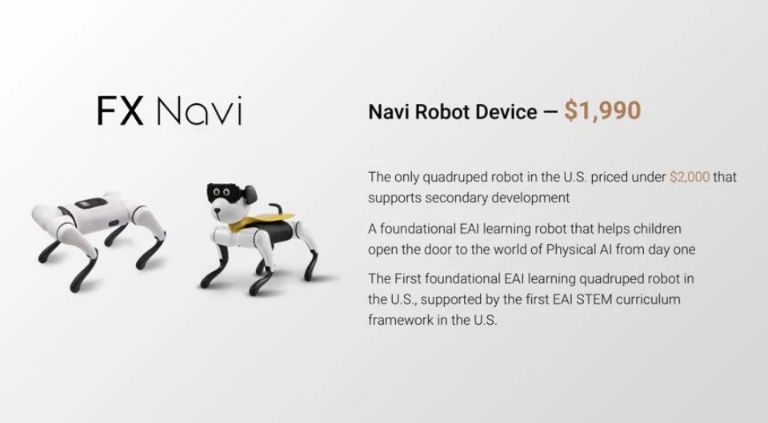
    Faraday Future FX Navi quadruped robot $1,990 poster
    Faraday Future FX Navi quadruped robot $1,990 posterv

    Introduction

    Educational robots have long occupied an awkward market position. Industrial-grade quadruped platforms like Boston Dynamics Spot cost $75,000, putting them out of reach for schools and families. Low-end programming toys like Sony toio are affordable but cannot deliver real robot interaction experiences. Faraday Future’s FX Navi attempts to break this deadlock—packing quadruped locomotion, STEM curriculum, and secondary development capabilities into a $1,990 base package.

    The FX Navi launched for immediate purchase on June 17, 2026, targeting families and schools with technology education needs. It features 12 joint motors, uses iOS/Android phones as the computing “brain,” includes a 9-level EAI STEM curriculum (annual fee $490), and offers a $390 permanent enhancement pack unlocking secondary development capabilities.


    Product Overview

    The FX Navi is Faraday Future’s first consumer-facing educational robot, and Jia Yueting’s latest attempt to cross over from electric vehicles to robotics. In stark contrast to the FF 91’s production struggles, the FX Navi chose a more pragmatic path: avoiding autonomous driving-level complexity to focus on “affordable embodied intelligence education.”

    The core design trade-off is “phone as brain”: the robot dog body handles only mechanical execution and sensor acquisition, while computation and AI processing are entirely offloaded to the user’s iOS or Android phone. This architecture significantly reduces base hardware costs (no need for built-in high-performance processors) while leveraging devices users already own. Twelve joint motors enable basic locomotion—walking, turning, sitting, standing, and simple obstacle avoidance.

    For battery life, the FX Navi includes a rechargeable battery delivering approximately 2 hours per charge, with support for use-while-charging. The lightweight plastic body keeps total weight under 3 kg, making it easy for children to carry and store.


    Technical Specifications and Curriculum

    The FX Navi offers a 9-level EAI STEM curriculum covering a complete learning path from kindergarten through high school:

    LevelThemeCore ContentAge Range
    Level 1-2Motion Control BasicsForward, backward, turning, speed adjustment5-7 years
    Level 3-4Sensor CognitionDistance detection, sound recognition, light sensing8-10 years
    Level 5-6Programming LogicConditional judgment, loop structures, event triggers11-13 years
    Level 7-8AI Algorithm IntroductionImage recognition, voice commands, path planning14-16 years
    Level 9Comprehensive ProjectSelf-designed tasks, team collaboration competitions17+ years

    The annual curriculum fee of $490 includes video tutorials, project assignments, and online Q&A. The $390 permanent enhancement pack unlocks secondary development capabilities: modifying walking algorithms, adding custom sensors, and integrating third-party AI services.

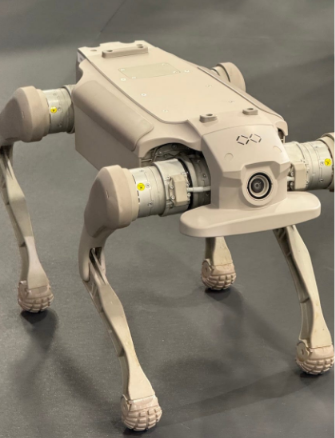
    FX Navi robot dog joint motors close-up
    FX Navi robot dog joint motors close-up

    The intelligence of this curriculum design lies in transforming “playing with robots” into “learning engineering.” Each level has clear skill objectives and quantifiable learning outcomes, allowing parents to track their children’s progress rather than buying a toy that gathers dust.


    “Phone as Brain”: Beyond Cost Cutting

    The FX Navi’s “phone as brain” design is not merely a cost compromise but an expression of educational philosophy.

    Traditional educational robots like LEGO Mindstorms suffer from fixed hardware and closed functionality, with students quickly hitting ceilings. The FX Navi achieves a “hardware-standardized, software-infinitely-extensible” architecture by using the phone as the computing hub. Users’ phones upgrade annually, and the robot dog’s “intelligence” upgrades along with them—meaning the FX Navi won’t become obsolete two years after purchase.

    A deeper benefit is lowered secondary development barriers. Students can use familiar mobile app interfaces (rather than unfamiliar embedded systems) to program robot control, creating a gentler learning curve. Support for Python and JavaScript allows advanced students to directly call mainstream AI frameworks like TensorFlow Lite, enabling genuine machine learning projects.

    Yet risks exist equally: phone performance varies enormously, with budget models potentially unable to run complex AI inference smoothly; Bluetooth/Wi-Fi connection stability directly impacts classroom experience; parents may be unwilling to let children occupy phones for extended periods.


    Competitive Comparison

    FeatureFaraday Future FX NaviUnitree Go2 EduXiaomi CyberDog 2Sony toio
    Price$1,990 base~$1,400~$1,800~$280
    Curriculum9-level EAI STEMNoDeveloper docs onlyBasic programming
    Annual Fee$490NoneNoneNone
    QuadrupedSupportedSupportedSupportedNot supported
    Secondary Dev$390 unlockSupportedSupportedLimited
    Phone DependencyRequiredOptionalOptionalNot required
    Target Age5-17 years12+ years14+ years6-10 years

    The FX Navi’s pricing strategy is particularly interesting. At $1,990 base + $490 annual + $390 skill pack, three-year total cost reaches approximately $3,850. Against Unitree Go2 Edu ($1,400, no curriculum) and CyberDog 2 ($1,800, developer-oriented), the FX Navi costs more but offers a more complete educational. Against Sony toio ($280, basic programming), the FX Navi delivers real quadruped robot experience rather than wheeled toys.

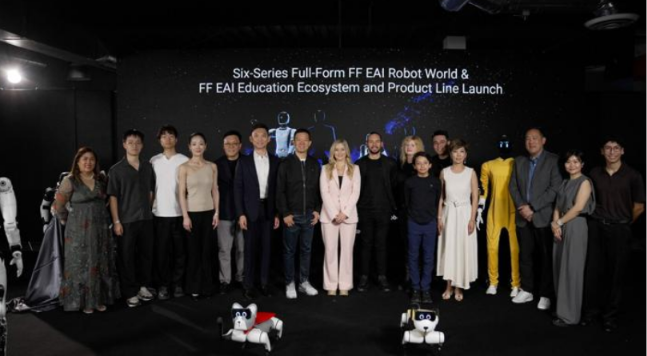
    Faraday Future FX Navi launch event with team
    Faraday Future FX Navi launch event with team

    Pros and Cons

    ProsCons
    $1,990 base lowers quadruped robot entry barrierMust depend on phone, budget models limit experience
    9-level curriculum provides systematic learning path$490 annual fee increases long-term cost
    “Phone as brain” enables continuous compute upgrades2-hour battery insufficient for full-day classes
    Secondary development cultivates advanced engineering thinkingBrand trust affected by FF 91 production struggles
    Lightweight design suits child operation and storagePlastic body durability remains to be validated

    Buying Guide

    Recommended for:

    • Middle-class families with tech education budgets: systematic curriculum + real robot experience proves more effective than fragmented online courses
    • Private schools and training institutions: needing standardized STEM teaching tools, with 9-level curriculum ready to embed into teaching systems
    • Students planning to enter robotics competitions: secondary development capabilities support custom projects with strong competition adaptability
    • Tech enthusiasts curious about the FF brand: wanting to experience Jia Yueting’s “new story” product

    Consider carefully if:

    • Budget-sensitive and unwilling to pay annual fees: three-year total cost nears $4,000, far exceeding one-time programming toys
    • Needing phone-independent operation: classroom phone management is complex, and occupies students’ personal devices
    • Pursuing industrial-grade precision and performance: the FX Navi is an educational tool, not a research platform, with limited 12-motor locomotion capability
    • Low trust in Faraday Future brand: FF 91 delivery history may affect purchase confidence

    FAQ

    Q: Does the FX Navi require phone connection to function? 

    A: Yes. The robot dog body handles mechanical execution; all computation and AI processing is completed through the mobile app. Offline mode only supports basic motion control.

    Q: Can the 9-level curriculum be purchased separately? 

    A: No. The curriculum is bundled with hardware sales; the $490 annual fee begins counting upon device activation.

    Q: What programming foundation is needed for secondary development? 

    A: Levels 7-8 require basic Python; Level 9 and the enhancement pack require familiarity with API calls and simple algorithms.

    Q: Does it support multi-robot collaboration? 

    A: Yes. Through mobile apps on the same Wi-Fi network, up to 3 FX Navi units can achieve formation collaboration.

    Q: Is the body waterproof? 

    A: No. Indoor dry environment use is recommended; avoid liquid splashing.


    Conclusion

    The Faraday Future FX Navi is not a perfect educational robot—battery life, phone dependency, and brand trust all have room for improvement. But it precisely targets a market gap: families and schools who want real quadruped robot experience without paying industrial-grade premiums; students who need systematic STEM learning rather than scattered programming toys.

    The “phone as brain” architecture transforms this device from “a cheaper robot dog” into “an upgradeable education platform.” Behind the $1,990 pricing lies a bet that content monetization can sustain hardware innovation.

  • Moore Threads MTT AICUBE Launch: Home AI Hub for $1,380

    Moore Threads MTT AICUBE Launch: Home AI Hub for $1,380

    One-sentence verdict: If Moore Threads can prove that a domestic GPU manufacturer can build a credible consumer AI hub, the MTT AICUBE could redefine what a smart home centerpiece looks like—though at $1,380, it is betting that enthusiasts will pay premium prices for unproven integration.

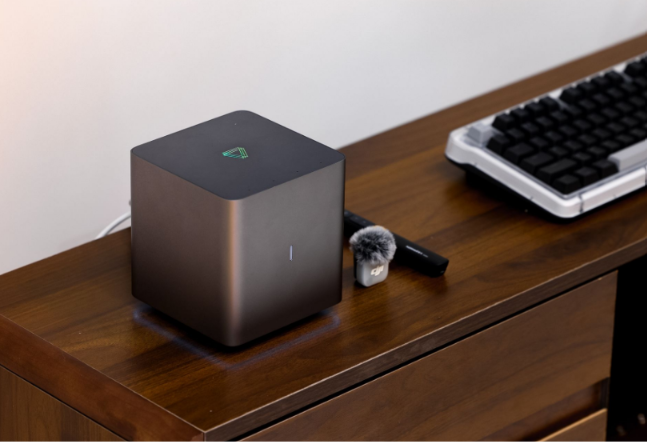
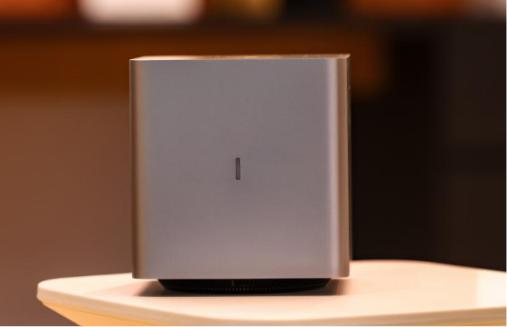
    Moore Threads MTT AICUBE silver front view on desk
    Moore Threads MTT AICUBE silver cube on desk

    Quick Summary

    On June 18, 2026, Moore Threads officially opened pre-orders for the MTT AICUBE home AI hub on JD.com. The device integrates AI PC, all-flash AI NAS, and smart speaker capabilities through built-in universal AI agent “Xiaomai.” Powered by the self-developed “Changjiang” intelligent SoC with 50 TOPS on-device compute, it supports cross-app control for 36+ applications. Pricing starts at 9,999 RMB ($1,380) for the 16GB+1TB configuration and 10,999 RMB ($1,520) for 32GB+1TB. This marks the first time a domestic GPU manufacturer has targeted consumer home scenarios with an on-device AI computing product.


    What Happened

    Moore Threads built its reputation as a domestic GPU challenger, developing graphics processors as alternatives to NVIDIA and AMD in the Chinese market. The MTT AICUBE represents a dramatic strategic pivot—from enterprise and government GPU sales to consumer home electronics.

    The product architecture fuses three traditionally separate categories into one chassis. As an AI PC, it provides local compute for AI workloads without cloud dependency. As an AI NAS, it offers all-flash network-attached storage with intelligent classification and retrieval. As a smart speaker, it delivers voice-controlled home management. The unifying layer is “Xiaomai,” a universal AI agent capable of understanding natural language commands and executing them across all three domains.

    The “Changjiang” SoC is Moore Threads’ self-developed silicon, delivering 50 TOPS of on-device AI compute. This positions the chip in the mid-range of edge AI processors—sufficient for local inference but not competing with high-end server GPUs. The 36+ supported applications for cross-app control represent the practical demonstration of Xiaomai’s capability: rather than opening individual apps, users issue commands like “find that document from last Tuesday and send it to the TV,” with the AI agent coordinating file retrieval, content transfer, and display output.

    Moore Threads MTT AICUBE dark desktop setup with microphone
    Moore Threads AICUBE desktop setup beside keyboard and mic

    The 618 launch timing is strategically significant. China’s mid-year shopping festival provides guaranteed traffic and media attention, while the “first domestic GPU consumer product” narrative generates patriotic technology interest. Moore Threads is leveraging both commercial momentum and national sentiment.


    Why It Matters

    The MTT AICUBE matters for three reasons beyond its hardware specifications.

    First, category creation. “Home AI hub” does not exist as a recognized product category. Existing smart home ecosystems—Xiaomi, Huawei, Apple HomeKit—organize around distributed devices with cloud intelligence. Moore Threads is proposing a centralized, on-device alternative where all computation happens locally. If this architecture gains traction, it challenges the cloud-dependent models that currently dominate.

    Second, domestic semiconductor validation. Moore Threads’ GPUs have faced skepticism about performance and software compatibility. A consumer product that actually ships, functions, and satisfies users would provide tangible proof that domestic GPU technology can transcend enterprise niche applications. The 50 TOPS figure is modest compared to NVIDIA’s offerings, but entirely local processing eliminates latency and privacy concerns that cloud solutions cannot address.

    Third, integration ambition. AI PC, NAS, and smart speaker are each mature categories with established leaders. Combining all three risks delivering none well. Yet if Moore Threads succeeds in seamless integration—where the AI agent genuinely coordinates across storage, compute, and voice interaction—it creates a user experience no single-function device can match.

    The pricing strategy signals confidence. At $1,380-$1,520, the MTT AICUBE sits above most smart speakers and NAS devices, approaching entry-level MacBook territory. This is not mass-market pricing; it targets technology enthusiasts and heavy home digitization users who value integration over individual component excellence.

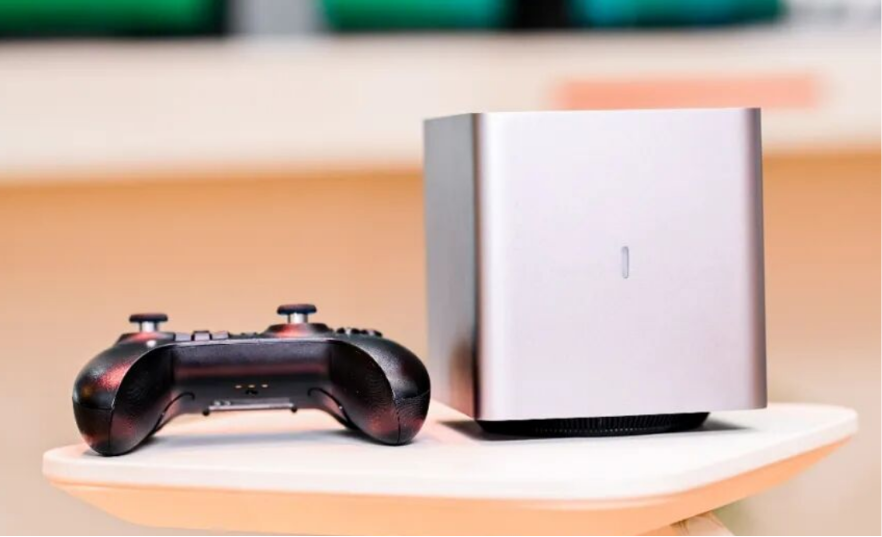
    Moore Threads MTT AICUBE size comparison with game controller
    Moore Threads AICUBE size comparison next to game controller

    Impact Analysis

    Market impact: The MTT AICUBE could catalyze a “home AI hub” category if sales demonstrate demand for centralized, on-device intelligence. Competitors from traditional NAS manufacturers (Synology, QNAP) to smart speaker leaders (Amazon, Google) might respond with integrated offerings. The domestic GPU angle also pressures international chip vendors to accelerate China-market localization.

    Consumer impact: Tech enthusiasts gain a locally-controlled alternative to cloud-dependent smart home ecosystems. For privacy-conscious users, on-device processing means voice commands and personal data never leave the home network. However, the premium pricing limits accessibility, and early adopters face ecosystem immaturity risks.

    Industry impact: Moore Threads’ consumer pivot may inspire other domestic semiconductor companies to explore end-user products rather than remaining component suppliers. The “Changjiang” SoC’s success or failure in real-world home scenarios provides data points for China’s broader edge AI chip development.


    What’s Next

    Several variables will determine whether the MTT AICUBE establishes lasting market presence:

    First, cross-app control reliability. Supporting 36 applications is impressive on paper, but maintaining compatibility as those apps update independently creates ongoing engineering challenges. Users will judge Xiaomai by whether “it just works” or requires constant troubleshooting.

    Second, NAS performance against established players. All-flash storage is fast, but Synology and QNAP have years of software refinement in data management, backup workflows, and third-party app ecosystems. Moore Threads must match or exceed these capabilities to justify the premium.

    Third, developer ecosystem growth. A home AI hub’s value increases with the number of connected devices and services it can control. Moore Threads needs to attract developers to build Xiaomai-compatible integrations, a challenge for a company without established consumer platform experience.

    Fourth, production and delivery execution. Moore Threads has historically struggled with GPU availability and software maturity. Translating enterprise supply chain experience to consumer electronics—where user expectations for immediate functionality are far higher—presents operational risks.