Author: Gavin

  • Midjourney Scanner: When an AI Art Company Bets on Medical Hardware

    Midjourney Scanner: When an AI Art Company Bets on Medical Hardware

    One-Sentence Verdict

    If you believe the ultimate form of consumer health monitoring is “scanning your whole body as easily as stepping on a scale,” the Midjourney Scanner may be one of the most compelling concept hardware devices to watch in 2027—provided it crosses the chasm from prototype to regulatory approval.
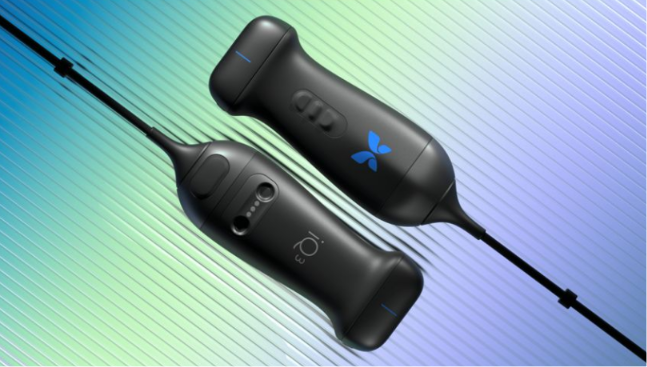
    Butterfly Network iQ Ultrasound Probe handheld product photo
    Butterfly Network handheld ultrasound probe for medical imaging

    Introduction: From Pixels to People

    Midjourney, the company famous for generating award-winning AI art with an 11-person team, just made a shocking pivot. On June 17, 2026, it announced Midjourney Medical and unveiled its first hardware product: the Midjourney Scanner, a full-body ultrasonic CT device that looks like a sci-fi movie prop. Users stand in a shallow pool of water and slowly descend through a ring of thousands of transducers, generating a whole-body 3D image in about 60 seconds.

    For a company that generated $200 million in annual revenue with just 11 employees and won a top art prize with Théâtre D’Opéra Spatial, this leap into medical imaging is as bold as Musk building rockets.

    Product Overview: Echolocation in Water

    The core experience is uniquely futuristic. The user steps into a shallow pool, stands on a platform that slowly descends through a 70 cm diameter ring. This ring contains 40 Butterfly Network Ultrasound-on-Chip imaging modules, totaling 358,000 ultrasonic elements that capture data at 17 GB per second. Each body slice requires roughly 40 GB of raw data, reconstructed by 21 servers delivering 2 PFLOPS of compute power.

    Midjourney compares the process to “a circle of dolphins using echolocation to observe you.” Sound waves travel through water at approximately 1,481 meters per second, while the platform descends at 4 cm per second. The ultimate goal: hundreds of slices in 60 seconds, producing 0.5 mm resolution images comparable to MRI—without radiation or powerful magnets.

    Currently, this remains a Gen 1 prototype. Only about a dozen people have been scanned, and the actual process takes roughly 20 minutes due to bandwidth, algorithm, and data-transfer limitations.

    Technical Specifications

    ParameterSpecification
    Transducer Count358,000 (8,960 per chip × 40 modules)
    Ring Diameter70 cm
    Data Capture Rate17 GB/s
    Data per Slice~40 GB
    Reconstruction Compute2 PFLOPS
    Reconstruction Servers21
    Target Scan Time~60 seconds
    Current Scan Time~20 minutes (prototype limits)
    Resolution~0.5 mm
    Platform Descent Speed4 cm/s
    Sound Speed in Water~1,481 m/s

    Business Model: Spa, Not Clinic

    Perhaps the most striking aspect of the Midjourney Scanner is not its technology but its business model. The first Midjourney Spa is planned for San Francisco’s Union Square by the end of 2027, occupying 25,000 square feet across four floors. In addition to scanning rooms, the facility will feature hot tubs, saunas, cold plunges, and a gym. The initial deployment includes approximately 10 scanners.

    Midjourney David Holz CEO speaking at tech conference
    Midjourney CEO David Holz presenting at technology conference

    This is not a clinic—it is a wellness center. To avoid complex FDA approval, the device initially offers only “body composition maps,” not disease diagnoses. Users can track muscle growth, fat distribution, injury recovery, post-surgical asymmetry, and long-term body changes. This positioning mirrors whole-body MRI services like Prenuvo and Ezra, falling under the FDA’s “general wellness” category.

    Future diagnostic capabilities will require gradual FDA clearance. Midjourney says it will submit regular test results to apply for broader clinical claims over time.

    Competitive Landscape: The Democratization Challenge

    FeatureMidjourney ScannerTraditional MRIDEXA Scan
    Scan Time~60 sec (target)30-60 min10-15 min
    RadiationNoneNoneLow-dose X-ray
    Cost per SessionFew dollars (target)$1,000-3,000$100-300
    RepeatabilityHigh (no radiation limits)Moderate (cost limits)Moderate (radiation limits)
    Diagnostic PowerNone (initially)YesLimited
    Regulatory StatusGeneral wellnessMedical deviceMedical device

    Midjourney’s long-term ambition is enormous: deploy 50,000 scanners worldwide by 2031, achieving one billion scans per month. The company claims that fewer than 12 of these machines could outperform all MRI machines on Earth combined.

    Pros and Cons

    Pros:

    • No radiation, no magnetic fields—safe for frequent repeated scanning
    • Extremely low cost (target: a few dollars per session)
    • Consumer-grade experience, spa setting reduces medical anxiety
    • Body composition tracking suits fitness, rehabilitation, and aging monitoring
    • Proprietary AI segmentation algorithms automate image reconstruction

    Cons:

    • Current prototype scans take 20 minutes, far from the 60-second target
    • Only about a dozen people tested, extremely small sample size
    • Diagnostic capabilities require lengthy FDA approval pathways
    • Whole-body screening may produce incidental findings, false positives, and overdiagnosis
    • Health data privacy concerns (sensitive body image storage policies unclear)
    • The American College of Radiology has warned that whole-body MRI screening lacks evidence for asymptomatic individuals

    Buying Guide (2027)

    Recommended for:

    • Fitness enthusiasts tracking muscle and fat changes with quantified results
    • Rehabilitation patients monitoring injury recovery and post-surgical asymmetry
    • Health trackers building long-term body baseline data
    • Early technology adopters experiencing “the future of health monitoring

    Consider carefully if:

    • You need disease diagnosis: initial offering has no diagnostic capability
    • You are privacy-sensitive: whole-body scan data storage policies remain unclear
    • You expect a mature product immediately: 2027 remains early with limited functionalit

    Conclusion

    Midjourney App Logo mobile app on smartphone display
    Midjourney AI image generation app displayed on smartphone

    The Midjourney Scanner is not a perfect device—20-minute prototype scans, a tiny test sample, and a lengthy regulatory path all need improvement. However, it precisely targets a market gap: consumers need affordable, repeatable, radiation-free body monitoring, and existing technologies (MRI is too expensive, DEXA uses radiation, smart scales are inaccurate) fail to deliver.

    From “generating images” to “scanning human bodies,” Midjourney’s pivot is surprising yet logically consistent. Its accumulated expertise in AI image reconstruction, large-scale computation, and consumer user experience directly serves the core requirements of ultrasonic 3D reconstruction. Combined with Butterfly Network’s semiconductor ultrasound chip technology, this partnership has the potential to redefine preventive health monitoring.

    If you are searching for a whole-body health tracking method as simple as stepping on a scale, the Midjourney Scanner deserves a spot on your 2027 watchlist. Just remember: it currently offers only “body composition maps,” not diagnostic tools. True medical-grade applications still face the dual test of time and regulation.
  • xTool WonderPress Launch: 5-in-1 Heat Press for $279

    xTool WonderPress Launch: 5-in-1 Heat Press for $279

    One-sentence verdict: If xTool can replicate its laser engraver dominance in the heat press market, the WonderPress may become the next must-have desktop tool for makers and POD sellers—and at $279, it undercuts most single-function industrial machines by a factor of ten.

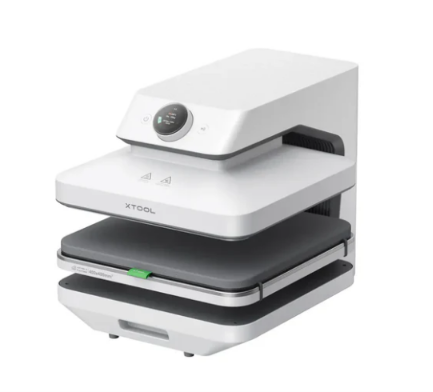
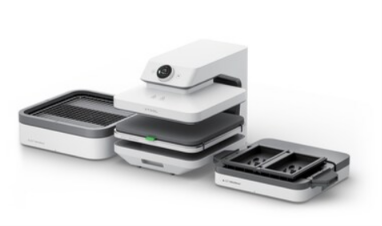
    xTool WonderPress 5-in-1 modular heat press
    xTool WonderPress five module heat press system

    Quick Summary

    On June 17, 2026, xTool officially opened domestic pre-orders for the WonderPress modular multi-function creative heat press workstation. The device integrates five capabilities through swappable modules: automatic flat heat pressing, 3D heat transfer, vacuum thermoforming, professional DTF curing, and multi-function baking. Built-in preset material parameters enable zero-experience operation. The product previously raised $4.61 million on Kickstarter from over 8,169 backers within days of launch. Domestic pricing starts at 2,799 RMB ($387), with early bird Kickstarter pricing at $279. xTool holds 47% market share in consumer laser engravers and filed for Hong Kong IPO in January 2026.


    What Happened

    xTool built its reputation by doing one thing exceptionally well: making industrial-grade laser engraving accessible to consumers. Its laser engravers command 47% of the consumer segment—six times the share of its nearest competitor. The WonderPress represents the company’s attempt to replicate this formula in an adjacent category.

    The product architecture centers on modularity. Five distinct functions occupy the same desktop footprint through interchangeable modules:

    Automatic flat heat pressing handles T-shirts, bags, hats, mouse pads, and Perler beads. The machine automatically matches temperature and time parameters; users load items and retrieve finished products without manual calibration.

    3D heat transfer extends capability to curved surfaces. A dedicated module presses patterns onto phone cases, mug exteriors, and irregular objects—functions impossible with conventional flat-bed machines.

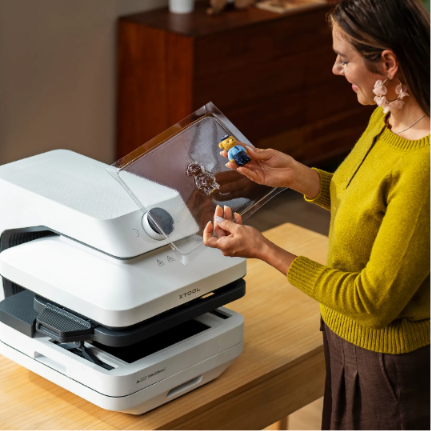
    Vacuum thermoforming heats and softens plastic sheets, then vacuum-seals them against molds. The integrated heating-pressuring-shaping workflow produces custom packaging prototypes and small-batch molds within seconds.

    Professional DTF curing completes the Direct-to-Film workflow. Users print patterns onto specialized film, then use the WonderPress to heat-cure and activate adhesive properties. This supports single-piece orders without plate-making—currently the hottest process in apparel customization circles.

    Multi-function baking provides precise temperature-controlled heating for polymer clay curing, shrink plastic processing, and mug sublimation. The 80×398×158mm chamber accommodates three standard mugs simultaneously.

    The unifying intelligence is a preset material parameter library. Load an item, the machine identifies material type, and automatically configures temperature, duration, and pressure. This “microwave simplicity” approach eliminates the traditional heat press learning curve where novices ruin dozens of garments calibrating settings.


    Why It Matters

    The heat press market suffers from a fundamental segmentation problem. Industrial machines cost thousands of dollars, occupy workshop space, and require trained operators. Consumer alternatives are typically single-function devices with crude temperature controls that frustrate beginners. The gap between “professional results” and “accessible price” has remained largely unbridged.

    xTool WonderPress auto heat press front view
    xTool WonderPress auto heat press front detail

    xTool’s WonderPress targets this gap directly. At $279-387, it costs roughly what a mid-range smartphone commands, yet replaces five separate pieces of equipment. For Print on Demand sellers—who list customized products on e-commerce platforms and produce only after receiving orders—this consolidation matters enormously. A typical POD operation might separately purchase a flat press ($300), mug press ($200), vacuum former ($500), DTF oven ($400), and polymer clay oven ($150). The WonderPress bundles equivalent capability at roughly one-third the combined cost and one-fifth the workspace.

    The Kickstarter performance validates demand. Crossing $1 million within four hours and ultimately reaching $4.61 million indicates strong pre-market validation. For context, most hardware Kickstarter campaigns struggle to reach $100,000. The 8,169 backer count suggests this is not merely speculative investment but genuine purchase intent from makers and small business operators.


    Impact Analysis

    Market impact: China’s heat press market reached approximately 3.9-4.5 billion RMB in 2026 with 8-19% annual growth. The WonderPress could accelerate this expansion by expanding the user base from professional workshops to individual creators and small e-commerce sellers. If xTool achieves even 10% of its laser engraver market penetration in heat presses, it would capture significant share of a rapidly growing category.

    Consumer impact: Individual makers gain access to production capabilities previously requiring industrial equipment. A hobbyist can now produce professional-quality custom apparel, promotional items, and prototypes without outsourcing. For POD sellers, the reduced equipment footprint and simplified workflow directly improve unit economics—less space rent, faster turnaround, lower defect rates from misconfigured parameters.

    Industry impact: The “modular multi-function” approach may influence broader desktop manufacturing equipment design. Rather than purchasing separate machines for each process, users increasingly expect swappable modules that transform base hardware. This trend, already visible in 3D printing (tool changers) and CNC (spindle modules), now extends to thermal processing equipment.

    xTool WonderPress user crafting scene
    xTool WonderPress user crafting custom items

    What’s Next

    Several variables will determine whether the WonderPress achieves sustained market traction:

    First, module durability and interchangeability. Frequent module swapping must not degrade connection precision or heating uniformity. Early user reports on connector wear and temperature consistency will be critical.

    Second, material library expansion. The preset parameter database currently covers common materials, but specialty substrates (metallic films, reflective fabrics, composite plastics) may require user calibration. How quickly xTool expands official library coverage affects the “zero-experience” promise.

    Third, domestic versus overseas performance divergence. xTool generates 85% of revenue from Europe and America through direct-to-consumer channels. The WonderPress domestic launch tests whether Chinese consumers—who face different POD ecosystem maturity and e-commerce platform structures—respond equally strongly.

    Fourth, IPO implications. With Hong Kong listing application submitted in January 2026, WonderPress sales performance becomes a narrative element for investor presentations. Strong numbers validate the “platform expansion beyond laser engraving” growth story; weak numbers raise questions about category extension capabilities.

  • Aoganwei Moxy Launch: Tactile AI Plush Toy Without Cameras

    Aoganwei Moxy Launch: Tactile AI Plush Toy Without Cameras

    One-sentence verdict: If a plush toy can make users feel genuinely understood through touch alone, Moxy proves that AI companionship does not need cameras or conversations to create emotional bonds—and at $96, it tests whether tactile interaction can carve out its own category.

    Aoganwei Moxy tactile AI plush toy
    Aoganwei Moxy tactile AI plush toy product

    Quick Summary

    On June 15, 2026, Aoganwei launched Moxy, the world’s first AI interactive plush toy with systematic tactile perception, available for pre-order exclusively on JD.com. Priced at 699 RMB ($96) for the launch period, the product abandons cameras and voice dialogue entirely, relying on full-body tactile sensors to recognize touch actions including petting, patting, kneading, and shaking. Each interaction influences Moxy’s personality development, eventually generating an exclusive MBTI label. The product represents Aoganwei’s strategic move from B2B sensor supplier to consumer AI hardware.


    What Happened

    Current AI companion toys universally rely on voice dialogue as core interaction, using cameras and microphones to capture information. This creates two persistent problems: privacy concerns from always-on visual and audio monitoring, and homogeneous experiences where every product feels like a voice assistant stuffed into a stuffed animal.

    Moxy breaks this mold by making touch the primary interaction channel. High-sensitivity tactile sensor arrays embedded across the body precisely recognize multiple touch actions—petting, patting, kneading, ear-pinching, shaking—with varying force and location. The toy responds in real time: gentle strokes trigger pleasant vibrations and soft chirps; excessive force elicits small emotional reactions; calling its name produces lively responses. The entire interaction requires no screen and no voice conversation.

    Moxy AI plush toy market comparison
    Moxy AI toy vs competitors market view

    The official positioning sums this as “no peeking, no cameras guarding privacy; no chatting, no voice dialogue for comfortable companionship.” This returns the product to the physical companionship essence of traditional plush toys.

    The personality development system represents Moxy’s second core pillar. Every touch interaction continuously influences the toy’s character trajectory, eventually cultivating unique personality traits and generating an exclusive MBTI label. The companion app displays real-time emotional states, joy value changes, and growth history. It also supports “Moxy social” interactions between users, extending single-person human-machine companionship into lightweight social attributes.

    The form factor employs a “faceless” plush design without fixed facial features, weakening electronic device associations while strengthening customization potential. Users freely accessorize with hair ornaments, glasses, hats, and other decorations, adapting to different scene styles. Essentially, the product becomes a customizable “emotional carrier.”


    Why It Matters

    Moxy’s significance extends beyond being a novel toy. It represents a fundamental rethinking of how AI should interact with humans in intimate spaces.

    The camera-free, voice-free design is not merely a privacy feature but an interaction philosophy. Cameras create surveillance anxiety even when inactive; microphones raise concerns about who might be listening. By removing both, Moxy eliminates the psychological friction that prevents users from forming casual, habitual relationships with AI devices. A child can hug Moxy without parental concerns about video recording. An adult can keep Moxy on their pillow without worrying about nighttime audio capture.

    The tactile-first approach also addresses a genuine limitation of voice-based AI companions: conversation fatigue. Talking to AI is cognitively demanding—it requires formulation, listening, and interpretation. Touch is pre-verbal, instinctive, and emotionally direct. A stressed user does not need to explain their feelings to Moxy; squeezing harder communicates distress automatically. This non-verbal emotional channel is something no voice assistant can replicate.

    Aoganwei’s background as a sensor manufacturer rather than a toy company explains the technical depth. Founded in November 2023 as a joint venture between Guangdong Audiwell (a Beijing Stock Exchange-listed sensor manufacturer with deep ultrasonic and piezoelectric expertise) and SaiGan Technology (focused on high-flexibility electronic skin and tactile perception algorithms), Aoganwei possesses combined capabilities in materials, devices, algorithms, and mass production.

    The company has established the industry’s first flexible tactile sensor mass production line, with products covering industrial tactile sensing, automotive electronics, and consumer electronics. Prior to Moxy, its technology primarily served B2B scenarios like robotic dexterous hands and smart buttons. Moxy represents the company’s first C-end terminal product.

    From an industrial logic perspective, Aoganwei’s entry into the consumer hardware sector represents the expansion of core technology application scenarios to the mass consumer market: the company has integrated industrial-grade high-precision tactile perception capabilities into plush toys, to verify the commercial value of tactile AI in the field of emotional companionship.

    This also marks a typical exploratory move by Chinese sensor manufacturers. They are no longer content to remain upstream suppliers, and instead use terminal products to test more possibilities for translating technologies into commercial applications.


    Impact Analysis

    Market impact: Moxy’s launch could establish “tactile AI” as a distinct category within AI companionship, separate from voice-centric smart toys and screen-based virtual pets. If sales validate demand, expect rapid follower products from established toy manufacturers and emerging sensor startups.

    Consumer impact: Users gain a privacy-respecting emotional outlet that requires no verbal articulation of feelings. For children, this means companionship without digital addiction risks. For adults, it offers stress relief without the cognitive load of maintaining conversation.

    Industry impact: The product demonstrates a viable path for sensor manufacturers to build consumer brands around their core technologies. Rather than selling components to toy makers, Aoganwei captures full margin and brand value by going direct-to-consumer. This vertical integration model could inspire other Chinese sensor and actuator companies to launch their own terminal products.

    Moxy tactile interaction hands holding
    Moxy tactile interaction user hands holding

    What’s Next

    The product’s success depends on three variables:

    First, tactile fidelity in real-world use. The sensor array must distinguish intentional emotional touches from accidental bumps, backpack compressions, and washing machine encounters. Durability testing will reveal whether industrial-grade sensors survive consumer-grade abuse.

    Second, personality depth over time. The MBTI generation mechanic is clever marketing, but users will judge the system by whether Moxy genuinely feels different after weeks of interaction, or merely cycles through preset responses. The difference between “growing personality” and “randomized behavior” is subtle but critical for long-term retention.Third, social feature traction. The “Moxy social” friend interaction feature is an interesting experiment, but lightweight social layers in single-purpose apps often struggle to achieve network effects. Whether users genuinely want to share their plush toy’s emotional state with strangers remains to be proven.

  • PlantSenso Turns Plant Care Into a Tamagotchi-Style Game

    PlantSenso Turns Plant Care Into a Tamagotchi-Style Game

    PlantSenso has launched on Kickstarter with a bold premise: turn plant care into a game. This AI-powered plant wearable uses soil probes and an egg-shaped host to monitor plant conditions, then displays the results through Tamagotchi-style emotional expressions. Moreover, it reached over 500% of its funding goal within just three days, proving strong demand for accessible home gardening tools.

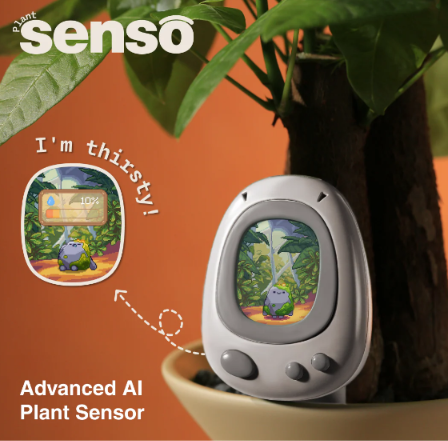
    PlantSenso Pro virtual pet display
    PlantSenso Pro device with virtual pet display

    How PlantSenso Works

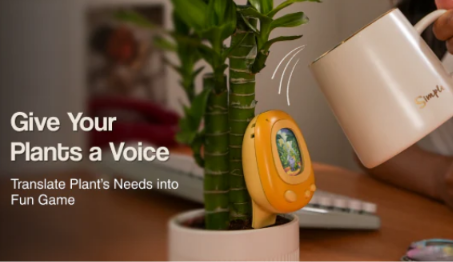
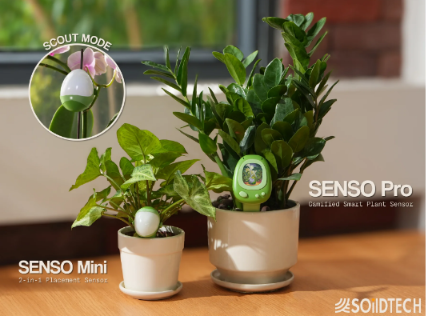
    The device uses a split design. A probe inserts into the soil to track moisture and temperature, while the egg-shaped host monitors ambient light through built-in sensors. Therefore, users get a complete picture of their plant’s environment without checking multiple devices.

    Unlike traditional plant sensors that show cold numbers, PlantSenso translates data into facial expressions. The virtual pet on the host screen frowns when soil dries out, squints under excessive light, and smiles when conditions are ideal. Consequently, users understand plant needs instantly without learning technical parameters.

    The hardware comes in Pro and Mini versions. The Pro model features a full display with the virtual pet system, while the Mini offers a compact form factor for managing multiple plants. Additionally, a single device can monitor several plants simultaneously, and the IP54 rating handles everyday splashes without issue.

    Gamification: From Watering to Pet-Raising

    PlantSenso’s smartest innovation is its growth system. Drawing inspiration from Tamagotchi, the virtual pet on screen grows and evolves as the real plant thrives. Every correct care action—timely watering, proper lighting, temperature adjustments—advances the pet’s development.

    This design transforms a low-frequency chore into an engaging daily interaction. Instead of guessing whether a plant needs attention, users check in to see how their virtual companion is doing. As a result, the emotional bond between human and plant deepens through consistent, rewarding feedback loops.

    Technical Foundation

    The device ships with a database covering over 12,000 plant species. It automatically matches care thresholds to each species’ specific needs, so users never have to research watering schedules or light requirements. Whether caring for a succulent, a fern, or a flowering plant, PlantSenso adapts its feedback logic accordingly.

    Furthermore, the product supports integration with select smart home systems. When light levels drop, it can trigger connected grow lamps. When humidity falls too low, it activates linked humidifiers. Thus, the system moves plant care toward full automation while keeping users engaged through the gamified interface.

    PlantSenso 黄色模型在盆栽中
    Plants

    How PlantSenso Compares

    The table below positions PlantSenso against similar products:

    FeaturePlantSensoPlantsioplantiemoji
    Core FormProbe + Egg HostSmart PotMini Sensor
    InteractionVirtual Pet FacesTouch + ExpressionsEmoji Display
    Database12,000+ PlantsNot DisclosedNot Disclosed
    GamificationGrowth Progress SystemPlayful RemindersSocial Sharing
    Smart HomeSupportedUnclearUnsupported
    Price$79.99 KitNot DisclosedNot Disclosed
    Target UserHome Gardening BeginnersHobbyist GrowersSocial Media Users

    PlantSenso leads in gamification depth and database breadth. Plantsio focuses more on pot-based interaction charm, while plantiemoji prioritizes social media appeal. All three share the same underlying approach: using sensors and algorithms to translate invisible plant states into human-perceivable signals.

    Who Should Buy PlantSenso

    PlantSenso suits self-proclaimed “plant killers” who want to try again with guided support. Likewise, families benefit from its intuitive design that lets children participate in plant care. Tech enthusiasts seeking novel AI hardware will also find it an interesting addition to their collection.

    However, experienced horticulturists may find the virtual pet interface unnecessary, since they already understand plant needs intuitively. Similarly, minimalists might resist adding another gadget to their space.

    PlantSenso Pro Mini comparison
    PlantSenso Pro and Mini versions comparison

    Final Verdict

    PlantSenso is not the first AI plant device, but it may be the first to truly turn plant care into play. Its core insight is precise: people fail at gardening not from lack of knowledge, but from lack of feedback and motivation.

    The combination of gamification, emotional expression, and a massive plant database creates a genuinely differentiated product in the vertical AI hardware space. At $79.99 for the crowdfunding kit, the price barrier is low, while the engagement mechanics offer long-term value that technical specifications alone cannot match.

    AI hardware innovation does not always need to center on humans. PlantSenso proves that giving AI perception and expression to overlooked aspects of daily life—plants, pets, household objects—can yield surprisingly compelling products. It may not change the world, but it might finally bring that pot of pothos on your desk to life.