One-sentence verdict: If DingTalk can prove that a $138 clip-on device plus a vertical medical model can genuinely reduce doctors’ documentation burden without compromising patient privacy, this could be the most practical AI healthcare hardware to watch in 2026.
Quick Summary
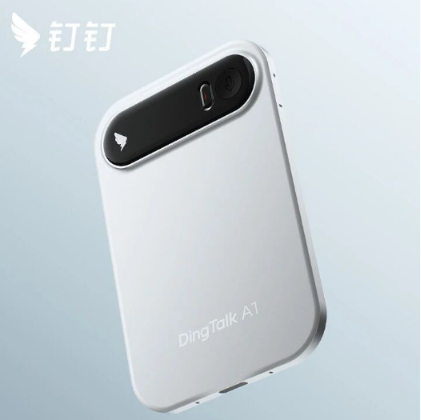
On June 12, 2026, DingTalk officially launched the A1 Doukou Doctor Edition, priced at 999 RMB ($138). Rather than creating new hardware, the product reuses the existing DingTalk A1 clip-on AI chassis, deeply integrating Alibaba’s Doukou medical large model to provide full-diagnosis-workflow AI assistance for medical professionals. The device measures 3.8mm thick and weighs 40.8g, attaching magnetically to the back of phones. It packs the BES2800 AI audio chip, a 6-microphone array, and supports 8-meter precise pickup with 45-hour continuous recording. The core differentiation lies in software: the Doukou model, trained on 40 million publications and passing China’s senior gynecologist examination, enables real-time transcription, structured medical record generation, and clinical guideline matching across outpatient, inpatient, conference, and academic scenarios.
What Happened
DingTalk’s approach to medical AI hardware is notably restrained. Instead of designing dedicated medical devices from scratch, the company chose “hardware reuse, software deep cultivation”—taking a chassis already validated across sales, legal, and HR professionals, and layering vertical medical capabilities on top.
The hardware foundation is the DingTalk A1 clip-on design. At 3.8mm thickness and 40.8g weight, it attaches to phone backs via magnets, adding zero carrying burden. The BES2800 AI audio chip (6nm process) powers a 6-microphone array: five omnidirectional mics plus one bone conduction mic for 8-meter precise pickup. The Fun-ASR model reduces hallucination rates from 78.5% to 10.7%. Battery life reaches 45 hours of continuous recording or 60 days standby, with 21-language simultaneous interpretation covering international academic exchange needs.
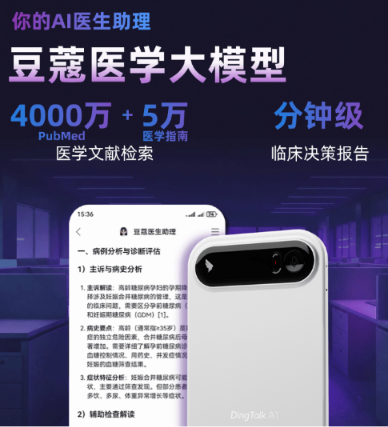
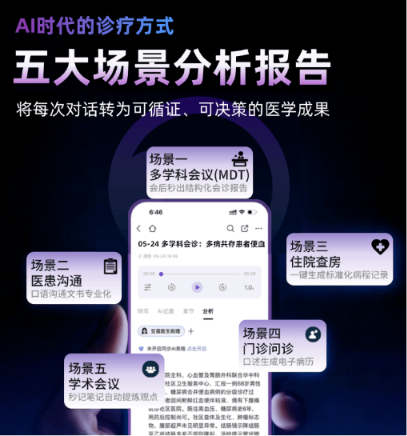
Based on this capability, DingTalk A1 Doukou Doctor Edition adapts four core scenarios:
Outpatient consultation: Real-time transcription generates structured electronic medical records while matching clinical guidelines for auxiliary decision-making.
Inpatient rounds: Full voice recording automatically produces standardized progress notes and actionable order lists.
Multidisciplinary conferences: Pre-meeting rapid retrieval of historical cases, in-meeting extraction of core consensus, post-meeting automatic generation of analysis reports with archiving to difficult case libraries.
Academic meetings: Precise transcription and minute generation with simultaneous matching to relevant guideline literature, building personal academic databases.
Privacy design addresses medical-grade requirements. Recording files use triple-end encryption, large model calls operate in privacy environments, enterprise administrators can centrally manage devices and data, and full-process traceability meets medical industry compliance standards.
Why It Matters
The DingTalk A1 Doukou Doctor Edition represents a pragmatic approach to AI healthcare that contrasts sharply with more ambitious but less grounded competitors.
Most AI medical products fall into two traps: either they over-promise diagnostic capabilities that regulators will never approve, or they under-deliver on workflow integration, forcing doctors to toggle between multiple systems. DingTalk’s approach avoids both by focusing on what AI can reliably do today—transcription, documentation, and information retrieval—while leaving diagnosis to human physicians.
The “hardware reuse” strategy is particularly clever. Developing medical-grade hardware from scratch requires years of regulatory navigation and massive capital investment. By reusing a proven chassis, DingTalk accelerates time-to-market by 12-18 months and avoids the regulatory burden of novel medical devices. The 999 RMB price point becomes achievable precisely because hardware R&D costs are amortized across multiple professional segments.
The Doukou model’s evidence-based foundation matters more than its exam-passing headline. Medical AI’s critical challenge is hallucination—generating plausible-sounding but clinically dangerous recommendations. Training on 40 million publications and validating against standardized examinations creates a verifiable accuracy baseline that most general-purpose medical AI lacks.
Impact Analysis
Market impact: The $138 pricing could democratize AI medical assistants beyond top-tier hospitals to county clinics and private practices. If DingTalk scales this model to other specialties (cardiology, oncology, pediatrics), it could establish a platform play in vertical medical AI.
Consumer impact: For doctors, the value proposition is time reclaimed. Chinese physicians average 4-6 hours daily on documentation. Automating transcription, record generation, and order list creation could recover 1-2 hours per day—equivalent to seeing 5-10 more patients or reducing overtime by 25%.
Industry impact: The “general chassis + vertical model” architecture could become the template for professional AI hardware. Rather than building custom devices for every profession, manufacturers may standardize on clip-on or wearable chassis, with software and models defining vertical differentiation. This would dramatically reduce hardware fragmentation and accelerate AI adoption across industries.
Leave a Reply