I. A Post-90s Counterintuitive Choice: Not Robots, But “Power-Ups”

Hypershell founder Sun Kuan, born in the 1990s, started the company in 2021.
At that time, humanoid robots were trending, with Unitree, Zhiyuan, and Fourier all demonstrating bipedal walking. Sun chose exoskeletons — a seemingly more old-fashioned, bulkier direction.
His logic was straightforward: humanoid robots replace humans; exoskeletons enhance humans. Replacement is a distant vision; enhancement is the present.
This logic determined the product form. Hypershell did not pursue full-body heavy equipment, but focused on lower-limb assistance; not extreme load capacity, but weight and cost reduction.
The self-developed Omega patented architecture compresses the entire machine to approximately 1.8kg, with motor peak power of 800W, offsetting 30% of load perception.
In 2023, the first-generation product raised over $1 million on overseas crowdfunding platform Kickstarter. In less than three years, Hypershell achieved global sales leadership, with products sold in 70+ countries.
From having only 200,000 yuan in the bank to raising $120 million, Sun proved a simple truth in hard tech:
Subtraction is harder than addition, but more likely to yield results.
II. Why Capital Entering? Exoskeletons Undergoing “Triple Transformation”

Ant Group and Meituan co-leading the round sends a clear signal: exoskeletons are no longer niche hardware, but regarded as potential mass-market entry points.
This industry is currently undergoing triple transformation:
First, from medical/industrial to consumer markets.
Traditional exoskeletons cost tens of thousands of dollars and weigh over ten kilograms, locked into hospital and factory scenarios. Hypershell reduced prices to accessible levels (entry model 5,999 yuan), weight under 2kg, directly targeting outdoor hiking, daily commuting, and elderly assistance. This is not simple price reduction, but a complete overhaul of application scenarios.
Second, from mechanical assistance to AI collaboration.
The X series launched on May 20 features HyperIntuition algorithm, with core evolution from “preset gait templates” to “end-to-end motion control.” Simply put, previous exoskeletons “followed your movement,” now they attempt to “anticipate your intention.” This leap from passive following to proactive collaboration is the watershed for consumer-grade experience.
Third, from single hardware to data entry point.
Exoskeletons run close to the body, naturally collecting gait, movement, and physiological data. When this data forms a closed loop with AI algorithms, the hardware itself becomes a physical interface for human-machine interaction. What Ant and Meituan likely value is this underlying logic.
III. Track Heating Up: Consumer Exoskeleton “Hundred-Regiment Battle”
In this blue ocean, Hypershell is not the only player smelling opportunity. Since 2026, the consumer exoskeleton track has visibly accelerated.
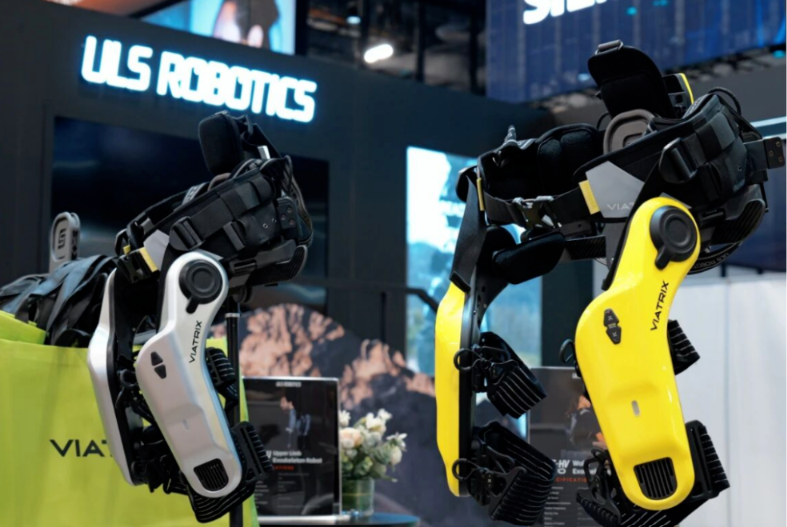
ULS Robotics transformed from industrial-grade, launching its first consumer product VIATRIX in 2025, priced at six to seven thousand yuan, adopting Float360 floating hip joint architecture, even winning an innovation award at CES 2026.
Cheng Tian Technology’s EasyGo personal exoskeleton priced at 2,500 yuan sold out in 15 seconds; Kenqing Technology’s Ant-H1 Pro designed for elderly users is available on JD.com and Tmall.
Capital data may more intuitively reflect this: 19 exoskeleton-related funding rounds in 2025, totaling 2.216 billion yuan, far exceeding 2024’s 8 rounds and 292 million yuan.
Investment logic has shifted from “investing in technological advancement” to “investing in commercialization capability.”
An industry moving from cold to hot typically shows two signals: first, leading enterprises securing consecutive large funding rounds; second, second-tier players beginning to emerge in batches — and exoskeletons have lit both signals.
IV. The Real Hard Battle: From “Can Sell” to “Users Willing to Wear Daily”
But beneath the hype, problems are equally apparent.
Consumer exoskeletons still face several hard gaps before true “daily integration”:
Experience gap: Can it achieve “imperceptible”? Existing products mostly achieve “assistance,” but “assistance” and “imperceptible” are clearly different.
Users can certainly walk farther wearing them, but are they smooth when facing daily high-frequency scenarios like emergency stops, turning, and stairs? Is there response delay?
These details determine whether exoskeletons are “novelty toys” or “daily equipment.”
Hypershell’s new HyperIntuition algorithm essentially targets this point.
Scenario gap: Can outdoor and elderly markets both be served?
Currently main outdoor hiking and elderly assistance scenarios have vastly different needs. Outdoor users want “enhanced physical ability,” elderly users want “safety and stability.” The same product logic serving both markets inevitably involves compromise. Future segmentation into more refined categories is likely.
Cognition gap: Why do I need this?
Although accessible pricing is already low, exoskeletons remain “non-essential” for ordinary consumers.
Unlike phones as communication tools, unlike headphones as entertainment accessories. How to make consumers feel “this money is well spent” is the marketing challenge for the entire industry.
V. Conclusion: Exoskeletons’ Ultimate Opponent Is Not Competitors
Sun Kuan said in an internal speech: “We started from a simple but firm idea — letting people go farther.”
This statement has two interpretations: physically farther, or life radius expanded farther.
When exoskeletons are light enough, cheap enough, and smart enough, they may become the “second spring” for elderly people, “physical ability外挂” for outdoor enthusiasts, or even basic equipment on everyone in the future.
But before that, the ultimate opponent the exoskeleton industry faces is not competitor competition, but consumers’ “habit inertia.”
Most people haven’t developed the habit of “wearing exoskeletons when going out,” just as many people hadn’t developed the habit of “wearing headphones when going out” ten years ago.
Hypershell’s $120 million funding is a milestone for this industry from 0 to 1. But from 1 to 100 depends on who can first make “wearing exoskeletons” as natural as wearing glasses.
Leave a Reply