Category: AI for Work

AI Work Hardware refers to consumer-grade devices and peripherals—driven primarily by artificial intelligence—that deeply embed capabilities for perception, comprehension, reasoning, decision-making, and continuous learning into their core system architecture and operational logic. Designed for use in personal, home, and small-office environments, these tools serve to support daily workflows such as AI generation, creative production, office tasks, and learning.

  • Revopoint POP 4 Review: AI-Powered 3D Scanner with 3DGS Modeling

    Revopoint POP 4 Review: AI-Powered 3D Scanner with 3DGS Modeling

    One-sentence verdict: If you need a scanner that works in direct sunlight and turns physical objects into game-ready assets, the POP 4 is among the most compelling productivity tools to watch in 2025.

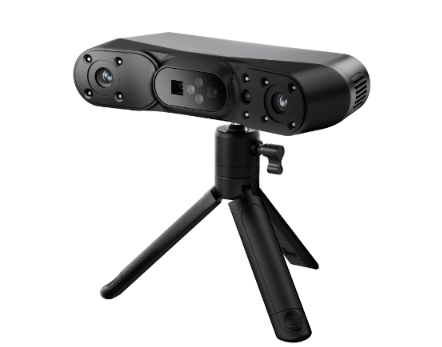
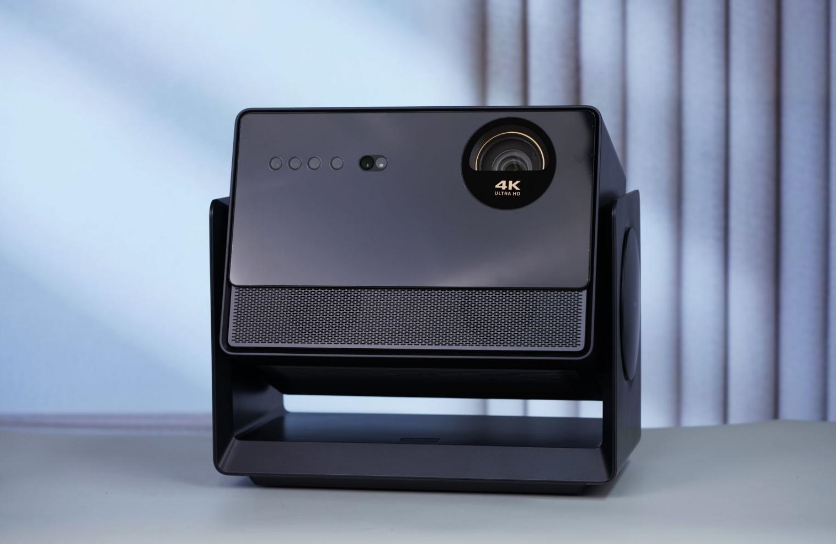
    Revopoint POP 4 dual-band scanner front view
    Revopoint POP 4 dual-band scanner front view

    Introduction

    3D scanners have long occupied an awkward position in the tech landscape. Industrial-grade units cost a fortune, while consumer-level devices struggle with accuracy. Revopoint’s POP series has been chipping away at this divide, and the POP 4 takes the most aggressive swing yet—packing AI algorithms and 3D Gaussian Splatting (3DGS) into a handheld form factor. The Kickstarter campaign raised over $2.6 million from more than 3,000 backers. For a specialized professional tool, those numbers signal genuine market demand.

    The POP 4 targets a clear audience: engineers, designers, cultural heritage professionals, and 3D content creators who need a complete “scan-and-go” solution. It refuses to be a toy, yet it does not want to stay trapped in a lab either.


    Product Overview

    The POP 4 represents Revopoint’s fourth-generation handheld scanner. The most significant evolution from previous models is the integration of AI-driven intelligent segmentation and 3DGS modeling capabilities. The device employs a dual-band optical system: blue multi-line laser handles high-precision detail work, while infrared structured light manages medium-to-large scenes and human body scanning.

    On the hardware front, the POP 4 features a dedicated depth computation chip, with laser scanning frame rates reaching up to 105 fps. Single-frame accuracy hits 0.03 mm, with volumetric accuracy at 0.03 mm + 0.05 mm × L(m). In practical terms, this means the device captures hair-width details while maintaining overall geometric fidelity.

    For fieldwork, the scanner includes a 5500 mAh removable battery grip delivering approximately 4 hours of continuous operation. Wi-Fi 6 wireless transmission enables real-time connectivity with PCs or mobile devices, eliminating the need to drag cables across outdoor job sites.

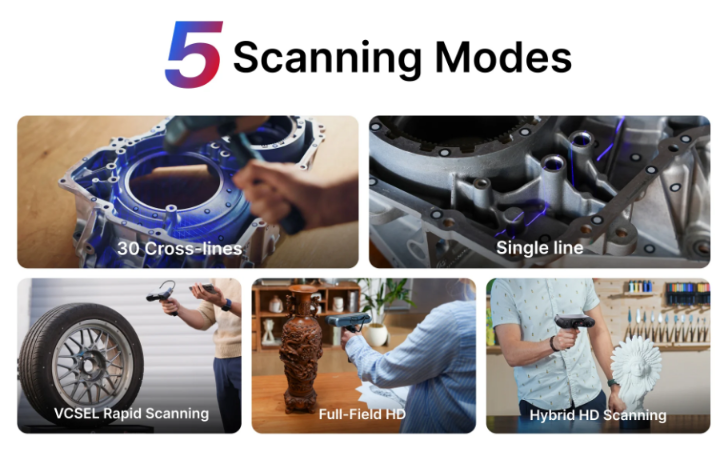
    POP 4 five scanning modes for diverse materials
    POP 4 five scanning modes for diverse materials

    Technical Specifications and Scanning Modes

    The POP 4 offers five distinct scanning modes covering everything from precision components to full-body capture:

    ModeLight SourceApplicationKey Feature
    Blue Laser StandardBlue multi-line laserDark objects, metal surfacesNo powder coating required
    Blue Laser FineBlue multi-line laserHigh-detail small objectsHigher precision, slower speed
    IR Full-Field HDInfrared structured lightMedium-to-large objects, human bodyFull coverage, high frame rate
    IR Hybrid HDIR + laser fusionComplex structuresAuto-switching, smooth tracking
    VCSEL Fast ScanVCSEL infraredBright environments, large scenes100,000 lux resistance, 30 fps

    The intelligent aspect of this design is that users need not become optics experts. The device automatically selects optimal parameters for each scene. The Hybrid HD mode deserves particular attention—it dynamically fuses both light sources during scanning, preventing data discontinuities caused by manual mode switching.


    AI and 3DGS: Beyond Spec Sheet Improvements

    The POP 4’s AI capabilities are not marketing fluff. Embedded algorithms recognize target objects in real time, automatically filtering background point clouds to output clean object data. For scanning novices, this eliminates hours of post-processing cleanup. For professionals, it means on-site quality confirmation rather than discovering corrupted data back at the office.

    More significantly, the 3DGS modeling capability changes the output pipeline. Traditional 3D scanning produces point clouds or mesh models requiring specialized software for texture mapping and rendering optimization before game or metaverse deployment. The POP 4’s patented 3DGS modeling technology converts point cloud and RGB data directly into Gaussian models, exportable in .splat format. This compresses the workflow from “scan → repair → bake → import engine” to “scan → export → use directly.”

    For game development and digital twin applications, this efficiency gain translates to substantially lower digital asset production costs. Cultural heritage digitization benefits equally—high-precision 3D documentation of artifacts no longer demands complex post-processing to achieve photorealistic presentation.


    Competitive Comparison

    FeatureRevopoint POP 4EinScan H2Artec Leo
    Accuracy0.03 mm0.05 mm0.1 mm
    Max Frame Rate105 fps60 fps80 fps
    Light Resistance100,000 lux50,000 lux80,000 lux
    WirelessWi-Fi 6Wired primaryWi-Fi 5
    3DGS SupportNativeNoNo
    Price Range~$800-900~$1,200~$30,000

    The POP 4’s pricing strategy is particularly interesting. The standard edition runs approximately $800, with the advanced edition around $900—occupying the empty space between consumer and professional tiers. Against industrial-grade devices like the Artec Leo, the POP 4 delivers comparable accuracy at less than 3% of the cost. Against the EinScan H2, it holds clear advantages in frame rate and AI functionality.


    Pros and Cons

    ProsCons
    AI auto-segmentation dramatically reduces post-processing timeAdvanced features still carry a learning curve
    Native 3DGS support enables direct digital asset usageExtremely reflective materials still need auxiliary treatment
    Dual-band system covers extensive application scenariosBrand recognition trails established Western manufacturers
    Wireless design enhances outdoor workflow freedom4-hour battery life falls short for full-day operations
    Price-to-performance ratio is exceptionally competitive in the professional segmentSoftware ecosystem remains a work in progress

    Buying Guide

    Recommended for:

    • Reverse engineering engineers: sufficient accuracy, friendly pricing, wireless design suits workshop environments
    • 3D printing service providers: shortest scan-to-print pipeline, AI cleanup saves labor costs
    • Indie game developers: 3DGS output goes directly into engines, bypassing intermediate steps
    • Cultural heritage digitization teams: outdoor scanning capability plus photorealistic modeling suits fieldwork

    Consider carefully if:

    • You require sub-micron precision for semiconductor or ultra-precision manufacturing: the POP 4’s accuracy is solid for professional use but falls short of metrology-grade equipment
    • You expect pure plug-and-play operation as a complete beginner: while AI lowers the barrier, selecting among five modes still requires some learning
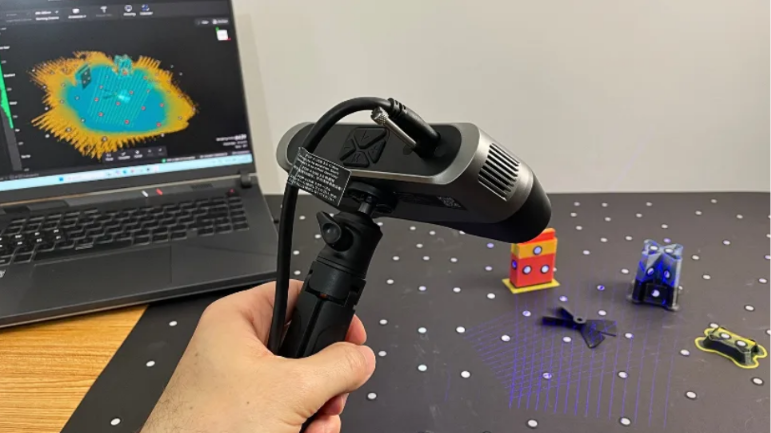
    POP 4 handheld scan with live preview
    POP 4 handheld scan with live preview

    FAQ

    Q: Can POP 4’s 3DGS models import directly into Unity or Unreal?

    A: The .splat export format is supported by plugins available for major engines.

    Q: Does human body scanning require special preparation?

    A: Infrared mode supports body scanning. Wear non-reflective materials and maintain steady or slow movement.

    Q: Which operating systems does the software support?

    A: Revo Scan 6 runs on Windows, macOS, Android, and iOS, with export compatibility to mainstream 3D design software.


    Conclusion

    The Revopoint POP 4 is not a perfect scanner—battery life and brand recognition have room for improvement. But it precisely targets a market gap: professional users who need industrial-grade precision without paying industrial-grade premiums; content creators who need photorealistic digital assets without drowning in technical complexity.

    The addition of AI segmentation and 3DGS modeling transforms this device from “a faster, more accurate scanner” into “a production tool that outputs usable digital assets.” Behind the $2.6 million crowdfunding achievement lies market validation for this efficiency revolution.

    If you are searching for a scanner that handles both precision inspection and digital content production, the POP 4 deserves the top spot on your shortlist.

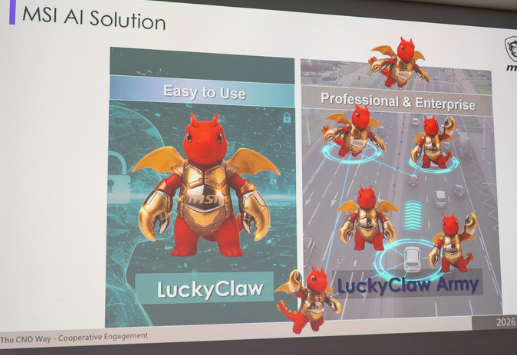
  • MSI LuckyClaw: The “App Store Moment” for AI Agents at COMPUTEX 2026

    MSI LuckyClaw: The “App Store Moment” for AI Agents at COMPUTEX 2026

    Introduction: The “AI Agent Year” at COMPUTEX 2026

    MSI LuckyClaw AI agent presentation demo screen
    MSI LuckyClaw AI agent presentation demo screen

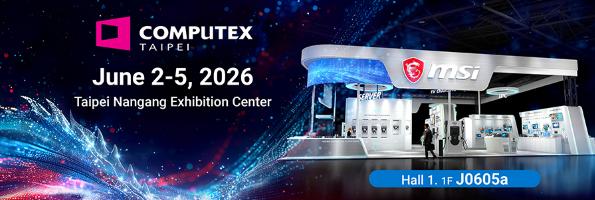
    On June 2, 2026, at the Taipei Nangang Exhibition Center. COMPUTEX 2026 officially opened. This year’s theme is not graphics cards, not motherboards—but AI Agents.

    MSI showcased LuckyClaw, a platform designed specifically for Windows-side AI Agent deployment. At the same time, MSI is among the first manufacturers to display NVIDIA RTX Spark laptops and desktops.

    Product Overview: What Is LuckyClaw?

    LuckyClaw’s core positioning: let Windows users deploy AI Agents as easily as installing apps.

    Feature highlights:

    • LLM Calculator: Built-in large language model computing tool, supporting local inference
    • Cloud/Edge Hybrid: Cloud + local hybrid architecture, automatically allocating compute based on task complexity
    • NVIDIA hardware acceleration: Supports RTX Spark, RTX 40/50 series GPU acceleration
    • Windows native: Deeply integrated with Windows system, not a virtual machine solution

    MSI simultaneously showcased hardware:

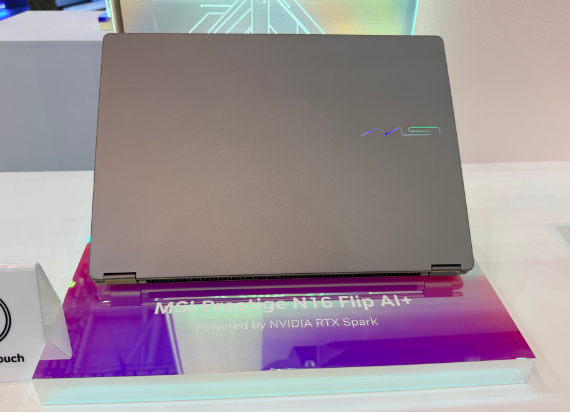
    • RTX Spark laptops: 14mm thickness, Blackwell GPU + 20-core ARM CPU
    • RTX Spark desktops: Flagship configurations, 128GB unified memory
    • AI workstations: Dual RTX 5090, designed specifically for AI training
    MSI COMPUTEX 2026 booth at Nangang hall
    MSI COMPUTEX 2026 booth at Nangang hall

    Killer Feature #1: The “App Store Moment” for AI Agents

    The core problem LuckyClaw attempts to solve: AI Agent deployment is too complex.

    Currently deploying a local AI Agent requires:

    • Installing Python environment
    • Configuring CUDA and GPU drivers
    • Downloading model weights (tens of GB)
    • Writing launch scripts
    • Debugging compatibility issues

    LuckyClaw’s solution: one-click deployment. Users select needed Agent functions (document analysis, code generation, image processing), and the platform automatically downloads models, configures environments, and optimizes parameters.

    This is similar to how the early App Store made mobile app installation simple—LuckyClaw wants to make AI Agent installation equally simple.

    Killer Feature #2: Cloud/Edge Hybrid, Intelligent Compute Allocation

    LuckyClaw’s Cloud/Edge Hybrid architecture:

    • Simple tasks: Local execution (document summaries, email replies, code completion)
    • Complex tasks: Cloud handoff (video generation, large model training, multimodal analysis)
    • Auto-switching: Intelligent decision-making based on task type, local compute, and network conditions

    This means:

    • Thin-and-light laptop users can also run AI Agents, with complex tasks automatically going to cloud
    • Desktop users with sufficient local compute complete all tasks locally
    • No manual configuration needed, platform auto-optimizes

    Killer Feature #3: MSI Hardware Ecosystem Closed Loop

    MSI Prestige N16 Flip RTX Spark laptop
    MSI Prestige N16 Flip RTX Spark laptop

    MSI does not just make software. LuckyClaw is deeply bound to MSI hardware:

    • Laptops: Stealth, Raider, Vector series with RTX Spark
    • Desktops: Infinite, Codex, Trident series supporting dual GPUs
    • Monitors: AI-assisted color calibration, auto-adapting to content type
    • Peripherals: Keyboard shortcuts for one-key AI Agent wake-up

    This hardware-software integration is MSI’s core advantage over pure software Agent platforms.

    Specs Comparison: LuckyClaw vs OpenAI GPTs vs Anthropic Claude Desktop

    FeatureMSI LuckyClawOpenAI GPTsAnthropic Claude Desktop
    DeploymentLocal + Cloud hybridPure cloudLocal + Cloud
    Hardware RequiredNVIDIA GPUNoneNone
    Hardware Acceleration✅ RTX Spark/40/50❌ None❌ None
    Offline Capability✅ Core functions offline❌ Needs network❌ Needs network
    Ecosystem BindingMSI hardware ecosystemOpenAI ecosystemAnthropic ecosystem
    Target UsersWindows gamers/creatorsGeneral usersDevelopers/professionals

    LuckyClaw’s differentiation is razor-sharp: it is the only AI Agent platform deeply bound to NVIDIA hardware, supporting local high-performance inference, and targeting Windows gamers and creators.

    Caveats to Note

    • Feature maturity: First showcased June 2, functional demo stage, official version pending release
    • Ecosystem limitation: Deeply bound to MSI hardware, compatibility with non-MSI devices unverified
    • Model sources: Supported model list not announced, whether mainstream open models (Llama, Qwen, DeepSeek) are included unknown
    • Privacy concerns: Cloud/Edge Hybrid means some data uploads to cloud, enterprise users may hesitate
    • Competitive pressure: OpenAI, Anthropic, and Google’s cloud Agent features are stronger, is LuckyClaw’s local advantage enough to attract users?

    Who Should Watch LuckyClaw?

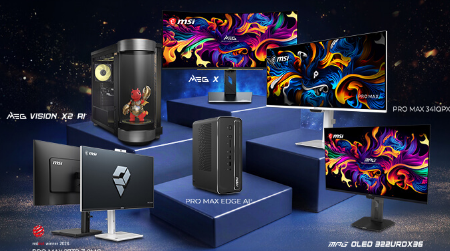
    MSI 40th anniversary product lineup on display
    MSI 40th anniversary product lineup on display

    Highly Recommended:

    • MSI laptop/desktop users (hardware ecosystem加成)
    • NVIDIA graphics card users (RTX 40/50 series can accelerate)
    • Windows gamers (want to use AI assistants while gaming)
    • Content creators (local video/image AI processing)

    Consider Waiting:

    • Mac users (no Windows version planned)
    • Pure cloud users (OpenAI/Anthropic already sufficient)
    • Enterprise users (waiting for security compliance certification)

    Future Outlook: The “Windows Moment” for AI Agents

    LuckyClaw represents an important trend: AI Agents are shifting from “cloud services” to “local applications”.

    If LuckyClaw succeeds:

    1. Lower AI Agent barriers: Let ordinary users deploy without technical background
    2. Activate NVIDIA ecosystem: RTX Spark + LuckyClaw forming hardware + software closed loop
    3. Push Windows on Arm: RTX Spark’s Arm architecture needs Windows native Agent support
    4. Drive new hardware demand: Users willing to upgrade GPUs for better Agent performance

    For MSI, LuckyClaw is not just a software product, but a catalyst for hardware sales—just as NVIDIA’s DLSS drove RTX graphics card sales.


    Rating: 7.6/10 (Promising Concept)

    Bottom Line: LuckyClaw could be the bridge that brings AI Agents from tech enthusiasts to mainstream Windows users. But it needs to ship before the hype fades.

  • Cuneflow AI Notebook Preview

    Cuneflow AI Notebook Preview

    Rating: 8/10 (Pre-Production Preview)

    Introduction: When Five Thousand Years of Writing Wisdom Meets AI

    Cuneflow AI Notebook Kickstarter early bird preview
    Cuneflow AI Notebook Kickstarter early bird preview

    Humans carved stone for three millennia, wrote on paper for two, and have typed on keyboards for merely four decades. Now the Cuneflow team asks a different question: what if AI did not interrupt your thinking, but guarded the temple where it happens?

    The Cuneflow AI Notebook is launching soon on Kickstarter. This is not another “iPad killer.” It is a temple built for thinkers—E-Ink display, ceramic nib, real-time voice transcription, and AI-powered insight generation, all packed into a body lighter and thinner than an iPad mini.

    Product Overview: Handwriting Is Sacred, AI Is Invisible

    Cuneflow’s core belief is disarmingly simple: handwriting is a cognitive anchor. In an age of screen bombardment and endless notifications, the act of writing by hand quiets the noise, deepens focus, and helps you process information rather than merely receive it.

    On the hardware side, Cuneflow sports a 300 PPI A5 E-Ink display with adjustable front light. The ceramic nib requires no replacement tips. Hard and fine, it produces a satisfying scratchy texture on the screen—not slippery glass, but textured paper.

    The entire unit is lighter and thinner than an iPad mini, paired with a leather-like folio case that closes magnetically and secures the stylus during transport. This is not a toy. It is a serious tool you actually want to carry.

    Hand writing with Cuneflow stylus on E-Ink screen
    Hand writing with Cuneflow stylus on E-Ink screen

    Killer Feature #1: The Meeting Trinity—Notes, Transcript, Insight

    Cuneflow’s interface is ruthlessly minimal: just two main tabs, Meetings and Files. Create a new meeting and a three-panel workspace unfolds:

    • Notes: A handwriting canvas. Currently supports fountain pen and marker tools, with lasso selection and undo/redo. Selected content can be copied, erased, flagged as a section heading, or sent to AI for explanation.
    • Transcript: Real-time voice transcription. Automatically segmented by topic. Recognition speed is “reasonably fast and surprisingly accurate.” Can be set to auto-record when a meeting begins, or triggered manually.
    • Insight: Where AI processing happens after the meeting concludes. The system auto-generates summaries, timelines, to-do lists, decisions, disagreements, risks, and key questions. A chat interface allows custom prompts, with AI drawing from all source materials—handwritten notes, voice transcripts, and imported files.

    Engadget’s hands-on test noted: “The transcription appeared pretty instant and surprisingly accurate.”

    Killer Feature #2: Privacy-First, Data Leaves No Trace

    The biggest concern with AI devices? Your meeting recordings being used to train models.

    Cuneflow’s response is direct:

    • Data sent for AI processing is not stored
    • It is deleted immediately after processing
    • It is not used to train language models

    Audio is encrypted and piped to the cloud (using OpenAI and Gemini as underlying tools). Once transcription is complete, the original recording is wiped, leaving only the AI-generated text. On the Insight tab, you can trace the origin of each conclusion to verify whether the system hallucinated.

    Killer Feature #3: Zero-Distraction Design, Politely Present

    Cuneflow’s design philosophy is “polite, human-centered”—in face-to-face meetings, handwriting replaces laptop typing, maintaining eye contact and signaling respect and engagement.

    No pop-up notifications. No social media. No browser tabs. Just you and your notes, with AI running silently in the background. Technology becomes “warm” and invisible, supporting your thinking rather than interrupting it.

    Specs Comparison: Cuneflow vs reMarkable vs iFLYTEK

    FeatureCuneflow AI NotebookreMarkable Paper ProiFLYTEK AINOTE Air 2
    Display300 PPI A5 E-InkCANVAS color E-Ink8.2″ E-Ink
    StylusCeramic nib (no replacement)Marker PlusWacom EMR
    Voice Transcription✅ Real-time + AI segmentation❌ Not supported✅ Real-time + multilingual
    AI Insights✅ Summary / Tasks / Risks / Decisions❌ None✅ Summary + translation
    Workflow SyncNotion / Slack / 365 / GoogleLimited third-partyLimited third-party
    SubscriptionUnknown (PRO membership)Connect $2.99/monthUnknown
    Price$399 (early bird $20 deposit + $379)$629~$400-500

    Cuneflow’s differentiation is clear: reMarkable is pure digital paper. iFLYTEK is a transcription tool. Cuneflow is the trinity of handwriting + voice + AI insight, deeply integrated with modern workflows.

    Caveats to Note

    As an E-ink pre-production device, limitations exist:

    • Export functionality not yet complete: ewritable’s test found that AI-generated articles could not be transferred from the device to a computer—”a nicely written article sitting on the device itself, couldn’t actually transfer it.”
    • Limited pen tools: Currently only fountain pen and marker, fewer than reMarkable’s offerings.
    • Web App incomplete: Custom AI outputs are not yet accessible via the web interface, only handwritten notes, voice transcripts, and some AI summaries.
    • Bare-bones reader: PDF import works, but the default reading app is “very bare bones.”
    • Delivery timeline unconfirmed: The official statement only mentions “launching soon on Kickstarter.” Specific mass production and delivery schedules have not been announced.

    These are acceptable at the crowdfunding stage, but the firmware update roadmap and official delivery commitments warrant close attention.

    Audience Analysis: Who Should Watch Cuneflow?

    Highly Recommended For:

    • Consultants, bankers, and product managers averaging 2+ meetings daily
    • Legal and financial professionals requiring compliant meeting archives
    • Remote teams relying on async communication across time zones
    • Workplace professionals tired of “typing on a laptop is rude” but who must take notes

    Consider Waiting If:

    • You are a pure creative (designer/writer) not needing structured meeting output
    • You are a minimalist (reMarkable’s pure writing experience suffices)
    • You are budget-sensitive ($399 early bird confirmed, MSRP not yet announced)

    Future Outlook: From Crowdfunding to Workflow Infrastructure

    Cuneflow’s ambition extends beyond hardware sales. The 6-month free PRO membership hints at a subscription model—advanced AI models, larger cloud storage, team collaboration spaces.

    If delivery goes smoothly, Cuneflow could become workflow infrastructure for the meeting scene: pre-meeting material prep, real-time capture during, automatic archiving and Notion/Slack sync afterward. This is not merely a device. It is a thinking operating system.

    The Kickstarter campaign page is going live soon. A $20 deposit secures early-bird pricing. For knowledge workers drowning in meetings daily, this may be the most anticipated office gear of 2026—but remember, all feature promises require final hardware validation before a crowdfunding product ships.


    Bottom Line: The most thoughtfully designed AI-powered handwriting device for meeting-centric professionals. Not yet perfect, but the vision is clearer than competitors.

  • Why Chinese Brands Are Betting Everything on Overseas Creators

    Why Chinese Brands Are Betting Everything on Overseas Creators

    Introduction: The Silent War for Attention

    GlobalStar marketing team discusses influencer marketing plans
    GlobalStar marketing team discusses influencer marketing plans

    The global influencer marketing market is projected to hit $197 billion in 2025. Within that massive pie, an unprecedented phenomenon is unfolding: TikTok creators in America, tech reviewers on YouTube, and lifestyle influencers on Instagram are finding their inboxes flooded with partnership requests from Chinese brands.

    This is no accident. For a decade, Chinese merchants dominated through supply chain advantages—endless SKUs, unbeatable prices, and the assumption that listing products was enough. But rising tariffs, logistics costs, and compliance barriers have killed the white-label, race-to-the-bottom model. The new competitive question is stark: why should a stranger trust a product from another country?

    The answer points to brand equity, influence, and user awareness. Overseas creators have become the scarcest resource in this war.

    What Happened: Not Enough Creators to Go Around

    A nine-figure TikTok Shop seller, who has trained over a thousand cross-border merchants in the past three years, told me the question he hears most lately is: “How do I find influencers?”

    “American creators are genuinely in short supply. There are more merchants than creators,” he said. His team once sent a 3C product to a creator for review. The response: “This is the fourth identical product I’ve received this week.”

    Supply-demand imbalance is driving prices up. William Ren, founder of influencer marketing agency GlobalStar, notes that annual creator rate increases of 10-30% are normal, with some repped creators doubling their fees after signing with agents. GlobalStar’s long-term enterprise clients are increasing influencer budgets by roughly 50% year-over-year.

    Creator ad revenue structures are shifting dramatically. For tech creators in GlobalStar’s network, Chinese brands once contributed roughly 10% of ad income. Today, that figure can reach 50%. DJI, Narwal, and Anker have become major clients.

    Why It Matters: The Trust Gap

    William Ren grew up in North America and launched GlobalStar in 2021 with a thesis: “The biggest problem for Chinese brands going global wasn’t product or traffic. It was trust.”

    That thesis has only sharpened with time. At CES 2024, 942 Chinese companies exhibited, roughly 22% of total attendance. Among 38 humanoid robot exhibitors, 21 were Chinese. Of 23 AI glasses brands, 16 came from China. Product capability is there. Trust is not.

    Creators fill that void. Beatbot’s pool cleaning robot debuted at CES 2024 with zero sales. Three months later, through partnerships with top tech reviewers and luxury lifestyle creators, the brand broke $1 million in daily North American sales during a major promotion. Pool robots have no domestic market in China, but fit American households perfectly—a demand gap activated precisely through creator content.

    The Creator Bargaining Power Era

    Negotiating leverage is shifting from merchants to creators.

    TikTok lowered its creator storefront threshold from 5,000 to 1,000 followers, boosting quantity without guaranteeing quality. Creators who can reliably drive conversions or produce compelling content remain scarce on every platform.

    The seller I spoke with observes that creators show little interest in low-ticket, non-trending products. “They basically don’t respond, or fulfill the minimum shooting obligation without putting in real effort.” But facing $80-100 products, 95% of orders come through creator-driven sales. “The creator shoots a one-to-two-minute long video, from unboxing to full experience.”

    Good products need good creators. Good creators only pick good products. Once this filtering mechanism locks in, merchants holding generic inventory cannot secure a seat at the table.

    Creative Freedom vs. Commercial Control

    YouTube creator filming product review in studio
    YouTube creator filming product review in studio

    “The overseas creator ecosystem lags China’s by over three years.” William Ren’s assessment from 2021 still holds.

    Live commerce content in China follows a mature three-act formula: a 3-second hook, soft product placement, and hard conversion CTA. Hand this script to an overseas creator, and the result is often “only two of three acts get done.”

    The fundamental difference: overseas creators want to make “good content,” not “correct ads.” William Ren once booked a million-subscriber YouTube tech creator for a domestic robotics brand. The creator insisted on a comparative review, mentioning both strengths and weaknesses. The brand initially objected. The video ran with flaws included—and drove dozens of unit sales.

    Overseas creators are not pure vendors or “tools.” Chinese MCNs bind creators through restrictive contracts, but overseas MCNs function more as agents. Creators retain ultimate control. Weekends, holidays, travel plans—there are a thousand reasons to ignore an email.

    Why Influencer Marketing?

    For small merchants, influencer marketing is the most accessible entry point. SEO and Google Ads require 3-6 months to show results. Creator content offers a faster validation loop: send samples broadly, watch who converts, chase short-term ROI.

    For established brands, creators solve the trust problem. As William Ren puts it: “Chinese brands are already on the shelf. They just haven’t entered the consumer’s mind.”

    Influencer marketing is not fully controllable, and ROI is hard to calculate precisely. Chinese merchants accustomed to efficiency and predictability struggle with this model. Yet budgets keep flowing here because old tactics are failing, and new competition demands a deeper answer: how does “Made in China” become a genuinely influential brand?

    The Signal to Overseas Creators

    DJI Mini 3 Pro drone outdoor flight test
    DJI Mini 3 Pro drone outdoor flight test

    If you create content in tech, lifestyle, or travel, several trends are tilting in your favor:

    • Your rates are climbing. Top tech creators now derive 50% of ad revenue from Chinese brands, up from 10%, with annual increases of 10-30% becoming standard.
    • Your creative freedom is protected. Leading brands have learned: authentic content outperforms polished ads.
    • Long-term partnerships are replacing one-off deals. Brands are shifting from single sponsored posts to 10-20 video retainers with separate commission structures.
    • Your product pipeline is expanding. From 3C accessories to pool robots, AI glasses, and humanoid robots—Chinese brand product capability is now competitive.

    Attention. Trust. Influence. Chinese merchants are learning capabilities beyond efficiency. And you are the central node in that transformation.

    What I Can Do for You

    I’m Gavin, a senior tech editor based in Silicon Valley with ten years of AI hardware industry experience. I track Chinese brand globalization dynamics closely and maintain direct connections with multiple top-tier outbound brands and marketing agencies.

    If you are an overseas content creator looking for:

    • Reliable Chinese brand partnership resources
    • Access to high-product-quality brands instead of generic white-label goods
    • Insights into Chinese brands’ content collaboration preferences and negotiation strategies
    • Long-term retainer deals rather than one-off transactions

    I can serve as your bridge. I understand both sides—what Chinese merchants need and what overseas creators care about. No agency commission, just precise matching.

    Please leave your email address in the comments section so we can contact you via email. We’ll help you unlock this door, which is rapidly opening.


    -END-