One-sentence verdict: If you need a scanner that works in direct sunlight and turns physical objects into game-ready assets, the POP 4 is among the most compelling productivity tools to watch in 2025.
Introduction
3D scanners have long occupied an awkward position in the tech landscape. Industrial-grade units cost a fortune, while consumer-level devices struggle with accuracy. Revopoint’s POP series has been chipping away at this divide, and the POP 4 takes the most aggressive swing yet—packing AI algorithms and 3D Gaussian Splatting (3DGS) into a handheld form factor. The Kickstarter campaign raised over $2.6 million from more than 3,000 backers. For a specialized professional tool, those numbers signal genuine market demand.
The POP 4 targets a clear audience: engineers, designers, cultural heritage professionals, and 3D content creators who need a complete “scan-and-go” solution. It refuses to be a toy, yet it does not want to stay trapped in a lab either.
Product Overview
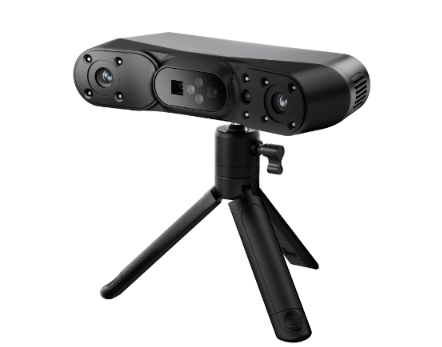
The POP 4 represents Revopoint’s fourth-generation handheld scanner. The most significant evolution from previous models is the integration of AI-driven intelligent segmentation and 3DGS modeling capabilities. The device employs a dual-band optical system: blue multi-line laser handles high-precision detail work, while infrared structured light manages medium-to-large scenes and human body scanning.
On the hardware front, the POP 4 features a dedicated depth computation chip, with laser scanning frame rates reaching up to 105 fps. Single-frame accuracy hits 0.03 mm, with volumetric accuracy at 0.03 mm + 0.05 mm × L(m). In practical terms, this means the device captures hair-width details while maintaining overall geometric fidelity.
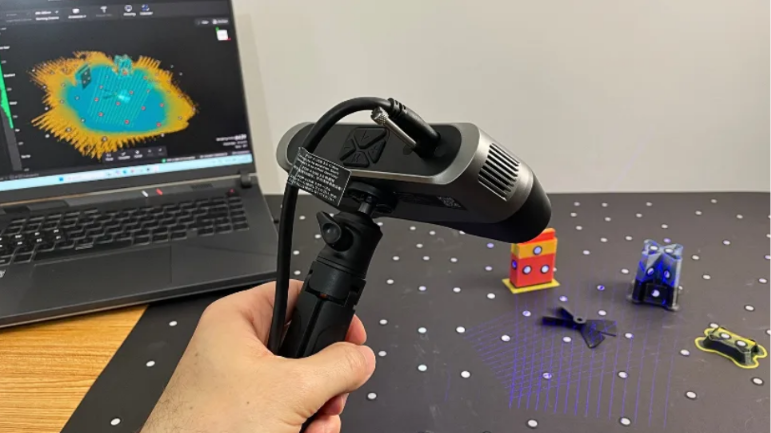
For fieldwork, the scanner includes a 5500 mAh removable battery grip delivering approximately 4 hours of continuous operation. Wi-Fi 6 wireless transmission enables real-time connectivity with PCs or mobile devices, eliminating the need to drag cables across outdoor job sites.
Technical Specifications and Scanning Modes
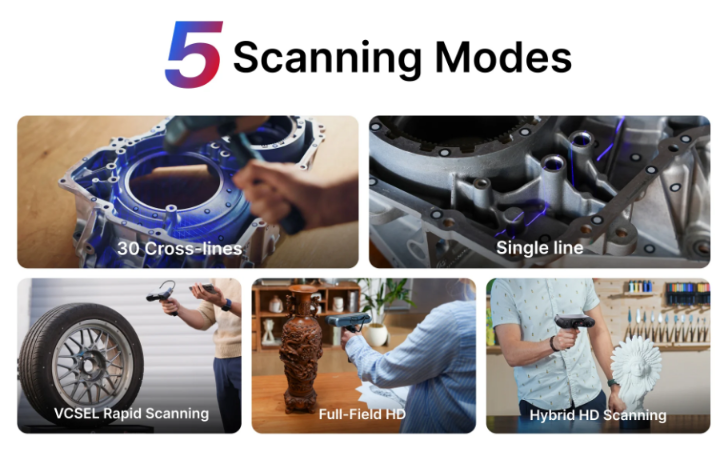
The POP 4 offers five distinct scanning modes covering everything from precision components to full-body capture:
| Mode | Light Source | Application | Key Feature |
|---|---|---|---|
| Blue Laser Standard | Blue multi-line laser | Dark objects, metal surfaces | No powder coating required |
| Blue Laser Fine | Blue multi-line laser | High-detail small objects | Higher precision, slower speed |
| IR Full-Field HD | Infrared structured light | Medium-to-large objects, human body | Full coverage, high frame rate |
| IR Hybrid HD | IR + laser fusion | Complex structures | Auto-switching, smooth tracking |
| VCSEL Fast Scan | VCSEL infrared | Bright environments, large scenes | 100,000 lux resistance, 30 fps |
The intelligent aspect of this design is that users need not become optics experts. The device automatically selects optimal parameters for each scene. The Hybrid HD mode deserves particular attention—it dynamically fuses both light sources during scanning, preventing data discontinuities caused by manual mode switching.
AI and 3DGS: Beyond Spec Sheet Improvements
The POP 4’s AI capabilities are not marketing fluff. Embedded algorithms recognize target objects in real time, automatically filtering background point clouds to output clean object data. For scanning novices, this eliminates hours of post-processing cleanup. For professionals, it means on-site quality confirmation rather than discovering corrupted data back at the office.
More significantly, the 3DGS modeling capability changes the output pipeline. Traditional 3D scanning produces point clouds or mesh models requiring specialized software for texture mapping and rendering optimization before game or metaverse deployment. The POP 4’s patented 3DGS modeling technology converts point cloud and RGB data directly into Gaussian models, exportable in .splat format. This compresses the workflow from “scan → repair → bake → import engine” to “scan → export → use directly.”
For game development and digital twin applications, this efficiency gain translates to substantially lower digital asset production costs. Cultural heritage digitization benefits equally—high-precision 3D documentation of artifacts no longer demands complex post-processing to achieve photorealistic presentation.
Competitive Comparison
| Feature | Revopoint POP 4 | EinScan H2 | Artec Leo |
|---|---|---|---|
| Accuracy | 0.03 mm | 0.05 mm | 0.1 mm |
| Max Frame Rate | 105 fps | 60 fps | 80 fps |
| Light Resistance | 100,000 lux | 50,000 lux | 80,000 lux |
| Wireless | Wi-Fi 6 | Wired primary | Wi-Fi 5 |
| 3DGS Support | Native | No | No |
| Price Range | ~$800-900 | ~$1,200 | ~$30,000 |
The POP 4’s pricing strategy is particularly interesting. The standard edition runs approximately $800, with the advanced edition around $900—occupying the empty space between consumer and professional tiers. Against industrial-grade devices like the Artec Leo, the POP 4 delivers comparable accuracy at less than 3% of the cost. Against the EinScan H2, it holds clear advantages in frame rate and AI functionality.
Pros and Cons
| Pros | Cons |
|---|---|
| AI auto-segmentation dramatically reduces post-processing time | Advanced features still carry a learning curve |
| Native 3DGS support enables direct digital asset usage | Extremely reflective materials still need auxiliary treatment |
| Dual-band system covers extensive application scenarios | Brand recognition trails established Western manufacturers |
| Wireless design enhances outdoor workflow freedom | 4-hour battery life falls short for full-day operations |
| Price-to-performance ratio is exceptionally competitive in the professional segment | Software ecosystem remains a work in progress |
Buying Guide
Recommended for:
- Reverse engineering engineers: sufficient accuracy, friendly pricing, wireless design suits workshop environments
- 3D printing service providers: shortest scan-to-print pipeline, AI cleanup saves labor costs
- Indie game developers: 3DGS output goes directly into engines, bypassing intermediate steps
- Cultural heritage digitization teams: outdoor scanning capability plus photorealistic modeling suits fieldwork
Consider carefully if:
- You require sub-micron precision for semiconductor or ultra-precision manufacturing: the POP 4’s accuracy is solid for professional use but falls short of metrology-grade equipment
- You expect pure plug-and-play operation as a complete beginner: while AI lowers the barrier, selecting among five modes still requires some learning
FAQ
Q: Can POP 4’s 3DGS models import directly into Unity or Unreal?
A: The .splat export format is supported by plugins available for major engines.
Q: Does human body scanning require special preparation?
A: Infrared mode supports body scanning. Wear non-reflective materials and maintain steady or slow movement.
Q: Which operating systems does the software support?
A: Revo Scan 6 runs on Windows, macOS, Android, and iOS, with export compatibility to mainstream 3D design software.
Conclusion
The Revopoint POP 4 is not a perfect scanner—battery life and brand recognition have room for improvement. But it precisely targets a market gap: professional users who need industrial-grade precision without paying industrial-grade premiums; content creators who need photorealistic digital assets without drowning in technical complexity.
The addition of AI segmentation and 3DGS modeling transforms this device from “a faster, more accurate scanner” into “a production tool that outputs usable digital assets.” Behind the $2.6 million crowdfunding achievement lies market validation for this efficiency revolution.
If you are searching for a scanner that handles both precision inspection and digital content production, the POP 4 deserves the top spot on your shortlist.
Leave a Reply