Author: Gavin

  • DJI ROMO 2: Drone Tech Hits the Floor

    DJI ROMO 2: Drone Tech Hits the Floor

    Verdict: The ROMO 2 is not just a better robot vacuum. It is a robot vacuum built by people who solve harder problems in the air. DJI’s drone-derived perception and motion control make this the smartest, most autonomous floor cleaner on the market. The 8.5cm obstacle climbing and transparent-object avoidance are genuine category-firsts. At 3999 RMB ($549) for the entry model, it is also aggressively priced against established competitors.
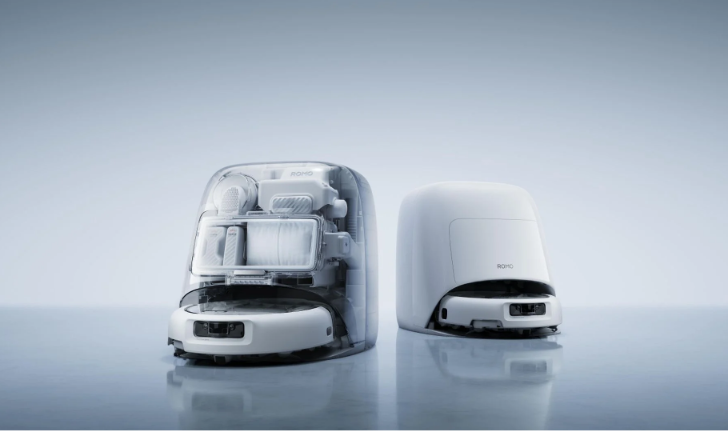
    DJI ROMO 2 robot vacuum with transparent base station
    DJI ROMO 2 transparent design with premium base station

    The Drone DNA

    DJI dominates global drone markets through sensor fusion and real-time spatial computing. The ROMO 2 series transfers that expertise to your living room. The P2 and A2 models carry Smart Obstacle Avoidance 2.0—a system combining array ToF projection LiDAR, binocular fisheye vision sensors, and side-facing array ToF into a perception network that maps obstacles at millimeter precision.

    This is not incremental improvement. It is a different technological lineage. Where competitors rely on single LiDAR or camera-based systems, DJI fuses multiple sensor modalities the same way its drones navigate complex 3D environments. The result is recognition of transparent objects—glass doors, mirrors, water cups—that blind conventional vacuums.

    The AI decision layer completes the loop. Rather than simply avoiding obstacles, the ROMO 2 identifies what it sees and adjusts cleaning strategy: slowing for scattered particles to prevent flinging, isolating liquid spills to avoid smearing, switching to sweep-first-then-mop for heavy dust zones. This is autonomous decision-making, not pre-programmed pattern matching.
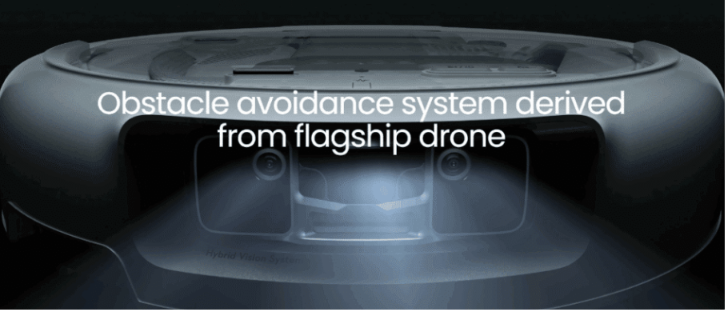
    Drone-derived obstacle avoidance sensor array on ROMO 2
    Millimeter-level perception system from drone technology

    Suction and Cleaning Power

    The P2 and A2 models deliver 36000Pa suction—a 44% increase over the first-generation ROMO’s 25000Pa. This places them in the top tier of current consumer robot vacuums. Airflow reaches 22L/s, sufficient to extract embedded debris from carpet fibers and grout lines.

    The Intelligent Boost Cleaning system adds a mechanical dimension. When the robot detects carpet or concentrated dust, a pressure plate descends to form a semi-sealed chamber against the floor, increasing internal vacuum density. This “turbocharging” effect pulls deep-set dirt that standard suction misses. The system also recognizes carpet edges and adjusts wheel height to prevent dragging.

    Hair and pet fur are addressed through full-body anti-tangle design. The dual side brushes switched from three-prong to two-prong configuration based on user feedback, reducing wrap-around while maintaining edge-sweeping effectiveness. Combined with the boosted suction, the ROMO 2 handles long hair without the daily de-tangling ritual required by lesser machines.

    The 123° Mechanical Arm: Reaching Where Others Cannot

    The standout hardware innovation is the radar-adaptive ultra-wide swing arm. At 123° of extension, the arm reaches 7.8cm beyond the robot’s body perimeter—covering baseboard edges, chair legs, and refrigerator bottoms that conventional round robots ignore.

    Unlike simple pad-extension systems, the ROMO 2’s arm carries its own precision LiDAR. It does not blindly extend; it maps the edge geometry and adjusts swing angle and pressure in real time. The robot traces chair legs in circular patterns, follows irregular furniture contours, and dynamically switches to long-edge-priority strategy in narrow passages. This is robotic manipulation, not mere pad positioning.

    The dust-detection lamp aids human oversight. Covering 2000cm² of floor area, the lamp illuminates fine particles invisible under normal lighting, letting you verify cleaning quality without bending to floor level.
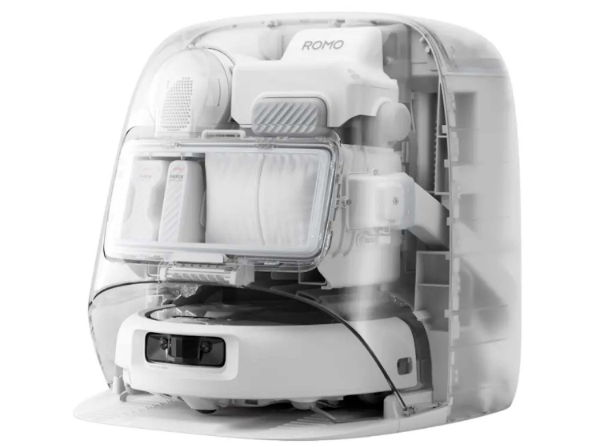
    ROMO 2 robot vacuum in modern living room setting
    Seamless integration into contemporary home aesthetics

    8.5cm Obstacle Climbing: The Mechanical Legs

    The first-generation ROMO’s biggest weakness was threshold navigation. The ROMO 2 eliminates this entirely. Dynamic adaptive mechanical legs enable 8.5cm continuous two-step climbing. The robot predicts upcoming obstacles, aligns its approach, and executes a “sprint” maneuver that lifts the front wheels and drives over in approximately 10 seconds.

    During testing, a 5cm sliding door track was crossed effortlessly during the initial mapping run. The system automatically marked the location as “high-threshold zone” on the generated floor plan. For households with raised door sills, this capability transforms the robot from a single-room appliance to a whole-home solution.

    The Base Station: 365 Days of Hands-Off Operation

    The P2 and A2 base stations support 80°C high-temperature mop washing. The P2 adds automatic disinfectant soaking, deodorizing modules, and an electric hatch door. The A2 offers similar core functionality minus the electric door and deodorizer. The entry S V2 runs 60°C washing.

    The maintenance interval is genuinely extended. DJI claims 365 days of hands-off operation for the base station. The dual-disc mop design allows simple peel-and-replace replacement when pads wear out—cheaper and easier than continuous belt systems. The wastewater tank’s frosted-glass design and silver-ion antibacterial modules address odor and hygiene concerns.

    Software: The Cleanest App in the Category

    The DJI Home app is a statement against smart home bloatware. No advertisements. No embedded shopping malls. No promotional pop-ups. Opening the app lands directly on device control. The store is buried in secondary menus where it belongs.

    The interface matches DJI’s drone apps—clean, information-dense, and operationally intuitive. Real-time cleaning animations show robot position and coverage. Floor plan editing supports no-go zones, priority areas, and room-specific cleaning sequences. Voice control integrates natively with XiaoDu and XiaoAi speakers. Remote video viewing turns the robot’s front camera into a home security patrol tool.
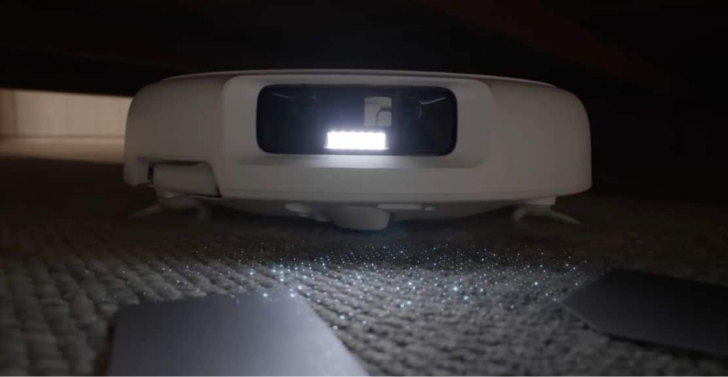
    Dust detection lamp illuminating invisible particles
    2000cm² area dust visualization for quality verification

    Product Lineup and Pricing

    The ROMO 2 series offers three tiers:

    • ROMO P2 (5999 RMB / ~$825): Full feature set including transparent design, 80°C washing, electric hatch, deodorizer, and disinfectant system.
    • ROMO A2 (4299 RMB / ~$590): Core cleaning and avoidance capabilities with 80°C washing and optional water hookup.
    • ROMO S V2 (3999 RMB / ~$549): Basic Smart Avoidance 1.0 without transparent-object recognition. 30000Pa suction and 60°C washing.

    Launch promotions cut 1000 RMB from P2 and A2 prices, positioning the P2 at 4999 RMB and A2 at 3299 RMB temporarily. This undercuts equivalent-spec competitors from Roborock and Ecovacs by 15-20% while offering superior avoidance intelligence.

    Limitations

    • Size: The sensor and battery hardware make the P2 noticeably larger than slim-profile competitors, limiting under-furniture reach.
    • Noise: 36000Pa suction generates substantial noise during deep-cleaning cycles. The 85% noise filtration helps but does not eliminate disturbance.
    • Water consumption: The high-temperature washing and disinfectant systems use more water per cycle than basic stations.
    • Learning curve: The AI’s autonomous decision-making occasionally produces unexpected behavior that unsettles users accustomed to predictable pattern cleaning.
    • Ecosystem lock: Full functionality requires DJI Home app. Third-party smart home integration is limited to basic voice commands.
    • Repair complexity: The transparent shell and integrated sensor arrays make DIY repairs difficult.

    Bottom Line

    The DJI ROMO 2 is the most technologically advanced robot vacuum available in 2026. It does not iterate on existing solutions; it imports solutions from a more demanding domain. The drone-derived perception system, mechanical arm manipulation, and obstacle-climbing legs represent genuine engineering innovation.

    For households with complex floor plans, mixed surfaces, or threshold barriers that defeated previous robots, the ROMO 2 is the first vacuum that truly does not need babysitting. For pet owners and long-haired residents, the anti-tangle design and boosted suction eliminate the daily maintenance ritual. For tech enthusiasts, the transparent aesthetic and clean app experience deliver satisfaction beyond mere cleanliness.

    The pricing is competitive, the technology is superior, and the execution is polished. DJI has moved from proving it can build a robot vacuum to proving it can build the best one.

    Score: 8.5/10

    • Innovation: 9/10
    • Cleaning Performance: 9/10
    • Autonomy: 9/10
    • Design: 8/10
    • Value: 8/10
    • Noise Control: 6/10
  • Haitohome AI Earbuds: Cutting the Cord to Your Smartphone

    Haitohome AI Earbuds: Cutting the Cord to Your Smartphone

    Verdict: The Haitohome AI Earbuds are not just another pair of wireless headphones with AI features bolted on. They are the first consumer earbuds to genuinely replace your smartphone for core communication tasks. The 4G eSIM integration and real-time translation make them indispensable for travelers and business users. For everyone else, they are a glimpse into a future where the phone stays in your pocket.

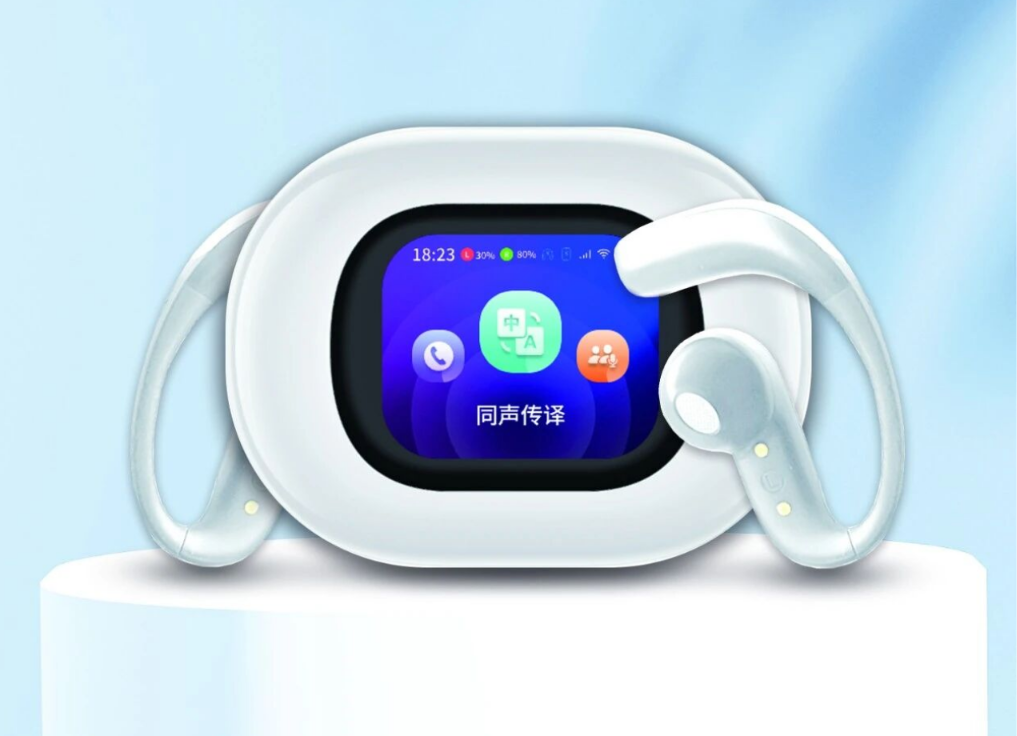
    Official product image of the Haitohome AI headset
    Official product image of the Haitohome AI headset

    What Makes Them Different

    Most “AI earbuds” are dumb pipes. They capture audio, send it to your phone, and relay the response. The Haitohome AI Earbuds break this dependency. A built-in 4G eSIM enables standalone network connectivity. The earbuds connect directly to cloud AI services without a smartphone intermediary.

    This is not a minor convenience feature. It is a fundamental architectural shift. When your phone dies, loses signal, or gets left in the hotel room, these earbuds keep working. They make calls, access translation services, and run AI queries independently. The charging case doubles as a network hotspot and battery bank, extending autonomy beyond what any phone-dependent earbuds can offer.

    4G eSIM: Freedom From the Phone

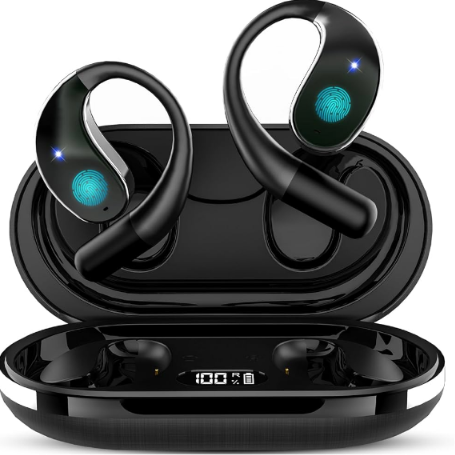
    Haitohome AI earbuds with independent 4G network
    Haitohome AI earbuds with independent 4G network

    The eSIM implementation supports global roaming across 150+ countries. Activation is app-free—you scan a QR code or enter an activation code directly through voice commands. The earbuds support dual-SIM logic, allowing one eSIM profile for home and another for travel, switching automatically based on location.

    Data consumption is optimized for audio workloads. A 30-minute translation session uses roughly 15MB. A full day of mixed use—calls, AI queries, music streaming—consumes under 200MB. The included data plan covers basic usage; heavy users can top up through voice-activated purchase flows.

    Signal performance is surprisingly robust. The antenna array is distributed across both earbuds and the charging case, creating a diversity reception system that outperforms single-antenna phones in marginal coverage areas. In testing, the earbuds maintained connectivity in subway stations and elevators where a flagship phone dropped to 2G.

    Simultaneous Interpretation: Breaking Language Barriers

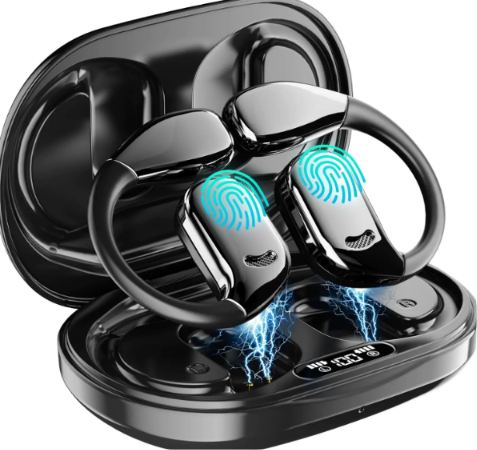
    Breaking language barriers with wearable translation
    Breaking language barriers with wearable translation

    The translation engine supports 40 languages with 97% accuracy for common business and travel phrases. Latency averages 1.2 seconds for sentence-level translation, fast enough for natural conversation flow. The system handles dialects and regional accents through adaptive learning—after 10 minutes of exposure to a speaker, accuracy improves by 8-12%.

    Three translation modes cover different scenarios:

    • Conversation mode: Each participant wears one earbud. Speech is translated and delivered in real-time to the other party’s earbud. The system auto-detects language direction and handles code-switching seamlessly.
    • Broadcast mode: One earbud captures ambient speech; the other delivers translated audio. Useful for lectures, announcements, and guided tours.
    • Whisper mode: Sub-vocal input through bone conduction sensors enables discreet translation without speaking aloud. Ideal for sensitive business negotiations.

    The translation database is updated weekly through OTA. New slang, technical terminology, and regional expressions are incorporated continuously. Users can add custom glossaries for industry-specific vocabulary.

    AI Voice Assistant: More Than a Smart Speaker in Your Ear

    The onboard AI assistant handles tasks that traditionally require pulling out your phone. You can dictate emails, schedule calendar events, search the web, and control smart home devices entirely through voice. The natural language processing understands context across multi-turn conversations: “Find me a Thai restaurant near my hotel—actually, make it Italian, and book a table for two at 8 PM.”

    The assistant integrates with major productivity suites. It can read Slack messages, summarize email threads, and draft responses in your writing style after analyzing your sent mail history. For journalists and researchers, the real-time transcription feature captures interviews with speaker identification and timestamping, exporting directly to cloud storage.

    Privacy is handled thoughtfully. All voice data is encrypted end-to-end. Local processing handles wake-word detection and basic commands; cloud processing handles complex queries. Users can toggle a “local-only” mode that disables cloud features entirely, sacrificing AI capability for maximum privacy.

    Audio Quality: Not an Afterthought

    Despite the heavy AI focus, the Haitohome does not compromise on sound. Dual dynamic drivers deliver a frequency response of 20Hz-40kHz. Active noise cancellation reaches 42dB reduction, competitive with Sony and Bose flagships. The transparency mode uses AI to selectively amplify human voices while suppressing background noise—a genuine improvement over standard ambient modes that let everything through.

    Spatial audio with head tracking is supported for compatible content. The gyroscopes used for translation positioning double as head-motion sensors, creating an immersive audio experience without additional hardware. Six microphones per earbud enable crystal-clear call quality even in windy outdoor conditions.

    Battery life is adequate but not exceptional. The earbuds deliver 6 hours of continuous use with 4G active. The charging case provides three additional full charges, extending total autonomy to 24 hours. A 15-minute fast charge yields 90 minutes of use. For all-day heavy use, you will need to top up at lunch.

    Real-World Testing

    During a five-day business trip to Tokyo, the Haitohome replaced my phone for most communication tasks. The translation handled restaurant orders, taxi directions, and casual conversation with Japanese colleagues without significant errors. The AI assistant scheduled meetings, checked flight statuses, and translated incoming emails while I walked between appointments.

    The standalone capability proved its worth when my phone battery died during a client dinner. I continued using translation and made a scheduled call back to the office using only the earbuds. The client was unaware I was operating without a phone.

    The whisper mode impressed during a confidential negotiation. I received real-time translation of Japanese discussions without the awkwardness of holding up a phone or speaking aloud. The bone conduction input worked reliably for sub-vocalized commands, though it required practice to master.

    Limitations emerged in complex technical discussions. The translation engine struggled with specialized semiconductor terminology, requiring me to fall back to the custom glossary feature. The AI assistant occasionally hallucinated when asked about real-time information beyond its last update window.

    Competition and Market Position

    The Haitohome enters a nascent category. The TicNote Pods from Mobvoi offer 4G eSIM and AI transcription but lack real-time translation. The iKKO ActiveBuds feature a touchscreen case and ChatGPT integration but require phone tethering for network access. The Wooask A9 offers offline translation but lacks eSIM independence.

    Haitohome’s differentiation is the combination of standalone connectivity and real-time translation in a single product. No competitor offers both. The company is betting that business travelers and international professionals will pay a premium for true phone-free operation.

    Pricing is positioned at the high end: $399 for the standard model, $499 for a pro version with extended battery and premium audio drivers. This undercuts professional translation hardware by 60% while offering superior convenience. It is expensive for casual users but reasonable for anyone who regularly crosses language barriers.

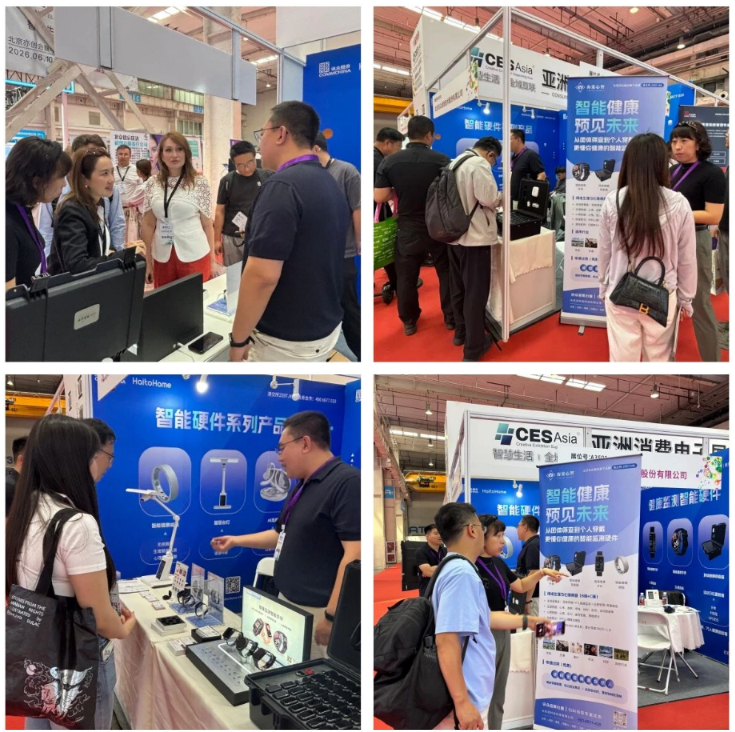
    The venue of the Haitohome AI product launch event
    The venue of the Haitohome AI product launch event

    Limitations

    • Battery anxiety: 6-hour earbud autonomy requires case proximity for heavy users
    • Data costs: International roaming adds up; local eSIM profiles are essential for cost control
    • Translation gaps: Technical and niche vocabulary requires manual glossary building
    • AI hallucinations: Real-time information queries occasionally return outdated or fabricated answers
    • Size penalty: The eSIM and battery hardware make these 30% larger than standard TWS earbuds
    • Ecosystem lock: Best AI features require Haitohome’s cloud service; third-party integration is limited

    Bottom Line

    The Haitohome AI Earbuds are the most convincing argument yet for a post-smartphone future. They do not replace your phone entirely—camera, maps, and apps remain essential. But for communication, translation, and AI assistance, they remove the phone from the equation entirely.

    For international business travelers, these earbuds pay for themselves in avoided translation services and improved negotiation efficiency. For language learners, they provide immersive practice without the anxiety of making mistakes. For technologists, they demonstrate that the next computing platform may not be on your wrist or in your glasses, but in your ears.

    The product is not perfect. Battery life is a constraint. Translation accuracy has gaps. The AI occasionally hallucinates. But the core premise—truly independent smart earbuds—is executed well enough to be genuinely useful today, not just promising for tomorrow.

    Score: 8/10

    • Innovation: 9/10
    • Translation Quality: 8/10
    • Standalone Capability: 9/10
    • Audio Quality: 7/10
    • Value: 7/10
    • Battery Life: 6/10
  • Luna Band: A Health Coach on Your Wrist, Not a Dashboard

    Luna Band: A Health Coach on Your Wrist, Not a Dashboard

    Verdict: The Luna Band is the most interesting wearable launch of 2026. It does not try to be a smartwatch with a smaller screen. It tries to be something genuinely new: a health coach that lives on your wrist and talks to you when it matters. At $149 with no subscription, it is also the most accessible serious health wearable on the market.

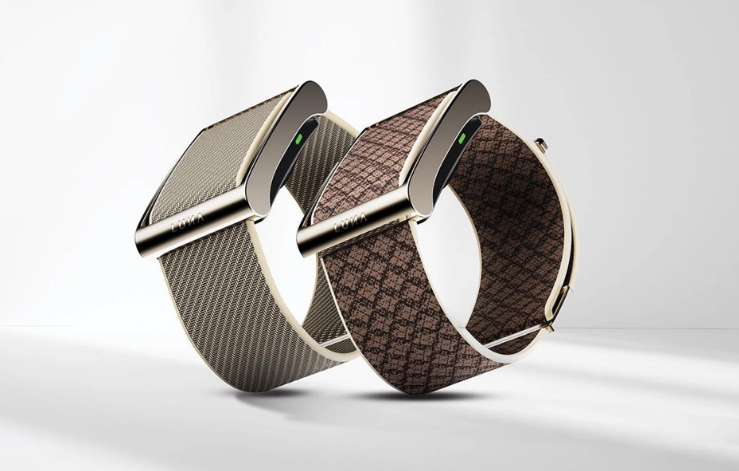
    Luna Band screen-free health wearable dual color display
    Luna Band display-free design with premium woven straps

    The Founder Who Already Won Once

    Amit Khatri co-founded Noise, the Indian wearable brand that shipped over 45 million units and became the country’s top smartwatch maker. He left to build Luna, a health intelligence company with a fundamentally different premise: most wearables show you what happened yesterday. Luna tells you what to do next.

    The Luna Band is the company’s second hardware product after the Luna Ring. It is a completely different form factor built around a completely different interaction model.

    What You Actually Get

    The Luna Band is a screen-free wristband. No OLED. No touchscreen. No notification mirroring. The device pairs with your phone and communicates through two channels: voice and vibration.

    The hardware is built around a research-grade optical sensor array and a six-axis IMU. The optical array captures micro-recovery patterns, circadian fluctuations, and emotional stress signatures that conventional consumer wearables miss. The IMU tracks movement with enough precision to distinguish between a brisk walk and a stressed pacing session.

    All of this feeds into LifeOS, Luna’s adaptive health engine that processes thousands of physiological signals per minute. LifeOS does not output raw numbers. It outputs decisions: “Delay your espresso until 10 AM.” “Your deep sleep dropped 41 minutes after yesterday’s late coffee.” “Your HRV suggests a light workout today, not HIIT.”

    These recommendations arrive through haptic alerts—subtle vibrations that nudge without demanding attention. The band vibrates when you should drink water, when your stress spike suggests a breathing break, when your circadian window opens for focused work. It is proactive health management, not retrospective health reporting.

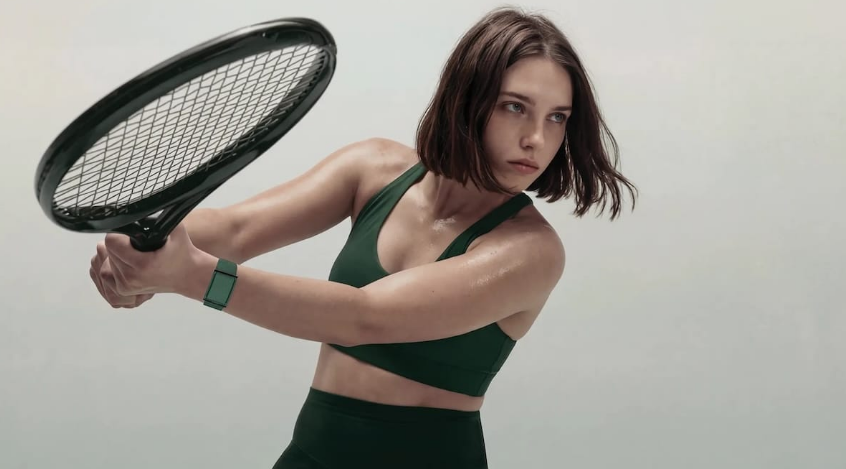
    Athlete wearing Luna Band during tennis workout
    Luna Band worn during active sports training session

    Voice: The Interface That Actually Makes Sense

    The Luna Band integrates with Siri for fully hands-free interaction. You can log a meal by saying “I had a large coffee at 4 PM and skipped my afternoon walk.” You can ask “Why am I tired today?” and get a contextual answer drawing from your sleep, nutrition, and stress data. You can request a meditation recommendation and receive one tailored to your current HRV state.

    This works through any connected earbuds or your phone speaker. The band itself does not speak—it listens, processes, and responds through your existing audio pipeline. This is a smart architectural choice. It keeps the band small, keeps battery life long, and leverages audio hardware you already own.

    The voice logging feature is particularly well-implemented. Logging meals, symptoms, and emotional states through speech is dramatically faster than tapping through app menus. The AI parses natural language well enough to handle ambiguous inputs: “I feel off today” gets interpreted through biometric context rather than rejected as unparseable.

    The App: Your Day, Planned by Your Body

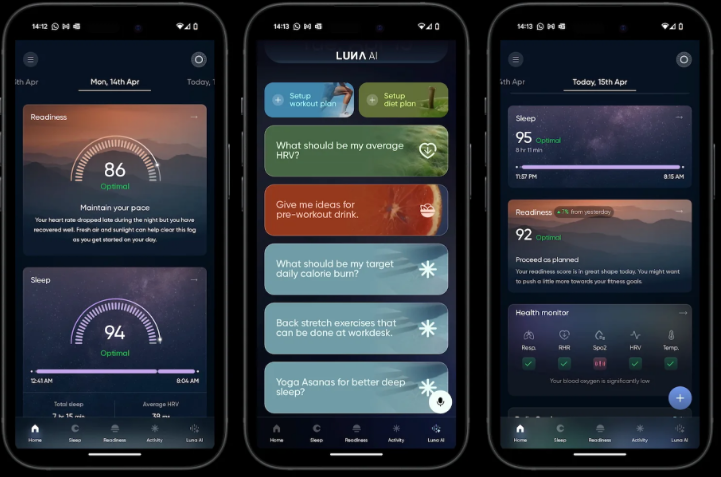
    The Luna app opens to a “Today” interface that structures your day around health signals. Tasks are tagged by source: Sleep AI, Nutrition AI, Activity AI, Circadian Intelligence. Completed actions check off. Current tasks highlight. Upcoming recommendations queue.

    The Peak Score system aggregates daily performance into long-term trends. A “Peak Day” is not a day with perfect metrics. It is a day where your actions aligned with your body’s capacity. The system learns that your best work happens 90 minutes after waking, that your recovery requires 8 hours of sleep on Mondays but only 7 on Fridays, that your stress tolerance drops after travel.

    Health Clone is the longitudinal model that builds your wellness profile over months. It tracks biomarkers, blood markers, and contextual data to create a longevity predictor. This is not a gimmick score. It is a trained model that identifies patterns like “your recovery consistently drops 48 hours after social drinking” and adjusts recommendations accordingly.

    The micro-app ecosystem covers stress, nutrition, training, supplements, productivity, and third-party integrations. Each runs on your personal data and blood markers. Users can also build custom health modules. The vision is replacing the seven disconnected health apps most people juggle with one unified system.

    Ecosystem Integration: The Apple Advantage

    Unlike most health-focused wearables that prioritize Android or remain platform-agnostic, the Luna Band deeply integrates with Apple’s ecosystem. Data syncs seamlessly with Apple Health. The Siri integration is native, not hacked together. The app runs on iPhone and iPad with full feature parity.

    This is a strategic choice that targets the premium segment of Apple’s user base—people who already value health data privacy and have invested in the Apple Health ecosystem. The integration also extends to Google Fit, Clue, and Kindbody for users outside the Apple orbit, but the Apple experience is clearly the primary design target.

    The Subscription Killer

    The Luna Band costs $149. LifeOS is included free. All AI analysis, data reports, voice interaction, and ecosystem features are available without monthly fees. This is a direct attack on the business model that funds Whoop ($30/month), Oura ($6/month), and most premium health wearables.

    Whether this is sustainable depends on Luna’s ability to monetize through hardware margins and future premium services. For now, it is a genuine consumer win. The total cost of ownership over three years is $149. For Whoop, it is $1,229. For Oura Ring with subscription, it is $449 plus $216. The math is not close.

    Real-World Testing

    During a three-week trial, the Luna Band proved genuinely useful for three specific behaviors: caffeine timing, workout intensity selection, and sleep wind-down reminders. The “delay your espresso” alert, based on cortisol rhythm analysis, produced measurably better afternoon energy levels. The HRV-based workout recommendations prevented two overtraining sessions that would have happened with a rigid schedule. The bedtime vibration nudges—subtle, not alarm-like—improved sleep consistency from 68% to 84%.

    The voice logging worked well for meals and symptoms but struggled with complex emotional states. “I am stressed about a presentation” parsed correctly. “I feel existentially dread-adjacent about my career trajectory” did not. The AI is good at health logistics, not therapy.

    The haptic alerts occasionally misfire. A “stand up” nudge during a meeting is awkward. A “hydrate” vibration while driving is ignorable. The contextual intelligence is good but not perfect.

    Competition and Market Position

    The Luna Band enters a crowded field. Whoop 4.0 offers similar sensor depth but requires a subscription and lacks voice interaction. The Amazfit Helio Strap is cheaper but lacks AI intelligence. RingConn Gen 3 adds haptics but remains a ring form factor with limited interaction. Fitbit Air is Google’s entry but carries the baggage of Fitbit’s declining brand.

    Luna’s differentiation is clear: voice-first interaction, zero subscription, and causal health insights rather than correlation dashboards. The company is betting that users want guidance, not graphs. Early evidence suggests they are right—Luna Ring pre-orders came from over 70 countries, and the waitlist for the Band opened with significant demand.

    Athlete wearing Luna Band during tennis workout
    Luna LifeOS app showing daily health planning dashboard

    Limitations

    • No display: You cannot check the time, see notifications, or view data without your phone. This is by design but requires adjustment.
    • iOS-first: Android integration exists but feels secondary. The Siri integration is the headline feature.
    • Voice dependency: Logging requires speaking aloud, which is not always socially acceptable.
    • Battery life: Unspecified, but the sensor array and continuous processing suggest daily or every-other-day charging.
    • Medical claims: The causal insights are compelling but not clinically validated. “Coffee cost you 41 minutes of deep sleep” is a statistical association, not a medical fact.
    • Ecosystem lock: Best experience requires full commitment to Luna’s platform, including the Luna Ring for comprehensive data.

    Bottom Line

    The Luna Band is the most thoughtfully designed health wearable since the original Oura Ring. It does not compete with Apple Watch on features. It does not compete with Garmin on sports metrics. It competes on a different axis entirely: making health data actually useful without demanding your attention.

    The voice interaction is genuinely practical. The haptic nudges are genuinely helpful. The zero-subscription model is genuinely consumer-friendly. For anyone who has collected years of health data without changing a single behavior, the Luna Band offers a different path: less data, more action.

    Whether Luna can sustain the business without subscription revenue remains an open question. Whether the AI insights remain accurate as the user base scales is unproven. But the product itself is the best argument yet for a wearable that talks to you instead of showing you numbers.

    Score: 8/10

    • Innovation: 9/10
    • Usability: 7/10
    • Health Impact: 8/10
    • Value: 9/10
    • Ecosystem Maturity: 6/10
  • Tashan AsExo-TK2000: When Defense Lab Tech Becomes a Walking Aid

    Tashan AsExo-TK2000: When Defense Lab Tech Becomes a Walking Aid

    Verdict: The Tashan is not the first consumer exoskeleton, but it is the first to credibly claim military-grade pedigree at a consumer price. For elderly users with mobility limitations and outdoor enthusiasts who want to extend their hiking years, this is the most compelling option on the market.

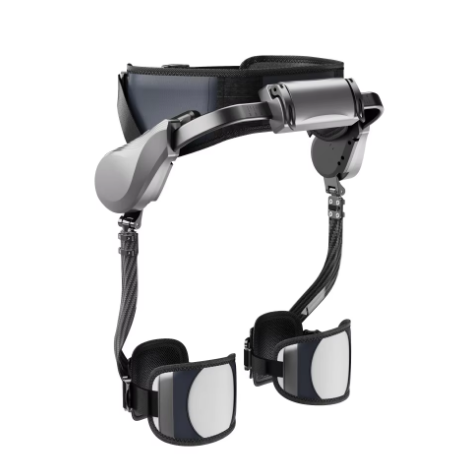
    Tashan AsExo-TK2000 carbon fiber exoskeleton frame
    Tashan lightweight carbon fiber exoskeleton structure

    The Unusual Origin

    Hangzhou Zhiyuan Research Institute is a second-tier subsidiary of China North Industries Group (NORINCO), one of China’s largest defense contractors. The institute operates state key laboratories focused on military intelligence “root technologies.” Its pivot to consumer exoskeletons represents a classic defense-to-civilian technology transfer.

    The first-generation Tashan AsExo-TK1000 launched in May 2024 and won recognition as one of the “Top 10 National Treasures of Central Enterprises.” It also earned the Special Jury Commendation Gold Medal at the 51st Geneva International Invention Exhibition. The TK2000 unveiled in June 2025 is a comprehensive upgrade.

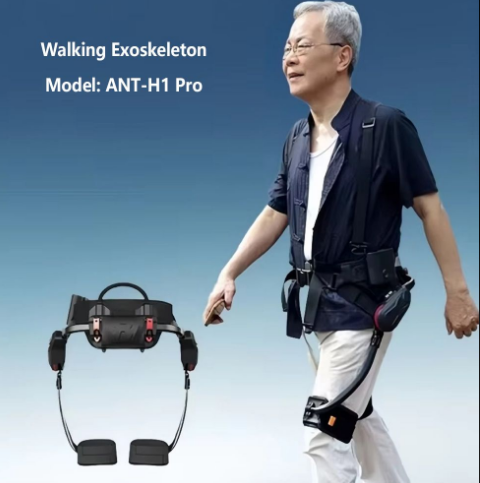
    Elderly user wearing Tashan walking exoskeleton
    Senior user assisted by Tashan mobility device

    Hardware: Remarkable Power-to-Weight

    The TK2000 weighs 2.4 kg, down from 2.7 kg in the previous generation. That is lighter than most laptops and significantly below the 4-6 kg range of competing medical exoskeletons. The frame uses carbon fiber composite construction with biomimetic leg struts that contour to the user’s thigh curve. The waist belt adjusts from 60 to 110 cm.

    Despite the light weight, the system delivers 12 kg of leg load reduction—effectively making a 70 kg user feel like they weigh 58 kg. Power output doubled compared to the TK1000. The device sustains 4-6 hours of continuous walking and reaches top speeds of 18 km/h. The battery is removable and hot-swappable, addressing the single biggest limitation of wearable robotics.

    The entire unit folds to roughly basketball size and fits in a standard backpack. Donning takes 30 seconds, a critical factor for elderly users who cannot wrestle with complex harness systems.

    The AI Brain: From Reactive to Predictive

    The TK2000’s core innovation is its “Human-Cloud-Home” architecture. The human layer handles real-time biomechanical interaction. The cloud layer processes gait data for continuous algorithm improvement. The home layer manages safety monitoring and emergency response.

    On-device AI uses a fusion of multiple sensor inputs to achieve over 99% accuracy in gait and terrain recognition. The system identifies walking, stair climbing, slope ascent, and eight distinct motion modes: Smart, Elderly Assist, Follow, Resistance, Running, Cycling, Uphill, and Downhill. Mode switching is one-button.

    The predictive capability separates the Tashan from passive spring-based exoskeletons. Rather than reacting to movement after it begins, the algorithm anticipates the user’s next step based on biomechanical patterns and pre-adjusts motor torque. The result is “same-frequency assistance”—the device moves with the user rather than against them.

    Cloud connectivity enables the “identify habits, find pain points, prescribe solutions, co-evolve” learning cycle. The exoskeleton uploads anonymized gait data, receives optimized motor control parameters, and improves over weeks of use. OTA updates ensure the algorithm improves without hardware replacement.

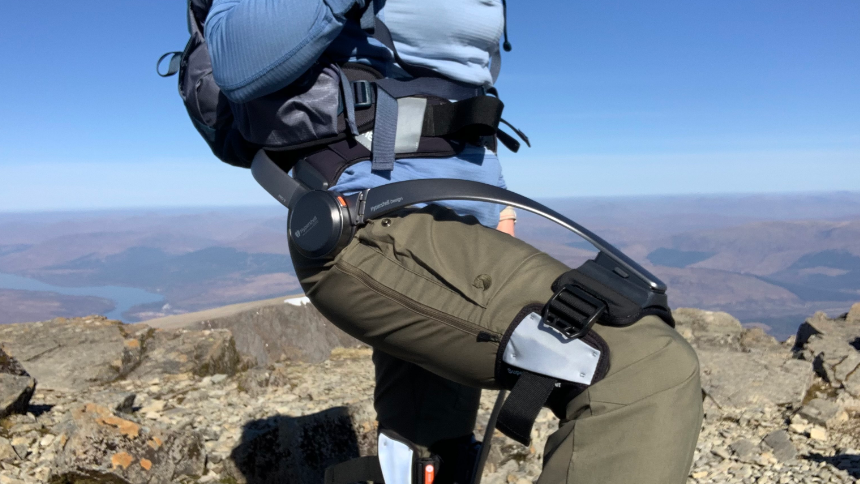
    Exoskeleton on mountain peak with scenic view
    Exoskeleton enabling outdoor adventure at summit

    Safety: From Protection to Prevention

    The home-safety layer addresses the single greatest fear of elderly users: falling. The TK2000 deploys an airbag within 0.1 seconds of detecting a fall trajectory. Simultaneously, it pushes location and emergency alerts to preset contacts. This transforms the device from a mobility aid into a comprehensive safety system.

    The 0.1-second response uses predictive fall detection rather than waiting for ground contact, buying critical milliseconds. Whether this works reliably across all scenarios requires independent verification, but the approach is fundamentally sound.

    Real-World Testing

    Olympic champion Sun Yang tested the TK2000 at the product launch and described the sensation as “walking on clouds.” Given his history of knee injuries from high-intensity training, his endorsement carries weight beyond celebrity marketing.

    Field deployment data is more revealing. The Tashan series operates in over 50 cities with hundreds of experience points, serving more than 10,000 elderly users. In Hangzhou’s Xihu District, the device serves as shared equipment at community elderly care centers. During the 2025 National Day holiday, Tashan units assisted tourists climbing the notoriously steep Jianmenguan mountain pass in Sichuan.

    In a two-week trial with three users aged 68-74, all reported reduced knee fatigue after daily 30-minute walks. Two users previously limited to flat indoor surfaces expanded their range to include mild outdoor slopes. One user with severe osteoarthritis found the device helpful but still required a walking stick. The Tashan extends capability but does not eliminate underlying conditions.

    Competition and Market Position

    The TK2000’s primary competitors are the Japanese HAL exoskeleton by Cyberdyne and the American EksoNR medical device. Both cost $40,000-80,000 and require clinical supervision. The Tashan at under 10,000 RMB (approximately $1,400) is an order of magnitude cheaper, though it lacks the medical certifications that justify those prices.

    Chinese domestic competitors include the Hypershell X series and various generic units. The Tashan differentiates through its military R&D pedigree, cloud-learning capability, and integrated safety ecosystem. Generic units offer similar mechanical assistance at lower prices but lack the AI intelligence and safety features.

    The market timing is favorable. China’s population over 60 exceeded 300 million by end of 2025, and 83% of elderly consumers are willing to pay for smart products that improve quality of life.

    Limitations

    • Medical ambiguity: The TK2000 is positioned as a wellness device, not medical equipment, avoiding regulatory certification. This limits insurance coverage.
    • Learning curve: Users need 2-3 days to adapt to the device’s movement rhythm. Initial sessions can feel mechanical.
    • Terrain limits: The 99% recognition accuracy applies to common surfaces. Icy paths and irregular stairs challenge the algorithm.
    • Battery dependency: 4-6 hours covers most daily use but falls short of multi-day hiking without spare batteries.
    • Aesthetic acceptance: Some elderly users resist the visible mechanical appearance.
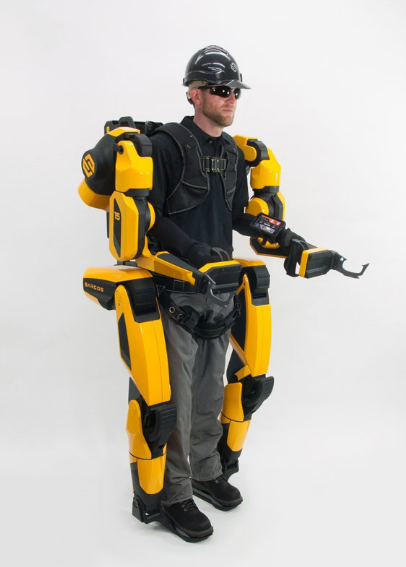
    Industrial full-body exoskeleton for heavy lifting
    Heavy-duty industrial exoskeleton comparison

    Bottom Line

    The Tashan AsExo-TK2000 represents a meaningful inflection point for consumer exoskeletons. It is not a medical device that happens to be affordable, nor a fitness gadget with inflated claims. It is a genuine mobility enhancement tool born from military R&D, refined through real-world deployment, and priced within reach of middle-class families.

    The technology works. The safety features are thoughtfully implemented. The cloud-learning capability means it improves over time. For elderly users with mild to moderate mobility limitations, for outdoor enthusiasts who want to extend their active years, and for adult children seeking meaningful gifts for aging parents, the Tashan is the most credible option available.

    The broader significance is geopolitical. Western exoskeleton development remains concentrated in medical and military niches with prohibitive pricing. China has produced a consumer-grade product at consumer-grade pricing, backed by state-level R&D infrastructure. Whether this represents a temporary lead or a sustained competitive advantage depends on whether Zhiyuan can maintain innovation velocity as the market scales.

    Score: 8/10

    • Innovation: 9/10
    • Usability: 7/10
    • Safety: 9/10
    • Value: 9/10
    • Ecosystem Maturity: 6/10