As the computing power race expands from cloud to edge, a quiet battle for “local AI freedom” is unfolding. In May 2026, AMD officially launched its first self-branded AI development platform—the Ryzen AI Halo—a mini PC the size of a paperback dictionary that claims to run language models with over 700 billion parameters locally. Is this product genuinely revolutionary or just clever marketing? Let’s find out.
Design: Serious Hardware in a Small Package
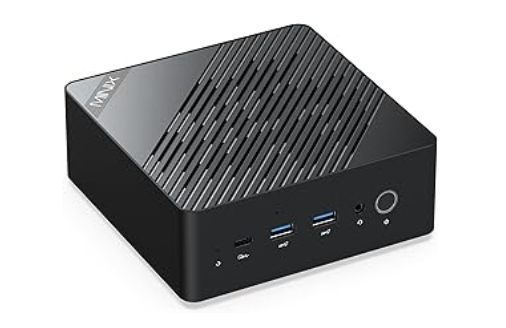
The Ryzen AI Halo features a compact, square design that easily fits into a backpack for on-the-go portability. The machine’s top surface displays AMD’s corporate logo, surrounded by a programmable ARGB light strip that creates a cyberpunk-inspired glow in low-light environments.
The cooling system stands out as a key highlight. AMD equipped it with a dual-fan side-blowing thermal design that maintains reasonable surface temperatures even during extended high-load AI operations. During testing, running continuous local LLM inference for one hour left the chassis only mildly warm—an impressive thermal performance.
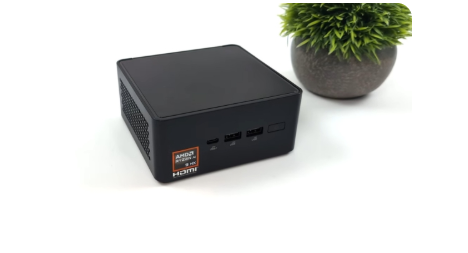
Port configuration offers abundant connectivity options: the rear panel provides multiple USB-C ports, HDMI video output, and wired ethernet, while the front panel reserves commonly used USB-A ports and audio jacks. Notably, this host eliminates traditional graphics card external power requirements, operating with just a single power cable to simplify desktop wiring.
Hardware Specifications: Flagship Performance in Your Palm
The Ryzen AI Halo’s core is AMD’s flagship Ryzen AI Max+ 395 processor, codenamed Strix Halo. This APU features a Zen 5 architecture with 16 cores and 32 threads, accompanied by 40 compute units of RDNA 3.5 integrated graphics and a 50 TOPS NPU.
Memory configuration represents another major selling point. The Ryzen AI Halo supports up to 128GB LPDDR5X-8533 unified memory, enabling effortless handling of ultra-large-scale models. Unlike traditional PC architectures, AMD’s unified memory design integrates CPU and GPU memory into a single shared pool, eliminating bandwidth bottlenecks in data transfer—a critical advantage for large model inference scenarios requiring frequent parameter loading.
In standard testing, the Ryzen AI Max+ 395 platform can simultaneously operate up to 6 AI agents while maintaining approximately 45 tokens/s generation speed under high load. For developers pursuing a “smart agent host” experience, this figure means running multiple AI assistants and executing complex multi-task workflows locally.
Software Ecosystem: Out-of-the-Box Development Experience
Beyond hardware, software support proves equally crucial. The Ryzen AI Halo comes pre-installed with AMD ROCm 7.2.2 software stack, the core component of AMD’s open-source GPU computing platform. After deep optimization, ROCm now natively supports mainstream AI development tools like LM Studio, ComfyUI, and VS Code, allowing developers to start working without tedious configuration.
Model compatibility spans a broad range. For open-source models, Llama, Mistral, and other mainstream large language models run smoothly; in image generation, Stable Diffusion XL, FLUX, and similar models perform admirably on this mini host. AMD commits to “Day 0” support for new models, ensuring developers access the latest technology immediately.
Additionally, the Ryzen AI Halo supports both Windows and Linux dual systems, accommodating users’ preferred development environments. Windows users gain complete Linux development experience through WSL2, while Linux native users directly leverage ROCm’s full capabilities.
Use Cases: Who Needs This “Pocket Supercomputer”?
Positioning-wise, the Ryzen AI Halo targets three primary user groups:
AI Developers and Researchers: Those frequently testing models and debugging prompts locally. This device provides sufficient computing power while avoiding accumulating cloud service costs and data leakage risks. For research teams exploring “private deployment” solutions, the Ryzen AI Halo offers a cost-effective starting point.
Small and Medium Enterprises and Independent Studios: Industry clients with strict data privacy requirements—legal, medical, and financial AI application developers. Local inference ensures sensitive information never leaves the enterprise network while eliminating server build-out costs and maintenance burdens.
Privacy-Conscious Individual Users: Developers or tech enthusiasts with strong personal data protection preferences. They prefer controlling their own AI tools and data rather than uploading work content to third-party cloud platforms.
Competitive Analysis: Can It Challenge NVIDIA’s Moat?
When discussing AI computing devices, NVIDIA remains unavoidable. Currently, the top competitor to Ryzen AI Halo is NVIDIA’s DGX Spark, which also supports 128GB LPDDR5X shared memory but carries a steep $4,699 price tag. In contrast, third-party mini hosts equipped with the Ryzen AI Max+ 395 generally retail between $2,500 and $3,000.
However, price advantage isn’t AMD’s winning card. NVIDIA’s DGX Spark features GB10 chip supporting 20 Petaflops FP4 AI compute power with on-chip NVLink-C2C achieving 900GB/s interconnect bandwidth, potentially offering advantages in ultra-large-scale context processing. Furthermore, AMD’s ROCm ecosystem still trails NVIDIA’s decade-plus CUDA ecosystem in proprietary acceleration libraries and enterprise-grade tooling.
AMD’s strategy appears more as “differentiated competition” than “head-on confrontation.” The Ryzen AI Halo targets the niche market of “personal workstations that fit in your backpack”—an attractive option for developers who don’t need DGX Spark’s full capabilities but want to break free from cloud dependency.
Conclusion: The Right Way to Do Local AI
After deep experience with this device, two impressions stand out: first, it genuinely delivers on “bringing AI with you”—700 billion parameter model capability means developers can work on AI projects anytime, anywhere, without being constrained by network conditions or cloud service quotas. Second, AMD’s commitment to hardware-software coordination is evident—the pre-installed ROCm ecosystem and direct adaptation of mainstream development tools dramatically lowers the barrier to edge AI usage.
Of course, this isn’t a perfect solution. ROCm ecosystem maturity requires time to develop, and some CUDA-dependent frameworks may face compatibility issues during migration. But for developers willing to try AMD platforms and embrace open-source ecosystems, the Ryzen AI Halo provides a trustworthy starting point.
When “AI democratization” transitions from slogan to reality, when edge devices truly gain the capability to compete with cloud services, the era of on-device AI may have already begun.
Leave a Reply