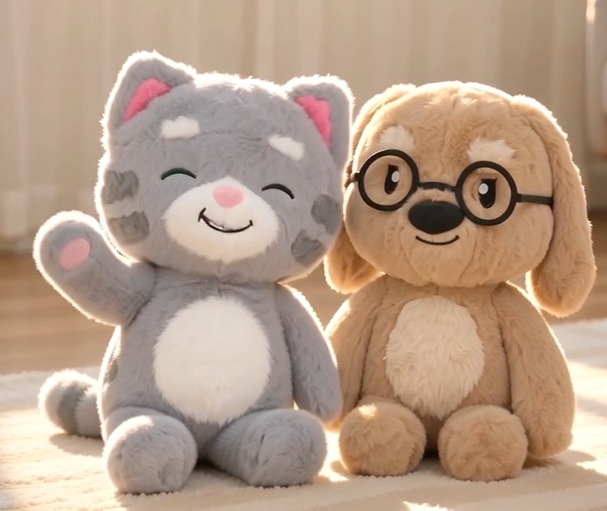
Product Positioning: A screen-free AI companion device for children aged 3–8. It is the third AI hardware product in the “Talking Tom” franchise, officially launching in August and featuring two character options: Talking Tom and Talking Hank.
I. Product Appearance and Hardware Design: Stepping Beyond the Screen to Become a Huggable AI Companion
Most AI educational devices on the market rely on form factors like tablets, smart dictionary pens, or desktop robots. The “Talking Tom AI Huggable” takes a different approach by embedding an AI core inside a plush toy. Essentially a “conversational comfort toy,” it targets scenarios such as bedtime, solitary play, and emotional soothing.
The exterior is made of skin-friendly, short-pile plush fabric that feels soft to the touch and meets safety standards for children’s toys. A hidden zipper on the back allows access to the removable AI core; all functions—charging, resetting, and pairing—are handled by this unit. The plush cover is detachable and washable, addressing the common issue of plush toys getting dirty easily.
The interaction method differs from traditional wake-word systems: shaking the toy’s belly wakes it up for conversation, while a second shake interrupts current playback (such as stories or music) to start a new interaction. This design is highly user-friendly for young children, eliminating the need to memorize complex wake-up commands. Saying “Time to rest” puts the device into sleep mode. The hardware is entirely screen-free, avoiding blue light exposure and eye strain, and focuses on auditory interaction.
Hardware Limitations: Because the core is housed inside the plush body, the microphone is slightly muffled by the fabric, which can reduce speech recognition accuracy in noisy environments. There are no adjustable volume levels for the speaker; while the “sleep-soothing mode” offers a gentle volume, the sound may be too quiet for a noisy living room. The toy itself is not waterproof; only the fabric cover can be washed after the core is removed—the unit cannot be rinsed as a whole.
II. Core AI Functionality: Centered on Sleep-Soothing and Early Childhood Education
Powered by Xihu Xinchen’s large language model and leveraging the “Talking Tom” IP, the device features a child-friendly conversational tone—avoiding stiff, robotic speech—and offers four main capability areas. ### 1. Bedtime Soothing (Core Strength)
This is the primary use case for “AI Hug” (AI Baobao). It features a vast library of bedtime stories, white noise, and lullabies, while also supporting real-time AI generation of custom stories. Children can ask for specific tales—such as a kitten’s adventure—and the AI will improvise gentle, bedtime-appropriate content. Once the story ends, it automatically switches to a low-volume, soft music mode to help lull the child to sleep.
Unlike standard story players with fixed audio libraries, it can respond to a child’s emotions; if a child says, “I’m unhappy today,” the AI offers an emotional response rather than simply playing a pre-recorded track. This addresses the common pain point of traditional soothing plush toys, which can be hugged but cannot interact.
2. Children’s Encyclopedia Q&A and Conversational Companionship
It handles a child’s endless stream of “whys” through natural conversation, answering questions about science and general knowledge. It supports casual chat, allowing children to share school anecdotes or simply ramble; the AI follows the conversation flow rather than engaging in robotic, one-off Q&A exchanges.
Observed limitation: It lacks depth when handling complex scientific questions, making it better suited for younger children (ages 3–8) rather than older elementary students seeking in-depth learning.
3. Language Introduction and Speaking Practice
It supports conversations in both Chinese and English, simple English shadowing exercises, and pronunciation correction for words and short phrases. Children can play voice-based games like word chain or riddles, integrating early education into casual conversation rather than a rigid classroom setting. Note: It is not designed for systematic academic study; it lacks exercises or a formal curriculum, focusing instead on casual, bite-sized learning.
4. Companion App Management
Used alongside the “AI Tongban” (AI Child Companion) mobile app, the device connects to Wi-Fi, allowing parents to view conversation and growth logs, customize content preferences, and update firmware and audio libraries. Stories and early education materials are continuously updated via the cloud.
Limitation: It requires a Wi-Fi connection and lacks built-in 4G connectivity. Compared to another portable AI model in the product family, “AI Hug” is better suited for use in the bedroom at home rather than for offline use while out and about. ## III. How to Choose Among the Talking Tom AI Family Products
- AI Huggable : Plush toy; ideal for bedtime soothing and emotional companionship; designed for bedroom use; requires Wi-Fi; suitable for ages 3–8.
- AI Companion : Desktop robot; features a movable head with expressive facial animations; offers home-based early education and general knowledge; suitable for learning in the living room.
- Talking Tom Portable AI: Compact neck-worn device; built-in 4G connectivity; designed for outdoor use, location tracking/safety, and on-the-go scenarios.
Quick Summary: The three products complement each other in terms of usage scenarios; the AI Huggable focuses on bedtime companionship and is not suitable for carrying outdoors.
IV. Summary of Pros and Cons Based on Real-World Use
✅ Pros
- Innovative Form Factor: A screen-free plush design that fills a niche in the bedtime companionship market; transforms AI from a screen-based experience into a huggable toy that children readily accept.
- Low Interaction Barrier: Wake up the device with a simple shake—young children don’t need to memorize voice commands; strong focus on emotional companionship.
- IP Appeal: Features the classic Talking Tom character, which is popular with children; the plush cover is removable and washable, ensuring hygiene.
- Dynamic Content: Content is continuously updated and supports AI-generated stories, distinguishing it from traditional “story machines” with static, pre-recorded audio.
❌ Cons
- Wi-Fi Dependency: Cannot be used offline outdoors; the plush material can muffle the microphone, reducing voice recognition accuracy in noisy environments.
- Not an Academic Tool: It is a companion toy, not a learning machine; it lacks structured curricula, so do not expect it to help with drilling practice questions or improving academic grades.
- Internal Core Unit: The electronic core is housed inside the plush toy; charging requires unzipping the back to remove the unit, making the process more cumbersome than with standard story machines.
- Age Limitations: Best suited for ages 3–6; children over 8 will likely find it too childish.
V. Who Should Buy It? / Tips to Avoid Pitfalls
Target Audience: Families with children aged 3–6 who need help with bedtime routines or emotional soothing; parents wanting to reduce screen time and looking for a companion toy that can respond to their child’s chatter; suitable as a gift.
Not Recommended If: You want a device for academic drills/practice questions; you need something portable for frequent outdoor use; or the child is over 8 years old.
Leave a Reply