For a long time, standard body fat scales have suffered from homogenization: while the hardware measures a host of metrics, the accompanying apps merely list raw numbers that the average user struggles to interpret. Consequently, these devices often end up as mere ornaments used only for a quick daily weight check. However, the deep integration of large AI models with smart hardware is redefining the value of health devices. The Ant Afu AI Smart Body Fat Scale A1—a product that has recently taken the market by storm—breaks away from the hardware-only race. It employs an integrated hardware-software solution combining “four-electrode body fat sensing hardware” with the “Afu AI health model” to address the biggest pain points for the general public: understanding the data and obtaining actionable plans. After a week of continuous testing, we provide a comprehensive breakdown of the real-world experience, strengths, and limitations of this standout smart device.
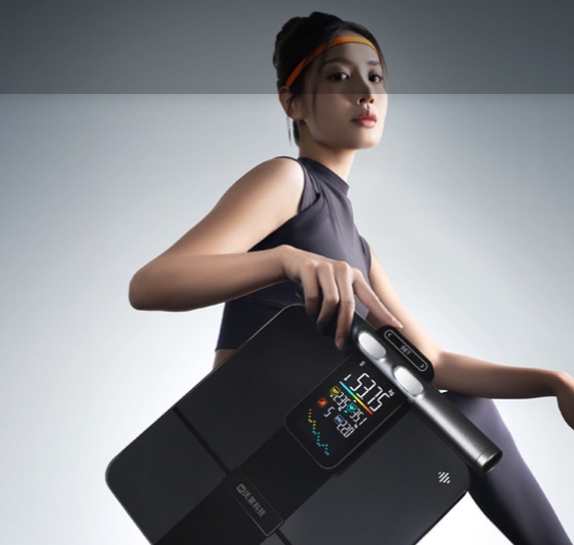
I. Hardware Design and Build: A Practical Home-Use Device
Manufactured by iHealth (Voletti), the Ant Afu body fat scale utilizes the mainstream four-electrode bioelectrical impedance analysis (BIA) technology found in home devices, featuring a minimalist and understated design.
- The top surface features a thickened tempered glass panel with rounded corners to prevent bumps and scratches. Four circular conductive metal electrodes are positioned at the corners, allowing for bioelectrical impedance measurement simply by standing barefoot on the scale.
- The base is equipped with non-slip silicone pads, ensuring stability on tile or wood flooring. It features a Type-C charging port and a built-in lithium battery, eliminating the need for frequent battery replacements and offering a battery life of several months under normal use.
- There is no physical power button; the device wakes up automatically via pressure sensors, completing a measurement in about three seconds. A small built-in LED display shows the weight reading directly, while detailed body fat data can be viewed via the Ant Afu App.
The overall build quality is consistent with standard home scales in the sub-100 RMB price range, avoiding any “cheap plastic” feel. However, there are clear limitations: it relies on a four-electrode system. Unlike high-end eight-electrode scales, it cannot differentiate fat distribution between the upper and lower body. While suitable for daily trend monitoring in average households, it is not designed for the precise data tracking required by professional fitness enthusiasts. ## II. Measurement Capabilities: 18 Body Metrics—Sufficient, Though Not Extreme
At the hardware level, it can output 18 core body metrics in a single session: weight, BMI, body fat percentage, visceral fat level, skeletal muscle mass, basal metabolic rate (BMR), body water, bone mass, protein content, and more.
Key takeaways from testing:
- Excellent weight stability: Minimal variance across repeated weigh-ins; the deviation from commercial-grade scales is within 0.2 kg.
- Body fat data follows standard patterns for home devices: Bioelectrical impedance analysis (BIA) is susceptible to factors like hydration, food intake, exercise, and foot moisture. Rather than obsessing over a single absolute reading, long-term trend changes offer valuable insights.
- Supports multi-user recognition; the whole family can share one scale, while the app automatically distinguishes between accounts and archives data separately—making it ideal for household use.
>
A Note on the Technology: Home body fat scales are not equivalent to clinical DEXA scans or MRI tests. All consumer-grade body fat devices serve only as references for health trends and cannot be used as a basis for medical diagnosis.
III. Core Highlights: Hardware Is Just the Vehicle; AI Interpretation Is the Differentiating Edge
For the vast majority of smart body fat scales on the market, hardware measurement and software services remain disconnected; this is precisely where the “Ant Afu”product makes its biggest breakthrough.
Traditional workflow: Step on scale → Get a list of numbers → User looks up meanings online.
Ant Afu workflow: Step on scale → Sync 18 metrics via Bluetooth → One-tap launch of AI-powered interpretation.
Testing the AI’s Core Capabilities
- Plain-Language Interpretation of Metrics
The AI avoids jargon overload, automatically labeling metrics as “Low,” “Normal,” or “High” and explaining the associated risks for each. For instance, if it detects high visceral fat, it clearly outlines the potential impact; if muscle mass is insufficient, it offers targeted advice on protein intake. Users can directly ask the AI follow-up questions about data they don’t understand, engaging in an interactive Q&A process. 2. Generation of Personalized Action Plans
By combining long-term historical data, the AI distinguishes between “short-term fluctuations in water weight” and “actual changes in body fat,” avoiding generic, one-size-fits-all recommendations:
- For those aiming to lose fat: Estimates daily caloric needs and provides guidance on dietary composition, exercise duration, and workout types;
- For those in a sub-healthy state: Offers daily wellness advice focusing on bone mass, body water content, and basal metabolic rate;
Plans are dynamically adjusted based on weekly body data rather than being static, one-time outputs.
- Integration of Health Data
The app supports connectivity with various health devices, such as smartwatches and pulse oximeters. Moving beyond reliance on body fat scale data alone, the AI analyzes multi-dimensional health profiles to create a comprehensive personal health overview. - Weight Loss Community & Incentive System
Leveraging the “Scientific Weight Loss: Shedding 100 Million Catties” campaign framework, the system includes built-in check-ins and weight loss challenges to address the common struggle of maintaining consistency, creating a closed-loop ecosystem of hardware, AI services, and community support.
IV. Summary of Advantages
✅ Low Barrier to Entry: The official campaign model significantly lowers the cost of acquiring the hardware, allowing average users to experience AI-driven health management affordably;
✅ Deep Hardware-Software Synergy: Hardware collects data while AI interprets it and generates plans, addressing the core need to “understand the data and know what to do”;
✅ User-Friendly Interaction: Uses accessible, easy-to-understand language suitable for older adults and weight-loss beginners, requiring no complex learning curve;
✅ Rechargeable Design & Multi-User Support: Suited for the daily usage scenarios of most ordinary households;
✅ Automated Trend Curves: Automatically generates trend charts, providing a clear visual representation of long-term changes in fat loss and body shaping.
V. Limitations and Usage Precautions
❌ Hardware Limitations (4-Electrode System): Serious fitness enthusiasts seeking localized fat monitoring for specific limbs should opt for high-end 8-electrode body fat scales;
❌ General-Purpose AI Plans: AI-generated exercise and diet plans are designed for the general public and cannot match the quality of one-on-one guidance from a professional nutritionist;
❌ App Dependency: Full functionality requires the “Ant Afu”app; without the app, the device functions only as a standard weight scale, rendering the AI features unusable;
❌ Bioelectrical Impedance Constraints: Due to the underlying bioelectrical impedance technology, use is not recommended for pregnant women or individuals with implanted medical devices. ## VI. Who Is It For? Who Is It Not For?
Recommended For
- Beginners in weight loss and average household users who want to monitor changes in weight and body fat over the long term;
- Users who find complex body fat metrics confusing and want AI to provide easy-to-understand interpretations along with basic dietary and exercise advice;
- Those looking for a cost-effective, rechargeable home body fat monitor suitable for the whole family.
Not Recommended For
- Serious fitness enthusiasts engaged in professional strength training who require granular data on fat distribution across specific limbs;
- Users who expect the scale’s data to match the precision of professional medical-grade diagnostic equipment.
VII. Conclusion
Smart wearables and health hardware are undergoing a transformation: the era of simply competing on sensors and technical specifications is over; AI service capabilities based on hardware data have become the core competitive advantage.
The Ant Afu AI Smart Body Fat Scale A1 offers solid, mainstream home-use hardware without featuring revolutionary sensor innovations; however, its true value lies in establishing a seamless “data collection — AI interpretation — action plan” workflow. It is no longer merely a weighing tool, but an accessible AI-powered health management device designed for the average person.
For the vast number of consumers who wish to manage their physique scientifically and avoid blind dieting, this device lowers the barrier to entry for health monitoring and effective weight loss. If you need a home body fat scale for daily tracking and AI-assisted analysis, it offers great practical value; if you are seeking professional-grade precision in body composition analysis, however, you should maintain realistic expectations regarding the technical limitations of home-use devices.
Leave a Reply