Lightweight outdoor assistive exoskeletons represent a newly emerging niche within the broader exoskeleton sector. Distinct from traditional exoskeletons designed for medical rehabilitation or industrial material handling, these products are defined by lightweight carbon-fiber frames, AI-driven gait intent recognition, and applications such as outdoor hiking, mountaineering, and long-distance fitness walking. Following nearly three years of technological iteration, the weight of domestically produced units has generally dropped to the 1.6–3 kg range, with AI-based force control algorithms serving as a core competitive advantage. A diverse array of players—including tech startups, outdoor brands, home appliance giants, and component manufacturers—has entered the market. However, the industry remains in the early stages of commercialization (the “0-to-1” phase), facing multiple challenges regarding mass production stability, costs, user education, and real-world scenario validation. Current strategies prioritize rental-based experiences and overseas expansion, while the consumer retail market awaits further development.
I. Market Definition: Differences Between Outdoor Assistive Exoskeletons and Traditional Exoskeletons
The three established segments of the traditional exoskeleton market—medical rehabilitation, industrial load-bearing/fatigue-reduction, and specialized military applications—are generally characterized by heavy weight and high costs, and they primarily target institutional (B2B) clients.
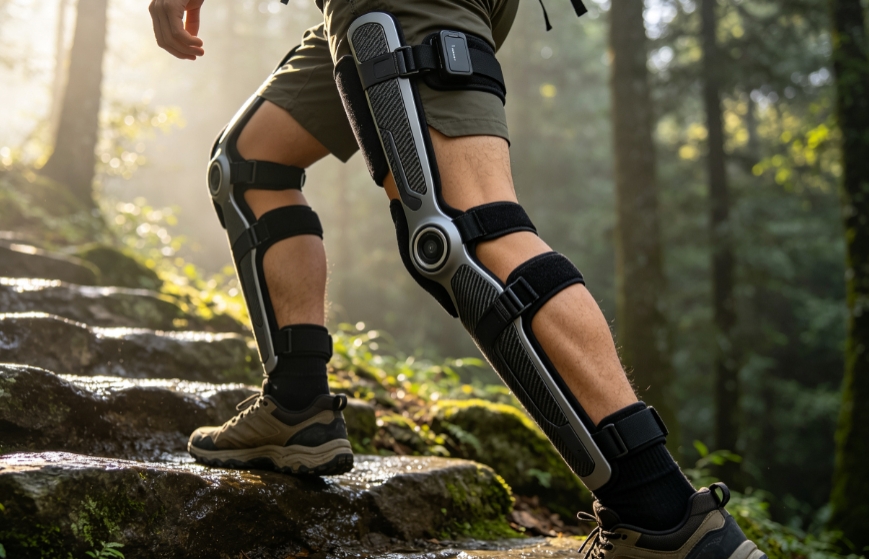
Lightweight outdoor assistive exoskeletons fall into the category of consumer-grade sports-assistive hardware. Positioned for outdoor fitness, hiking, mountaineering, and reducing physical strain during long-distance walking, they are not classified as medical devices and are not intended for treating medical conditions. Their core objectives are to alleviate the load on lower-limb muscles and knee joints and to extend the duration of outdoor activities, while simultaneously generating biomechanical data—thereby establishing a new branch of AI-powered smart fitness hardware. Key Product Features:
- Lightweight Design: The unit weighs between 1.6 kg and 3 kg; extensive use of carbon fiber and titanium alloy composites eliminates the need for heavy metal frames.
- AI-Driven: Features multi-sensor fusion capable of recognizing flat terrain, uphill/downhill slopes, and cycling gaits within milliseconds. It anticipates user movement intent and dynamically adjusts assistance torque to prevent conflict between the machine and the user’s natural movement.
- Wearability: Equipped with quick-release straps, allowing the device to be put on or taken off in 30–180 seconds and stowed in a backpack.
- Outdoor Adaptability: Dust- and splash-resistant with a battery life of 4–6 hours, supporting long-distance hiking.
- Data-Driven Fitness: Collects data on gait, joint stress, and muscle work output to generate exercise analysis reports; integrates seamlessly with smart fitness equipment ecosystems.
Representative products: Hypershell X Series, Aoshar Smart Mecha Hiking Exoskeleton, Toread Crest C3, Haier W3, Kunwei Technology HiiBex prototype, Youlong Series, etc.
II. Drivers of Industry Development
1. Breakthroughs in Domestic Component Localization Enable Lightweight Design
Domestic supply chains for harmonic reducers, frameless servo motors, IMU attitude sensors, and 6-axis torque sensors have matured. Component costs have dropped by approximately 60% compared to early stages, laying the foundation for reducing both the weight and cost of the complete unit.
Upstream sensor manufacturers—exemplified by Kunwei Technology—have adapted industrial-grade 6-axis force sensing technology for consumer prototypes, achieving high-precision force perception without relying on overseas imports; this serves as the underlying foundation for smooth human-machine collaboration in domestic AI exoskeletons. The widespread adoption of carbon fiber composites has reduced the total unit weight from over 10 kg in early models to the 2 kg range, resolving the historical pain point where the exoskeleton itself was too heavy and became a burden.
2. Policy Tailwinds for Outdoor Sports and Smart Fitness
The population participating in outdoor sports in China continues to grow, with mountain hiking, camping, and long-distance “City Walks” becoming mainstream forms of leisure and fitness. Industry plans encourage the development of smart sports equipment and outdoor sports destinations; new use cases like “mecha-style hiking” are being implemented, with scenic area rental models serving as a key commercialization pathway. Many domestic mountain scenic areas have already established rental stations for exoskeletons, lowering the barrier to entry for first-time users and fostering market awareness.
3. AI Algorithm Evolution: Solving the Biggest Pain Point in Human-Machine Collaboration
The major flaws of early exoskeletons included lag in assistance and jerky force application, resulting in the machine and the human body working against each other.
Current domestic products generally employ multi-sensor fusion combined with AI-based gait prediction models. They learn the user’s gait characteristics within seconds of being worn, automatically switch between assistance and damping modes based on terrain, and engage cushioning protection during descents. This eliminates the need for frequent manual gear changes, truly achieving “machine-follows-human” movement. Support for OTA (Over-the-Air) updates allows for continuous algorithm optimization, transforming the exoskeleton from a mere mechanical device into an AI-powered smart hardware product.
4. Capital and Diverse Players Enter the Market, Boosting Sector Momentum
Market players come from diverse backgrounds, forming four main camps:
- Robotics Startups (e.g., Jike Technology, Aoshar Intelligent, Youlong Robotics): Possess the strongest capabilities in robotics algorithms and full-system integration, and were the first to achieve mass production. Jike, for instance, has delivered 30,000 units globally to over 70 countries, serving as a benchmark for the commercialization of consumer exoskeletons.
- Upstream Component Manufacturers (e.g., Kunwei Technology): Entered the market leveraging expertise in sensors and motor technology; showcased prototypes at exhibitions. While they possess a strong technical foundation, they often lack experience in consumer-facing productization (e.g., HiiBex outdoor exoskeletons).
- Traditional Outdoor Brands (e.g., Toread): Leveraged existing outdoor sales channels and deep user insights to develop the “Crest C3.” They integrated online e-commerce with offline outdoor retail stores, capitalizing on their situational advantages.
- Major Home Appliance Manufacturers (e.g., Haier Smart Home W3): Benefit from significant advantages in supply chains and after-sales networks. Their products cater to both outdoor mobility assistance and daily travel for the elderly, featuring a lightweight design (1.75kg) and targeting the mass consumer market. ## III. Market Status and Commercialization Pathways
According to IDC data, the total domestic exoskeleton market size is projected to reach approximately RMB 1.6 billion by 2025. Within this, consumer-grade assistive exoskeletons account for 19,000 units—or 73% of total shipments—making them the fastest-growing segment; the average selling price is around RMB 5,800, with prices generally ranging from RMB 5,000 to RMB 16,000.
There are currently two main commercialization routes:
- B-to-B Rental-First Model: Scenic spots and outdoor campsites offer short-term rentals (ranging from tens to over a hundred yuan per session) to lower the barrier to entry for users. Companies like Aoshea and Toread have already launched pilot programs at various mountainous scenic areas. While this model is effective for market education, profitability is heavily influenced by visitor traffic and equipment wear and tear.
- C-to-B Direct Retail: Sales via e-commerce platforms, targeting outdoor enthusiasts and older adults with limited physical strength who engage in fitness activities. However, with price points in the RMB 10,000 range, these remain niche, high-end products with low mass-market penetration.
- Overseas Expansion: Domestic manufacturers export consumer exoskeletons to Europe and North America, where hiking culture is mature and consumers show a greater willingness to pay. Companies like Jieke (Jike Exoskeleton) derive a significant portion of their revenue from overseas markets, making this a crucial income stream at the current stage.
Summary of Industry Status: There are many prototypes but few mature, mass-produced products; B-to-B experiential models are leading the way while mass-market consumer adoption has yet to explode; overseas markets are currently ahead of the domestic market.
IV. Core Technical Barriers
- Balancing Lightweight Design with Structural Strength: The device must weigh around 2kg while ensuring structural integrity amidst the rugged terrain of mountain climbing. It must also incorporate ergonomic design to prevent chafing or pinching during prolonged wear; balancing rigid structural components with the natural range of motion of the human body presents an inherent conflict.
- AI-Based Motion Intent Recognition and Force Control Algorithms: Algorithms must adapt to users with varying heights, stride lengths, and exertion habits, as well as diverse terrains such as uphill, downhill, and loose-gravel paths. Downhill cushioning and protection are widely recognized as industry challenges; if algorithms are poorly executed, they can actually increase the strain on the user’s knees. Sensor sampling rates and torque response latency are critical factors that directly determine the quality of the user experience. 3. The Trilemma of Range, Weight, and Assist Torque: A larger battery extends range but increases the unit’s total weight; conversely, reducing weight sacrifices battery capacity and motor torque. It is difficult to maximize all three simultaneously.
- Consumer-Grade Reliability: Outdoor environments expose devices to rain, dust, and physical impacts. Consumer products must achieve IP ratings and impact resistance while keeping costs down—a critical hurdle in transitioning from laboratory prototypes to mass-produced goods. Prototypes like the Kunwei HiiBex have not yet publicly disclosed reliability metrics such as IP ratings, illustrating a typical limitation of the prototype stage.
V. Existing Industry Pain Points and Challenges
1. Product Differentiation: Many Prototypes, Few Mature Mass-Produced Products
Many products showcased at exhibitions—such as the Kunwei HiiBex—are merely technical prototypes; they lack mass production plans, pricing, or launch schedules. While many prototypes boast impressive hardware specifications, they often lack validation through real-world outdoor testing over tens of kilometers. Furthermore, their software ecosystems are incomplete, with motion data tracking and mobile app functionalities not yet fully realized. There are very few domestically produced consumer outdoor exoskeletons that have achieved stable, large-scale mass production.
2. High Price Barrier
Mainstream mass-produced products range from 5,000 to 16,000 RMB—a high price point compared to standard outdoor gear. For the average consumer, “load reduction for hiking and mountaineering” is a lifestyle enhancement rather than an essential need, limiting mass-market acceptance.
3. User Misconceptions
Many consumers equate outdoor assistive exoskeletons with medical rehabilitation equipment. However, these products are designed solely to reduce physical strain during activity and cannot treat joint injuries. Individuals with joint disorders should not use them without professional assessment, yet there is insufficient public education on this matter.
4. Underdeveloped Software Ecosystems
Currently, most products focus on hardware-based assistance, while AI-driven fitness ecosystems remain weak. Capabilities regarding motion data, training assessments, personalized fitness plans, and OTA algorithm updates vary significantly in quality. As AI-powered fitness hardware, the value of the software component has yet to be fully realized. ## VI. Future Development Trends
1. Price drops driving broader consumer adoption
As supply chains mature, mass-produced models priced between 3,000 and 5,000 RMB are expected to emerge within the next 3–5 years, helping the product transition from niche enthusiast circles to the general outdoor fitness community.
2. Enhanced AI fitness capabilities: From “assistive tool” to “AI sports coach”
Moving beyond simple mechanical assistance, these devices will deeply analyze exercise data—such as muscle load, joint stress, and gait irregularities—to provide fitness recommendations. Integration with fitness apps and sports watches will transform them into next-generation wearable fitness hardware, distinguishing them from mere robotic equipment.
3. Diversification of business models
Parallel development of scenic area rentals, outdoor campsite experiences, online retail, and overseas expansion; simultaneous exploration of B2B niche scenarios such as outdoor scientific expeditions and emergency rescue operations.
4. Further market differentiation among players
- Robotics startups capable of mass production will continue to lead the market;
- Component manufacturers (e.g., Kunwei Technology) will primarily act as technology suppliers or selectively launch small-batch flagship products;
- Traditional outdoor brands will leverage their channel advantages to focus on specific use cases and user engagement;
- Prototype products lacking mass-production capabilities will gradually be phased out of the market.
5. Iteration of materials and drive technologies
Flexible exoskeletons will emerge as a key trend, further minimizing the sensation of wearing a foreign object; improvements in battery energy density will help resolve the trade-off between battery life and weight.
VII. Conclusion
China’s lightweight outdoor assistive exoskeleton sector is at a critical turning point, transitioning from technical validation to commercialization. Domestic manufacturers have successfully moved beyond the “existence” phase, producing a range of prototypes with impressive specifications and a limited number of mass-produced models; advantages have already been established in AI force-control algorithms, lightweight carbon fiber technology, and local supply chains.
However, the industry is far from mature: prototypes do not equate to mass-produced products, specifications do not equate to the actual outdoor experience, and impressive technology does not equate to a mass-market necessity. The ultimate goal of this sector is not merely to build a lightweight assistive machine, but to create a complete ecosystem integrating hardware, AI algorithms, fitness software, and business models. Once product costs decrease further, AI fitness capabilities mature, and the market becomes sufficiently educated, lightweight exoskeletons are poised to become another major category of AI-powered fitness hardware, following in the footsteps of sports watches and smart fitness mirrors.
Leave a Reply