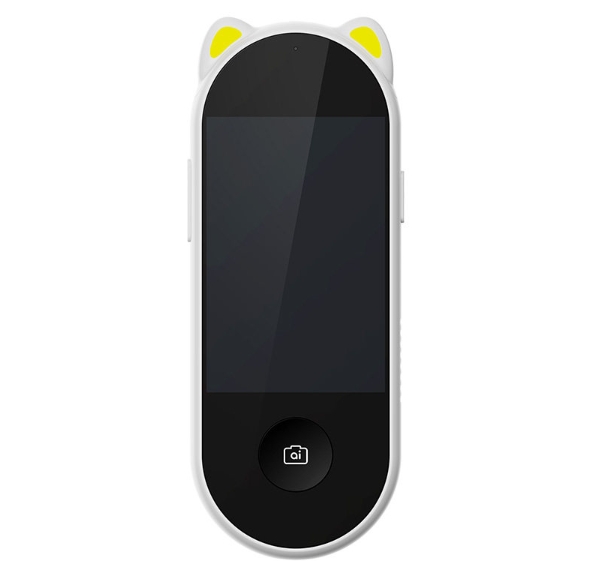
The market for smart hardware for children heats up every summer, with learning tablets, audio players, and smartwatches all vying for attention; however, there has been a lack of a lightweight, all-in-one device that combines outdoor exploration, homework assistance, early English learning, and a fun camera for kids. Skyworth recently launched its new AI “Snap-to-Learn” device. Powered by the Doubao large language model for children, it targets the 3–12 age demographic with a handheld, pocket-sized design that integrates object recognition, AI Q&A, and homework grading. Can a device priced in the 300-yuan range truly deliver such versatility? This article evaluates the product’s experience, strengths, and limitations through real-world testing across home, outdoor, and after-school study scenarios.
I. Design and Hardware: Cute pocket-sized form factor, designed for small hands
The Skyworth AI device features a vertical handheld body adorned with signature “cat-ear” accents and comes in white or yellow. Weighing just 110g, it is easy for children to hold with one hand; a lanyard is included, allowing it to be carried around or attached to the outside of a schoolbag.
Screen: A 3.3-inch eye-protection color touchscreen with 320×480 resolution and hardware-level low-blue-light tuning. Its smaller size compared to smartphones helps reduce eye strain from prolonged use. Peak brightness is 300 nits; while clear indoors, visibility is average under strong outdoor sunlight.
Camera: A dedicated shutter button sits in the center of the body, enabling one-touch activation without complex operations. It supports object recognition, question scanning, and image/text translation.
Battery Life & Charging: Equipped with a built-in 1000mAh lithium battery and a universal Type-C charging port. It lasts about a day with intermittent daily use, though continuous high-frequency photography or AI interaction requires recharging after roughly half a day.
Build Quality: Rounded edges with no sharp corners; the ABS casing withstands minor bumps. It is not waterproof, so care must be taken to avoid rain or water exposure during outdoor play.
Clear Positioning: Distinct from bulky large-screen learning tablets or single-function “point-and-read” pens, this device emphasizes portability, serving as both a learning tool and a fun camera for children. II. Hands-on Testing of Core Capabilities: Powered by the Doubao Children’s Model, Covering Four Key Scenarios
The product’s standout feature is its deep integration with the Doubao model specifically designed for children, combined with a content safety system for young users. It moves beyond the limitations of traditional hardware—which relies on pre-loaded audio and fixed question banks—to support open-ended Q&A.
- AI “Snap & Identify”: An Outdoor Exploration Classroom
When encountering plants, insects, buildings, or vehicles while out and about, users can simply take a photo to identify them. The screen displays the name, bilingual (Chinese-English) definitions, and extended educational facts.
Performance: High accuracy in identifying common flora and fauna, accompanied by child-friendly, accessible explanations; occasional errors occur with rare species. It is ideal for satisfying the curiosity of young children—answering their endless “whys”—and turning walks or field trips into real-world classrooms. - After-School Homework Support: Photo-based Search & Smart Grading
Covers all primary school subjects and supports image recognition for written exercises:
✅ Rapid grading (correct/incorrect) for mental math and multiple-choice questions;
✅ Step-by-step problem-solving logic and concept explanations for word problems;
✅ Recognition of Chinese characters, Chinese-English paragraph translation, and pronunciation practice for vocabulary.
Includes built-in mechanisms to discourage answer-copying by prioritizing the explanation of the thought process over simply providing the result; parents can control when the photo-search function is available to prevent children from simply copying answers. - Multi-Persona AI Voice Interaction: All-Day Companionship
Features multiple AI personas for children and supports continuous, multi-turn conversations: English situational practice, Q&A on traditional Chinese culture, storytelling, and emotional support. The synthesized voice is gentle and suited to children’s hearing preferences; all interactions are filtered to block inappropriate online content.
Free from complex games or short-video feeds; content focuses on early learning and development, minimizing the risk of addiction. - Creative Camera for Kids: Capturing Fun Moments
More than just a learning tool, it includes a dedicated camera mode with filters and fun special effects, allowing children to snap photos and document their daily lives. This camera feature significantly boosts the product’s appeal, making children more likely to use it voluntarily compared to dull, traditional “point-and-read” devices. Additional Practical Features
Includes smart posture reminders, bilingual picture book read-alouds, a vast library of traditional Chinese cultural content, and graded English audio resources. All features are available without requiring a separate subscription or ongoing fees—a distinct advantage over similar products.
III. Parental Control System
Paired with a dedicated Skyworth parental control mini-program, key management capabilities include:
Remotely setting usage schedules, including locking the device during class hours;
Toggling features like “snap-to-search” (for homework questions), the camera, and voice interaction;
Monitoring device usage duration and feature activity logs;
Customizing filters to block topics unsuitable for young children.
The control logic is intuitive and easy to understand, allowing even older family members to master it quickly.
IV. Objective Limitations (Key Considerations Before Buying)
This review remains neutral; please note the following clear shortcomings:
No independent cellular module: The device requires Wi-Fi and does not support 4G. Without Wi-Fi (e.g., when outdoors), AI Q&A and “snap-to-search” functions are unavailable; only locally stored audio can be accessed.
Small screen size: Viewing exercise explanations for extended periods can strain the eyes; it is better suited for short tutoring sessions and cannot replace a full-fledged dedicated learning tablet.
No built-in fill light: Recognition efficiency for homework questions or objects drops significantly in low-light conditions; use in well-lit environments is recommended.
No calling or GPS tracking functions: It cannot replace a children’s smartwatch or serve as a safety monitoring tool for the commute to and from school.
Limited storage: Large numbers of photos require periodic exporting, and the device does not support high-capacity memory card expansion.
V. Target Audience & Purchasing Recommendations
✅ Highly Recommended For:
Preschoolers and lower-elementary students (ages 3–10);
Families who enjoy outdoor trips or nature study and want a tool for real-world science education;
Those needing simple after-school homework help and English language introduction, with a budget of 300–400 RMB;
Parents who prefer not to give their child a smartphone but want a lightweight, portable learning device;
Those who dislike ongoing subscription fees for learning hardware and prefer a one-time purchase model. ❌ Not the best fit if:
You need to use AI features offline outdoors (where there is no Wi-Fi);
Your core requirements are precise positioning, two-way calling, and safety alerts;
The user is a middle school student needing in-depth tutoring for numerous exam papers and complex, long-form questions;
You hope a single device can replace a large-screen learning tablet for attending online classes over the long term.
Conclusion
The current market for portable learning hardware for children is polarized: high-priced learning tablets offer comprehensive features but lack portability, while “point-and-read” pens offer limited functionality and lack open-ended interaction.
The Skyworth AI “Snap-to-Learn” device strikes a middle ground: it leverages the Doubao large language model to address the lack of open-ended Q&A capabilities, integrates multiple functions—such as object recognition, problem scanning, and camera use—and lowers the barrier to entry with an accessible price point.
While it falls short of being an all-in-one learning terminal—due to limitations like network dependency and screen size—it offers excellent value as a supplementary tool for home-based study support and outdoor exploratory learning. If you already own a children’s smartwatch and want to add a lightweight, engaging portable learning device, this product is worth considering; however, if you require all-day offline functionality and in-depth academic tutoring, it is best used in conjunction with a large-screen learning device.
Leave a Reply