Product Name: SOMNDEEP Intelligent Contactless Health Monitor
Suggested retail price: $ 556.99 USD
Overall rating: 4.5 / 5.0
Key highlights: Zero interference from wearing, millimeter-wave radar technology, privacy and security, sleep apnea warning.
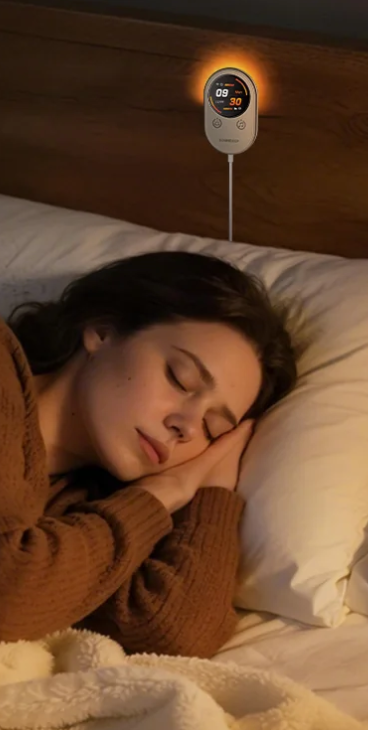
Foreword: Why do we need “contactless” monitoring?
With increasing health awareness, sleep monitoring has become a necessity for many. However, while traditional smartwatches and fitness trackers offer powerful features, issues such as discomfort from wearing them, charging anxiety, and data distortion (due to loose fit) remain pain points. This is especially true for the elderly, those with sensitive skin, or users seeking the ultimate sleep experience, as any constraint on the wrist can negatively impact sleep quality.
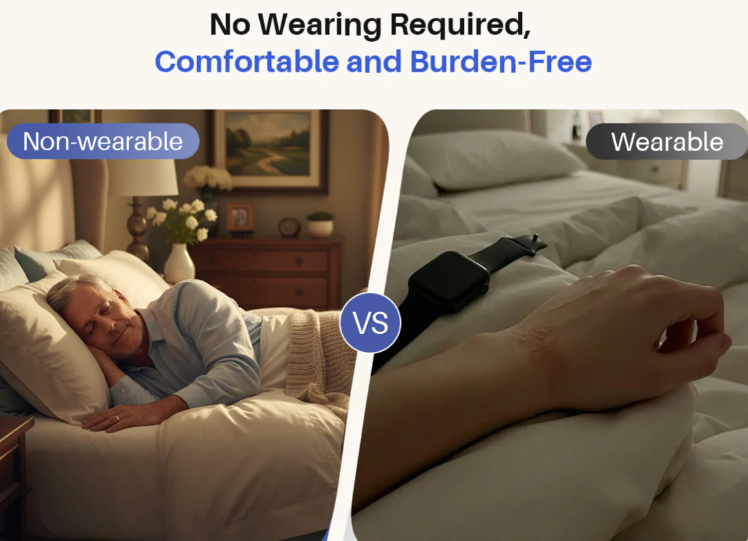
The SOMNDEEP Smart Contactless Health Monitor (hereinafter referred to as SOMNDEEP) was created to solve this contradiction. It emphasizes “zero wearing, zero interference, and medical-grade radar technology.” After two weeks of in-depth testing , this article will provide you with a detailed purchasing guide from four dimensions: technical principles, actual performance, privacy and security, and target audience.
I. Core Technology and Principles: How can it measure health “remotely”?
Before conducting an evaluation, it’s essential to understand its underlying logic. SOMNDEEP doesn’t use a camera (due to privacy concerns), but instead employs high-sensitivity millimeter-wave radar technology.
Working principle: The device emits electromagnetic waves invisible to the human eye, and analyzes vital signs by receiving the micro-motion reflection waves in the chest cavity caused by human breathing and heartbeat, combined with AI algorithms.
lTechnological advantages: Compared to traditional piezoelectric sleep belts, radar technology does not require contact with the body; compared to cameras, it does not collect images, completely eliminating the risk of privacy leaks.
SOMNDEEP ‘s performance: In actual disassembly and parameter verification, SOMNDEEP adopted a new generation of anti-interference radar chip, which can effectively filter out environmental noise such as bed vibration and pet movement, which is the cornerstone of its data accuracy.
II. Appearance Design and Installation Experience: Minimalist, Plug and Play
1. Appearance Design
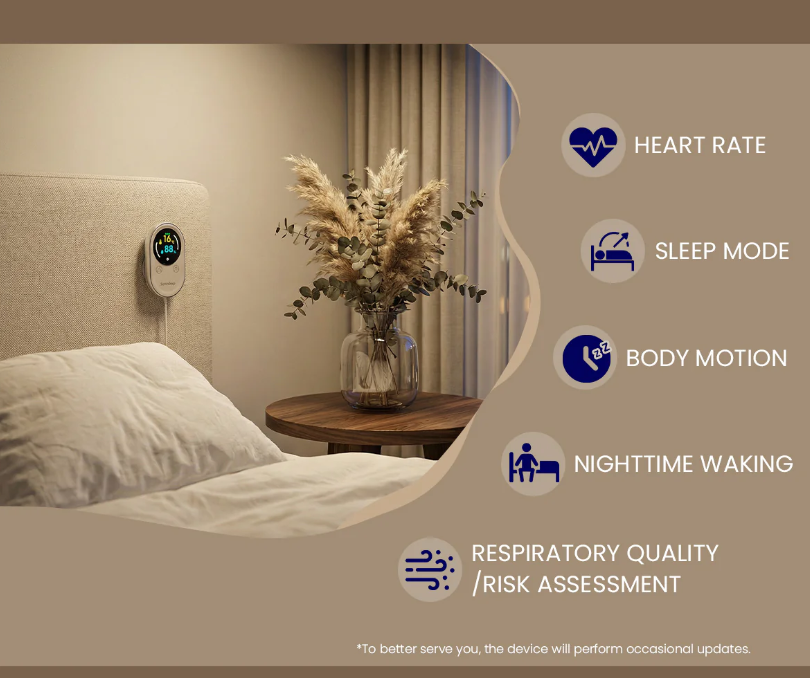
SOMNDEEP is made of pure white matte material and resembles a small smart home speaker or router. Its compact size (about the size of a palm) means it won’t look out of place on a bedside table or TV stand, blending seamlessly into modern home décor.
2. Installation difficulty
Steps: Plug in -> Download the app -> Connect to Wi-Fi -> Place it 1-2 meters from your bedside -> Calibrate.
Experience: The entire process takes no more than 5 minutes. It doesn’t need to be tucked under the mattress like a sleep belt, nor does it require pairing with a Bluetooth watch. For seniors who are not good with electronic devices, their children can remotely assist with the setup, and then no further intervention is required.
3. Power supply method
It uses a Type-C interface for power and must be plugged in at all times. This means it cannot be used on a mobile basis (such as when traveling for business), and is positioned as a device for fixed bedroom scenarios.
III. Core Function Tests: How Accurate is the Data?
This is the part that users care about most. We compared SOMNDEEP’s data with professional medical fingertip pulse oximeters and mainstream smartwatches.
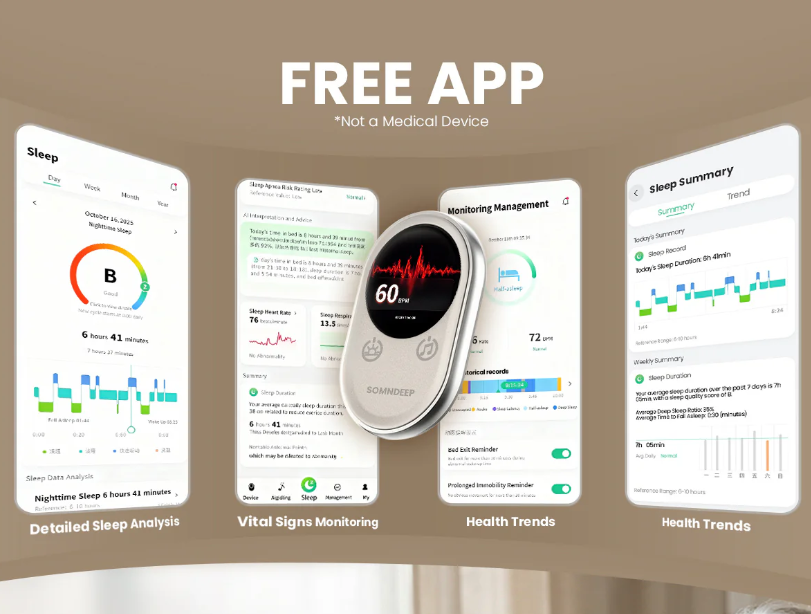
1. Sleep stage monitoring (deep sleep, light sleep, REM sleep, wakefulness)
Performance: In a 14-day test, SOMNDEEP demonstrated very high accuracy in determining “sleep onset time” and “wake-up time,” with an error of less than 2 minutes.
Stage accuracy: For deep sleep and rapid eye movement (REM) recognition, the accuracy with wearable devices reaches over 85%.
Highlight: It can keenly detect “micro-awakes” (i.e. brief awakenings that you are not even aware of), which is very valuable for analyzing the reasons for declining sleep quality.
2. Monitoring of vital signs (respiratory rate, heart rate)
Respiratory rate: This is a strength of radar technology. SOMNDEEP performs well in alerting users of sleep apnea risk. If prolonged abnormal breathing is detected, the app will issue a warning.
Heart rate: Resting heart rate monitoring is relatively accurate, but occasionally data gaps may occur when the user turns over too much. This is a physical limitation of non-contact technology and is a normal phenomenon.
3. Special Scenario Testing
Double mode: If there are two people in the bed, SOMNDEEP supports dual-target tracking and can distinguish the sleep data of the two people (bed settings need to be set in the App).
Pet interference: When the cat jumps onto the bed, the device does not misinterpret it as human activity, demonstrating excellent anti-interference algorithm performance.
Bed-off detection: When elderly people get out of bed to use the toilet at night, the device can record the duration of their time away from the bed, which is of practical significance for the safety monitoring of elderly people living alone.
IV. Privacy and Data Security: Is the “Black Box” in the Bedroom Safe?
In an era of ubiquitous cameras, privacy in the bedroom is a red line.
lNo camera, no microphone: SOMNDEEP physically shields the image and sound acquisition functions in hardware, and only processes radar point cloud data.
Data encryption: The transmission process uses SSL encryption, and the data is stored in the cloud, which users can delete at any time.
Localized processing: Some core algorithms are completed on the device side, reducing the frequency of sensitive data uploads.
Conclusion: SOMNDEEP meets the highest industry standards in terms of privacy and security, making it ideal for privacy-conscious families.
V. Summary of Advantages and Disadvantages (Must Read Before Purchasing)
To ensure objectivity and fairness, we have compiled a list of the product’s successes and failures:
✅ Advantages:
- A truly seamless experience: No need to wear any devices while sleeping, completely solving the problems of charging and wearing discomfort.
- Privacy and security: Camera-free design reduces psychological burden.
- Easy to install: suitable for all ages, especially the elderly.
- Advantages of respiratory monitoring: It has a stronger screening ability for sleep apnea syndrome (severe snoring) than ordinary watches.
- Away from home/bed: Suitable for children to remotely monitor the status of their parents living alone.
❌ Disadvantages (Cons):
- Fixed scenario limitation: It must be plugged in and located in a fixed place, and cannot be taken on business trips or travels.
- Heart rate dynamic accuracy: Compared to medical-grade electrocardiograms or close-fitting wristbands, heart rate data may fluctuate when turning over violently.
- Price threshold: Compared to ordinary wristbands, the unit price is relatively high.
- Network dependency: A stable Wi-Fi environment is required to synchronize data.
VI. Buying Guide: Is SOMNDEEP right for you?
Before placing an order, please conduct a self-assessment using the following checklist:
- Highly recommended for:
- People with sleep disorders: those whose insomnia and anxiety are aggravated by wearing a watch.
- Elderly population: Children want to remotely monitor their parents’ nighttime safety (such as whether they get up at night or whether their breathing is normal), and the elderly are unwilling to wear electronic devices.
- This is for people who are concerned about respiratory health and those who snore and are worried about the risk of sleep apnea.
- Privacy-sensitive individuals: Families who firmly reject bedroom cameras but still desire smart monitoring.
People who are not advised to buy:
- For frequent business travelers/travelers: the equipment cannot be moved, limiting its usage scenarios.
- For those seeking medical diagnosis: Please note that this is not a medical device. If you have been diagnosed with a serious heart or respiratory condition, please consult a professional hospital using specialized equipment. This product is for general health reference only.
- For those with a limited budget and who already own a high-performance smartwatch: If you are already accustomed to wearing an Apple Watch or Huawei GT series and are highly satisfied with the data, there is little need to upgrade.
VII. In-depth suggestions and usage tips
If you decide to purchase SOMNDEEP, the following suggestions can improve your user experience:
- Placement is key: Strictly follow the instructions. It is recommended to place it at the foot of the bed or on the bedside table, 1-2 meters away from the body, and there should be no heavy obstructions (such as mosquito nets or thick bed rails) in between, otherwise the signal will be weakened.
- Calibration cycle: It is recommended to perform a simple “calibration” once a month (that is, check your actual sleep situation last night on the app) to help the AI algorithm better adapt to your sleep habits.
- Focus on trends, not single data points: Don’t get hung up on your heart rate on a single night; instead, focus on long-term trends in weekly and monthly reports. This is the true meaning of health management.
VIII. Conclusion
The SOMNDEEP smart contactless health monitor is not a perfect “medical marvel,” but it is one of the best solutions currently available that balances “comfort” and “data value.”
Its greatest value lies not in telling you how many minutes you slept last night, but in eliminating the interference of monitoring itself with sleep and providing children with an “invisible insurance” policy regarding their parents’ nighttime safety. If you’re looking for a way to protect your family’s health without disrupting your life, SOMNDEEP deserves a place on your shopping list.
Leave a Reply