According to reports, Mercedes-Benz China is implementing a new round of structural layoffs, aiming to reduce the number of employees at Beijing Mercedes-Benz Sales and Service Co., Ltd. from approximately 900 to less than 600. This is the second large-scale personnel reduction by Mercedes-Benz China in less than a year and a half, following the first round of layoffs in February last year.
Mercedes-Benz
Multiple sources familiar with the matter have revealed that this round of adjustments is not limited to the sales and service company. Since 2025, personnel adjustments within Mercedes-Benz’s China system have been occurring across various departments, including automotive finance, sales, IT, and R&D and manufacturing. These adjustments are distributed across different business entities and employment relationships, and the compensation standards are not uniform. The R&D system is one of the key departments targeted for staff reduction. Public information shows that Mercedes-Benz’s R&D centers in China are mainly located in Beijing and Shanghai, with approximately 2,000 R&D personnel covering multiple areas such as local model development, intelligent technology, electrification, software, and in-vehicle systems.
However, this round of layoffs failed to stem the company’s continued decline, forcing it to initiate two more rounds of layoffs this year: one currently underway with a 10% reduction, and the other to begin at the end of the year. The goal is to reduce the number of employees at Mercedes-Benz Sales Company from over 900 to just over 600 after these two rounds.
Besides layoffs, Mercedes-Benz China is also experiencing a deep organizational upheaval. On May 25th, the head of Mercedes-Benz Sales Company’s North China region resigned after a company-wide meeting, and the following day, a company-wide email announced that he would no longer serve as the general manager of the North China region.
It is understood that Mercedes-Benz’s R&D system is expected to lay off 10% of its staff this year. This figure has not yet been officially confirmed by Mercedes-Benz China.
Two months ago, the vice president in charge of after-sales service also suddenly resigned. Even earlier, Duan Jianjun, Mercedes-Benz China’s first Chinese CEO, resigned in March of this year, and was succeeded by Li Desi, the executive vice president of sales. Within just a few months, there has been a flurry of changes in the core management team, from CEO to regional heads to vice presidents.
Spirit AI’s current Chief Scientist, responsible for the Embodied Intelligence Model, is reportedly leaving the company. Just six months ago, another Chief Scientist, Jie Junyuan, also known as the Chief Scientist, resigned. This means Spirit AI has lost two Chief Scientists within a short period.
Following Jie Junyuan’s departure, Spirit AI recruited a VP from Huawei as Chief Scientist. This VP, who had only been with the leading company for a little over six months, left due to disagreements over technical direction and internal management practices.
Spirit AI’s valuation has reached tens of billions of dollars, and it has raised billions of dollars in funding rounds. However, its approach to talent management is controversial within the tech community. Not only is there high turnover in the technical team, but even HR personnel change frequently, with both recruiters and hires changing rapidly.
Spirit AI is known in the industry for its strict probationary period policy. When recruiting algorithm model engineers, a certain percentage of them are dismissed when it comes time to become permanent employees. This is extremely unfriendly to engineers, who have turned down other job offers to join the company. If they’re held up during their probationary period and not offered permanent positions, the losses are significant. This leading company’s approach clearly shifts the burden of trial-and-error costs onto employees while minimizing its own. This leads to disguised employee dismissal and probationary period freezes.
In the AI era, talent is the most crucial factor for success. Building a capable and cohesive technical team is a key advantage in the fiercely competitive environment.
Therefore, startups, while busy showcasing “globally leading” demos and fundraising scale, should also consider their talent strategies: how to effectively recruit top talent and how to ensure their employees are happy and satisfied with their work. These are crucial factors in determining the outcome of future intense competition.
Sources familiar with the matter revealed that SenseAuto expects to lay off more than 200 employees, bringing the company’s total workforce to over 400. The layoffs will affect departments including algorithm engineering and software.
SENSEAUTO
This restructuring by SenseTime’s SenseAuto division is a microcosm of the increasingly competitive landscape of intelligent driving. Following the layoffs, the workload for remaining employees will increase significantly, posing a considerable challenge to ensuring mass production and delivery of projects to automotive clients.
Over the past two to three years, SenseTime’s SenseAuto has aligned its intelligent driving solutions and technologies with industry changes.
In terms of solutions, SenseTime SenseAuto has launched three solutions: AD Pro, based on the Horizon J6E with 80T computing power; AD Max, based on the Horizon J6M with 128T computing power; and AD Ultra, based on Orin/Thor with 200T+ computing power. These three solutions represent the most mainstream demands from automotive companies over the past two years and represent the largest volume of demand in the industry.
Technically, SenseTime’s SenseAuto platform released a world model back in November 2024, placing it among the earlier companies in the intelligent driving industry to release cutting-edge technology.
Whether in terms of intelligent driving solutions or technology, SenseTime’s SenseAuto demonstrates strong foresight and strategic planning. However, compared to leading companies, it has secured relatively few targeted projects, the reasons for which are complex.
It is understood that SenseTime’s SenseAuto is in talks with Dongfeng Motor for strategic investment, which presents a good opportunity for the company. Strategic investment from automakers not only means money but also targeted projects and deep collaboration.
Informed sources revealed that this investment may be cancelled or significantly reduced.
However, at a crucial juncture in the 2025 intelligent driving competition, SenseTime’s SenseAuto Chairman Wang Xiaogang co-founded Daxiao Robotics with Academician Tao Dacheng of the Australian Academy of Science in the second half of 2025.
Both highly competitive sectors require core operators to go all in. For Wang Xiaogang, as the core operator, managing both the highly competitive intelligent driving sector and embodied robotics effectively is a significant challenge.
If you still think pet smart hardware means automatic feeders and GPS collars, you have probably missed the hottest track of 2026.
Traini’s cognitive smart collar just secured backing from executives at NVIDIA, Google, and Meta. PettiChat blew past 770% of its Kickstarter goal. MOVA Pets closed a Series A round and now clears millions in monthly GMV. Meanwhile, domestic players like PurrPurr, SATELLAI, and Loona have all raised fresh capital this year. Investors are voting with their wallets faster than a dog can wag its tail.
Auren AI wearable captures pet life from first-person view
The global pet tech market is projected to hit $14.1–20 billion in 2026, yet AI penetration sits at just 8–12%. Translation? This is a massively under-tapped growth market, and AI is the key.
But here is the catch: most AI pet products on the market today are stuck in “incremental upgrade” mode—slapping behavior recognition onto GPS, adding cameras to feeders, or bolting heart-rate monitors onto collars. These features are useful, but they are not exciting. They solve labor-replacement needs like monitoring and feeding, not the harder question: what is my pet actually thinking?
Auren shows up with a fundamentally different answer.
Auren’s Play: Do Not Translate, Just Record
Auren’s first product is a 50g AI-native wearable. Its core innovation is not translating barks into human language. Instead, it records the world from the pet’s first-person perspective.
The scenes your pet sees, the sounds it hears, the routes it runs—all captured 24/7. Then AI steps in, sifting through the ocean of data to curate the “top 1% highlight moments” and behavioral anomalies into a “digital life archive” that owners can read, share, and revisit.
This logic is completely different from Traini’s “emotion translation.” Traini tries to decode pet “language”—analyzing vocalizations, expressions, and behaviors to output “your dog is anxious right now.” Auren chooses a dumber but perhaps more honest path: do not guess emotions, just present facts. It lets owners see “what my dog saw, heard, and visited today,” then leaves the emotional connection to them.
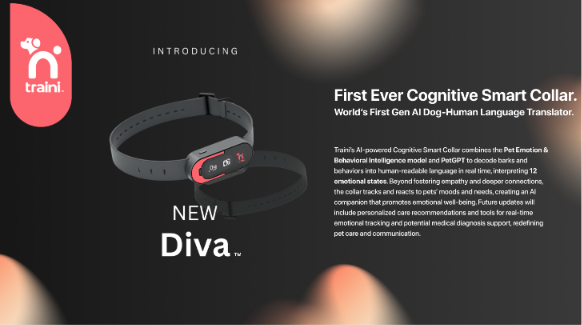
Traini cognitive collar translates dog emotions in real time
It is basically a GoPro meets a diary, except the protagonist is your pet.
Why “Recording” Might Be More Reliable Than “Translation”
Traini’s PEBI system claims 94% emotion-translation accuracy across nearly 120 dog breeds, with models trained on over 900 research papers and behavioral data from 2 million dogs. The numbers look great, but there is a fundamental problem: can an algorithm really translate pet emotions accurately?
A wagging tail does not always mean happiness. A cat rubbing against your leg does not always mean affection. Animal behavior is inherently uncertain, and feeding that behavioral data into an AI to output “your pet is currently at anxiety level 3” is a translation whose reliability remains questionable.
Auren’s strategy is clever—it sidesteps this minefield entirely. No emotion translation, just factual recording. Owners see the world from their pet’s perspective and judge for themselves: “my dog looked pretty happy today” or “it seemed nervous about that sound.” AI here plays curator, not translator.
This design also carries a hidden advantage: privacy. Traini’s collar continuously uploads audio, heart rate, and temperature data to the cloud for analysis. Auren’s first-person video raises privacy concerns too, but at least it does not perform “emotion diagnosis” or make conclusions on the owner’s behalf. The data-use boundary is relatively clearer.
The Competitive Landscape: Two Routes Colliding
The AI pet hardware track has split into two distinct camps.
Camp One: Incremental Upgrades. MOVA Pets’ LB10 Prime smart litter box (monitoring bathroom frequency and weight changes) and SureTrack Pro tracking collar (two-way voice plus multi-layer positioning) fall here. They add AI to mature categories, solving “how to take care of pets more conveniently.”
Camp Two: Category Creation. Traini (emotion translation), PettiChat (two-way dialogue translation), and Auren (first-person life archive) belong here. They attempt to invent entirely new product categories, solving “how to understand my pet better.”
Neither route is inherently superior, but the category-creation camp carries both higher risk and higher upside. Traini must prove its 94% accuracy is not just a lab number. PettiChat must prove two-way translation is not a pseudo-demand. Auren must prove owners will actually spend ten minutes a day watching their pet’s “vlog.”
PettiChat two-way translator device for cats and dogs
Commercialization Challenges: From Cool to Essential
Auren’s “digital life archive” concept is romantic, but commercial reality is brutal.
First, hardware cost. A 50g device running 24/7 video recording, audio capture, GPS tracking, and on-device AI filtering faces a brutal trade-off between battery life and compute power. If it needs daily charging, user compliance will crater.
Second, content value. Will AI-curated “top 1% highlight moments” actually move owners? If the curated clips are mostly “my dog sniffed a fire hydrant,” how long does novelty last? This is fundamentally a content-recommendation algorithm problem, and “surprise factor” is the hardest metric to quantify.
Third, pricing. PettiChat’s crowdfunding starts around $120, and Traini’s collar targets a similar range. If Auren lands in the $150–$200 bracket, it faces a market of “people who own pets” rather than “people who spend heavily on pets.” The latter group is much smaller.
Conclusion: The Battle for Emotional Premium in AI Pet Tech
Auren, Traini, and PettiChat are all fundamentally doing the same thing: redefining pets from “property” to “family members,” then charging an emotional premium for that new definition.
This logic has been validated countless times in the pet economy—from natural pet food to pet insurance, from pet funeral services to pet psychological counseling. “Anthropomorphization” is the most valuable narrative in this industry. AI simply pushes that narrative into the technical layer.
Can Auren’s 50g camera truly understand pets? Probably not. But it at least offers a new possibility: letting owners “see” the world through their pet’s eyes, instead of forever guessing what they think from a human perspective.
In that sense, Auren is not selling hardware. It is selling an “empathy illusion”—and in the pet economy, that illusion may be worth more than any technology.
This analysis is based on publicly available product information and industry data. AICrunchX will continue tracking developments in the AI pet tech sector.