Home

  • DJI Osmo Pocket 4 : It’s Finally Here After Such A long Wait

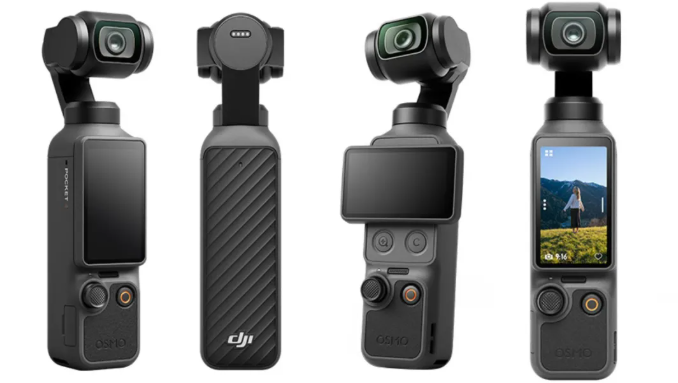
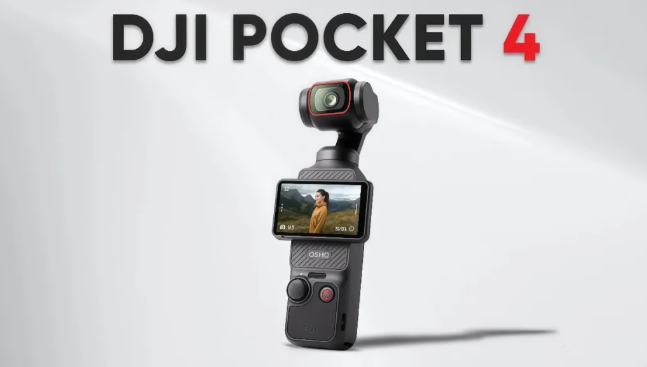
    DJI Osmo Pocket 4 product view
    DJI Osmo Pocket 4 product view

    After a long wait by global consumers, DJI has finally released the Osmo Pocket 4 !

    DJI will officially release the Osmo Pocket 4 at 8:00 PM on April 16, 2026. With the slogan “A myriad of images in an inch, light and shadow on the go,” this pocket gimbal camera, which has been iterated after two and a half years, once again pushes the balance between “portability” and “professionalism” to a new level.

    consumers who are holding off on buying , piling up specifications is not the end goal. The real “decisive moment” lies in how to transform paper data into actual productivity and how to combine accessories to build an efficient workflow .

    aicrunchx will provide you with an objective and practical product preview guide, starting from core performance, storage architecture, control ecosystem, and version differences. Once the product is officially released, we will purchase it and conduct a review as soon as possible .

    I. Image Quality and Optical System: The Synergy Between a 1-inch Sensor and Hardware-Level 2x Zoom

    The most fundamental upgrade in the Pocket 4 is the replacement of the sensor with a 1-inch image sensor. The increased light intake per pixel, combined with 14 stops of dynamic range, significantly improves detail retention in backlit, nighttime, and high-contrast scenes. Optimized shadow clarity and highlight suppression mean that the output images have high commercial delivery potential. For users with post-processing needs, the new 10-bit D-Log color mode (different from the previous generation’s D-Log M) offers wider color gradation latitude, and 1.07 billion color depth makes sky gradients and skin tone transitions smoother, greatly reducing the risk of color banding when applying LUTs or manually adjusting colors.

    On the optical level, the all-new hardware-level 2x lossless zoom is an unmissable highlight. Compared to digital cropping, this feature uses sensor area reading and lens optical axis coordination to magnify the image without sacrificing resolution. Combined with a three-axis mechanical stabilization system (not the previously rumored four-axis magnetic levitation), the gimbal provides more precise smooth compensation during zooming, resulting in images free of breathing or tearing. In everyday composition, 2x zoom allows for quick switching between portrait close-ups and environmental details, reducing the risk of continuity errors caused by frequent movement, making it extremely user-friendly for solo vloggers.

    II. High Frame Rate and Cropping: The Practical Boundaries of 4K/240fps

    Slow-motion performance is doubled to 4K/240fps, stretching dynamic moments nearly 10 times, making it ideal for capturing action, pet interactions, or fluid effects. However, it’s important to note that this mode introduces approximately 1.2 times image cropping. This is not a design compromise, but rather an engineering optimization to ensure sensor data throughput, heat dissipation control, and image stabilization processing power at high frame rates.

    In actual shooting, a 1.2x crop is only equivalent to a slight extension of the focal length. It is recommended to leave about 15% of the ambient space when composing the shot, and then crop it again in post-processing to perfectly restore the original image. If a full wide-angle view is required, 4K/120fps or 4K/60fps modes remain the primary formats, and the image quality is still maintained at 10-bit full sampling level. Treating 240fps as an “emotional embellishment” rather than a daily recording format will maximize its creative value.

    III. Storage Architecture Restructuring: Workflow Transformation with 107GB Built-in Flash Memory

    Eliminating the traditional MicroSD card slot and featuring 107GB of high-speed internal storage as standard is the most revolutionary design of the Pocket 4. Read and write speeds of 800MB/s exponentially improve the efficiency of media export: via USB-C direct connection to a computer or mobile phone, tens of gigabytes of 4K Log footage can be transferred in under a minute, significantly reducing post-production waiting time during outdoor shooting. The card-free design also eliminates memory card compatibility issues and the risk of media loss due to physical damage, resulting in higher system stability.

    New habits need to be established for capacity management. 107GB can support a day’s high-intensity creative work under normal 4K/30fps recording, but if 4K/240fps or 10-bit Log is frequently used, the capacity will be consumed significantly faster. It is recommended to develop a light workflow of “shooting and archiving on the same day” and backing up regularly with a high-speed NVMe external hard drive or NAS. If an official docking station or Pro version is released in the future, the capacity anxiety of heavy users will be further alleviated.

    IV. Tracking, Reception, and Control: The Leap from “Usable” to “Effective”

    At the algorithm level, the intelligent tracking feature has been upgraded to version 7.0, integrating an independent intelligent focus module, which significantly improves the recognition accuracy and focus smoothness for faces, pets, and irregularly moving objects. When the subject is briefly obscured or turns rapidly, the coordinated response of the gimbal and focus system is more decisive, significantly reducing the rate of unusable shots.

    In terms of audio, the four-channel Osmo Audio microphone matrix achieves 360° ambient sound field acquisition, with wind noise suppression algorithms and human voice enhancement frequency bands optimized simultaneously. The physical controls have also been redesigned: a new independent zoom lever and a customizable C button have been added. The probability of accidental touches during two-finger pinch zoom is reduced to zero, and the C button can be used to switch frame rates, activate slow motion, or bind frequently used filters, improving blind operation efficiency. The 1545mAh battery, after power consumption optimization, offers a combined battery life exceeding 200 minutes. The Wi-Fi 6 protocol results in lower latency for mobile app monitoring, stronger anti-interference capabilities for image transmission, and a more stable experience for multi-camera collaboration or remote control.
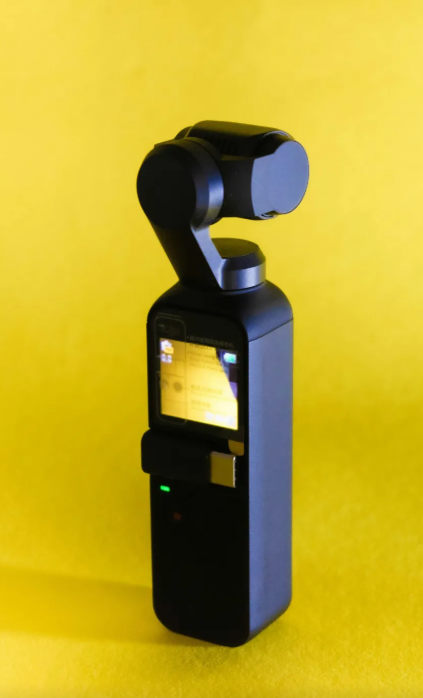
    The leap from usable to truly usable
    The leap from usable to truly usable

    V. Version Selection and Price Prediction: Standard Edition vs. All-in-One Set

    Based on DJI’s product line pricing logic and imaging market trends, the Pocket 4 is expected to continue with a dual-version strategy:

    • Standard version : Includes the main unit, charging case, and basic adapter. Suitable for existing DJI Mic series microphones and tripods, or for users who simply need a lightweight upgrade. Estimated price: $499–$549 USD .
    • The Creator Combo adds a wireless lavalier microphone, wide-angle/telephoto adapter lenses, a multi-functional carrying case, spare batteries, and a fast-charging cable to the standard version. It allows you to build a complete vlog workflow right out of the box, eliminating the hidden costs of purchasing items separately later. Estimated price: $699–$749 USD .

    If the shooting scenario involves outdoor interviews, long-term follow-up shooting, or has strict requirements for sound recording/protection, the all-in-one kit offers better overall value; if it is only used for daily recording and a mature audio solution is already available, the standard version can still deliver core performance when paired with third-party accessories.

    VI. Purchase Decision Recommendations

    • Highly recommended for : Vloggers, travel photographers, short video creators, and pet/sports enthusiasts. 1-inch screen, 200 minutes of battery life, and four-channel audio recording precisely address the core pain points of mobile video.
    • It’s advisable to wait and see : This is suitable for users who only want to take casual family photos and don’t need post-processing color correction. The performance of the Pocket 4 is somewhat excessive; older models or entry-level mirrorless cameras may offer better value for money.
    • Not suitable for : Professional film and television teams that need to shoot RAW video, use interchangeable lenses, or work in extremely harsh environments. The Pocket series is always positioned as an “efficient portable recording tool,” not a replacement for a main unit.

    Conclusion
    DJI Pocket 4 Login Instantly
    DJI Pocket 4 Login Instantly

    The Osmo Pocket 4 is not simply an iteration of stacked parameters, but a systematic reconstruction centered around the “on-the-go creation” scenario. From the 1-inch sensor to 107GB high-speed flash memory, from 2x hardware zoom to Smart Follow 7.0, every upgrade directly addresses the pain points in real workflows.

    After its official release on April 16th, aicrunchx will bring you an in-depth review as soon as possible. At that time, readers are welcome to refer to the actual test results to confirm whether the firmware stability and the color calibration of the output meet their personal aesthetics, and then make a choice based on their budget and accessory ecosystem.

    The essence of video creation is capturing moments, and the significance of Pocket 4 is to make every press of the record button easier and more reliable.


  • Nike “Recovery Sleep-Sock” Venous Compression Stockings

    NIKE
    NIKE

    Aicrunchx has learned that this week, Nike’s Technology Innovation Lab (NSRL) officially launched a new type of compression sock called “Recovery Sleep-Sock”.

    The “Recovery Sleep-Sock” is not a traditional sports accessory, but a set of “smart hardware” that incorporates flexible sensing, gradient compression algorithms, and IoT connectivity.

    In today’s era of rapid advancements in AIoT and biosensing, Nike is attempting to enter the AI sleep race with a pair of socks.

    But can the “Recovery Sleep-Sock” truly help Nike reap the rewards of the AI sleep market?

    As long as you have a body, you are an athlete.
    As long as you have a body, you are an athlete.

    Figure 1: As long as you have a body, you are an athlete.

    Aicrunchx believes that the breakthrough in hardware architecture is the core barrier to entry for this product.

    Unlike the single physical restraint of daytime compression gear, NSRL employs “gradient microcirculation knitting technology.”

    Based on extensive biomechanical modeling of athletes, the “Recovery Sleep-Sock” socks deliver differentiated pressure gradients (approximately 8-15 mmHg) to the arch, Achilles tendon, and calf muscles.

    During the body’s resting phase, it simulates the venous pump effect, significantly improving blood return efficiency and accelerating the clearance of lactic acid and inflammatory factors.

    Even more noteworthy is its sensor solution: a flexible thin-film temperature sensor and a micro-impedance monitoring module are embedded within the sock, using medical-grade silicone encapsulation and a seamless weaving process.

    Combined with a low-power MCU and a miniature antenna, it achieves zero-feel-of-absence wear throughout the night and millisecond-level vital sign data acquisition, marking a leap forward in sports textiles towards the form of “wearable electronic terminals.”

    Nike's National Science and Technology Innovation Lab (NSRL)
    Nike’s National Science and Technology Innovation Lab (NSRL)

    Figure 2: Nike’s National Science and Technology Innovation Lab (NSRL)

    Hardware is merely the carrier; the edge AI of smart hardware and its interconnected ecosystem are the key to success. Medical data shows that a natural drop of 0.5℃-1℃ in core body temperature is the physiological switch that triggers deep sleep.

    The edge computing chip of “Recovery Sleep-Sock” can analyze foot microclimate fluctuations in real time and communicate bidirectionally with the smart home hub (temperature control air conditioner, smart mattress) through open protocols to dynamically build a “micro-environment for easy deep sleep”.

    All anonymized data will be seamlessly integrated into the Nike Run Club ecosystem. Leveraging machine learning models, the system can not only generate recovery reports that include sleep cycles and HRV variability, but also combine daytime training load to output “dynamic bedtime suggestions” and “next day training intensity warnings.” From passive recording to proactive intervention, Nike is building a “data-driven recovery loop.”

    Behind this is the strategic positioning of the sports technology industry as it moves towards the “Elite Sleep” track, a blue ocean market that capital is eagerly seeking.

    When daytime athletic performance approaches physiological limits, the quality of nighttime recovery becomes a new variable for breaking through bottlenecks.

    For marathon runners and CrossFit enthusiasts, it is a “bio-accelerator” to reduce delayed onset muscle soreness; for people who sit or stand for long periods, it is a “nighttime therapy device” to improve lower limb microcirculation and combat venous stasis; and for tech elites who pursue ultimate efficiency, it transforms 8 hours of sleep into quantifiable and iterative “productivity assets.”

    Nike’s recovery socks mark a significant step for smart wearables, moving beyond the “data collection era” and into the “algorithm intervention and biological optimization era.”In the second half of the integration of flexible electronics and AI big data models, whoever can accurately decode the black box of sleep will hold the ticket to the next generation of health hardware.

  • Jollybubu’s First AI Interactive Doll

    Jollybubu’s First AI Interactive Doll

    Since completing its tens of millions of yuan angel round of financing last October, Lingji Tianci has always held a clear industry vision: to become “the Nintendo of children’s AI”.

    After months of refinement and scenario testing, on April 6, 2026, Jollybubu, the company’s first AI interactive doll, finally met with countless families. This is not an electronic toy piled up with specifications, but a smart terminal designed for family fun, specifically for children aged 3-12. It attracts children with its task-based mechanism and highly interactive experience, responds to parents’ expectations with systematic educational content, and is committed to “training” a unique and exclusive growth partner for each child.

    Jollybubu
    Jollybubu

    In the current era of rapid iteration in AI hardware, Jollybubu has chosen a restrained yet precise path of innovation. Its product pioneers a “split-type intelligent agent hardware” architecture, cleverly separating the core computing module from the secure interactive terminal.

    For children, it is a gentle companion that can listen, speak, and interact; for parents, the built-in child content safety filtering and privacy protection mechanism, combined with the “task-based” progressive gameplay, truly realizes the “listen-learn-practice” educational loop.

    Parents can easily track interaction patterns and skill development curves through the accompanying app, providing peace of mind. Jollybubu doesn’t prioritize long screen time; instead, it embeds AI’s “intelligence” into a warm, tactile experience, allowing technology to return to its essential purpose of companionship.

    Open the story channel, and the doll will instantly “transform” into the protagonist of the story. Unlike the one-way playback of traditional audio, Jollybubu uses contextualized voice guidance, branching plot choices, and immersive interactive sound effects to allow children to get into the story while “listening” and extend their imagination.

    From classic fairy tales to cutting-edge science stories, each tale features an open ending and role-playing opportunities. As children drive the plot forward, they subtly cultivate a love of reading and boundless imagination. Here, listening to stories is no longer a passive experience, but a series of fantastical journeys woven by the children themselves.

    In daily companionship, Jollybubu is a child’s most understanding and caring playmate. Based on a custom-designed large-scale children’s model, the doll supports in-depth, scenario-based intelligent dialogue, not only accurately responding to a child’s whimsical ideas but also providing emotional responses in a gentle and encouraging tone.

    It’s also a helpful life assistant: it supports customized weather forecasts and schedule reminders, allows for sharing fun encyclopedic knowledge anytime, and helps establish time management skills. As children gradually develop habits, Jollybubu naturally transitions into an “invisible coach” for independent living, gently supporting each stage of growth with the delicacy and patience of AI.

    Learning should not be a tedious task, but rather a joyful exploration. The subject exploration module covers multiple fields such as Chinese, mathematics, English, and natural sciences, cleverly integrating core knowledge points into quizzes and situational games.

    The system dynamically adjusts the difficulty based on the child’s cognitive level, making learning as easy as playing. Through instant feedback, achievement badges, and positive incentives, children consolidate knowledge and build confidence through play, truly breaking the traditional dilemma of “learning versus play.”

    Jollybubu firmly believes that true AI education should not confine children to virtual worlds, but rather guide them towards real-world interaction. Jollybubu has specially designed a “Social and Critical Thinking Development” module:

    In interest group discussions, the system deliberately hides the “standard answer,” guiding children to express multiple viewpoints on the same topic and cultivate critical thinking and independent thinking skills through communication. The accompanying educational games fully support two-player battles, whether it is parent-child cooperation or partner competition, they can exercise logical thinking and reaction speed in a fun way, making real-world emotional connection the core of the experience.

    Every child’s growth trajectory is unique. Jollybubu’s ultimate goal is to “train” a personalized character doll for each child. With the accumulation of daily interactions, the built-in AI will continuously learn the child’s personality preferences, interest map, and cognitive pace. Through continuous data fine-tuning and emotional memory, it will gradually evolve into a growth partner that truly understands, accompanies, and inspires the child’s desire to explore.

    From the debut of its first product to the realization of its “Children’s AI Nintendo Paradise” ecosystem blueprint, Jollybubu   is ushering in a new era of family-friendly education with its flexible hardware form factor and powerful AI core. On April 6, 2026, Jollybubu will upgrade its companionship and continue its exploration. Jollybubu is ready to embrace every curious and sparkling childhood.

  • RoboBooster Panther 4-in-1 Robotic Lawnmower

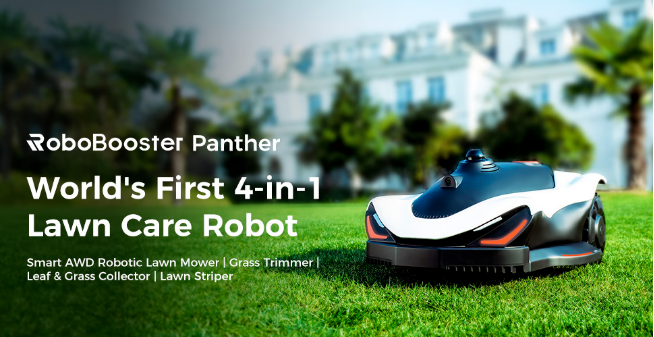
    RoboBooster Panther 4-in-1 Robotic Lawnmower

    In the realm of smart home hardware, “robotic lawn mowers” are hardly a novelty anymore. Much like the smartphone market of yesteryear, this sector has entered a “Red Ocean” phase—a fierce battleground characterized by intense competition among a multitude of players. However, for users in the past, traditional robotic lawn mowers have consistently addressed only one specific issue: “cutting the grass short.”

    Subsequent tasks—such as leaf removal, edge trimming, and aesthetic lawn grooming—have invariably required human intervention. Today, AICRUNCHX presents an in-depth review of a device touted as the “world’s first 4-in-1 lawn care robot”: the RoboBooster Panther. Is this product—set to make its debut on Kickstarter (KS)—truly worth the wait? Can it genuinely redefine the concept of “situational intelligence”? Join us in this buying guide as we uncover the answers.

    RoboBooster Panther
    RoboBooster Panther

    I. Market Pain Points: Why Do We Need a “4-in-1” Solution?
    Over the past decade, mainstream robotic lawn mowers on the market—whether traditional random-collision models relying on buried boundary wires, or advanced products utilizing RTK (Real-Time Kinematic) positioning and visual navigation—have consistently confined their functional scope to a single dimension: “cutting.”

    For homeowners living in detached suburban properties across North America, lawn care constitutes a comprehensive, multi-step process. Mowing is merely the first step; the subsequent tasks—such as “clearing fallen leaves or grass clippings” and “trimming lawn edges and curbs”—often require users to manually switch between different tools (such as leaf blowers and string trimmers) to complete the job. This process is not only time-consuming, but the need to store multiple pieces of equipment also places a significant burden on limited yard space. Current high-end market players—such as Yarbo—have already achieved a “3-in-1” functionality (combining snow blowing, mowing, and leaf blowing) through modular design; however, this comes at the cost of a higher price point and still requires users to manually swap out the various modules.

    The RoboBooster Panther emerges precisely to address this critical pain point. According to official releases, the Panther is far more than a simple lawn mower; it is a comprehensive system integrating four distinct functions: mowing, blowing/sweeping, edge trimming/collection, and lawn striping. This all-in-one design aims to completely liberate users from the drudgery of yard work.

    II. In-Depth Analysis of RoboBooster Panther’s Core Features

    Based on pre-launch materials, AICRUNCHX has broken down the Panther’s core competitive strengths into the following four dimensions:

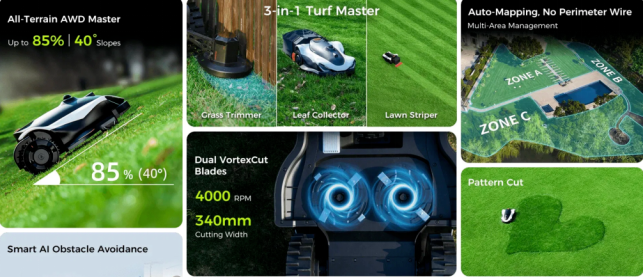
    1. Intelligent Mowing System: The Panther inherits the advanced navigation capabilities found in current high-end models. While the specific navigation solution awaits final confirmation upon mass production, its positioning accuracy is sufficient to handle complex yard layouts, thereby minimizing damage to grass roots caused by repetitive mowing.
    2. Powerful Blowing and Grass Collection: This stands as the Panther’s most significant differentiator compared to its competitors. The machine can switch to a “blowing” mode, utilizing airflow to sweep grass clippings and fallen leaves scattered across paved surfaces or lawns into a single pile, or to vacuum them directly into a collection bag. This means users no longer need to purchase a separate handheld leaf blower.
    3. Automatic Edging: Trimming the borders between lawns and paved edges is often the most tedious and frustrating task for manual labor. The Panther features a dedicated edging module designed to cut precisely along curbs and edges, effectively resolving the awkward “uncut strips” issue commonly associated with traditional lawnmowers.
    4. Lawn Patterning (Embossing): Catering to users with exceptionally high standards for their outdoor living spaces, the Panther even offers a lawn patterning feature, allowing the turf to display the aesthetic beauty of the striped patterns typically seen on professional sports fields.

    To help readers make a more intuitive assessment, AICRUNCHX has compiled the following comparison dimensions.

    Traditional models—exemplified by brands like Husqvarna—leverage decades of accumulated technical expertise to refine their mowing capabilities to a high degree of maturity. Their core strengths lie in focus and stability: they require no complex manual operation—once parameters are set, they automatically handle lawn trimming—and fall within a price range of $1,000 to $3,000, offering exceptional value. These models are perfectly suited for households with modest yard care expectations, where the primary requirement is simply basic lawn mowing. As pioneers in the field of smart robotic mowers, Husqvarna models also feature practical functions such as waterproofing, silent operation, and automatic recharging. They are capable of navigating narrow spaces and lawns with moderate slopes, can operate normally even in rainy weather, and feature critical components effectively shielded against dust and grass clippings—making the basic mowing experience truly hassle-free. However, constrained by their single-function design, the limitations of these robots are equally apparent: they perform only the act of mowing. Subsequent tasks—such as clearing grass clippings or trimming lawn edges—still require manual intervention, preventing full-process automation of yard care and making it difficult to satisfy users who prioritize maximum efficiency and convenience.

    Modular robots—such as those introduced by brands like Yarbo—employ an innovative “core unit plus interchangeable modules” design that effectively resolves the “seasonal idleness” pain point associated with traditional robotic mowers. By pairing a single core unit with various modules, users can perform mowing tasks in the spring and summer, then switch to snow-clearing or leaf-blowing modes in the autumn and winter. This approach provides a one-stop solution for year-round yard maintenance, eliminating the need for users to stockpile multiple large pieces of equipment; it saves valuable storage space while simultaneously reducing long-term investment costs. The modular attachments on these products require no tools for installation or removal—offering a true “plug-and-play” experience. Furthermore, powered by intelligent AI navigation algorithms, they can automatically optimize their operational paths based on the yard’s size and vegetation type. Combined with autonomous charging capabilities, they deliver a seamless user experience where, once a task is set, the entire process unfolds without any need for human intervention. However, this modular design does come with its own set of limitations: switching functions still requires the manual swapping of modules, meaning true, end-to-end automation remains out of reach. Additionally, due to the cumulative cost of supporting multiple modules, their price points generally exceed $3,000. Positioned as premium products, they are best suited for households or owners of large properties who have multi-seasonal yard care requirements and a sufficiently flexible budget. The RoboBooster Panther distinguishes itself with “integrated intelligence” as its core highlight, pioneering a new frontier in precision yard care and emerging as a compelling choice that strikes an optimal balance between convenience and cost-effectiveness. Compared to the two aforementioned product categories, this robot’s most significant breakthrough lies in its “all-in-one multifunctionality”—it can automatically execute four core operations—mowing, blowing, edging, and striping—without the need to swap out modules. This truly ensures a completely hands-free experience, requiring absolutely no human intervention from start to finish. Equipped with dual-vortex cutting blades and a high-power motor, it delivers professional-grade mowing results with no missed spots and smooth, clean edges. Its edging function is adept at navigating tight pathways and the perimeters of flowerbeds; the blowing function simultaneously clears away grass clippings and fallen leaves; and the striping function allows users to create personalized lawn patterns, elevating yard care from a mere chore to a refined art form. On the technical front, the unit employs a navigation system that fuses 3D LiDAR with visual recognition technology. This eliminates the need to lay down physical boundary wires, allowing the robot to generate a real-time digital map of the lawn, precisely identify obstacles, and dynamically adjust its route. Furthermore, it boasts all-terrain adaptability, effortlessly handling steep slopes and complex landscapes, all while operating at a low noise level of just 55dB—ensuring it never disrupts the tranquility of home life.

    IV. Buying Guide: Who Should Buy the RoboBooster Panther?
    As a startup hardware product poised to make its debut on Kickstarter, consumers are advised to make their purchasing decisions with careful consideration. AICRUNCHX recommends that the following groups pay particular attention to this device:

    1. North American Suburban Homeowners: Those owning detached single-family homes with yard areas ranging from 0.5 to 2 acres, and who place an exceptionally high priority on lawn aesthetics.
    2. Early Adopters of Technology: Individuals willing to support innovation and comfortable with the possibility of firmware iterations inherent in early-stage products.
    3. Budget-Conscious Users Seeking a Premium Experience: Those who wish to solve all their yard maintenance needs with a single device, rather than purchasing multiple single-function machines.
      Risk Advisory:
      Delivery Timeline: Crowdfunded products often face shipping delays; users should closely monitor official updates regarding delivery schedules.
      After-Sales Support: As a startup company, its global after-sales support network may not be as comprehensive or established as those of major brands (e.g., Worx, Husqvarna).
      Complex Terrain: For yards featuring extremely steep slopes or an abundance of obstacles, it is advisable to wait for real-world testing videos before making a final decision.

    V. The Future of Smart Yards: From “Single Devices” to “Integrated Scenarios”
    The launch of the RoboBooster Panther serves as a microcosm of the evolution of smart yard devices—shifting from “single-device intelligence” to “scenario-based intelligence.” By choosing Kickstarter as its launchpad for the Western market, this hardware startup is leveraging the platform’s inherent affinity for “disruptive innovation” products, which naturally attracts a high volume of relevant traffic.
    The trend of the future lies in interconnectivity and integration. Imagine a scenario where the Panther detects an increase in fallen leaves during autumn and automatically increases its blowing frequency; or recognizes that lawn growth has slowed and automatically adjusts its cutting height. This type of scenario-based automation represents the ultimate form of the smart home ecosystem. For readers of AICRUNCHX, our focus extends beyond mere technical specifications; we are primarily interested in how technology transforms our daily lives.

    RoboBooster Panther Formidable Professional Capabilities
    RoboBooster Panther Formidable Professional Capabilities

    VI. Summary and Purchase Recommendation
    The RoboBooster Panther is an ambitious product. It precisely targets the deep-seated pain points of yard maintenance in Western markets, attempting to eliminate the tediousness of coordinating multiple single-purpose tools through a comprehensive “4-in-1” integrated solution. • Recommendation Rating: ⭐⭐⭐⭐ (4/5)
    • Estimated Launch Price: $1,999 – $2,999 USD (Kickstarter Early Bird Pricing)
    • Launch Platform: Kickstarter
    AICRUNCHX Recommendation: If you are tired of spending your weekends pushing a leaf blower and trimmer around your yard—and are open to embracing emerging tech brands—the Panther is definitely worth keeping an eye on on Kickstarter. We recommend subscribing to our website; once the product officially begins shipping, we will provide a first-hand, long-term field review.

    📢 Frequently Asked Questions (FAQ)
    Q1: Does the RoboBooster Panther support boundary-wire-free navigation?
    A: Based on current pre-launch information, the Panther is positioned for the high-end market and is highly likely to utilize RTK or vision-fusion navigation, meaning no buried boundary wires are required.
    Q2: Is the power of the blowing function sufficient to clear wet leaves?
    A: The manufacturer claims it offers “powerful blowing capabilities,” but regarding its effectiveness against heavy, wet fallen leaves, we recommend waiting for AICRUNCHX’s upcoming real-world test results.
    Q3: How can I purchase it on Kickstarter?
    A: The product is currently in the pre-launch phase. Please visit Kickstarter and search for “RoboBooster Panther,” or follow AICRUNCHX to get the latest crowdfunding link.
    Q4: What is the warranty policy?
    A: Startups typically offer a 1–2 year limited warranty. Since this involves an international purchase, you should verify whether local repair services are included.