Home

  • Apple Accelerates Six AI Hardware Products, Smart Glasses and HomePad as Strategic Priorities

    Apple:symbolizing the shadow of innovation
    Apple:symbolizing the shadow of innovation

    On April 24, 2026, the tech world received significant news: Apple is accelerating the development of six entirely new hardware categories, including AI-powered AirPods, smart glasses, portable accessories, smart displays, home robots, and security cameras. This announcement quickly sparked industry-wide discussion, marking Apple’s major strategic shift from a single flagship product approach to a comprehensive intelligent ecosystem.

    Six New Products Outline the Future

    These six upcoming products show a clear gradient distribution. AI AirPods are viewed as a natural evolution of the current audio lineup, primarily enhancing AI interaction capabilities on existing hardware—a gradual upgrade. The remaining five products, however, represent Apple’s first entry into previously uncharted territory, carrying far greater strategic significance.

    Industry analysts suggest that smart glasses and smart displays represent the true strategic priorities. The core objective of these two categories is to break free from iPhone’s role as a single entry point, creating next-generation human-computer interaction interfaces and home intelligence hubs. Apple hopes to build a complete ecosystem covering personal wearable, home life, mobile office, and multiple other scenarios through these new products.

    Smart Glasses: A Decade in the Making

    Among the six new products, smart glasses are undoubtedly the most eye-catching. Information disclosed by overseas media reveals that Apple is developing smart glasses codenamed N50, featuring a display-free design with camera and audio components, enabling deep Siri integration.

    Notably, Apple CEO Tim Cook has designated AR glasses as the company’s “highest strategic priority.” Looking back at Apple’s decade-long AR journey, the company began its布局 as early as 2016, launching the premium Vision Pro headset in 2024. However, this product failed to become a mass consumer good due to its high price and bulky form factor.

    True consumer-grade AR glasses are estimated to still be several years away. Apple’s goal is to create lightweight, all-day wearable glasses that seamlessly overlay digital content onto the real world. Achieving this vision requires breakthroughs not only in optical display technology but also in balancing battery life, size, and interaction methods.

    Regarding the timeline, the N50 smart glasses are expected to launch between late 2026 and early 2027, with plans to complete market availability by end of 2027. This means consumers will have to wait until at least 2027 to truly experience Apple’s AR glasses.

    HomePad: A New Chess Piece for Home Scenarios

    Unlike smart glasses’ long development cycle, the HomePad smart display has been scheduled for fall 2026 release. According to reports, this product extends HomePod’s audio heritage while adding touchscreen functionality, aiming to become the intelligent interaction center for home scenarios.

    Industry insiders believe HomePad positions itself between smart speakers and iPad, offering both voice interaction convenience and screen-based operational advantages. With the maturing smart home ecosystem, such a highly integrated control device could become the “sixth screen” in home scenarios.

    However, HomePad faces a not-so-friendly competitive environment. Amazon’s Echo Show, Google’s Nest Hub, and domestic competitors like Xiaomi’s XiaoAI Touch Screen Speaker and Baidu’s Xiaodu Smart Screen have already captured market share. Whether Apple can achieve differentiation through its traditional advantages in ecosystem integration and user experience is worth continued attention.

    Home Robot: The Most Ambitious Exploration

    Among the six new products, the home robot is undoubtedly the most ambitious and uncertain. This represents Apple’s first entry into the home service robot sector, positioned as a premium desktop intelligent assistant.

    Sources indicate this project faces delays due to high technical complexity, with initial plans for 2027 release potentially pushed to 2028. Unlike current market offerings like robotic vacuum cleaners and delivery robots, home robots require more comprehensive capabilities in environmental perception, conversational interaction, and task execution—posing far greater technical challenges.

    Analysis suggests Apple’s decision to begin home robot development at this time reflects its judgment on home scenario intelligence trends. If technical maturity reaches expectations, this product could become Apple’s most disruptive hardware innovation since the iPhone.

    Ecosystem Integration Becomes Key
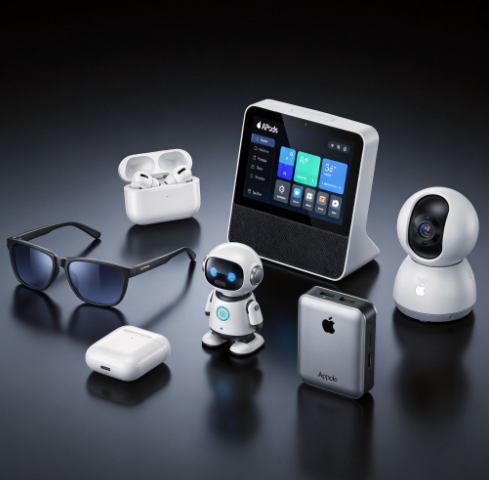
    Apple's vision for integrated AI hardware ecosystem, connecting personal devices with home intelligence.
    Apple’s vision for integrated AI hardware ecosystem, connecting personal devices with home intelligence.

    Overall, Apple’s six new hardware products show clear collaborative characteristics. Whether it’s AI AirPods’ audio interaction with smart glasses or HomePad’s home scenario connectivity with home robots, everything points in one direction: achieving seamless cross-device, cross-scenario experiences through a unified AI technology foundation.

    This ecosystem-oriented approach aligns with Apple’s strategy in software services. The introduction of Apple Intelligence has provided Apple’s hardware lineup with a unified AI capability platform. As the six new products gradually launch, this platform will gain richer hardware carriers, forming a true “AI hardware ecosystem closed loop.”

    Of course, the challenges Apple faces cannot be overlooked. In smart glasses, Meta’s Ray-Ban smart glasses have accumulated millions of users; in the home intelligence control sector, Amazon and Google have deep roots. Whether Apple can catch up and surpass in fierce competition ultimately depends on whether the product experience can truly resonate with consumers.
  • Intel Xeon 600 Workstation Processor Launch: 86-Core CPU with 32GB VRAM Offers New Option for Enterprise AI Deployment

    On April 23, 2026, Intel held a new-generation AI workstation platform launch event in Beijing, officially unveiling the Xeon 600 workstation processor and Arc Pro B70 and B65 GPUs. As AI applications scale and proliferate, enterprises increasingly demand high-performance local computing power. Intel’s latest release aims to provide a more complete and robust hardware foundation for professional heavy-duty scenarios including post-production, engineering design, and scientific computing.

    Growing Enterprise AI Computing Demands

    With the proliferation of large model training, intelligent agent applications, and multimodal content generation, enterprises are no longer satisfied with cloud computing. Instead, they pursue high-performance output and robust data security through local deployment. This trend drives workstation hardware toward stronger computing power and higher efficiency.

    “Xeon 600 workstation processor and Arc Pro B70 together build a more complete and robust foundation for the new generation AI workstation,” said Intel China Technical Director Gao Yu. “They provide powerful momentum for intelligent agent deployment, large model inference, content creation, and professional graphics processing, truly achieving ‘intelligent applications for all scenarios.’”

    Xeon 600: Four-Dimensional Upgrade Reshaping Workstation Performance

    The Xeon 600 workstation processor is specifically designed for professional heavy-duty scenarios, achieving breakthroughs in four dimensions: performance, expansion, AI acceleration, and management.

    In terms of performance leap, it features up to 86 performance cores with 61% multi-threaded performance improvement over the previous generation and boost clock up to 4.8GHz. This configuration ensures smooth response speed when handling complex computing tasks.

    Regarding flexible expansion, the processor supports 128 PCIe 5.0 lanes, providing rich and flexible expansion capabilities with the chipset. Whether multi-GPU parallel processing or high-speed storage device connectivity, all needs are fully supported.

    For AI acceleration, each core includes Intel AMX engine with native FP16 support. AI and machine learning performance improves by up to 17%. In typical image processing scenarios like noise reduction, speed improves by up to 4-5x. This enhancement effectively reduces enterprise local AI deployment barriers and total cost of ownership.

    In enterprise management, the processor leverages Intel vPro technology supporting multi-key memory encryption and one-click recovery. It adapts to tower, rack, and edge deployment forms, meeting enterprise flexible operations needs.

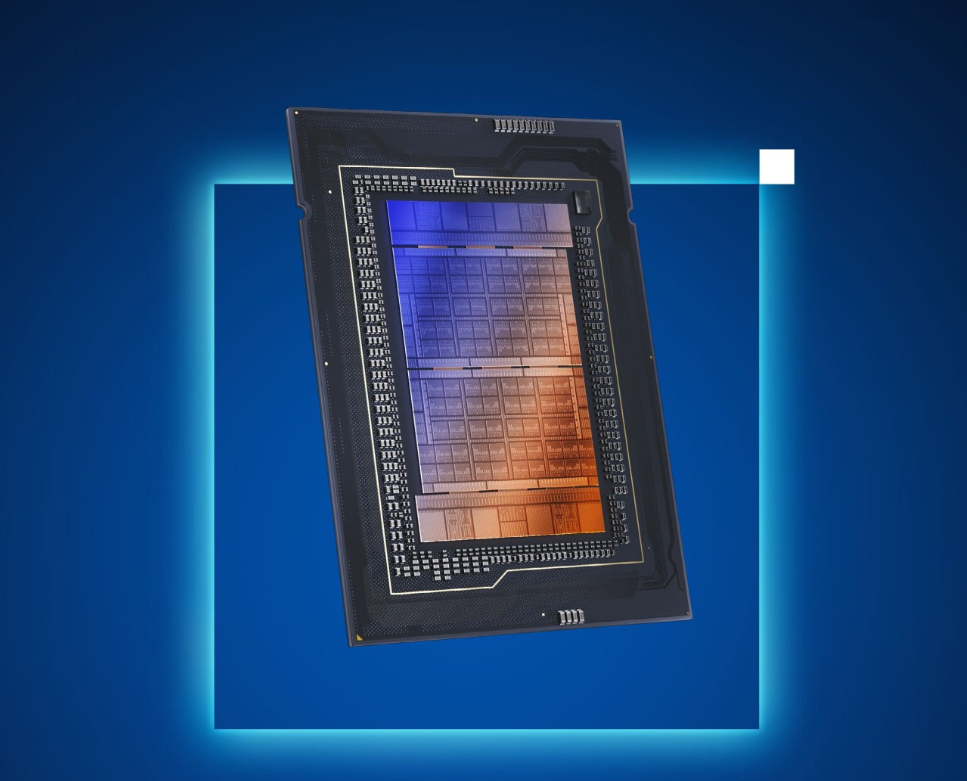
    Intel Xeon 600 workstation processor chip featuring advanced circuit design for enterprise computing
    Intel Xeon 600 workstation processor chip featuring advanced circuit design for enterprise computing

    Arc Pro GPUs: Large VRAM Driving AI Inference Revolution

    Collaborating with Xeon 600, Intel launched the Arc Pro series graphics cards based on the second-generation Xe2 architecture.

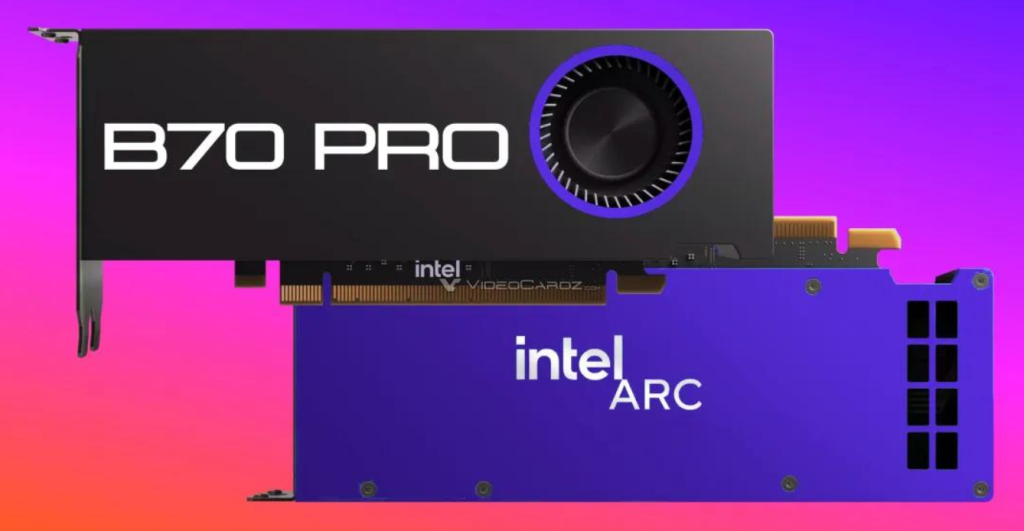
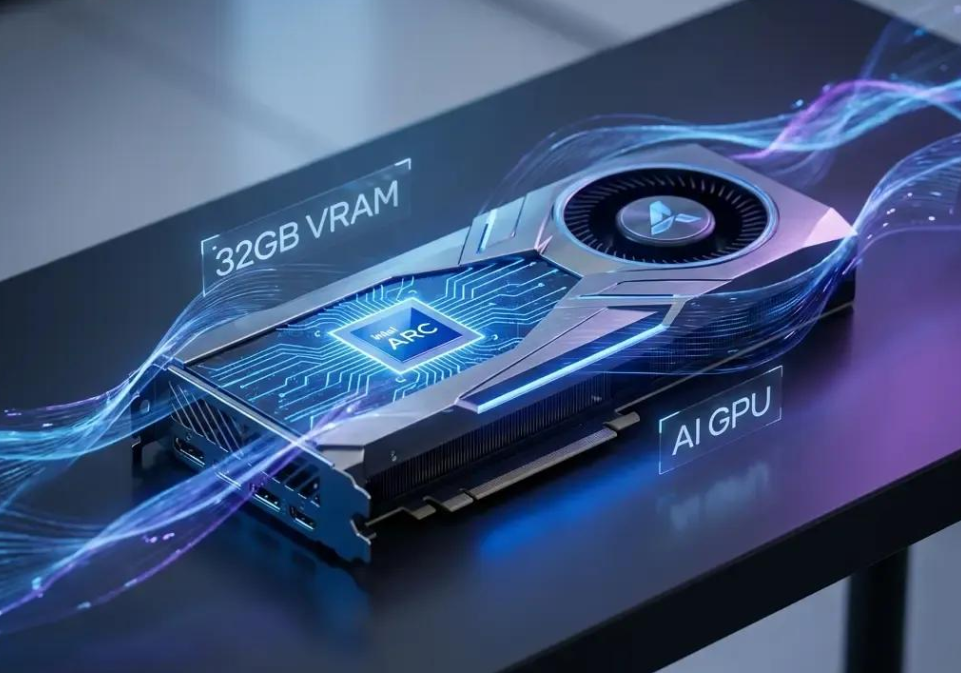
    The Arc Pro B70 features 32GB GDDR6 memory with 32 Xe cores delivering 367 TOPS peak AI performance. In AI inference scenarios, this graphics card supports larger AI models and longer context windows. Under multi-user concurrent scenarios, it maintains high throughput and fast response.

    Additionally, Arc Pro B70 supports SR-IOV virtualization and 50+ ISV software certifications, enabling flexible multi-card expansion configurations. With a complete Linux software stack (including vLLM, oneAPI, PyTorch), it meets diverse deployment needs.

    The Arc Pro B65 also features 32GB memory providing 197 TOPS performance, offering professional users more flexible choices.

    Intel Arc Pro B70 GPU featuring 32GB VRAM and AI-optimized architecture for enterprise workloads
    Intel Arc Pro B70 GPU featuring 32GB VRAM and AI-optimized architecture for enterprise workloads


    Ecosystem Implementation: From Enterprise Agents to Smart Healthcare

    Intel did not stop at hardware launches but partnered with ecosystem collaborators to build multi-scenario solutions, transforming high-performance computing into tangible productivity across industries.

    For enterprise agents, the Intel-Volcengine co-developed AgentSphere all-in-one machine solution leverages Xeon 600 and Arc Pro B70’s 32GB memory and high-performance local computing. It features higher concurrency, lower latency, and less jitter for multi-agent collaboration. The ready-to-use all-in-one solution reduces AI deployment barriers and maintenance costs.

    For smart office, Lenovo’s intelligent conference system Lenovo SCH-900S leverages Arc Pro B70’s excellent memory and AI computing power, achieving multi-conference concurrent access and real-time AI meeting minutes generation, effectively improving communication efficiency.

    For knowledge management, Fit2Cloud built an enterprise-grade long-context RAG solution based on Arc Pro B70’s multi-card concurrent capability, supporting efficient multi-card concurrent inference for LLM/VLM, improving processing speed and response quality in enterprise knowledge management and intelligent Q&A scenarios.

    For smart healthcare, BDH Healthcare utilizes Intel AI workstation platform to achieve precise medical record content quality control and medical record-assisted generation applications, helping medical institutions improve diagnosis and treatment quality and efficiency.

    For creative production, Yixin Shanhui leverages Arc Pro B70’s 32GB memory and AI computing power to generate detailed digital artworks from hand-drawn sketches in seconds, unleashing artists’ creative potential.

    Intel Arc Pro B70 PRO workstation graphics card designed for professional AI applications
    Intel Arc Pro B70 PRO workstation graphics card designed for professional AI applications


    Market Outlook: New Choices for Professional Heavy-Duty Scenarios

    This launch marks Intel’s continued deep cultivation in professional computing. For professional users in film post-production, engineering design, scientific computing, and AI model training and inference, consumer-grade processors with ordinary graphics cards can no longer meet their needs.

    The Intel platform’s combination of 86-core processor and 32GB VRAM graphics card provides enterprises with new hardware options for addressing challenges like high large model deployment costs, data security, and response efficiency. As AI technology penetrates deeper into various industries, demand for local computing power is expected to continue growing. Intel’s product iteration this time may bring broader and deeper industrial application momentum to the entire workstation ecosystem.

  • Anker Launches Self-Developed Thus Chip: Ushering in a New Era of AI Audio

    Small Chip, Revolutionary Change

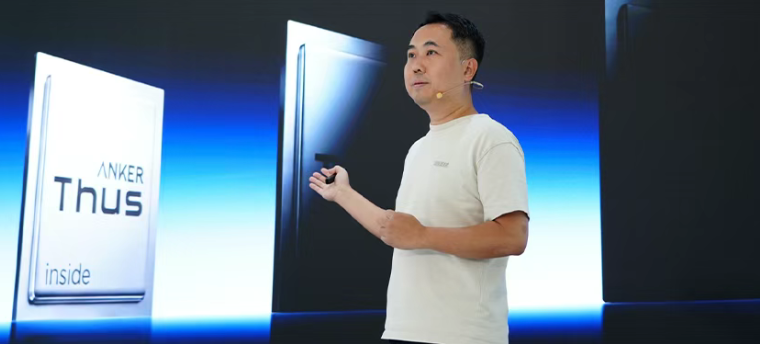
    AI data centers become key infrastructure for domestic computing ecosystem
    AI data centers become key infrastructure for domestic computing ecosystem

    On April 22, consumer electronics giant Anker officially unveiled its self-developed Thus chip, sparking widespread industry attention. The company claims this chip is the “world’s first neural network in-memory computing AI audio processor,” which will fundamentally change our understanding of AI capabilities in small audio devices like earbuds.

    During the launch event, Anker CEO Yang Meng explained the core innovation of the Thus chip: “Until now, all AI chips have been designed with separate storage and computing units. During every inference operation, devices must move parameters back and forth multiple times per second. Thus places computation directly where the model is stored, eliminating the need for data movement.”

    This in-memory computing architecture sounds simple, but it represents a fundamental shift in chip design philosophy. Traditional AI chips constantly shuttle data between storage and computing units, consuming significant energy and introducing latency. In an in-memory computing architecture, computation occurs at the data storage location, completely eliminating this bottleneck.

    Why Start with Earbuds

    Anker’s choice of earbuds as the first application for the Thus chip was by no means coincidental. In Anker’s view, earbuds are precisely the most challenging product category for embedding AI chips.

    First, the internal space in earbuds is extremely limited. Every cubic millimeter must be carefully planned, with components arranged at extremely high density. Traditional AI chips simply cannot meet these stringent space constraints.

    Second, earbuds have extremely strict battery life requirements. Users often wear earbuds for extended periods, requiring chips to provide sufficient computing power while maintaining ultra-low power consumption.

    Third, earbuds need to be ready at all times. Unlike smartphones, users wearing earbuds expect AI features to be available instantly without noticeable delays or interruptions.

    These challenges make AI upgrades for earbuds particularly difficult, making Anker’s breakthrough even more significant. Previous solutions, limited by hardware capabilities, could only use small neural networks with hundreds of thousands of parameters. The Thus chip, leveraging its energy-efficient in-memory computing architecture, can process millions of parameters—a qualitative leap in computing capability.

    A Quantum Leap in AI Noise Cancellation

    For ordinary users, the most tangible value of the Thus chip lies in its improvement to call noise cancellation.

    Traditional AI call noise cancellation primarily relies on small on-board neural networks. In particularly noisy environments, such solutions often struggle: environmental noise mixes into calls, or voices are over-suppressed, resulting in unnatural sound. This is a dilemma stemming from limited model capacity that cannot accurately distinguish human voices from complex environmental noise in various scenarios.

    Anker states that new earbuds equipped with the Thus chip will feature larger-scale neural networks. Combined with hardware configurations of 8 MEMS microphones and 2 bone conduction sensors, the system can more precisely capture the user’s voice. Even in high-noise environments like concert venues, busy restaurants, or subway platforms, users can enjoy clear call quality.

    More powerful AI capabilities also open up additional possibilities. Online translation, voice assistants, and real-time transcription will all be implemented on the earbuds themselves, with significantly improved response speed and accuracy. These features no longer need to rely on cloud processing—user voice data always stays on the device, protecting privacy while lowering usage barriers.

    Speculation on First Products

    Anker has not yet announced the specific models of the first earbuds equipped with the Thus chip, but the industry has made many guesses.

    According to The Verge’s report, the first earbuds powered by the Thus chip are likely the Liberty 5 Pro Max and Liberty 5 Pro. These two products are expected to be priced at $229.99 and $169.99 respectively.

    From the naming convention, these products should belong to soundcore’s high-end product line. Considering the Liberty series’ consistent market positioning, we can expect these new products to excel in sound quality, noise cancellation, and battery life. With the AI capabilities brought by the Thus chip, they will offer users entirely new experiences.

    Anker revealed that complete product information will be officially announced at the Anker Day event on May 21. At that time, we will see the Thus chip’s performance in real products and more AI features planned by Anker.

    Anker Launches Its Own Thus Chip Unlocking a New Era in AI Audio
    Anker Launches Its Own Thus Chip Unlocking a New Era in AI Audio

    AI Empowering the Entire Product Line

    Notably, the Thus chip is only the first step in Anker’s AI strategy. The company’s goal is to bring local AI capabilities to all product lines, covering audio devices, mobile accessories, and IoT devices.

    In the audio device sector, beyond earbuds, speakers, microphones, and other products will also benefit from the Thus chip’s powerful AI capabilities. Imagine smart speakers that more accurately recognize voice commands, or portable microphones that eliminate environmental noise in real-time—these will all significantly enhance user experiences.

    In the mobile accessories sector, products like power banks and chargers could also incorporate AI capabilities. For example, smart power banks could optimize charging strategies based on device usage patterns, extending battery life.

    In the IoT sector, the Thus chip’s low-power characteristics make it an ideal choice for various smart home devices. From smart light bulbs to security cameras, edge AI will make these devices smarter and more independent.

    Industry Impact and Future Outlook

    Anker’s breakthrough is not only a significant milestone for the company but will also have far-reaching effects on the entire consumer electronics industry.

    First, it demonstrates the feasibility of applying in-memory computing architecture in consumer electronics. Previously, this technology mainly existed in academic research and data center scenarios. Anker’s successful productization points the way for other manufacturers.

    Second, it showcases the value of vertical integration in the AI era. Anker develops its own chips while controlling terminal product design and software algorithms—this end-to-end optimization can maximize hardware potential.

    Third, it may trigger a wave of AI audio chip development. Chip manufacturers and terminal companies sensing business opportunities will accelerate their layout in this field, driving rapid technology iteration.

    Of course, challenges remain. Chip mass production yields, coordination with other chips, and the maturity of software development toolchains all need time to resolve. But regardless, Anker has taken the crucial first step.

  • Solving Two Pain Points with One Device

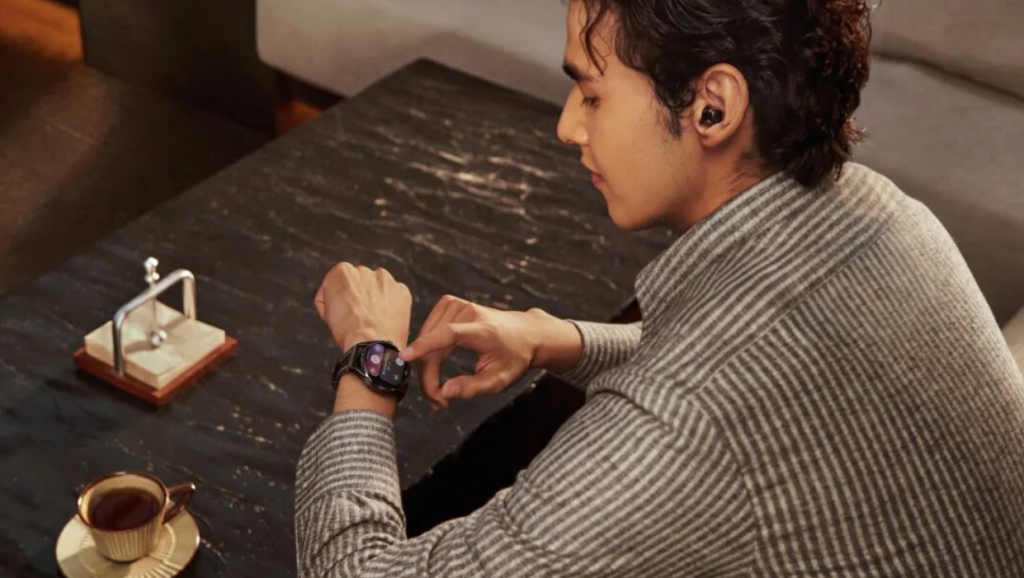
    HUAWEI WATCH Buds 2
    HUAWEI WATCH Buds 2

    Do you often find yourself fumbling through pockets or bags to locate your earbuds when rushing to catch the subway? This fragmented carrying experience is precisely the motivation behind HUAWEI’s WATCH Buds series.

    On April 20, 2026, HUAWEI officially launched the WATCH Buds 2, deeply integrating a smartwatch with true wireless earbuds. This single device meets triple demands for communication, health, and audio. The iterative product represents comprehensive optimization rather than simple hardware stacking. How does it perform? We conducted a week-long in-depth test.

    Design: Lighter and Thinner, Premium Feel Elevated

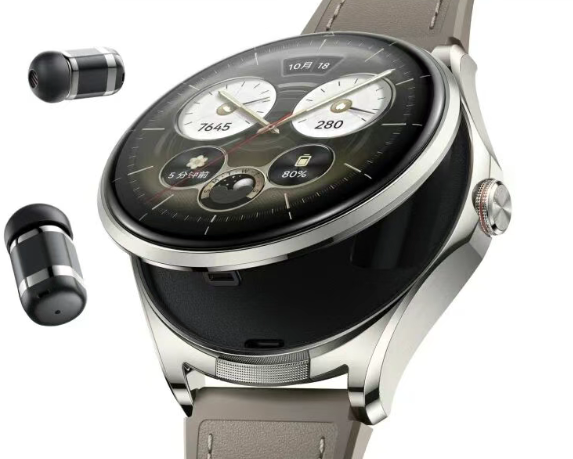
    The first impression of WATCH Buds 2 is “lightweight.” The entire device weighs approximately 54.5 grams, 12 grams lighter than its predecessor, with thickness controlled at 14.69mm. Extended wearing no longer causes noticeable heaviness.

    The body adopts aerospace-grade titanium alloy combined with ultra-hard nano-coating technology, achieving 200% improvement in wear resistance. This material combination ensures both lightweight portability and durability.

    The earbud design is equally compact. Each earbud weighs approximately 4 grams, with volume reduced by 50% compared to traditional TWS earbuds. The octagonal cylindrical shape conforms to ear canal contours. During testing, three hours of continuous wearing caused no discomfort.

    The watch body and earbud charging case feature a 360° magnetic adsorption design. When returned, they automatically align and dock precisely. This satisfying “click” magnetic placement eliminates the frustration of repeatedly adjusting angles.

    The screen upgrades to a 1.5-inch LTPO flexible display with 36% narrower bezels and 11.6% improved screen-to-body ratio. The 3000-nit peak brightness ensures clear visibility even under bright outdoor light.

    The WATCH Buds 2 offers three color options: Obsidian Black, Amber Brown, and Titanium Silver. The Obsidian Black and Amber Brown versions are priced at 3,488 yuan, while the Titanium Silver version with titanium strap costs 3,988 yuan.

    Smartwatch-Earbuds Combo
    Smartwatch-Earbuds Combo

    Audio: Quality Sound from a Compact Body

    Don’t underestimate the audio quality despite the compact earbud size. The WATCH Buds 2 features a full-range micro-planar driver unit combined with triple sound optimization technology, dynamically compensating for sound differences caused by varying ear canal shapes.

    Call quality is a highlight of this product. Using bone conduction sensors with DNN deep neural network noise reduction algorithms, callers can hear your voice clearly even in noisy subway cars or busy street environments. Testing confirmed significant environmental noise filtering with high voice fidelity.

    The earbuds support hybrid active noise cancellation with two modes: noise cancellation and transparency. Activate transparency mode during commuting to hear both music and surroundings; switch to noise cancellation in the office for focused work.

    Touch controls receive a major upgrade. The expanded touch area covers the auricle and cheek, with double-tap for play/pause and triple-tap to switch noise cancellation modes—discreet and efficient, avoiding the awkwardness of pulling out a phone.

    The unique left-right adaptive recognition makes usage more casual. No need to distinguish left from right; pick up and wear, and the system automatically calibrates channel allocation. Both single or dual earbud use works seamlessly.

    The wrist-controlled earbuds feature is particularly practical. Directly control earbud playback status, volume, and noise cancellation modes through the watch dial. Check remaining earbud battery with a raised wrist—no need to remove the earbuds.

    Health: From Recording to Proactive Management

    The WATCH Buds 2 runs HarmonyOS 6, with health monitoring capabilities rivaling professional smartwatches.

    The health summary feature integrates exercise, heart rate, blood oxygen, sleep, and mood data for comprehensive analysis, automatically generating personalized health reports and improvement suggestions. This one-stop service eliminates the hassle of switching between different functions.

    Heart health monitoring supports pulse wave atrial fibrillation and premature beat detection. Users can participate in the HUAWEI heart health research program, with the system continuously tracking cardiac rhythm changes and alerting abnormalities. This feature proves particularly valuable for those with high-stress work schedules.

    Sleep monitoring adds sleep apnea screening. The system automatically analyzes deep sleep and light sleep stages while identifying sleep apnea risks, providing targeted improvement plans. After one week of continuous wearing, testers reported significantly detailed sleep reports.

    Blood glucose risk assessment represents a key upgrade. After wearing for three or more days, the system analyzes blood glucose trends based on physiological data, providing early risk warnings. It’s important to note this function serves as consumer-grade reference and cannot replace professional medical testing.

    Mood monitoring analyzes user stress and fatigue states in real-time, guiding breathing exercises to relieve tension. Combined with 90+ exercise modes, AI automatically interprets exercise data, covering running, swimming, and fitness comprehensively.

    SmartFeatures:Empowered by HarmonyOS Ecosystem

    Detaching the earbuds, the WATCH Buds 2 itself functions as a fully capable smartwatch.

    Digital car key features enable automatic vehicle unlocking when approaching, supporting mainstream vehicle brands. NFC tap-to-pay covers supermarkets, convenience stores, and other scenarios—complete payments with a raised wrist.

    Multi-device collaboration breaks boundaries between phones, tablets, and computers. Audio playback and message notifications seamlessly switch across devices, enhancing cross-device collaboration in office scenarios.

    Regarding system compatibility, this product perfectly adapts to HarmonyOS, iOS, and Android systems, ensuring both Apple and Android users can purchase with confidence.

    Battery performance proves satisfying. The watch delivers up to 3 days of comprehensive battery life, with earbuds lasting 3 hours in noise cancellation mode or 4 hours with it disabled. Combined with watch charging functionality, all-day usage is essentially covered.

    Comparison with First Generation: Four Core Upgrades

    Upgrade DimensionFirst GenerationWATCH Buds 2
    Weight and MaterialHeavier, noticeable plastic feel54.5g, titanium alloy
    Audio PerformanceBasic driver unitFull-range micro-planar + bone conduction noise cancellation
    Health FeaturesBasic heart rate and sleep monitoringNew blood glucose risk and mood monitoring
    Interaction ExperienceTraditional touch controls360° magnetic adsorption + expanded auricle touch

    Target Users and Purchase Recommendations

    The WATCH Buds 2 isn’t for everyone. Users in the following scenarios should prioritize consideration:

    Commuters and frequent travelers represent the primary target users. The dual-function design significantly reduces burden—one device handles subway calls and café emails. Office professionals benefit from discreet call features, answering meetings with gentle auricle taps and wrist control to avoid frequent phone reaching. Health-conscious individuals gain comprehensive health monitoring data for proactive body management. Tech enthusiasts experience the innovation of the dual-function form factor.

    However, audiophiles seeking ultimate sound quality may be disappointed—limited by earbud volume, sound quality cannot match high-end professional TWS products. Users with slender wrists should also try before buying, as the 47mm case diameter may appear too large.

    Conclusion

    The HUAWEI WATCH Buds 2 represents a new approach in smart wearables—not feature stacking, but scenario deep cultivation. It precisely addresses the user pain point of “too many devices, cumbersome carrying” through innovative form factor design that maximizes value from a single device.

    Lightweight design solves wearing comfort issues. Dual online audio and health capabilities ensure practical value. HarmonyOS ecosystem support enables smoother multi-scenario usage. If you frequently travel for business, pursue efficient office work, and dislike device fragmentation, this product deserves a place in your shopping cart. Available across all channels from April 25, with purchases before May 31 receiving one year of HUAWEI Care+ service.