Home

  • Tesla Optimus V3 Officially Enters Mass Production: The Commercialization Inflection Point Arrives

    2026 marks a landmark moment for the humanoid robot industry. On April 23, Tesla officially announced that the third-generation Optimus humanoid robot V3 will begin mass production at the California Fremont Factory in late July to August 2026. Notably, the production line undertaking this historic mission is not newly built but converted from the lines previously used for Tesla’s flagship models, the Model S and Model X.

    Tesla formally announced the discontinuation of Model S and Model X in January 2026. Official data shows these two classic models accounted for less than 3% of 2025 deliveries. Behind the discontinuation decision lies Musk’s strategic pivot toward robotics. The Fremont Factory space, once filled with aluminum body welding and falcon-wing door installation, is being transformed into an automated fortress producing one million robots annually.

    Tesla Optimus humanoid robot display, showcasing its sleek and streamlined design
    Tesla Optimus humanoid robot display, showcasing its sleek and streamlined design

    Ambitions Behind Million-Unit Annual Capacity

    Tesla’s disclosed production plan reveals the tech giant’s grand ambitions. According to the plan, the converted Fremont Factory line has a designed annual capacity of one million humanoid robots. Simultaneously, Tesla is already deploying second-generation production lines at the Texas Super Factory, with a long-term target annual capacity of 10 million units.

    What does this number mean? The current global humanoid robot market annual shipments fall short of 10,000 units. Tesla’s production target exceeds the total market volume by over 100 times. Musk previously stated that he estimates the humanoid robot market valuation could reach $25 trillion by 2050, accounting for 80% of Tesla’s future total market value.

    However, industry insiders caution that initial production ramp-up will be “very slow.” The Optimus V3 contains over 10,000 unique components and represents an entirely new product category. The production line requires time to磨合. Musk candidly admitted that currently, they cannot predict the exact ramp-up speed.

    Tesla Optimus robot with sci-fi aesthetic, presenting precision mechanical structure
    Tesla Optimus robot with sci-fi aesthetic, presenting precision mechanical structure

    From $55,000 to $20,000: The Cost Challenge Remains

    The biggest challenge for mass production lies in cost control. Currently, each Optimus unit costs approximately $55,000 to manufacture, while Tesla’s mass production target is to push costs below $20,000—a reduction exceeding 60%.

    The high cost stems from technical difficulties in core components. The Optimus’ dexterous hand has 22 degrees of freedom, requiring manipulation capabilities similar to human hands. This places extremely high demands on the transmission system. Additionally, the core component for 14 linear joints—planetary roller screws—requires precision errors controlled within ±6 micrometers. Currently, the number of suppliers globally capable of stable mass production of this component remains limited.

    Supply chain restructuring is Tesla’s core strategy for cost reduction. Unlike directly adopting the automotive supply chain, Tesla chose to redesign components from first principles. Disclosed information shows 70% of core components will come from domestic suppliers, including Tuopu Group (actuators), Sanhua Intelligent Control (rotary joints), and Green Harmonic (harmonic reducers), with costs 40% lower than Japanese and German products.

    Commercialization Path: Factories First, Homes Later

    In terms of application scenarios, Tesla has adopted a pragmatic “internal first, external later” strategy. The Optimus V3 plans to deliver to enterprise customers in the second half of 2026, then expand to external scenarios in 2027.

    Currently, Tesla is conducting internal testing at the Austin factory, having Optimus perform simple tasks like material handling to accumulate actual operational data. This “verify in our own factory first, then promote externally” approach closely mirrors Xiaomi’s robotics deployment path.

    Looking across the industry, humanoid robot commercialization has already shown divergence. Domestic companies like UBTECH and Zhiyuan Robotics have achieved substantive breakthroughs in industrial scenarios. Zhiyuan Robotics particularly achieved its 10,000th general embodied intelligence robot offline in March 2026. However, the consumer market still needs to wait for the explosion. The core obstacle remains the balance between cost and reliability—surveys show 78% of household users have a psychological price point below a few thousand yuan, while current high-end models still cost hundreds of thousands of yuan.

    Tesla Optimus robot with sci-fi aesthetic, presenting precision mechanical structure
    Tesla Optimus robot with sci-fi aesthetic, presenting precision mechanical structure

    Industry Impact and Future Outlook

    Tesla Optimus V3’s mass production holds benchmark significance for the entire humanoid robot industry. Led by Tesla, tech giants including Honda, Toyota, Baidu, and Xiaomi have intensified their layout, accelerating the global humanoid robot industry from technology verification toward commercial deployment.

    Nevertheless, challenges remain formidable. Beyond costs, the durability of core components is also a limiting factor. Current joint module service life is approximately one year, far below the 5+ years required for industrial applications. The dexterous hand longevity issue is equally prominent. Early adoption of full tendon-drive solutions revealed problems like insufficient grip strength and material wear.

    Despite this, the industry remains optimistic about humanoid robot prospects. Kaiyuan Securities pointed out that 2026 is the critical node for humanoid robots transitioning from “0 to 1.” As the supply chain matures and scale effects emerge, the humanoid robot cost curve will continue declining, and the commercialization process is expected to accelerate. For the entire manufacturing sector, the intelligent transformation brought by humanoid robots may be just beginning.

  • Moonix AI Glasses by Xinmou Technology: Redefining Wearable Experience with 14.9g Ultra-Lightweight Design

    On April 29, 2026, Xinmou Technology (Hangzhou) Co., Ltd. held its global brand and product launch event at the San Francisco Palace of Fine Arts in Silicon Valley, officially unveiling its first flagship product line—Moonix AI Glasses (Chinese name: “Monet AI Glasses”). The two models, standard version focusing on audio recording and Pro version featuring video recording, both emphasize ultra-lightweight industrial design and proactive seamless AI interaction. The standard version is expected to launch in June, with the Pro version following in August, simultaneously worldwide.

    Industry Dilemma: Why AI Glasses Remain Niche

    AI glasses are currently viewed as the most promising next-generation personal computing platform to potentially replace smartphones, as they sit closest to the human face’s core triangular zone, covering both visual and auditory senses. However, the industry has fallen into a “addition logic” trap: competing over computing power, stacking sensors, pursuing exaggerated forms, and emphasizing visual interactions. This has directly resulted in products weighing consistently over 40 grams, with some display-enabled AI glasses exceeding 60 grams.

    “Consumers must sacrifice their most basic wearing experience to accommodate various smart features,” said Guo Yuchen, founder of Xinmou Technology, at the launch event. He bluntly stated that this dilemma is hindering AI glasses from achieving true mass adoption.

    Breakthrough Solution: Technology Through Subtraction

    Xinmou Technology chose a distinctly different path. At the launch event, Guo Yuchen proposed the core product philosophy: “Respecting tradition, returning to essence, and technology through subtraction.” In his view, the first principle of glasses is “lightweight, seamless, and design-first,” meaning AI glasses should first be excellent glasses, then a smart device.

    Based on this philosophy, Moonix AI Glasses achieved multiple breakthroughs:

    Ultra-Lightweight: The standard version weighs just 14.9g, while the Pro version is only 17.9g, with temple arms as thin as 4mm. What does this mean? The lightest AI glasses on the market currently weigh around 28g, mainstream products generally exceed 40g, and the Meta Ray-Ban Display reaches 69g. Moonix’s 14.9g not only sets a new industry record but is even lighter than many regular acetate glasses.

    Modular Design: Moonix integrates all electronic components inside the temple arms, completely decoupling frames from temples. This design not only provides more flexible space for internal stacking but also allows users to freely replace front frames. Over 100 frame options will be available at launch, covering business formal, daily commute, casual social, and reading styles, with support for prescription and sunglass lenses.

    Moonix AI glasses launch event keynote presentation showing ultra-thin design philosophy
    Moonix AI glasses launch event keynote presentation showing ultra-thin design philosophy

    Proactive AI: Transitioning from Tool to Companion

    Weight and appearance address “whether users are willing to wear them,” while “proactive AI” targets “what happens every day after wearing them.”

    Traditional AI glasses operate in “passive AI response” mode: after users give commands, the device takes photos, records audio, then calls upon large models for recognition, translation, and Q&A. Moonix’s breakthrough lies in its “proactive AI assistance”—the device autonomously transforms personal data into valuable scene experiences.

    The standard version features 6 micro-microphones for all-day audio capture; the Pro version adds a 1080p full HD camera supporting Always-On all-day recording and high-frequency capture. Based on RAG technology, the system automatically segments recorded meetings, interviews, inspirations, and daily conversations into event nodes, building an easily retrievable structured timeline and private knowledge base.

    The accompanying Moonix App uses a timeline as its core architecture, aggregating user data across learning, work, travel, and life dimensions. In workplace scenarios, the system automatically aggregates meeting audio, text notes, and key moments, intelligently extracting key points and generating standard meeting minutes with editable PPTs in one click. For personal recording scenarios, it filters video clips from the timeline to quickly create personal Vlogs.

    Moonix App interface showing Journal-style time-axis personal knowledge management
    Moonix App interface showing Journal-style time-axis personal knowledge management

    “This AI glasses won’t stop at the features launched today. Based on App-side workflows, it can expand infinitely,” Guo Yuchen stated. He noted that as usage time extends, the AI learns user expression habits, focus areas, and decision-making styles, providing responses that increasingly align with user thinking.

    Regarding battery life, Moonix employs innovative power balance algorithms, enabling both standard and Pro versions to achieve up to 16 hours of comprehensive battery life, meeting all-day usage needs.

    Privacy Commitment: End-to-End Encryption and Open Source

    With zero data popups, no bright light flashes, and no mechanical interaction interference, Moonix commits to achieving “intelligent presence without stealing the show” in an ultra-seamless experience.

    On privacy protection, Moonix AI Glasses implement end-to-end encryption ensuring data security throughout collection, transmission, and processing. The team solemnly commits to gradually open-sourcing key privacy and security-related module codes, accepting public supervision from the global developer community.

    “With extreme openness and transparency, we build a trustworthy AI hardware security foundation,” Guo Yuchen emphasized at the launch event.

    Moonix Glasses standard and Pro versions with modular frame options
    Moonix Glasses standard and Pro versions with modular frame options

    Launch Information and Market Strategy

    Moonix AI Glasses standard and Pro versions will launch in June and August respectively this year, simultaneously in domestic and international markets, with official pricing and sales channels to be announced.

    Partner recruitment has begun in Beijing, Shanghai, Guangzhou, Shenzhen, Suzhou, Hangzhou, and other cities, with users able to book offline experience sessions.

    From an industry perspective, Moonix’s launch marks a crucial step for AI glasses transitioning from “geek toys” to “mass daily consumer products.” With on-device models, AI agents, and multimodal sensing gradually maturing, redefining product value through ultra-lightweight design and proactive AI may lead the industry out of the “weight internal competition” dilemma.

  • DingTalk A1 Pro Redefines AI Recording: 180-Hour Battery Life Meets Power Bank in One Card

    On April 30, 2026, DingTalk officially launched the DingTalk A1 Pro, available for purchase at the DingTalk flagship store on Tmall, priced at 1,299 RMB. This all-in-one device combines professional AI recording with emergency phone charging, packing a 2,980mAh battery that delivers up to 180 hours of continuous recording, 180 days of standby, and has passed the new national 3C certification standards.

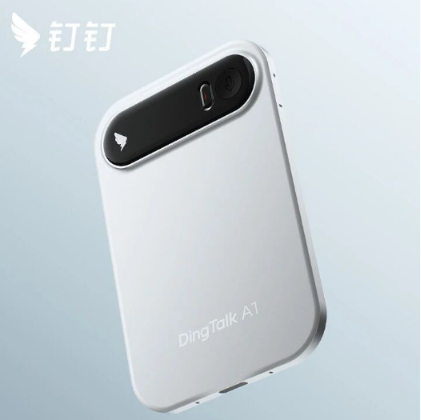
    DingTalk A1 series shares the same card-style design language; A1 Pro builds upon this foundation with a larger battery and touch display.
    DingTalk A1 series shares the same card-style design language; A1 Pro builds upon this foundation with a larger battery and touch display.

    Listening to Users: Pain Points Drive the Upgrade

    DingTalk released its first AI hardware, the DingTalk A1, in August 2025. Praised for its slim profile and AI transcription capabilities, both batches of pre-orders sold out rapidly. Yet users flooded social platforms with feedback: battery life fell short for week-long business trips, and running out of phone battery while on the road remained a persistent frustration.

    Responding directly to these pain points, DingTalk dramatically increased battery capacity from 660mAh to 2,980mAh and added reverse charging — transforming A1 Pro into a true 2-in-1 device: recorder and power bank combined.

    Industry-First MEMS Directional Microphone: 10-Meter Precision Pickup

    A1 Pro is equipped with a MEMS directional microphone, the first implementation of this technology in the AI recording card category. Compared with conventional microphones, MEMS directional microphones offer higher signal-to-noise ratios and stronger anti-interference performance, precisely locking onto and capturing sound sources up to 10 meters away — even in noisy environments. This means clear recordings from the corner of a large conference room.

    DingTalk A1 series in two color options; A1 Pro inherits this ultra-slim card design with added touch display and reverse charging.
    DingTalk A1 series in two color options; A1 Pro inherits this ultra-slim card design with added touch display and reverse charging.

    Ready to Use: Six Months of Exclusive AI Benefits

    Purchasers of A1 Pro receive six months of exclusive benefits, including 1,500 minutes of speech-to-text transcription per month — a total value of 450 RMB. Integrated with DingTalk’s AI Meeting Notes, the device transcribes recordings in real time, leverages large language models for intelligent analysis, and supports multilingual live translation.

    The product includes over 200 AI meeting note templates covering typical work scenarios: client visits, interview Q&A, legal consultations, and international meetings. Once a recording concludes, content uploads automatically to the cloud, where AI intelligently extracts key points, action items, and conclusions, generating summaries with one click that sync directly to the DingTalk workspace.

    DingTalk also offers an enterprise version supporting unified procurement, device management, and encrypted data storage for centralized B-end needs.

    Ultra-Portable: 6.4mm Slim Body

    A1 Pro measures just 6.4mm thick — thinner than the Apple iPhone 17 Pro Max — at approximately 40g. The built-in magnetic design attaches directly to a smartphone’s back without requiring a separate case, making it extremely convenient to carry. The addition of a touchscreen allows users to switch charging modes directly on the device, eliminating dependence on the phone app. Connectivity is handled via a standard Type-C port for both charging and data transfer.

    Key Specs at a Glance: A1 vs. A1 Pro

    SpecificationPrevious-gen DingTalk A1DingTalk A1 Pro
    Battery capacity660mAh2,980mAh
    Continuous recording45 hours180 hours
    Standby time60 days180 days
    Microphone typeOrdinary microphoneMEMS directional
    Pickup range8 meters10 meters
    DisplayNon-touch screenTouchscreen
    Power bank functionNot supportedReverse charging supported
    3C certificationNew national standard passed

    From Product to Ecosystem: DingTalk’s Hardware Philosophy

    Unlike pure hardware manufacturers, DingTalk’s approach to AI hardware centers on “collaboration.” A1 Pro is not an isolated recording device — it is deeply embedded within DingTalk’s office ecosystem. Recording, transcription, AI summarization, and task scheduling flow seamlessly without switching applications, completing an entire workflow within one platform.

    This integrated strategy of “AI software + dedicated hardware + cloud services” represents a new trend where enterprise AI applications extend from the cloud to the edge. The DingTalk A1 series has already won the 2026 German Red Dot Award for product design, and the A1 Pro further broadens the product line’s scenario coverage.

    Summary

    Priced at 1,299 RMB, the DingTalk A1 Pro targets frequent business travelers and “super individuals” with precision. The 180-hour recording capability, the 2-in-1 power bank design, professional pickup powered by MEMS directional microphones, and deep integration with the DingTalk ecosystem make this a noteworthy new productivity tool for professionals. As enterprise AI application scenarios continue to deepen, the “AI recorder + power bank” combination is well positioned to become a standard item in the business travel bag.

  • Ascend 950 Orders Exceed 400,000 Units: Domestic AI Computing Reaches Critical Inflection Point

    In April 2026, a significant development emerged in China’s AI computing sector: tech giants including ByteDance and Alibaba collectively placed orders for Huawei’s Ascend 950 chips, with total volume approaching 450,000 units and procurement value around 475 billion RMB. This figure represents over half of Huawei’s annual shipment plan, triggering a 20% price increase while demand still outstrips supply.

    This isn’t merely a commercial transaction—it’s a critical signal that domestic AI computing is transitioning from isolated breakthroughs to a complete industry chain closure.

    Behind the Mass Procurement Rush

    Where do these 400,000 orders originate? The answer lies in two core driving factors.

    LLMs have entered peak deployment. In 2026, mainstream large models including DeepSeek V4, ERNIE Bot, and Tongyi Qianwen are all expanding iterations, with inference and training computing demands growing exponentially. The Ascend 950PR focuses on inference scenarios while the 950DT targets training, perfectly covering the full LLM workflow.

    Supply chain security has become essential. China’s computing market previously relied heavily on NVIDIA, but sustained export controls have made high-end chip supplies unstable and prices volatile. The Ascend 950—with full-stack domestic control from chip manufacturing to HBM memory to software frameworks—has become the core choice for tech giants to mitigate risks.

    Orders concentrated immediately, creating supply-demand imbalance. Currently, the Ascend 950PR standard version costs approximately 50,000 RMB, with premium versions around 70,000 RMB. Even with the 20% price increase, orders remain booked through the second half of the year.

    Performance Verification: Multiple Metrics Surpass Benchmarks

    Major client endorsement isn’t enough—the chip’s own hard capabilities are paramount.

    The Ascend 950PR is the world’s first mass-produced FP4 low-precision inference chip. Test data shows single-card FP4 computing power reaches 1.56P, while NVIDIA’s H20 delivers only 0.54P—a 2.87x performance gap. In practical terms, running the same LLM requires just one Ascend 950PR card, while the H20 needs three cards working in concert.

    Ascend 950 chip close-up showing precision manufacturing
    Ascend 950 chip close-up showing precision manufacturing

    Self-developed HiBL 1.0 HBM memory represents another breakthrough. Its 112GB HBM capacity exceeds the H20’s 96GB, enabling direct deployment of 70B parameter models without splitting. Crucially, self-developed HBM breaks overseas monopoly while reducing costs by approximately 30%.

    At the cluster level, Ascend 950 pairs with the Atlas 950 SuperPoD supernode architecture, supporting full interconnection of 8,192 chips. This architecture boosts computing utilization from traditional clusters’ 30%-40% to 70%-80%, increasing inference throughput 8-10x. DeepSeek V4 running on Ascend 950PR demonstrates 35x faster inference speed compared to NVIDIA chips while reducing energy consumption by 40%.

    Manufacturing has also achieved breakthroughs. The Ascend 950 uses SMIC N+3 process (equivalent to 5nm) through MCM quad-die packaging technology, completely bypassing EUV lithography restrictions. Current computing die yield has reached over 80% with steadily climbing production capacity.

    Ecosystem Closure: From “Usable” to “Usable and Efficient”

    Hardware performance forms only the foundation—software ecosystem determines success.

    At the end of 2025, Huawei announced full-stack open source of the CANN heterogeneous computing architecture, directly benchmarking against NVIDIA’s closed-source CUDA ecosystem. CANN 9.0 released in April 2026 provides comprehensive low-precision format support, reducing model migration costs from “months” to “hours” with compatibility rates exceeding 95%.

    DeepSeek V4 represents a landmark event—this global top-tier large model achieved 100% Ascend 950PR adaptation with full-stack migration to Huawei’s CANN framework, completely departing from NVIDIA’s CUDA ecosystem. Currently, over 40 mainstream large models and 200+ open-source models have fully adapted to the Ascend ecosystem.

    Modern AI data center interior with server corridors
    Modern AI data center interior with server corridors

    From industry applications, the Ascend 950 series has penetrated over 20 sectors including internet, finance, government affairs, and industrial internet. ByteDance and Alibaba use 950PR for recommendation systems, reducing latency by 50% and costs by 30%; major banks use 950PR for intelligent risk control, improving efficiency by 40%.

    Gaps Remain: Closure is the Starting Point

    We must acknowledge that domestic computing still lags behind international leading levels. Ascend 950’s single-card FP8 computing power reaches approximately 1 PFLOPS, while NVIDIA’s H200 delivers 4.5 PFLOPS; in manufacturing processes, SMIC’s N+3 equivalent 5nm still maintains a generational gap from TSMC’s 3nm.

    Yet the catch-up path is clear. Huawei’s published roadmap shows: Q4 2026 launches Ascend 950DT for training, Q4 2027 introduces the double-computing-power Ascend 960, and Q4 2028 reveals the Blackwell-benchmark Ascend 970.

    From 400,000 orders to full-stack ecosystem closure, domestic AI computing is undergoing a critical transition from “substitute product” to “preferred choice.” This process won’t happen overnight, but the trend has become irreversible.