On June 23, a smart fitness device called the OMNI X1 hit Kickstarter. Twelve hours later, it had raised $1.4 million. Five hundred sixty-one backers had already locked in their pledges, and several high-tier bundles sold out completely.
That velocity is impressive even by Kickstarter hardware standards. What makes it wilder is that this machine comes from a Xiamen-based company called Renhe Sports, which had already turned heads at domestic trade shows and Germany’s FIBO fitness expo.
So here is the real question: why are Western users throwing money at a Chinese home gym device?
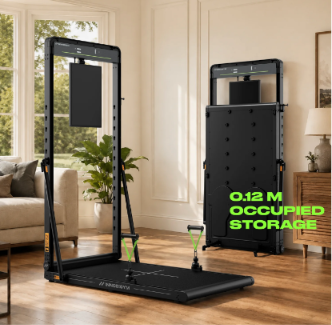
The Core Pitch: Squeezing a Commercial Gym into 1.1 Square Meters
The OMNI X1’s underlying logic is refreshingly direct—replace traditional iron weight stacks with servo motors, then deliver a commercial-grade strength training experience inside an ordinary living room.
Home fitness equipment has always faced a brutal trade-off. Treadmills and benches eat floor space. Resistance bands and cheap weight systems feel nothing like real gym equipment. Commercial cable machines feel amazing, but they will not fit in your apartment.
The OMNI X1 sidesteps this dilemma with dual servo motors that output up to 120kg of digital resistance per side, adjustable in 0.5kg increments. The resistance curve closely mimics the feel of barbells and cable machines. In plain terms, it tries to give you a gym-quality strength workout on your living room floor.
Moreover, the footprint matters. The unit occupies just 1.1 square meters, and when folded it shrinks to 14.5 centimeters thick. For urban apartments in Europe and North America where every square foot costs money, that compact profile is not a nice-to-have—it is essential.
AI Is Not a Gimmick Here, It Is a Barrier Killer
The hardware runs on a 360-degree multi-pulley system that supports squats, deadlifts, flyes, rows, and full-body movements. Yet the real differentiator from traditional strength gear is the AI layer.
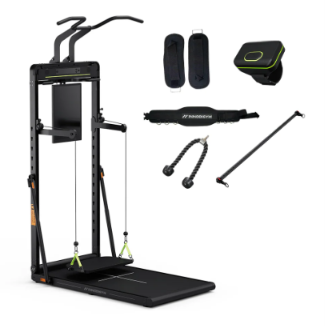
The standout feature is an AI-assisted pull-up system powered by LiDAR. It tracks your joint angles in real time and automatically provides assistance when you hit muscle failure. The practical value is simple: it dramatically lowers the entry barrier for upper-body training, letting beginners perform pull-ups that would otherwise take months to build up to.
On top of that, the machine packs a full smart safety system and iterative AI training software. It corrects your form, logs your workout data, and pushes customized training programs. These features serve both hardcore lifters and absolute beginners—essentially, it tries to please the gym veteran and the three-day-old gym member at the same time.
Why Now? The Post-Pandemic Home Fitness Wave Is Still Rolling
The OMNI X1’s success is not an isolated case. The home fitness hardware sector has been heating up for years, driven by three structural forces.
First, time economics. Gym memberships in Europe and North America are expensive, and the commute adds another thirty minutes each way. Many users would rather train at home than burn time on the road.
Second, space constraints. Urban housing is compact, and traditional home equipment is either too bulky, too ugly, or too limited in function. The OMNI X1 combines commercial-grade feel, small-footprint storage, and AI assistance in one package. It lands squarely on the pain point.
Third, the intelligence trend. Fitness consumers increasingly want more than “lift and count.” They want data, feedback, and personalization. AI and digital resistance technology deliver exactly that incremental value.
Product Tiers and Pricing Strategy
The OMNI X1 comes in two base configurations: a Basic screenless version and a Pro flagship with a high-definition display. You can also add a training bench and pull-up bar to build a complete home gym setup. This tiered approach is smart—use the basic model to lower the entry barrier, then drive average order value with premium bundles.
However, explosive crowdfunding numbers are only the opening act. Mass production, servo motor supply chain stability, overseas logistics costs, and after-sales infrastructure remain open questions. The gap between 561 Kickstarter backers and becoming a staple in Western home gyms is still massive.
Conclusion: A New Template for Chinese Fitness Hardware Going Global
The OMNI X1’s success boils down to a simple formula: identify a sharp pain point, build genuine technical differentiation, then validate demand through crowdfunding. It proves that Chinese fitness hardware has real demand in overseas markets, and it proves that the “digital resistance plus AI assistance” technical path has commercial legs.
But crowdfunding hype is merely step one. Moving from 561 backers to a genuine household name in home fitness requires crossing three major hurdles: product reputation, brand recognition, and distribution channels.
Either way, this is a space worth watching. Because any Chinese fitness device that convinces Western users to hand over $1.4 million in half a day is already saying something important.
This review is based on publicly available product information and Kickstarter campaign data. Actual user experience may vary. AICrunchX will continue tracking developments in the AI fitness hardware space.
Leave a Reply