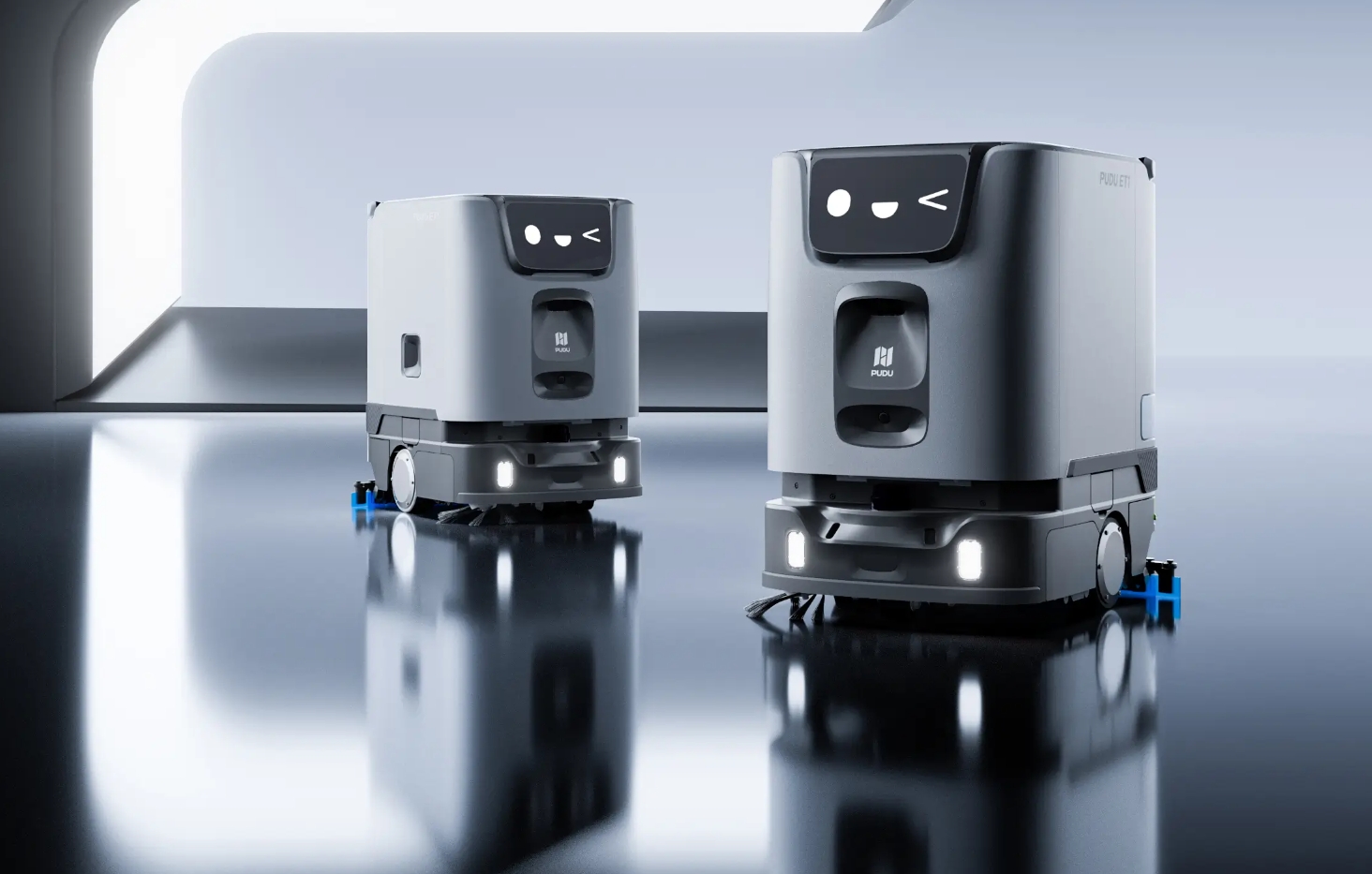
The commercial cleaning robot market has long been polarized. Large-scale floor-scrubbing robots offer high performance but are bulky and have strict aisle-width requirements; they struggle to operate in spaces ranging from 100 to 800 square meters—such as convenience stores, pharmacies, small eateries, and compact offices—where shelves are densely packed and aisles are narrow. Meanwhile, most standard small-scale cleaning devices on the market offer only automated sweeping without commercial-grade scrubbing capabilities; they often involve complex mapping and setup, and still require significant manual intervention for tasks like pre-treatment, water disposal, and brush cleaning, resulting in limited automation.
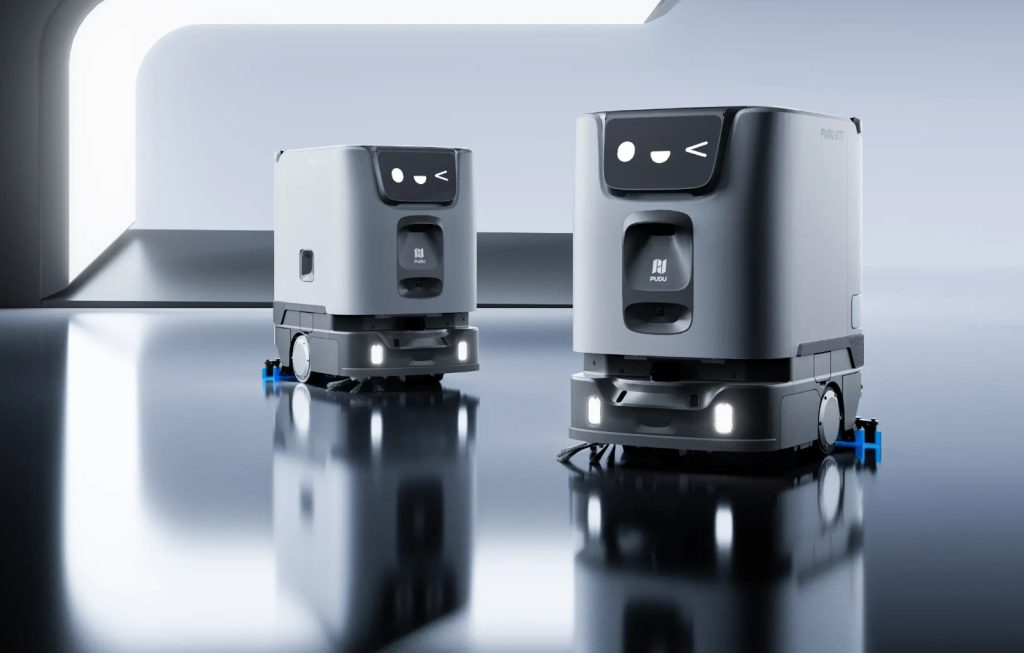
The all-new PUDU ET1 marks the debut of the E-series. Rather than simply shrinking a large scrubber, it was designed from the ground up for small and micro-commercial environments. It features an AI-native design, a “4-in-1” cleaning system, and an “8-in-1” fully automated workstation. Its goal is to bring comprehensive, unmanned cleaning capabilities to small chain stores, filling the industry gap where “large machines can’t fit, and small machines aren’t effective.”
Hardware: A compact body designed for narrow commercial spaces
The ET1 measures 500 × 380 × 580 mm, requiring an aisle width of only 50 cm and a clearance height of 60 cm. It can navigate and operate in tight spots—such as gaps between shelves, areas beneath counters, and spaces between tables and chairs—representing one of its core hardware advantages.
- 4-in-1 Cleaning Module: Front sweeping and rear scrubbing for simultaneous dry and wet cleaning
It integrates four functions—sweeping, scrubbing, vacuuming, and dust mopping—using a “sweep-front, scrub-rear” configuration. Front side brushes collect dry debris (such as paper scraps, crumbs, and hair), while the rear roller brush scrubs the floor and simultaneously recovers wastewater. This allows the robot to handle both dry debris and liquid stains in a single pass, eliminating the need for manual pre-sweeping. The roller brush reaches a maximum speed of 800 rpm with 20 kPa of vacuum suction, effectively handling footprints, beverage spills, and light oily residue.
It supports floor cleaning with 85°C hot water supplied by the docking station; this targets the sticky grease found in food service outlets and enhances the removal of stubborn stains.
The roller brush undergoes real-time self-cleaning, with continuous rinsing during operation to prevent cross-contamination of the floor. High wastewater recovery efficiency leaves minimal residual water, reducing the risk of customer slips and falls. - 8-in-1 fully automated docking station minimizes manual intervention
The core value of the system lies in its versatile docking station, which handles eight automated tasks: automatic charging, fresh water refilling, wastewater draining, detergent dispensing, roller brush rinsing, squeegee rinsing, roller brush spin-drying, and hot water generation.
After completing cleaning tasks, the robot automatically returns to the station for full maintenance, eliminating the need for staff to manually empty water or waste. It also features an industry-first automatic dust collection function; debris from the robot’s internal dust bin is automatically transferred to a large-capacity dust bag within the station, allowing for waste disposal only about once a week and significantly reducing the frequency of daily maintenance. - Perception and mobility hardware
The sensor suite includes LiDAR, depth vision, and multiple anti-collision sensors, making it suitable for dynamic environments with heavy foot traffic. It supports edge cleaning, allowing it to get close to corners and shelf edges to minimize cleaning blind spots.
The unit features a modular, quick-release design; the roller brush, squeegee, and dust bin can all be removed and cleaned by hand. Maintenance can be performed by regular store staff without the need for professional engineers, meeting the standardized maintenance requirements of chain stores.
AI Intelligent System: Magic Cleaning AI Agent—True AI-native cleaning
Unlike traditional robots that follow fixed routes based on pre-stored maps, the ET1 is equipped with the upgraded “Magic Cleaning AI Agent.” This creates a complete AI closed-loop process covering perception, analysis, path planning, execution, and optimization.
No pre-mapping required; autonomous exploration and mapping
Upon startup, it autonomously scans the environment to generate a map, eliminating the need for staff to manually guide the robot through the space. It is ready for deployment right out of the box. Whether for new chain locations or stores with layout adjustments, the robot autonomously detects environmental changes and updates its map. This lowers the barrier to entry, allowing regular staff to operate the system without requiring on-site setup by technical personnel. Intelligent Surface Recognition
AI identifies floor tiles, carpets, and areas with standing water, automatically adjusting cleaning components, suction power, and brush pressure. It prevents carpets from getting wet and adapts operational strategies when encountering large pools of water, making it suitable for the mixed flooring environments found in retail stores.
Dynamic Obstacle Avoidance & Pedestrian Compatibility
Designed for high-traffic environments like convenience stores and restaurants, the robot dynamically reroutes in real-time when encountering pedestrians, temporarily placed boxes, or movable furniture. It operates without interruption, allowing for cleaning during business hours rather than requiring store closure.
Cloud-Based Fleet Management
Chain brands can manage robots across multiple locations via a centralized backend, monitoring cleaning coverage, operation duration, and equipment status while deploying unified tasks—ideal for scalable deployment across chains. An optional 21.5-inch screen allows the robot to serve as a mobile marketing display while cleaning, adding value and enhancing project ROI.
Typical Deployment Scenarios
Chain convenience stores / drugstores: Narrow aisles with dense shelving, high foot traffic, and frequent spills (beverages/snacks); requires high-frequency, light-duty cleaning.
Small restaurants, cafes, and bakeries: Hot-water floor scrubbing to effectively tackle grease and oil stains.
Budget hotels and small offices: Daily maintenance for lobbies, corridors, and open-plan office areas.
Small retail stores: Compact sales floors; automates repetitive floor cleaning tasks previously done by staff.
Core Product Advantages
Precise positioning, filling a market gap: Few commercial products on the market integrate hot-water scrubbing, a fully automated docking station, and automatic dust collection into such a compact chassis; specifically targets 100–800m² spaces that were previously difficult for robots to service.
End-to-end automation with minimal human intervention: Handles everything from mapping and cleaning to docking for water refilling/drainage, brush self-cleaning, and dust disposal; minimizes repetitive tasks for staff such as emptying dirty water, washing brushes, and disposing of trash.
Low deployment barrier: Autonomous mapping and exploration eliminate the need for on-site professional engineers, enabling efficient rollout across chain locations.
Hardware designed for commercial durability: Modular construction ensures easy maintenance and supports long-duration, high-frequency commercial shift operations. Current Limitations and Areas to Watch
Cost Barrier: The complete solution—comprising the unit itself and a fully automated workstation—still presents a significant investment burden for independent small shops; it is better suited for bulk procurement by chains. ROI calculations for individual stores must factor in labor hours and personnel costs.
Extreme Conditions (Heavy Grease): While 85°C hot water enhances degreasing capabilities, heavily caked-on grease still requires manual pre-treatment.
Complex Obstacles and Boundaries: Tiny debris and tangled cables still pose a risk of jamming the roller brush—a common challenge for cleaning robots across the board.
Multi-unit Coordination: The product is currently designed primarily for single-unit store operations and does not yet target scenarios requiring multi-robot scheduling in massive spaces.
Summary: A Mature, Practical Solution for Automated Cleaning in Small Businesses
While commercial cleaning automation previously prioritized large-scale environments like shopping malls and logistics warehouses, the vast number of convenience stores and small eateries across cities have long relied on manual cleaning. The value of the PUDU ET1 lies in “scaling down” advanced commercial cleaning capabilities; this is not merely a reduction in hardware size, but a comprehensive adaptation of software, workstations, and maintenance systems to suit micro and small-scale stores.
Features such as autonomous mapping and environmental adaptability—powered by the “Magic Cleaning AI Agent”—combined with the 8-in-1 fully automated base station, address the biggest pain points for small-business robots: cumbersome deployment and tedious daily maintenance.
It demonstrates that competition in the AI cleaning robot sector is no longer just about scrubbing power or suction strength; the true differentiator is the extent to which human intervention can be minimized. The ET1 is ready for large-scale deployment within retail chains; its future success will depend on feedback from chain clients regarding actual mass implementation and the speed at which the total solution cost can be reduced.
Leave a Reply