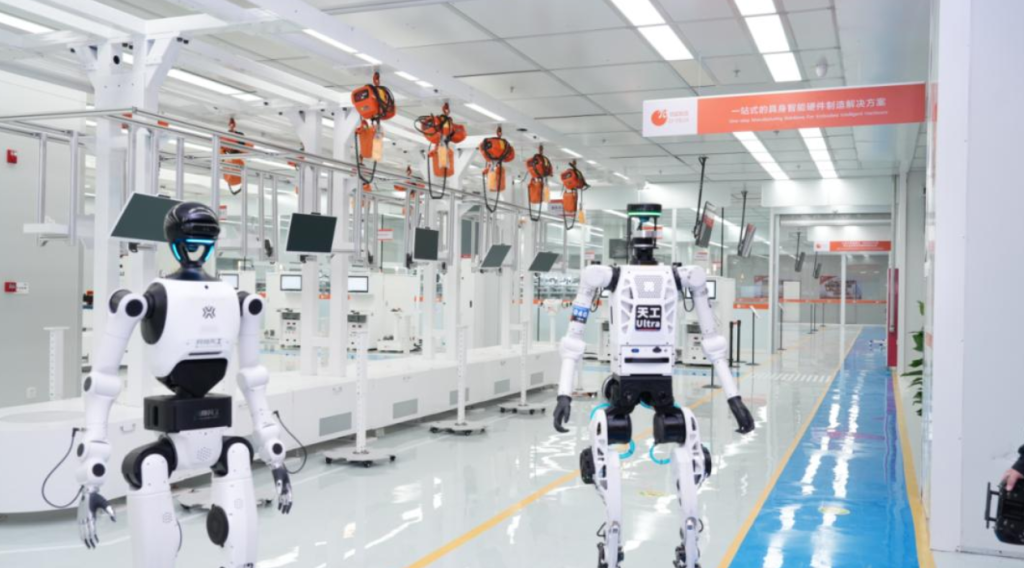
On April 17, 2026, at the Beijing Yizhuang Xiaomi Intelligent Port, an ordinary-looking launch ceremony might have changed the fate of China’s humanoid robot industry.
The first batch of humanoid robots officially rolled off the production line at Linkage Intelligent Manufacturing’s Beijing Embodied Intelligence Super Factory—including industry-leading models like Tiangong Ultra and Tiangong 3.0. As the first high-automation, high-compatibility, full-chain embodied intelligence super factory in the Beijing-Tianjin-Hebei region, it marks China’s humanoid robot industry’s official transition from “laboratory demonstrations” to “large-scale mass production.”
Breaking the “Easy R&D, Difficult Mass Production” Pain Point
The humanoid robot industry has an open secret: prototypes are easy to make, but mass production is extremely difficult.
UbTech spent 13 years reaching “thousand-unit mass production”; Tesla’s Optimus, announced in 2022, has repeatedly delayed its mass production timeline. Why? Because humanoid robots are incredibly complex—dozens of joints need precise coordination, control systems must respond in real-time, and heat dissipation, battery life, and reliability are all major obstacles.
More critically, traditional factories are often designed for single products. Switching robot models might require rebuilding entire production lines, making mass production costly and time-consuming.
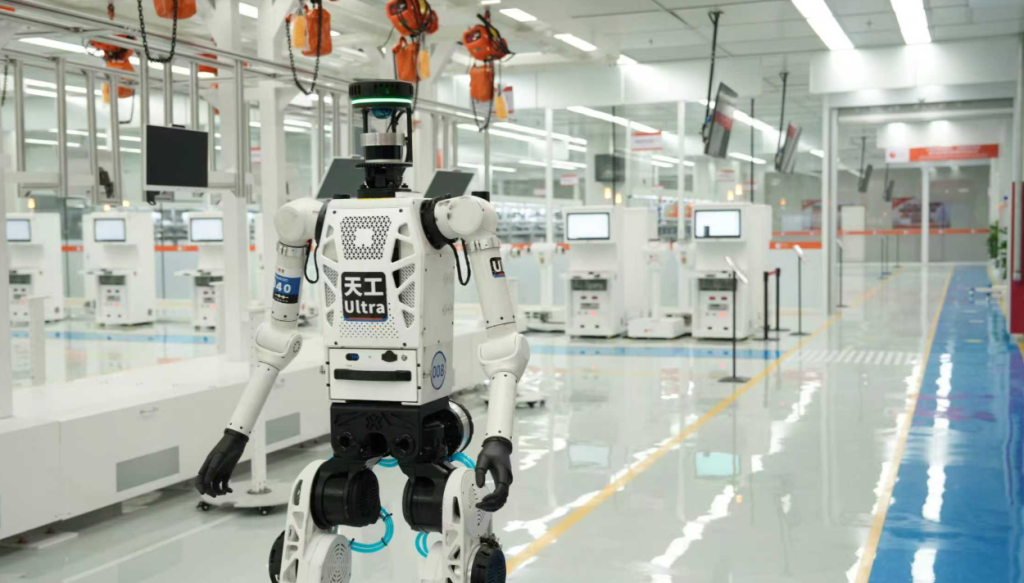
Linkage Intelligent Manufacturing’s super factory changed this situation. Through three core capabilities, the factory achieved efficient and flexible mass manufacturing:
- Multi-model mixed-line production: Joint line changeover time under 15 minutes—produce Tiangong Ultra today, switch to Tiangong 3.0 tomorrow
- Full-chain manufacturing: Core components, joint modules, complete assembly, and testing verification—all under one roof
- Flexible production: Testing platforms compatible with multi-protocol automatic docking, workstation adaptability for different sizes and configurations
From “Single-Point Breakthrough” to “Industrial Ecosystem”
In recent years, China’s humanoid robot industry showed “single-point breakthrough” characteristics—this company excels in motion control, that company leads in algorithms, another does components well. But these were isolated islands that couldn’t connect.
Now, a complete industrial closed loop is forming:
- Upstream: CATL supplies batteries and other core components
- Midstream: Beijing Humanoid Robot Innovation Center focuses on R&D, Linkage Intelligent Manufacturing handles manufacturing
- Downstream: Application scenarios like automotive manufacturing, consumer electronics, and power inspection continue expanding
More importantly, this super factory doesn’t serve just one company—it opens to the entire industry. It aims to become the “public infrastructure” for the embodied intelligence industry, enabling all companies that want to make robots to access its mass production capabilities.
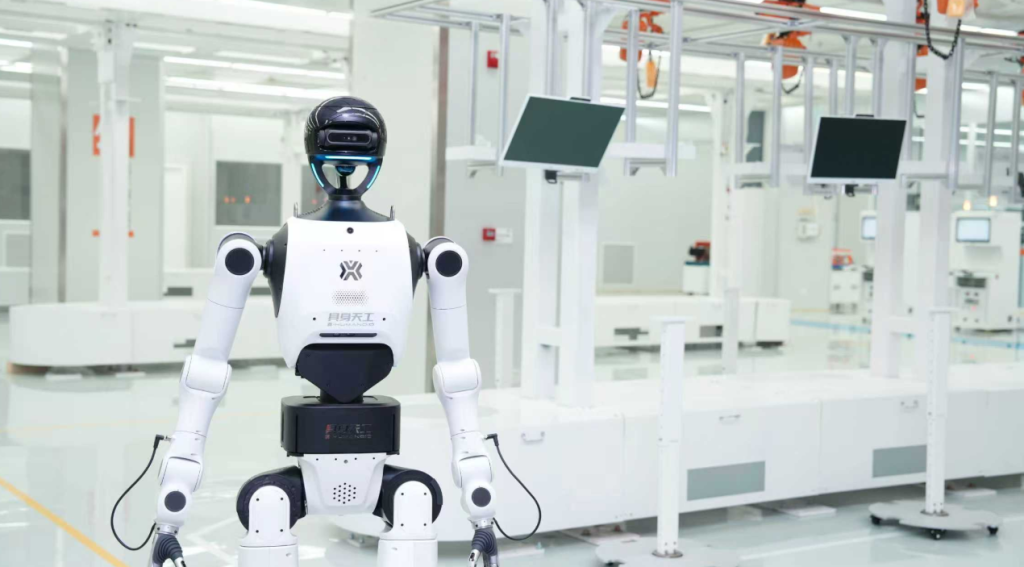
Tiangong Ultra: From Half-Marathon Champion to Mass Production
The first batch of models off the line represents the highest level of current humanoid robots.
Tiangong Ultra is the world’s first humanoid robot to complete a half-marathon. In April 2025, it finished the 21.0975-kilometer race in 2 hours 40 minutes 42 seconds, winning the championship. This robot achieves a maximum running speed of 12km/h and can withstand 45N·s impulse, equivalent to a professional boxer’s powerful strike. It maintains stable movement across various complex terrains including slopes, stairs, grass, gravel, and sand, validating reliability in challenging environments.
Tiangong 3.0, released in February 2026, goes even further. Standing approximately 1.69 meters tall and weighing 62 kilograms with 43 degrees of freedom, it can climb over approximately 1-meter-high obstacles with one hand, work flexibly on rough terrain, precisely dial knobs, and even perform complex movements like somersaults, table tennis bouncing, and dancing. As the industry’s first full-size humanoid robot achieving tactile interaction-based whole-body high-dynamic motion control, its operational precision is maintained at the millimeter level.
Ten-Thousand-Unit Production Capacity: Aiming for the Global First Tier
Look at the capacity plan: 10,000 units annually in 2026, 500,000 units annually by 2030.
What does this mean? Tesla Optimus’ 2025 capacity plan was 10,000 units with a goal of reaching 100,000 units by 2027. Linkage Intelligent Manufacturing’s super factory plan is already targeting the global first tier.
More notably, this factory has already received batch ODM orders from multiple North American AI and robotics companies. Foreign companies using Chinese factories to manufacture robots—this is not just a victory in production capacity, but a victory in the entire industry chain.
The Super Factory’s Core Strengths
What makes this super factory exceptional?
Full-chain manufacturing capability: Traditional humanoid robot manufacturing is typically divided—one company makes joints, another assembles, a third tests. Coordination costs between these stages are high. But this super factory integrates everything: precision structural components, joint module manufacturing, complete robot assembly, multi-condition parallel testing, and 24-hour smart logistics. Parts go in one end; fully tested robots come out the other.
High flexibility: Traditional factories might need to shut down for days to switch products. But this factory’s joint line requires only 15 minutes for changeover. Standardized interfaces, modular design, AI systems automatically adjusting production line configurations—small-batch, multi-variety, fast-iteration demands are perfectly met here.
High automation: You can hardly see workers in this factory. Component handling, assembly, testing, and storage are all automated systems. Operating 24 hours a day without stopping not only improves efficiency but, more importantly, ensures product consistency. Every robot coming off the line has equally stable quality.
A Chinese Sample of Industrial Ecosystem
The Beijing Humanoid Robot Innovation Center, the R&D entity behind Tiangong robots, has an interesting shareholder structure:
- Beijing Xiaomi Robot Technology Co., Ltd. (28.57%): Provides consumer hardware support and ecosystem collaboration
- Beijing UbTech Intelligent Robot Co., Ltd. (28.57%): Leads full-stack robot technology R&D
- Beijing Jingcheng Electromechanical Industry Investment Co., Ltd. (28.57%): Provides industrial-grade robot application support
- Beijing Yizhuang Robot Technology Industry Development Co., Ltd. (14.29%): Provides policy support and scenario opening
Xiaomi’s consumer electronics experience, UbTech’s robotics technology, Jingcheng Electromechanical’s manufacturing capabilities, and Yizhuang’s policy support—the four parties working together form a complete “technology + manufacturing + ecosystem” closed loop.
CEO Xiong Youjun stated that technology open-sourcing is key to industry development. The structural drawings, software architecture, and electrical systems of “Tiangong 1.0” are fully open-sourced; the large-scale multi-configuration intelligent robot dataset and evaluation benchmark “RoboMIND” are completely open to external parties; the “HuiSi KaiWu” platform is also open to the industry. Only through technology open-sourcing and ecosystem sharing can the entire industry progress rapidly.
From “Can Dance” to “Can Work”
From Tiangong 1.0 LITE’s release in April 2024, to Tiangong Ultra’s half-marathon championship in April 2025, to the super factory’s production launch in April 2026—in less than two years, Tiangong robots completed the evolution from “learning to walk” to “walking briskly.”
When tens of thousands of humanoid robots roll off this production line, when more automotive factories, logistics warehouses, and power inspection scenarios use these robots, when robot costs drop to levels affordable for ordinary enterprises—
Then, the humanoid robot industry will truly usher in its own “iPhone moment.”
Leave a Reply