Author: Gavin

  • Ascend 950 Orders Exceed 400,000 Units: Domestic AI Computing Reaches Critical Inflection Point

    In April 2026, a significant development emerged in China’s AI computing sector: tech giants including ByteDance and Alibaba collectively placed orders for Huawei’s Ascend 950 chips, with total volume approaching 450,000 units and procurement value around 475 billion RMB. This figure represents over half of Huawei’s annual shipment plan, triggering a 20% price increase while demand still outstrips supply.

    This isn’t merely a commercial transaction—it’s a critical signal that domestic AI computing is transitioning from isolated breakthroughs to a complete industry chain closure.

    Behind the Mass Procurement Rush

    Where do these 400,000 orders originate? The answer lies in two core driving factors.

    LLMs have entered peak deployment. In 2026, mainstream large models including DeepSeek V4, ERNIE Bot, and Tongyi Qianwen are all expanding iterations, with inference and training computing demands growing exponentially. The Ascend 950PR focuses on inference scenarios while the 950DT targets training, perfectly covering the full LLM workflow.

    Supply chain security has become essential. China’s computing market previously relied heavily on NVIDIA, but sustained export controls have made high-end chip supplies unstable and prices volatile. The Ascend 950—with full-stack domestic control from chip manufacturing to HBM memory to software frameworks—has become the core choice for tech giants to mitigate risks.

    Orders concentrated immediately, creating supply-demand imbalance. Currently, the Ascend 950PR standard version costs approximately 50,000 RMB, with premium versions around 70,000 RMB. Even with the 20% price increase, orders remain booked through the second half of the year.

    Performance Verification: Multiple Metrics Surpass Benchmarks

    Major client endorsement isn’t enough—the chip’s own hard capabilities are paramount.

    The Ascend 950PR is the world’s first mass-produced FP4 low-precision inference chip. Test data shows single-card FP4 computing power reaches 1.56P, while NVIDIA’s H20 delivers only 0.54P—a 2.87x performance gap. In practical terms, running the same LLM requires just one Ascend 950PR card, while the H20 needs three cards working in concert.
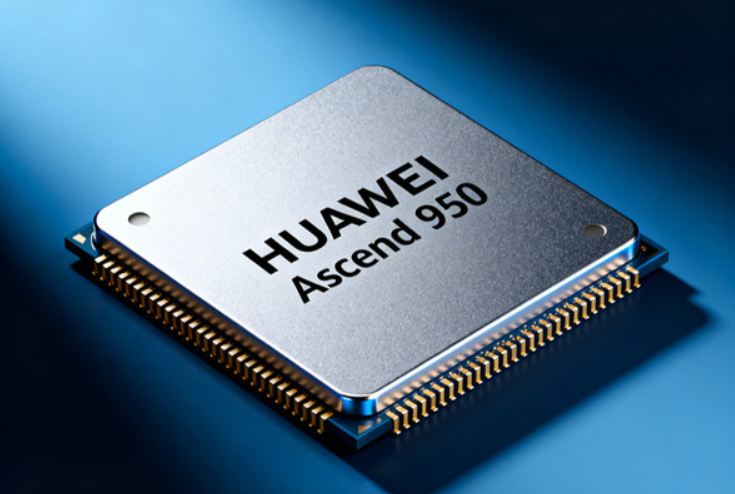
    Ascend 950 chip close-up showing precision manufacturing
    Ascend 950 chip close-up showing precision manufacturing

    Self-developed HiBL 1.0 HBM memory represents another breakthrough. Its 112GB HBM capacity exceeds the H20’s 96GB, enabling direct deployment of 70B parameter models without splitting. Crucially, self-developed HBM breaks overseas monopoly while reducing costs by approximately 30%.

    At the cluster level, Ascend 950 pairs with the Atlas 950 SuperPoD supernode architecture, supporting full interconnection of 8,192 chips. This architecture boosts computing utilization from traditional clusters’ 30%-40% to 70%-80%, increasing inference throughput 8-10x. DeepSeek V4 running on Ascend 950PR demonstrates 35x faster inference speed compared to NVIDIA chips while reducing energy consumption by 40%.

    Manufacturing has also achieved breakthroughs. The Ascend 950 uses SMIC N+3 process (equivalent to 5nm) through MCM quad-die packaging technology, completely bypassing EUV lithography restrictions. Current computing die yield has reached over 80% with steadily climbing production capacity.

    Ecosystem Closure: From “Usable” to “Usable and Efficient”

    Hardware performance forms only the foundation—software ecosystem determines success.

    At the end of 2025, Huawei announced full-stack open source of the CANN heterogeneous computing architecture, directly benchmarking against NVIDIA’s closed-source CUDA ecosystem. CANN 9.0 released in April 2026 provides comprehensive low-precision format support, reducing model migration costs from “months” to “hours” with compatibility rates exceeding 95%.

    DeepSeek V4 represents a landmark event—this global top-tier large model achieved 100% Ascend 950PR adaptation with full-stack migration to Huawei’s CANN framework, completely departing from NVIDIA’s CUDA ecosystem. Currently, over 40 mainstream large models and 200+ open-source models have fully adapted to the Ascend ecosystem.

    Modern AI data center interior with server corridors
    Modern AI data center interior with server corridors

    From industry applications, the Ascend 950 series has penetrated over 20 sectors including internet, finance, government affairs, and industrial internet. ByteDance and Alibaba use 950PR for recommendation systems, reducing latency by 50% and costs by 30%; major banks use 950PR for intelligent risk control, improving efficiency by 40%.

    Gaps Remain: Closure is the Starting Point

    We must acknowledge that domestic computing still lags behind international leading levels. Ascend 950’s single-card FP8 computing power reaches approximately 1 PFLOPS, while NVIDIA’s H200 delivers 4.5 PFLOPS; in manufacturing processes, SMIC’s N+3 equivalent 5nm still maintains a generational gap from TSMC’s 3nm.

    Yet the catch-up path is clear. Huawei’s published roadmap shows: Q4 2026 launches Ascend 950DT for training, Q4 2027 introduces the double-computing-power Ascend 960, and Q4 2028 reveals the Blackwell-benchmark Ascend 970.

    From 400,000 orders to full-stack ecosystem closure, domestic AI computing is undergoing a critical transition from “substitute product” to “preferred choice.” This process won’t happen overnight, but the trend has become irreversible.

  • Alibaba T-Head Expands Chip Portfolio with First Smart Network Card “Panmai 920” for Large-Scale AI Clusters

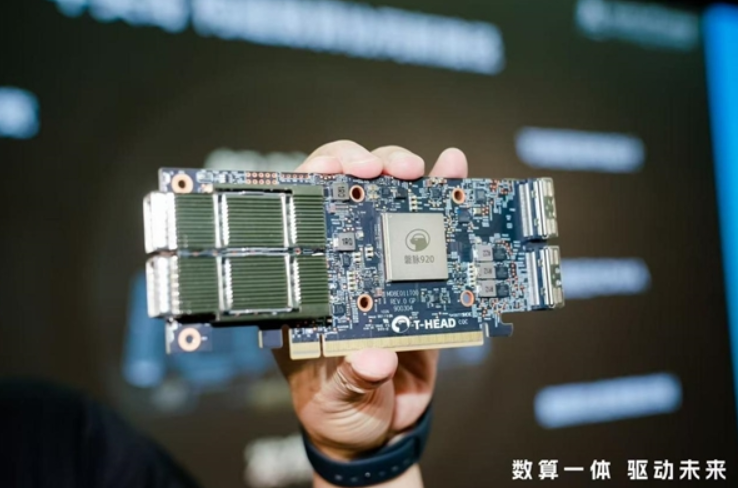
    On April 28, 2026, in Fuzhou, China — At the 2026 Digital China Construction Summit, Alibaba’s semiconductor subsidiary T-Head officially unveiled its first smart network card product, “Panmai 920.” Specifically designed for AI computing clusters with over 10,000 GPUs, this new product marks T-Head’s completion of a comprehensive “computing-storage-networking” chip layout.

    Three Years in the Making: T-Head’s Networking Milestone

    At the launch event, Li Xuhui, T-Head’s product director, showcased this smart network card developed over approximately three years. The Panmai 920 features T-Head’s self-developed network card chip and has achieved mass production, with initial deployment planned for Alibaba Cloud data centers. T-Head remains open to selling the product to external third parties.

    From a product perspective, the Panmai 920 is not an isolated device. Its debut completes T-Head’s comprehensive “computing-storage-networking” triangle layout. The Zhenwu series AI chips handle computing tasks, the Yitian series server CPUs provide general computing power, the Zhenyue series storage controllers manage data reading and writing, while the Panmai 920 focuses on high-speed network transmission. The collaboration of computing, storage, and networking — the three core data center components — forms the foundation for building efficient data centers.

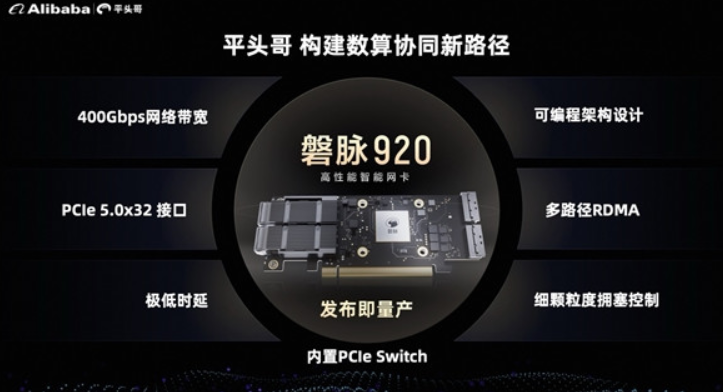
    Panmai 920 high-performance smart network card, showcasing its design and core specifications.
    Panmai 920 high-performance smart network card, showcasing its design and core specifications.

    Breaking the “Communication Wall”: 400Gbps Bandwidth Breakthrough

    In AI large model training scenarios, the “communication wall” represents a frequently discussed yet challenging problem. When GPU computing power continuously rises but network transmission capabilities fail to keep pace, significant computing resource idling occurs. Li Xuhui noted that many enterprise-grade network cards struggle to meet the high-performance demands of the large model era, resulting in only partial GPU computing power being effectively utilized.

    The Panmai 920’s core breakthrough lies in elevating network throughput bandwidth to 400Gbps. Current mainstream domestic smart network cards remain at the 100-200Gbps level, making the new product a two to four times performance leap. Higher bandwidth enables faster data exchange between computing nodes in GPU clusters, significantly reducing wait times.

    Beyond bandwidth improvements, the Panmai 920 introduces multi-path RDMA technology. RDMA is a high-speed network communication protocol allowing different servers to directly read and write each other’s memory. Traditional RDMA relies on single transmission paths, prone to congestion under high loads. The Panmai 920’s multi-path RDMA transmits data simultaneously across multiple physical paths, effectively breaking through this limitation. Li Xuhui stated that this technological upgrade can significantly shorten the completion time for model training and inference tasks.

    Alibaba T-Head semiconductor company logo, representing a significant force in China's self-developed chip industry.
    Alibaba T-Head semiconductor company logo, representing a significant force in China’s self-developed chip industry.

    Architectural Innovation: PCIe Switch Chip-level Integration

    At the hardware architecture level, the Panmai 920 employs an innovative PCIe Switch internal integration approach. PCIe is a standard high-speed interface connecting computer motherboards with peripheral devices, while PCIe Switch functions as a traffic hub for expanding connectivity and allocating bandwidth.

    Typically, PCIe Switch serves as a standalone device integrated on the motherboard. The Panmai 920’s breakthrough lies in directly integrating Switch functionality into the network card chip. This design delivers multiple advantages: it simplifies server motherboard design, reduces dependency on external switching chips, and more importantly, enables the network card to connect directly to GPUs and SSDs at ultra-low latency, eliminating performance losses from intermediate components. T-Head states this innovation reduces system costs by 30%.

    T-Head semiconductor product lineup, including Zhenwu AI chip, Yitian CPU, Zhenyue storage controller, and the newly launched Panmai 920 smart network card.
    T-Head semiconductor product lineup, including Zhenwu AI chip, Yitian CPU, Zhenyue storage controller, and the newly launched Panmai 920 smart network card.

    From Single Chip to Vertical Solutions

    Why did T-Head choose diversified layout rather than focusing on a single AI chip product? Li Xuhui explained that this strategic adjustment stems from in-depth understanding of actual AI infrastructure construction needs.

    In his view, releasing only one AI chip might result in being constrained by shortcomings in other hardware components when building computing clusters. True efficiency improvement requires coordinated optimization across computing, storage, and networking dimensions. The Panmai 920 was developed based on this philosophy — it’s not merely a hardware device but a key component of T-Head’s vertical solution.

    A Milestone for China’s AI Infrastructure

    From an industry perspective, the Panmai 920’s launch holds profound significance. As large model parameter scales continue expanding, clusters with 10,000 or more GPUs are becoming standard for training top-tier models. In this trend, network transmission capability’s importance grows increasingly apparent.

    The Panmai 920 addresses core challenges in ultra-large-scale clusters, enabling computing chips to fully release their potential. Its mass production marks a critical breakthrough in China’s AI infrastructure at the networking dimension, forming a synergy with already-progressed computing and storage products. It can be anticipated that with large-scale deployment of this product, domestic AI chips will possess stronger competitiveness in building high-performance, cost-effective data centers.

  • China’s Humanoid Robot Mass Production Breakthrough: How 15-Minute Production Line Changeover is Reshaping Industry Rules

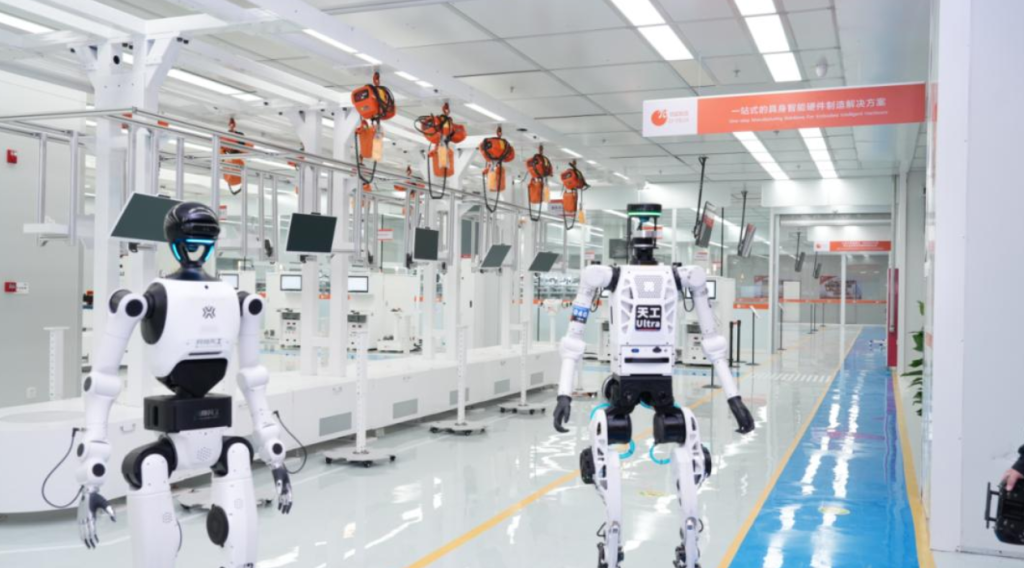
    A figure overlooking the Linkage Intelligent Manufacturing embodied intelligence factory
    A figure overlooking the Linkage Intelligent Manufacturing embodied intelligence factory

    On April 17, 2026, at the Beijing Yizhuang Xiaomi Intelligent Port, an ordinary-looking launch ceremony might have changed the fate of China’s humanoid robot industry.

    The first batch of humanoid robots officially rolled off the production line at Linkage Intelligent Manufacturing’s Beijing Embodied Intelligence Super Factory—including industry-leading models like Tiangong Ultra and Tiangong 3.0. As the first high-automation, high-compatibility, full-chain embodied intelligence super factory in the Beijing-Tianjin-Hebei region, it marks China’s humanoid robot industry’s official transition from “laboratory demonstrations” to “large-scale mass production.”

    Breaking the “Easy R&D, Difficult Mass Production” Pain Point

    The humanoid robot industry has an open secret: prototypes are easy to make, but mass production is extremely difficult.

    UbTech spent 13 years reaching “thousand-unit mass production”; Tesla’s Optimus, announced in 2022, has repeatedly delayed its mass production timeline. Why? Because humanoid robots are incredibly complex—dozens of joints need precise coordination, control systems must respond in real-time, and heat dissipation, battery life, and reliability are all major obstacles.

    More critically, traditional factories are often designed for single products. Switching robot models might require rebuilding entire production lines, making mass production costly and time-consuming.

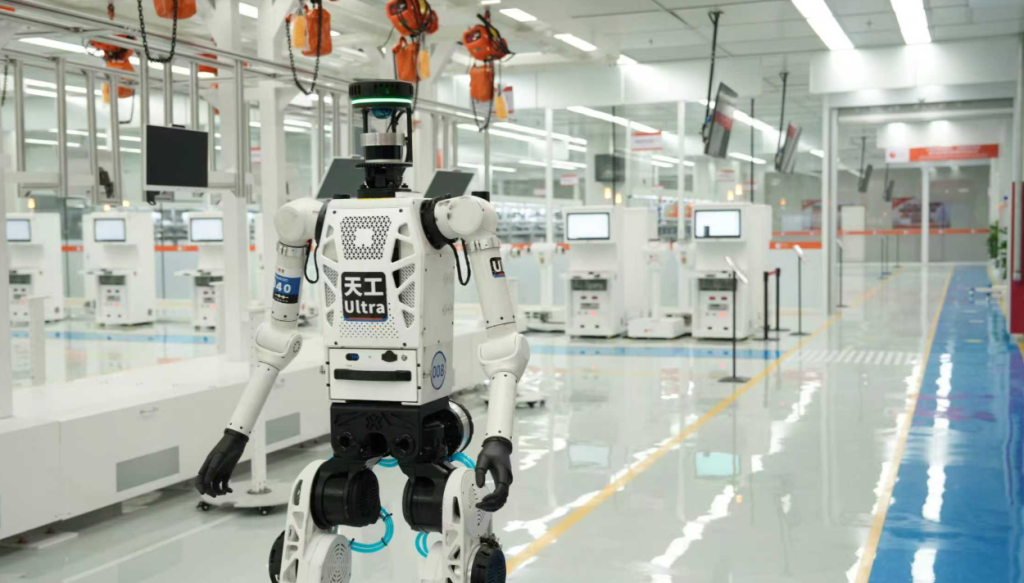
    The robot features a white body with black joints, a distinctive blue light ring on its head, and Tiangong Ultra markings on its chest. The fact
    The robot features a white body with black joints, a distinctive blue light ring on its head, and Tiangong Ultra markings on its chest. The fact

    Linkage Intelligent Manufacturing’s super factory changed this situation. Through three core capabilities, the factory achieved efficient and flexible mass manufacturing:

    • Multi-model mixed-line production: Joint line changeover time under 15 minutes—produce Tiangong Ultra today, switch to Tiangong 3.0 tomorrow
    • Full-chain manufacturing: Core components, joint modules, complete assembly, and testing verification—all under one roof
    • Flexible production: Testing platforms compatible with multi-protocol automatic docking, workstation adaptability for different sizes and configurations

    From “Single-Point Breakthrough” to “Industrial Ecosystem”

    In recent years, China’s humanoid robot industry showed “single-point breakthrough” characteristics—this company excels in motion control, that company leads in algorithms, another does components well. But these were isolated islands that couldn’t connect.

    Now, a complete industrial closed loop is forming:

    • Upstream: CATL supplies batteries and other core components
    • Midstream: Beijing Humanoid Robot Innovation Center focuses on R&D, Linkage Intelligent Manufacturing handles manufacturing
    • Downstream: Application scenarios like automotive manufacturing, consumer electronics, and power inspection continue expanding

    More importantly, this super factory doesn’t serve just one company—it opens to the entire industry. It aims to become the “public infrastructure” for the embodied intelligence industry, enabling all companies that want to make robots to access its mass production capabilities.

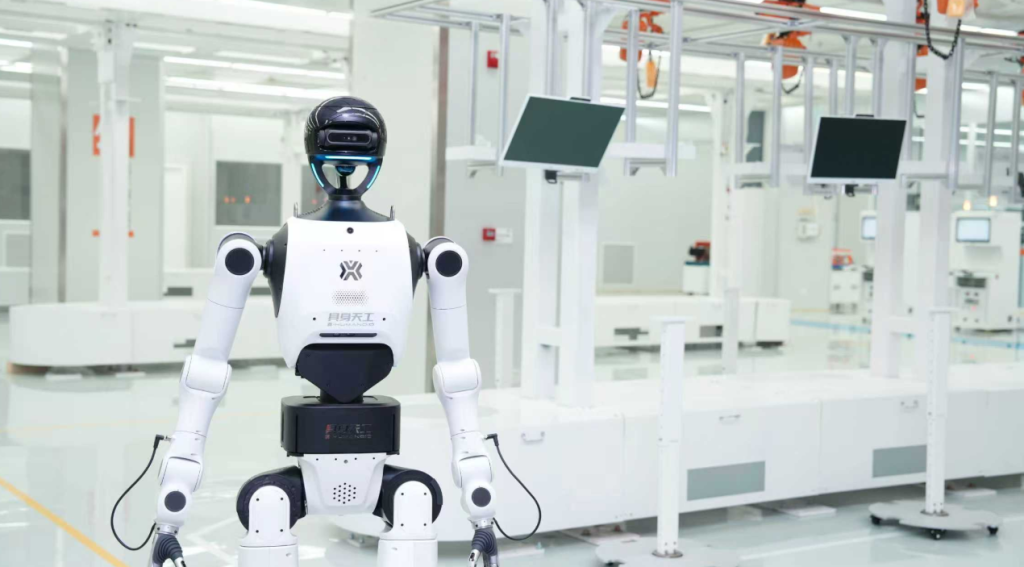
    The Tiangong embodied robot standing confidently in the factory setting, displaying its mechanical joints and blue lighting accents.
    The Tiangong embodied robot standing confidently in the factory setting, displaying its mechanical joints and blue lighting accents.

    Tiangong Ultra: From Half-Marathon Champion to Mass Production

    The first batch of models off the line represents the highest level of current humanoid robots.

    Tiangong Ultra is the world’s first humanoid robot to complete a half-marathon. In April 2025, it finished the 21.0975-kilometer race in 2 hours 40 minutes 42 seconds, winning the championship. This robot achieves a maximum running speed of 12km/h and can withstand 45N·s impulse, equivalent to a professional boxer’s powerful strike. It maintains stable movement across various complex terrains including slopes, stairs, grass, gravel, and sand, validating reliability in challenging environments.

    Tiangong 3.0, released in February 2026, goes even further. Standing approximately 1.69 meters tall and weighing 62 kilograms with 43 degrees of freedom, it can climb over approximately 1-meter-high obstacles with one hand, work flexibly on rough terrain, precisely dial knobs, and even perform complex movements like somersaults, table tennis bouncing, and dancing. As the industry’s first full-size humanoid robot achieving tactile interaction-based whole-body high-dynamic motion control, its operational precision is maintained at the millimeter level.

    Ten-Thousand-Unit Production Capacity: Aiming for the Global First Tier

    Look at the capacity plan: 10,000 units annually in 2026, 500,000 units annually by 2030.

    What does this mean? Tesla Optimus’ 2025 capacity plan was 10,000 units with a goal of reaching 100,000 units by 2027. Linkage Intelligent Manufacturing’s super factory plan is already targeting the global first tier.

    More notably, this factory has already received batch ODM orders from multiple North American AI and robotics companies. Foreign companies using Chinese factories to manufacture robots—this is not just a victory in production capacity, but a victory in the entire industry chain.

    The Super Factory’s Core Strengths

    What makes this super factory exceptional?

    Full-chain manufacturing capability: Traditional humanoid robot manufacturing is typically divided—one company makes joints, another assembles, a third tests. Coordination costs between these stages are high. But this super factory integrates everything: precision structural components, joint module manufacturing, complete robot assembly, multi-condition parallel testing, and 24-hour smart logistics. Parts go in one end; fully tested robots come out the other.

    High flexibility: Traditional factories might need to shut down for days to switch products. But this factory’s joint line requires only 15 minutes for changeover. Standardized interfaces, modular design, AI systems automatically adjusting production line configurations—small-batch, multi-variety, fast-iteration demands are perfectly met here.

    High automation: You can hardly see workers in this factory. Component handling, assembly, testing, and storage are all automated systems. Operating 24 hours a day without stopping not only improves efficiency but, more importantly, ensures product consistency. Every robot coming off the line has equally stable quality.

    A Chinese Sample of Industrial Ecosystem

    The Beijing Humanoid Robot Innovation Center, the R&D entity behind Tiangong robots, has an interesting shareholder structure:

    • Beijing Xiaomi Robot Technology Co., Ltd. (28.57%): Provides consumer hardware support and ecosystem collaboration
    • Beijing UbTech Intelligent Robot Co., Ltd. (28.57%): Leads full-stack robot technology R&D
    • Beijing Jingcheng Electromechanical Industry Investment Co., Ltd. (28.57%): Provides industrial-grade robot application support
    • Beijing Yizhuang Robot Technology Industry Development Co., Ltd. (14.29%): Provides policy support and scenario opening

    Xiaomi’s consumer electronics experience, UbTech’s robotics technology, Jingcheng Electromechanical’s manufacturing capabilities, and Yizhuang’s policy support—the four parties working together form a complete “technology + manufacturing + ecosystem” closed loop.

    CEO Xiong Youjun stated that technology open-sourcing is key to industry development. The structural drawings, software architecture, and electrical systems of “Tiangong 1.0” are fully open-sourced; the large-scale multi-configuration intelligent robot dataset and evaluation benchmark “RoboMIND” are completely open to external parties; the “HuiSi KaiWu” platform is also open to the industry. Only through technology open-sourcing and ecosystem sharing can the entire industry progress rapidly.

    From “Can Dance” to “Can Work”

    From Tiangong 1.0 LITE’s release in April 2024, to Tiangong Ultra’s half-marathon championship in April 2025, to the super factory’s production launch in April 2026—in less than two years, Tiangong robots completed the evolution from “learning to walk” to “walking briskly.”

    When tens of thousands of humanoid robots roll off this production line, when more automotive factories, logistics warehouses, and power inspection scenarios use these robots, when robot costs drop to levels affordable for ordinary enterprises—

    Then, the humanoid robot industry will truly usher in its own “iPhone moment.”

  • Apple Accelerates Six AI Hardware Products, Smart Glasses and HomePad as Strategic Priorities

    Apple:symbolizing the shadow of innovation
    Apple:symbolizing the shadow of innovation

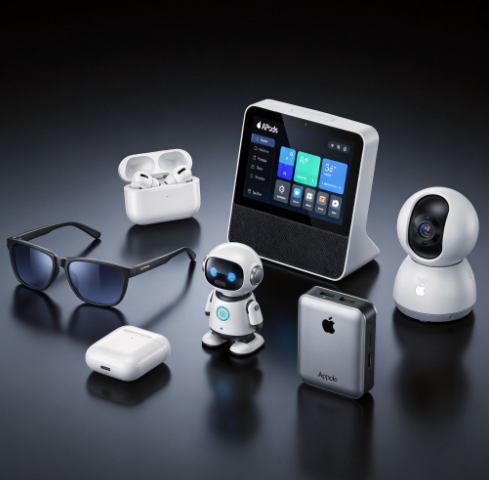
    On April 24, 2026, the tech world received significant news: Apple is accelerating the development of six entirely new hardware categories, including AI-powered AirPods, smart glasses, portable accessories, smart displays, home robots, and security cameras. This announcement quickly sparked industry-wide discussion, marking Apple’s major strategic shift from a single flagship product approach to a comprehensive intelligent ecosystem.

    Six New Products Outline the Future

    These six upcoming products show a clear gradient distribution. AI AirPods are viewed as a natural evolution of the current audio lineup, primarily enhancing AI interaction capabilities on existing hardware—a gradual upgrade. The remaining five products, however, represent Apple’s first entry into previously uncharted territory, carrying far greater strategic significance.

    Industry analysts suggest that smart glasses and smart displays represent the true strategic priorities. The core objective of these two categories is to break free from iPhone’s role as a single entry point, creating next-generation human-computer interaction interfaces and home intelligence hubs. Apple hopes to build a complete ecosystem covering personal wearable, home life, mobile office, and multiple other scenarios through these new products.

    Smart Glasses: A Decade in the Making

    Among the six new products, smart glasses are undoubtedly the most eye-catching. Information disclosed by overseas media reveals that Apple is developing smart glasses codenamed N50, featuring a display-free design with camera and audio components, enabling deep Siri integration.

    Notably, Apple CEO Tim Cook has designated AR glasses as the company’s “highest strategic priority.” Looking back at Apple’s decade-long AR journey, the company began its布局 as early as 2016, launching the premium Vision Pro headset in 2024. However, this product failed to become a mass consumer good due to its high price and bulky form factor.

    True consumer-grade AR glasses are estimated to still be several years away. Apple’s goal is to create lightweight, all-day wearable glasses that seamlessly overlay digital content onto the real world. Achieving this vision requires breakthroughs not only in optical display technology but also in balancing battery life, size, and interaction methods.

    Regarding the timeline, the N50 smart glasses are expected to launch between late 2026 and early 2027, with plans to complete market availability by end of 2027. This means consumers will have to wait until at least 2027 to truly experience Apple’s AR glasses.

    HomePad: A New Chess Piece for Home Scenarios

    Unlike smart glasses’ long development cycle, the HomePad smart display has been scheduled for fall 2026 release. According to reports, this product extends HomePod’s audio heritage while adding touchscreen functionality, aiming to become the intelligent interaction center for home scenarios.

    Industry insiders believe HomePad positions itself between smart speakers and iPad, offering both voice interaction convenience and screen-based operational advantages. With the maturing smart home ecosystem, such a highly integrated control device could become the “sixth screen” in home scenarios.

    However, HomePad faces a not-so-friendly competitive environment. Amazon’s Echo Show, Google’s Nest Hub, and domestic competitors like Xiaomi’s XiaoAI Touch Screen Speaker and Baidu’s Xiaodu Smart Screen have already captured market share. Whether Apple can achieve differentiation through its traditional advantages in ecosystem integration and user experience is worth continued attention.

    Home Robot: The Most Ambitious Exploration

    Among the six new products, the home robot is undoubtedly the most ambitious and uncertain. This represents Apple’s first entry into the home service robot sector, positioned as a premium desktop intelligent assistant.

    Sources indicate this project faces delays due to high technical complexity, with initial plans for 2027 release potentially pushed to 2028. Unlike current market offerings like robotic vacuum cleaners and delivery robots, home robots require more comprehensive capabilities in environmental perception, conversational interaction, and task execution—posing far greater technical challenges.

    Analysis suggests Apple’s decision to begin home robot development at this time reflects its judgment on home scenario intelligence trends. If technical maturity reaches expectations, this product could become Apple’s most disruptive hardware innovation since the iPhone.

    Ecosystem Integration Becomes Key

    Apple's vision for integrated AI hardware ecosystem, connecting personal devices with home intelligence.
    Apple’s vision for integrated AI hardware ecosystem, connecting personal devices with home intelligence.

    Overall, Apple’s six new hardware products show clear collaborative characteristics. Whether it’s AI AirPods’ audio interaction with smart glasses or HomePad’s home scenario connectivity with home robots, everything points in one direction: achieving seamless cross-device, cross-scenario experiences through a unified AI technology foundation.

    This ecosystem-oriented approach aligns with Apple’s strategy in software services. The introduction of Apple Intelligence has provided Apple’s hardware lineup with a unified AI capability platform. As the six new products gradually launch, this platform will gain richer hardware carriers, forming a true “AI hardware ecosystem closed loop.”

    Of course, the challenges Apple faces cannot be overlooked. In smart glasses, Meta’s Ray-Ban smart glasses have accumulated millions of users; in the home intelligence control sector, Amazon and Google have deep roots. Whether Apple can catch up and surpass in fierce competition ultimately depends on whether the product experience can truly resonate with consumers.