One-sentence verdict: If “wrist-worn AI recording” can prove its transcription accuracy withstands real meeting tests, the TicNoteWatch may be the strongest reason for business professionals to switch watches in 2026—after all, $138 buys not just a watch, but a secretary who never misses a note.
Breaking News
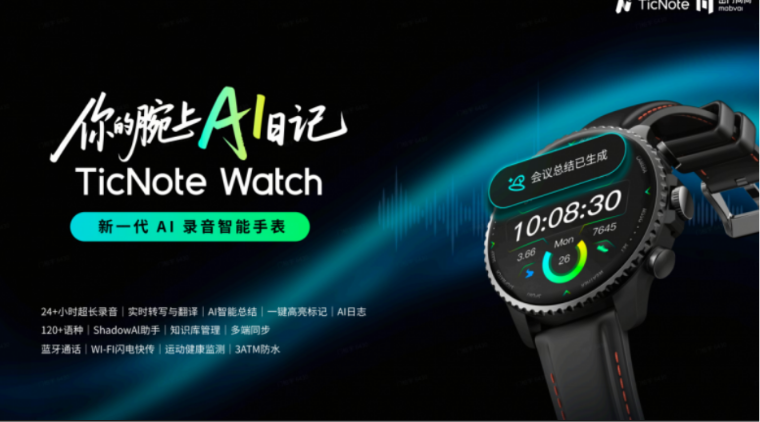
On June 15, 2026, Mobvoi officially launched the TicNoteWatch AI recording smartwatch, priced at 999 RMB ($138), now available on JD.com and Tmall. The device supports two-second long-press recording activation, with built-in ShadowAI assistant enabling real-time voice transcription across 120 languages (98%+ accuracy). Post-meeting AI automatically extracts core summaries and to-do items, with team collaboration mode support. The watch also covers all-day scenarios including fitness, health, and sleep tracking, forming an AI journal timeline with 24-hour battery life.
Full Story
Mobvoi is no newcomer to AI hardware. From early TicWatch smartwatches to TicPods earphones, the company has consistently explored the boundary of “AI + wearables.” The TicNoteWatch launch marks a clear strategic pivot from “general-purpose smartwatch” to “vertical productivity tool.”
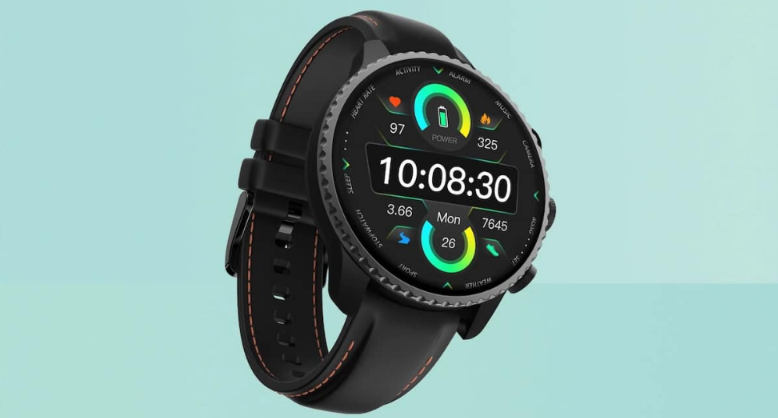
In form factor, the TicNoteWatch retains the basic smartwatch framework—round dial, touch screen, silicone strap—but the core interaction logic is redesigned. A two-second long press of the crown activates recording, an operation far smoother than pulling a voice recorder from a bag, unlocking a phone, opening an app, and tapping record. In business scenarios, “fast” often means “nothing missed”—many key details are lost in the seconds spent locating a device.
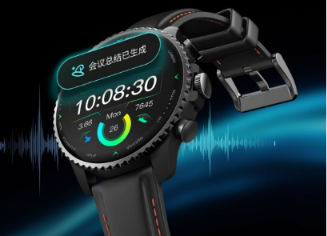
The post-meeting summary function is another differentiator. The traditional voice recorder workflow is: record → export → manual transcription → organize key points → distribute. The TicNoteWatch compresses this to: record → AI auto-transcription → auto-extract summary and to-dos → one-click share. For business professionals averaging two to three meetings daily, this efficiency gain is substantial.
The AI journal timeline is a conceptual innovation. The watch automatically integrates recordings, exercise, sleep, and heart rate data into a chronological “what happened today” structured log. The practical value of this feature depends on AI integration capabilities—if it merely piles data, the significance is limited; if it can automatically recognize that “the 3 PM recording relates to the morning email” and establish connections, it achieves genuine intelligence.
Analysis
The $138 Pricing Category Play
The smartwatch market has long been dominated by Apple Watch and Huawei at the high end, and Xiaomi and Amazfit at the low end, with the mid-range ($110-$210) lacking memorable products. The TicNoteWatch’s 999 RMB positioning precisely targets this gap.
More critically, it is not “selling a watch” but selling a bundle of “voice recorder + meeting minutes service + watch.” A professional voice recorder (like the Sony UX570) costs approximately $110, plus transcription service annual fees around $40, totaling over $150. The TicNoteWatch packages these functions for $138, with fitness and health monitoring included—this value equation is highly attractive to price-sensitive business professionals and students.
Birth of the “Wrist-Worn AI Recording” Category
The TicNoteWatch launch, alongside the concurrent aigo recording watch release, jointly gives birth to the “wrist-worn AI recording” category. The core logic of this category is: the watch is the only device worn every day, making it the optimal carrier for “passive recording.”
The pain point of traditional recording is “no device when you need it,” which the watch fundamentally resolves. Meanwhile, AI transcription and summary generation solve the secondary pain point of “recorded but don’t want to organize.” The continuous resolution of these two pain points constitutes the value foundation of the new category.
But whether the category can establish itself depends on two variables: first, the real-world performance of transcription accuracy; second, whether battery life can sustain all-day use. The 24-hour battery life is sufficient on paper, but actual performance with continuous recording and real-time transcription activated requires user validation.
Differentiated Positioning Against Competitors
| Feature | Mobvoi TicNoteWatch | Apple Watch Series 10 | Huawei Watch GT 5 | aigo Recording Watch |
|---|---|---|---|---|
| Price | $138 | $415+ | $205+ | ~$110 |
| Recording | One-touch + AI transcription | No native recording | No native recording | One-touch recording |
| AI Transcription | 120 languages real-time | None | None | Limited languages |
| Meeting Minutes | AI auto-generation | None | None | None |
| Team Collaboration | Supported | None | None | None |
| AI Journal | Timeline integration | Health data summary | Health data summary | None |
| Battery Life | 24 hours | 18 hours | 14 days | ~7 days |
The TicNoteWatch’s competitive advantage is clear: the only product in the sub-$150 tier offering a complete chain of “recording + AI transcription + meeting minutes + team collaboration.” Apple Watch and Huawei Watch GT series are stronger in ecosystem and brand but lack deep productivity scenario coverage. The aigo recording watch holds first-mover advantage in recording functionality but lags significantly in AI capabilities.
Industry Impact
The TicNoteWatch launch may drive smartwatches’ functional expansion from “health devices” to “productivity devices.”
Market impact: The $138 pricing may trigger price wars in the “AI recording watch” sub-category, forcing traditional voice recorder manufacturers (like Sony, Philips) to accelerate intelligent transformation, while pushing smartwatch brands (like Xiaomi, Amazfit) to add recording and AI features to entry-level product lines.
Consumer impact: Business professionals and students see significantly reduced meeting documentation costs. The previous three-layer investment of voice recorder + transcription service + manual organization is now solved by a single watch. The AI journal timeline concept may also change user recording habits, shifting from “active recording” to “passive recording.”
Industry impact: If the “wrist-worn AI recording” category gains market recognition, smartwatch functional definitions will expand from “health + notifications” to “health + notifications + productivity.” This may trigger a new round of hardware innovation, competing for larger storage, longer battery life, and more precise microphone arrays.
Leave a Reply