I. Starting from the original intention: A Chinese original team that has inscribed “children’s cognitive science” into code
Hippocampus (Hippocampus Daddy) is not a marketing upstart that suddenly appeared out of nowhere. It was founded in 2019 by a cross-disciplinary team including a PhD in child development psychology, a former curriculum director of a Montessori education institution, a Huawei AI algorithm engineer, and a senior picture book illustrator. The name “Hippocampus” comes from the hippocampus, a key neural structure in the brain that governs memory and spatial learning, while “Daddy” conveys warmth and companionship, directly addressing the product’s core: not a cold, impersonal tool, but a “digital parenting partner” who understands the rhythms of children’s development. Over the past five years, the team has conducted in-depth research on early language acquisition, concrete thinking transformation, and multimodal feedback mechanisms in children aged 0-8. They have obtained 7 national invention patents, received certification as a “Smart Early Childhood Education Application Demonstration Project” from the Ministry of Education, and jointly established an “AI Early Education Interactive Behavior Database” with the Institute of Child Psychology at Beijing Normal University.
The newly launched AI Magic Printer (model: HP-MagicPrint Pro Kids Edition) is the first hardware product to be implemented after 38 months, 12 iterations of prototype development, and real-world testing in 27 kindergartens across the country. It does not print documents, but only “understanding”; it does not output ink, but outputs a visible “cognitive scaffolding” for growth.
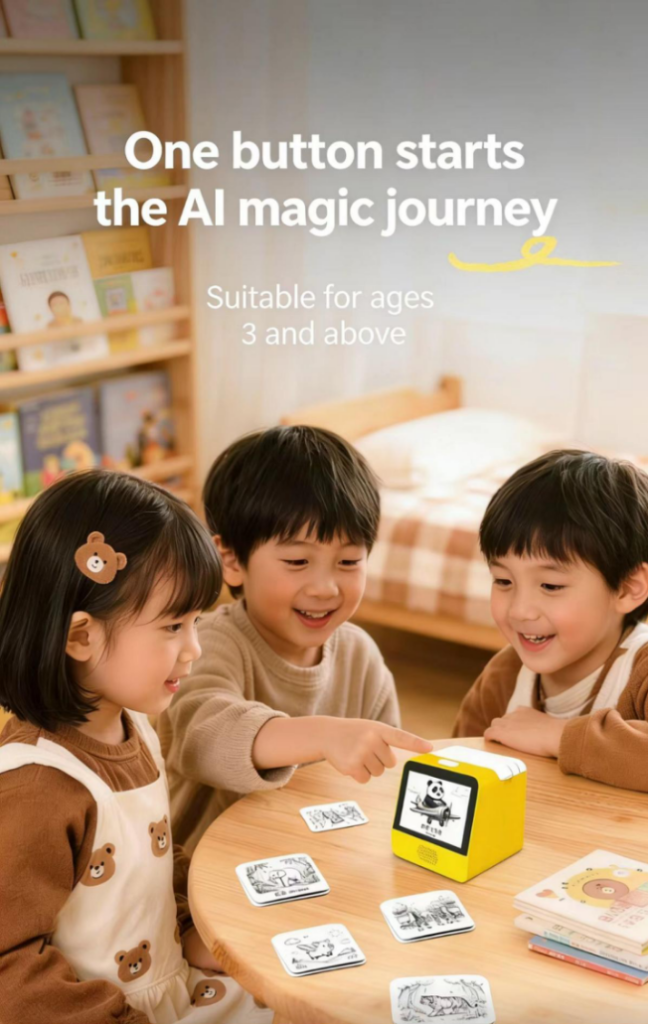
Figure 1: Hippocampus AI Magic Printer
II. Redefining the “Magical Three Primary Colors” of Children’s AI Toys
In a market saturated with similar smart toys, Hippocampus refuses to simplify AI to mere voice-based question-and-answer or animated playback. Its AI Magic Printer is anchored in the theory of “Embodied Cognition”—children construct knowledge through physical movement, hands-on manipulation, and interaction with their environment. Its core positioning is: **the world’s first “3D cognitive printer” integrating generative AI, real-time visual recognition, touch-sensitive thermal printing, and contextualized voice feedback.**
Three irreplaceable core highlights form a true “magical” closed loop:
The “Draw and Print” dynamic generation engine allows children to doodle on specially designed sensor paper using the accompanying inkless watercolor pens (such as drawing a crooked sun). The device recognizes the intention of the lines within 0.8 seconds through an AI visual model, automatically completes the drawing into a vector image that conforms to children’s aesthetic standards, and adds a voice explanation: “Wow! You drew a warm sun, which makes the little flowers open their eyes~”. Then, a high-definition color card (including an AR trigger code) is printed out using thermal printing.
The “Story Grower” cross-modal creation system: Children dictate 3 fragmented stories (such as “the puppy chases the butterfly”, “falls into the rainbow pool”, “becomes a cloud and flies home”), and AI automatically sorts out the logical chain, generates 4-panel comic strip storyboards, and simultaneously outputs age-appropriate voice narration + onomatopoeia (wind sound, wing flapping sound), and prints them into tear-off story journal pages.
“Growth Imprint Paper” digitizes growth records: each print is automatically encrypted and archived (local offline storage, no cloud upload), and generates monthly visual reports based on 6 dimensions such as “graphic representation ability”, “narrative integrity” and “vocabulary richness”. Parents can view trend curves and professional parenting advice on the APP (e.g., “the frequency of use of spatial orientation words increased by 40% this month, it is recommended to add block building games”).
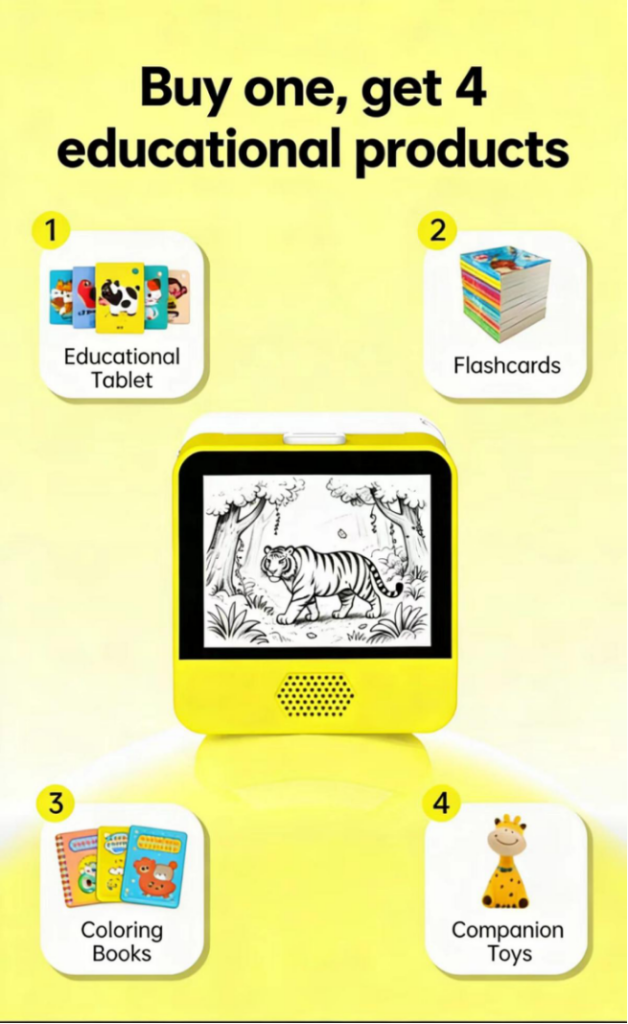
Figure 2: The AI Magic Printer can be…
three, Hippocampus configuration parameters
The Hippocampus AI Magic Printer is designed with child development principles in mind at both the hardware and algorithm levels, and all parameters are based on clear educational theories.
The AI processing unit uses a self-developed lightweight TinyLLM-Child model (1.2B parameters), which is specially designed for deep fine-tuning of real-world data such as daily spoken language, reduplicated words, and grammatically incomplete sentences of children aged 3-7. All calculations are completed on the device side without the need for an internet connection, and the response latency is stably controlled within 1.2 seconds, truly achieving “zero waiting time and zero privacy risk”.
The image recognition system is equipped with a dual-camera collaborative architecture: a 1-megapixel wide-angle main camera is responsible for capturing the overall composition and movement trajectory of the doodle, while a 2-megapixel macro auxiliary camera accurately senses changes in pen pressure, pen angle, and pause rhythm. This dual sensing capability allows it not only to distinguish “this is the sun” but also to judge “whether the child is hesitantly trying to draw a circle or confidently completing it in one go,” thus avoiding misjudging exploratory doodles as “drawing wrong” and greatly protecting the child’s desire to express themselves.
The printing module uses food-grade safe thermal direct injection technology with a resolution of up to 300dpi. It supports double-sided gradient color rendering (such as simulating the natural transition of sunlight from blue to yellow). The ink has passed SGS skin contact safety certification for infants and young children. When it comes into contact with water, it can reveal hidden patterns (such as smiling faces appearing on clouds after water is sprinkled), stimulating children’s interest in repeated observation and scientific exploration. A single roll of special developing paper can be printed approximately 300 times, balancing durability and environmental friendliness.
The interactive interface is a 2.8-inch anti-glare rounded touchscreen with minimalist icons and no text, using only graphic symbols to convey functions. Three flexible pressure-sensitive breathing lights are embedded on the top of the device, which slowly change brightness according to the child’s operation rhythm—a red light indicates “thinking”, a yellow breathing light means “please try again”, and a solid green light means “success!”—using the most primitive language of light to replace preaching and reduce cognitive load;
The safety system has passed the national CCC mandatory certification and the EU EN71-3 toy safety standard (the migration of heavy metals such as lead, cadmium, and mercury is less than 0.1mg/kg). The edges and corners of the whole machine adopt an R15mm ultra-large radius rounded corner design, and the holding weight is strictly controlled at 420 grams, ensuring that even a 3-year-old child can operate it stably with one hand.
The content ecosystem includes over 1,200 sets of original IP-themed materials (such as “Dr. Hippocampus Lab” and “Stardust Rabbit Math Garden”). All content has been validated by the Child Development Psychology Laboratory of Beijing Normal University, rejecting traffic-driven entertainment designs. Twenty “cognitive challenge packs” are pushed out monthly via OTA firmware updates, such as “Shape Detective Week” and “Emotion Color Day,” integrating abstract ability training into gamified tasks.
IV. Strengths and Weaknesses
Significant advantages:
A truly child-centered design philosophy: from the weight to hold (only 420g), button size (12mm diameter to prevent accidental touches), to the speech rate (142 words per minute, precisely matching the peak auditory processing speed of a 3-year-old child), every detail is not something that comes out of thin air, but is based on thousands of hours of children’s behavior video analysis and eye-tracking experiments;
Privacy protection is maximized: the device has no microphone, no camera recording function, and no network module. All AI recognition, generation, and storage are completed locally. Parents can turn off all sensors with a single physical switch on the side of the device, completely cutting off data output.
The educational value is measurable and traceable: In a 12-week controlled experiment at a provincial-level demonstration kindergarten in Yuexiu District, Guangzhou, 5-year-old children who used this product continuously showed a 57% increase in “naming accuracy” and a 2.3-word increase in “average length of spontaneous descriptive sentences” on the standardized “Preschool Children’s Graphic Representation Ability Assessment Scale”. Teacher observation records also showed that the duration of their drawing activities increased by 35%, confirming the product’s positive promotion of concentration and motivation for expression.
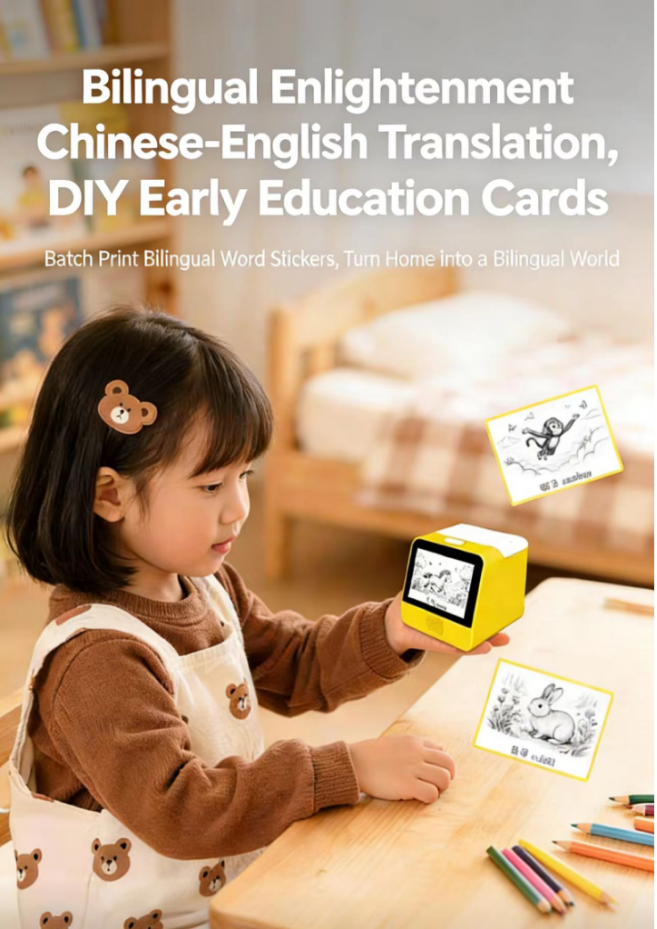
Figure 3: Bilingual early learning, DIY early education flashcards
Objective limitations:
Consumable costs are slightly higher: the unit price of dedicated thermal developer paper is $12.90/roll (approximately 300 effective prints). Although it integrates AR interaction, water-based printing technology and safe ink, it needs to be included in the long-term use plan for budget-sensitive families .
Creative guidance involves “gentle intervention”: When AI completes a doodle, it automatically optimizes the proportions and symmetry (such as adjusting a crooked circle into a more regular sun outline). While this “beautification” improves the visual completeness, it may inadvertently weaken a child’s self-acceptance of “imperfect expression.” This reminds us that technology is always secondary. The real finishing touch in education is when parents kneel down and say, “Mom likes the crooked sun you drew the first time. It looks like it’s smiling at you.”
The openness of the ecosystem still needs to be expanded: the current content library is entirely developed and reviewed by Hippocampus and does not yet support third-party educational institutions or parents to upload customized materials; the official announcement has clearly stated that the V2.1 firmware will launch the “Teacher Resource Import Interface” in Q4 of 2024, supporting kindergarten teachers to upload school-based curriculum drawing templates in batches.
V. Comparison of Mainstream Competitors
There are many children’s drawing hardware products on the market that claim to be “AI,” but if we examine them from the perspective of education, the differences become immediately apparent:
A certain international brand’s AI drawing box (priced at $199) is essentially a “voice-to-template” tool—when a child says “draw a dinosaur,” the device randomly selects one from five preset dinosaur templates and then mechanically fills in the colors. Throughout the process, the child is an observer rather than a creator. The seven-step operation process (selecting a theme → selecting a style → adjusting the size → changing the color → adding a background → confirming → printing) far exceeds the working memory capacity of children aged 3-6, easily leading to frustration. More importantly, all its voice and image data must be uploaded to overseas servers, and the privacy policy contains vague authorization clauses, which contradict the principle of protecting children’s digital rights.
A popular domestic brand of interactive printer (priced at $95) is limited to the functional combination of an “enhanced interactive pen + printer”: it cannot recognize children’s original doodles, but can only scan printed images and text to trigger pre-recorded audio; children cannot “speak their own words or draw their own shapes”, all interactions are one-way indoctrination, with no ability to generate, no process recording, and no growth feedback.
In contrast, the Hippocampus AI Magic Printer always places children in the position of active initiators: doodling is input, speaking is input, and every keystroke is a decision; AI is not a provider of answers, but an assistant for externalizing thought, a language scaffolding, and a witness to growth. It does not pursue flashy technology, but is committed to ensuring that every small expression is “seen,” “translated,” and “treasured . “
VI. Sincere Advice for Parents
Highly recommended for: children aged 3-6 who are in the peak period of “symbolic function”—they begin to use lines to represent things but struggle with hand-eye coordination; talkative children with a strong desire to express themselves but difficulty organizing their thoughts; learners whose attention is easily distracted and who need multi-channel anchoring through visual, auditory, and tactile senses; and working parents who crave high-quality time together but have limited time—it makes 15 minutes of parent-child drawing a cognitive dialogue that can be reflected upon, reviewed, and extended.
Temporarily postponed consideration: Children aged 7 and above who already have mature drawing habits and clearly reject electronic assistance; families that already have similar devices at home but use them less than 4 times a month (low-frequency use makes it difficult to form cognitive habits); parents who expect immediate “educational effects” and pursue short-term skill acquisition – this product focuses on consolidating basic abilities such as concrete thinking, narrative logic and self-expression, with effects appearing gradually, just like spring rain nourishing the earth.
Purchase Package: The launch package includes the console, 3 rolls of developer paper, 12 inkless markers, and “Parenting Magic Handbook” (containing 30 extension games that do not require any equipment). We recommend prioritizing the “Growth Subscription” ($45/year), which unlocks exclusive developmental milestone interpretations and allows you to book a spot at the “Seahorse Parenting Workshop” for face-to-face guidance from leading early childhood education experts.
VII. Conclusion
While educational technologies race to maximize computing power and user time, Hippocampus has chosen a more cumbersome yet precious path: concealing the sharpness of AI within a warm silicone shell, making each print a solemn ritual for children to engage with the world. It doesn’t promise to cultivate prodigies, but quietly helps children transform the chaotic sparks in their minds into tangible confidence on paper; it doesn’t replace parental embraces, but offers busy hands a key to understanding a child’s heart.
Leave a Reply