I. Funding and Team Composition
Smart glasses company Zhongjian Technology, founded in 2023, has completed three funding rounds totaling tens of millions of yuan. Investors include Shokz, Gaofeng Patience Fund (under Professor Gao Bingqiang), Haochen Capital, SEEFund, listed company Appotronics (688007), and Professor Gao Bingqiang personally, with Qiyu Capital serving as exclusive financial advisor. Funds will advance R&D, with the first-generation product already completed.
Founder Zhao Peng is a gold medalist of the 26th National Physics Competition, with a bachelor’s and PhD from Tsinghua University’s Department of Electronic Engineering, specializing in novel display and micro-nano optoelectronics technologies, with multiple SCI papers published. His career includes serving as Research Institute Director at Appotronics, responsible for frontier technology R&D and industrialization, focusing on novel displays and AR glasses, covering team building, technology innovation, product planning, R&D implementation, and business development. Zhao has traditional glasses industry resources, with relatives working in Danyang, a major glasses manufacturing hub.
Among investors, Shokz is a bone conduction headphone company, Appotronics is Zhao’s former employer, and Professor Gao Bingqiang is an emeritus professor at HKUST’s Department of Electronic and Computer Engineering.
II. Technical Solution and Product Form
Zhongjian Technology’s core product is smart zoom daily glasses using electrochromic zoom optical devices, changing lens optical properties through electrical signals. The product integrates distance sensors, inertial sensors, posture sensors, etc., automatically adjusting lens power based on viewing distance.
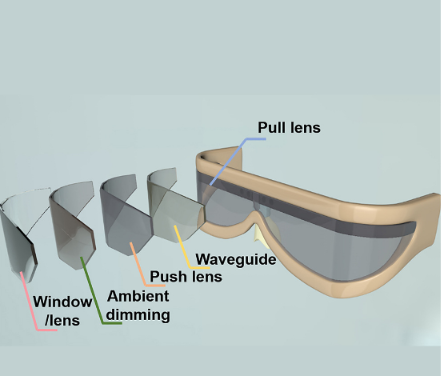
For anti-dizziness design, the product filters non-zoom noise signals by identifying user movement intentions through sensors. The zoom experience approaches single-vision glasses. The team is simultaneously advancing eye-tracking technology, further reducing dizziness through gaze-point adjustment. Optical design adopts a full-stack self-developed solution, with self-developed zoom components.
The ultimate target form is consistent with ordinary glasses, but early versions will be strongly function-oriented with a tech-style appearance, integrating full automation and strong interaction functions, with subsequent iterations gradually reducing form factor and simplifying design. The product is planned for crowdfunding in 2026.
III. Market Background and Demand Analysis
With information technology development, myopia prevalence among post-80s and post-90s generations has risen significantly. The industry saying “age 43, eye transition” refers to people in their 40s beginning to experience presbyopia, with declining dynamic focusing ability, creating “myopia-presbyopia coexistence” vision needs. Current market solutions include using two pairs of glasses or progressive multifocal lenses.
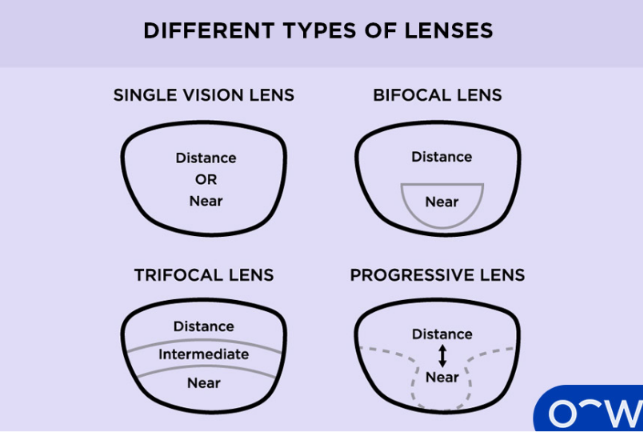
Progressive multifocal lenses integrate multiple focal points on a single lens, simultaneously satisfying far, mid, and near vision needs, but suffer from narrow usable field of view, obvious dizziness, high channel fitting costs, and expensive retail prices. Electrochromic zoom optical devices can achieve single-lens zoom, higher integration, smaller size and weight, and lower cost. This technology has currently reached the industrialization critical point.
China’s glasses market has exceeded 100 billion yuan scale.
IV. Industry Competition Landscape
From 2025 to 2026, the smart glasses market remains active. Public information shows: Xiaomi AI glasses entered the market at 1999 yuan starting price; Meta Ray-Ban continues iterating; Thunderbird Innovation completed Series C funding; Fourth Paradigm partnered with Anyka Microelectronics to release 13-megapixel full-scene AI glasses; Meizu StarV Snap AI shooting glasses with Snapdragon AR1 chip went on sale; XREAL, Yingmu Technology and other AR manufacturers actively raised funding.
These products generally feature AI functions (shooting, voice assistant, real-time translation, etc.) as core selling points. Zhongjian Technology’s product positioning differs, with core functions being optometric zoom and AI functions as subsequent add-on directions.

V. Analysis Perspectives
1. Track Divergence Signal
The smart glasses market is developing two parallel paths: one with AI interaction as core, emphasizing shooting, voice, translation and other functions, represented by Meta Ray-Ban, Xiaomi AI glasses, etc.; the other with optometric functions as core, emphasizing solving real vision problems, with Zhongjian Technology representing this path. The two paths are not mutually exclusive, but current product definition stages have different emphases.
2. Crowdfunding Model Rationality
Choosing crowdfunding as the debut channel has dual significance for electrochromic zoom as an entirely new category: first, validating real market demand; second, obtaining early user feedback to guide subsequent iterations. Considering progressive multifocal lenses’ long-standing user experience pain points, if the electrochromic zoom solution can achieve expected optical performance and wearing comfort, there is clear replacement space.
3. Technology Maturity Assessment
The judgment that electrochromic zoom devices “have reached the industrialization critical point” can be verified from two dimensions: first, Zhongjian Technology’s first-generation product has been completed; second, funding continues to be invested in R&D rather than mass production, indicating the product remains in optimization stage rather than large-scale manufacturing. The crowdfunding timeline set for 2026 also reflects the team’s prudent assessment of technology maturation pace.
4. Competition Boundary Uncertainty
Current smart glasses market competition boundaries have not solidified. AI-function-centered products may integrate zoom capabilities in future versions, while optometric-function-centered products are also planning to add AI functions. The two paths’ endgame may be convergence, but in the short term, product definition differences will determine respective target user groups and pricing strategies.
5. Investors’ Industrial Logic
Among the investor portfolio, Shokz (acoustic wearable devices), Appotronics (novel displays), and Professor Gao Bingqiang (semiconductors) represent different technology dimensions respectively, indicating capital recognizes the long-term logic of “glasses as visual entry point,” but has not formed consensus on specific technology paths, adopting a diversified layout strategy.
Leave a Reply