Rating: 8.2/10
The Meta Quest 3S is not the best VR headset, but it may be the most “right” VR headset in 2026. At $299, it packages mixed reality, wireless freedom, and a massive game library into an entry-level bundle with virtually no barrier. If you’ve never experienced VR or want to upgrade from Quest 2, this is currently the safest choice.
Product Overview
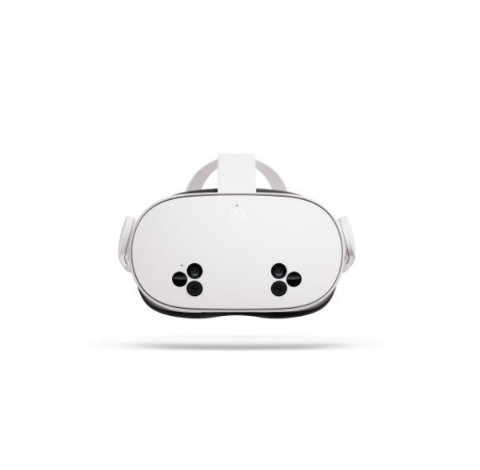
Launched in October 2024, the Quest 3S sits at the entry point of Meta’s current lineup. It shares the exact same Snapdragon XR2 Gen 2 chip and 8GB RAM as the flagship Quest 3, but downgrades the optical system from pancake to Fresnel lenses and drops resolution from 2064×2208 to 1832×1920 per eye — cutting the starting price to $299 (128GB), $200 less than Quest 3.
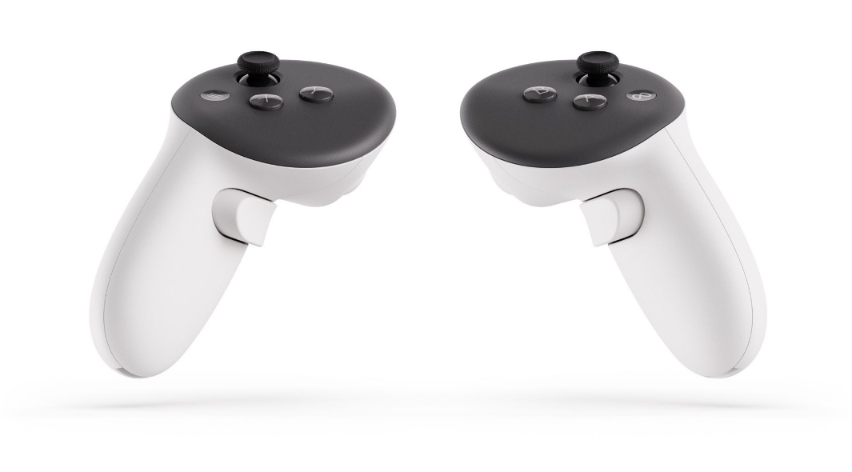
Core specifications remain consistent with Quest 3: full-color passthrough cameras, 6DoF inside-out tracking, Touch Plus controllers, Wi-Fi 6E connectivity. This means every game and app that runs on Quest 3 runs on 3S with nearly identical frame rates.
Performance Analysis
Visual Experience: Good Enough, Not Stunning
The Fresnel lenses represent Quest 3S’s biggest compromise. Compared to Quest 3’s pancake lenses, edges are noticeably blurrier with prominent “god rays” in dark scenes. The resolution gap is barely perceptible in actual gameplay, but the lens quality difference is immediately apparent — Quest 3 maintains sharpness from center to edge, while 3S requires keeping your gaze locked to the central “sweet spot” for optimal clarity.
For fast-paced games like Beat Saber or Gorilla Tag, this limitation matters little since attention stays centered. But for movie watching, reading virtual screens, or exploring open-world games, edge blur accumulates into fatigue.
Mixed Reality: Pleasantly Surprising
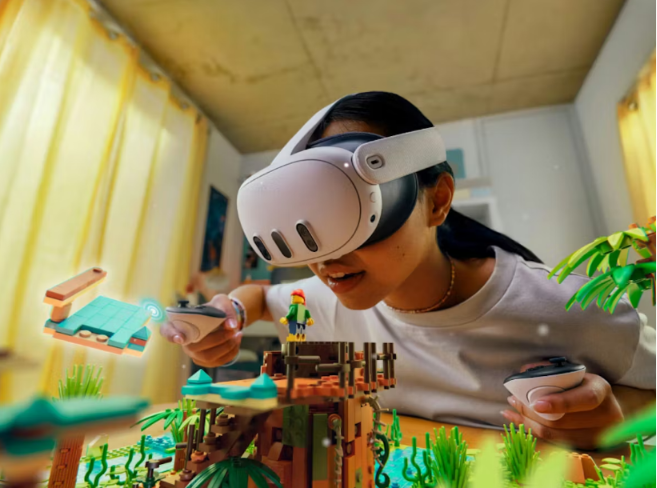
Full-color passthrough is Quest 3S’s most unexpectedly capable feature. Dual 4MP RGB cameras capture accurate colors with low latency, sufficient to walk around, grab a water bottle, or check phone notifications while wearing the headset. Though grainier than Quest 3, functional completeness is uncompromised — you can play all MR games, place virtual objects on real tables, and turn your living room into a game arena.
Offering usable mixed reality at $299 is Meta’s dimensional reduction attack on competitors. PlayStation VR2 ($549) lacks passthrough entirely; Apple Vision Pro ($3499) delivers superior MR but at a different price tier.
Performance and Battery: Flagship-Equivalent
Thanks to the identical XR2 Gen 2 chip, Quest 3S game frame rates nearly match Quest 3. AAA VR titles like Asgard’s Wrath 2 and Assassin’s Creed Nexus run stably at 72-90fps. The 8GB RAM ensures smooth multitasking and large scene loading.
Battery life sits at approximately 2-2.5 hours, matching Quest 3. Sufficient for single gaming sessions, but movie watching or extended fitness training requires mid-session charging or a battery head strap.
Competitor Comparison
| Feature | Quest 3S | Quest 3 | PlayStation VR2 |
|---|---|---|---|
| Price | $299 | $499 | $549 |
| Processor | XR2 Gen 2 | XR2 Gen 2 | Custom AMD |
| Resolution (per eye) | 1832×1920 | 2064×2208 | 2000×2040 |
| Lens Type | Fresnel | Pancake | Fresnel |
| Passthrough | Full-color | Full-color | None |
| Requires Console | No | No | PS5 Required |
| Weight | 514g | 515g | 560g |
Quest 3S’s core advantage is “zero dependency” — no PC, no console, no base stations, just power on and play. This makes it a true consumer product, while PS VR2 remains essentially a PS5 accessory.
Pros and Cons
| Pros | Cons |
|---|---|
| Flagship chip performance at $299 | Fresnel lenses with edge blur and god rays |
| Full mixed reality functionality retained | Three-step IPD adjustment only |
| Wireless design, no external hardware needed | 2.5-hour battery life |
| Massive game library, full Quest app compatibility | 128GB storage tight for large games |
| Lightweight and comfortable for extended wear | Grainier passthrough than Quest 3 |
Who Should Buy
Recommended for:
- First-time VR users
- Budget-conscious families wanting mixed reality
- Quest 2 owners seeking an upgrade
- Players needing a second headset for guests
Should Skip:
- Hardcore gamers demanding maximum visual fidelity (choose Quest 3)
- Professional users needing extended VR work sessions (choose Vision Pro)
- Users with existing high-end PC VR setups (3S cannot surpass PC VR quality)
Conclusion
The Meta Quest 3S is a product of “smart compromises.” It precisely trims configurations that minimally impact entry-level users (lens quality, resolution) while preserving core elements that determine the experience floor (chip performance, mixed reality, wireless freedom). At $299, no competitor matches its functional completeness.
Its true value lies not in the spec sheet but in “zero friction” — no researching PC configurations, no setting up sensors, no managing cables. You simply put it on and enter VR. For the average person wanting to try VR in 2026, that zero-barrier access may be the biggest selling point of all.
Leave a Reply