In the humanoid robotics sector, most products fall into one of two categories: wheeled-arm robots designed for home services or large-scale bipedal models built for heavy industrial loads. On August 20, GigaAI officially launched the Maker L01. As a lightweight, general-purpose bipedal humanoid robot, it is positioned as a platform for scientific research, robotics competitions, and algorithm validation. By leveraging high-performance mobility, fully open interfaces, and the GigaBrain embodied AI system, it fills a gap in the mid-range open bipedal robot market, enabling university laboratories and startups to conduct R&D on bipedal motion control and physical AI at a lower cost.
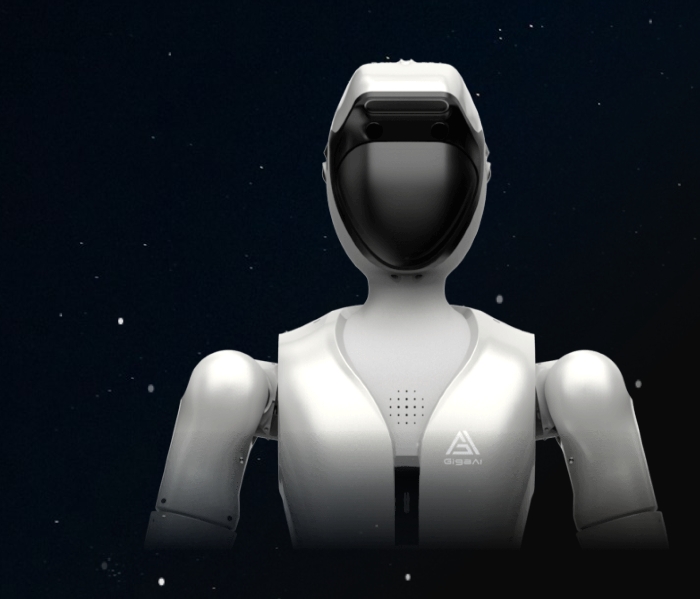
Appearance and Hardware Architecture: 42kg Lightweight Biped with 31 Joint Actuators Unlocking Movement Potential
The Maker L01 weighs just 42kg—distinct from industrial bipedal models that often exceed 50kg—striking a balance between explosive movement capabilities and operational safety, thereby reducing collision risks during laboratory use. The robot is equipped with 31 integrated joint actuators spanning the torso, arms, legs, and dexterous hands, enabling coordinated whole-body motion control. Official demonstrations show it performing highly dynamic actions such as running, continuous jumping, standing backflips, and table tennis rallies. It achieves a maximum movement speed of 4m/s, with dynamic balancing capabilities optimized for high-mobility scenarios rather than being limited to slow walking.
It utilizes a 518Wh hot-swappable lithium battery system, allowing for rapid battery replacement without lengthy charging downtime—ideal for continuous algorithm debugging and extended competition testing. The unit integrates multi-line LiDAR, depth cameras, an IMU (Inertial Measurement Unit), and joint torque sensors to establish a comprehensive multimodal perception pipeline. This system captures real-time data on the robot’s posture, 3D environmental point clouds, and obstacle distances, providing raw physical perception data to the GigaBrain embodied AI model.
The core philosophy behind the hardware design is full-stack openness: low-level motor drivers, motion control interfaces, and perception data interfaces are all fully open, supporting secondary development. Whether utilizing proprietary gait algorithms, reinforcement learning, or integrating third-party large models for embodied task planning, developers can directly access underlying data—eliminating the need to reverse-engineer closed firmware—and immediately deploy the platform for research projects or robotics competitions like RoboMaster.
Core AI Capabilities: Powered by the GigaBrain World Model, Closing the Loop from Simulation to Reality
The Maker L01 is far more than a mere mechanical motion platform; it integrates GigaAI’s proprietary dual-engine system—comprising the GigaBrain embodied foundation model and the GigaWorld world model—setting it apart from standard open-source bipedal robots.
- World Model Simulation & Pre-validation: Developers can perform gait tuning, motion planning, and task training within the GigaWorld virtual environment. By generating vast amounts of physical interaction data in the simulator before transferring it to the physical Maker L01, they can drastically reduce the costs of real-world trial-and-error and accelerate algorithm iteration cycles.
- End-to-End Embodied Decision-Making: GigaBrain handles the interpretation of text commands and visual scenes, decomposes long-sequence tasks, and outputs full-body motion commands. Beyond basic walking and jumping, the platform supports complex tasks such as grasping, object transport, human-robot interaction, and multi-robot collaboration; it also allows for integration with external general-purpose large models, enabling natural language control of physical robot operations.
- Data Collection Closed-Loop: Data regarding posture, collisions, and operations captured during real-world operation can be fed back to the training platform to continuously optimize the world model and embodied strategies. This establishes a complete “simulation training → real-world deployment → data feedback → model iteration” loop, aligning with the R&D paradigm for physical AGI. ## Use Cases: Primary Platform for Research and Top Choice for Competition Development
- University Research Labs: Supports research into bipedal gait control, reinforcement learning, human-robot interaction, and embodied AI; fully open interfaces enable graduate-level teams to innovate at the low-level algorithm layer.
- Robot Competition Development: High-speed running and dynamic capabilities (such as backflips) are ideal for competitive humanoid events; hot-swappable batteries facilitate multiple rounds of continuous competition.
- Corporate Algorithm R&D: Allows embodied AI startups to rapidly validate humanoid manipulation, navigation, and multi-robot coordination schemes without the need to develop the hardware platform from scratch.
- Science Education & Innovation Showcases: Visual demonstrations—such as table tennis interaction and acrobatic stunts—make it perfect for displaying physical AI technology in science museums and innovation centers.
Design Trade-offs and Limitations
As professional hardware designed for developers, the Maker L01 involves specific trade-offs and is not intended for general consumer home use:
- Not a Consumer-Grade Home Product: Lacks a simple, visual-friendly mobile app; getting started requires knowledge of robot kinematics and ROS (or proprietary frameworks), presenting a steep learning curve—average users cannot simply take it out of the box to perform household chores.
- High Unit Cost: Positioned as a professional development platform; pricing targets B2B laboratories and competition teams rather than the mass retail market.
- Limited Payload Capacity: The lightweight design prioritizes dynamic performance (running and jumping); upper-limb rated payload is lower than that of heavy-duty industrial humanoid models, making it unsuitable for heavy material handling tasks.
- Ecosystem Still Maturing: There are fewer third-party open-source examples and community tutorials compared to established open-source bipedal robots; initial debugging relies heavily on official technical support.
Comparison within GigaAI’s Product Line: The Maker H01 is a wheeled-base dual-arm robot focused on industrial loading/unloading and static home service tasks. In contrast, the Maker L01 features a pure bipedal configuration optimized for high-dynamic movement and gait algorithm research. The two models offer complementary positioning, together forming the Maker series embodied robot portfolio (gigaai.cc). ## Recommended For
✅ Target Audience: University laboratories specializing in automation, robotics, or AI; startups focused on embodied AI; teams participating in humanoid robot competitions; and R&D institutions needing to validate algorithms for dynamic bipedal locomotion and world model transfer.
❌ Not Recommended For: General household users expecting a robot for chores or companionship, or hobbyists without a background in robotics development.
Summary
The Maker L01 represents GigaAI’s new venture into the bipedal humanoid hardware sector: rather than targeting immediate deployment in service scenarios, it establishes a standardized bipedal development platform that is open, high-performance, and optimized for world model research. With capabilities such as 31-joint full-body actuation, running speeds of 4 m/s, and backflips, combined with the comprehensive GigaWorld + GigaBrain physical AI toolchain, it fills a gap in the domestic market for mid-range, open-platform bipedal robots.
At a time when the industry generally prioritizes household deployment and industrial mass production, the Maker L01 focuses on supporting upstream algorithm research, lowering the barrier for robotics development teams, and accelerating the evolution of domestic embodied AI and world model technologies. It is not a futuristic household butler, but a professional development tool designed to advance physical AGI technology. If you are conducting research on bipedal gait or humanoid reinforcement learning, this full-stack open solution offers immense engineering value; if, however, you are looking for a household humanoid robot, wheeled-arm service models like the Shiguang S1 would be a more suitable choice.
Leave a Reply