At the 2026 World Robot Conference (WRC 2026), Galbot—the company that previously gained widespread attention with its “Xiao Gai” robot featured on the Spring Festival Gala—officially launched its first bipedal humanoid robot: the Galbot ET1 (codenamed “Galaxy Star-Kid”). Unlike most industry products that prioritize refining basic motor capabilities like walking and load-bearing, the ET1 has a distinct core positioning: a natively intelligent humanoid terminal designed for the physical world, capable of interactive, autonomous learning. Powered by the proprietary AstraBrain embodied large model and AstraBrain-Agent architecture, the ET1 addresses long-standing industry pain points—such as reliance on pre-set scripts and the high cost of debugging new skills. It features “zero-shot generalization” capabilities, allowing it to learn new actions after observing a human just once. During the event, it performed complex dynamic demonstrations, such as a breakdancing handstand and autonomous tennis play, making it a standout new product at the conference.
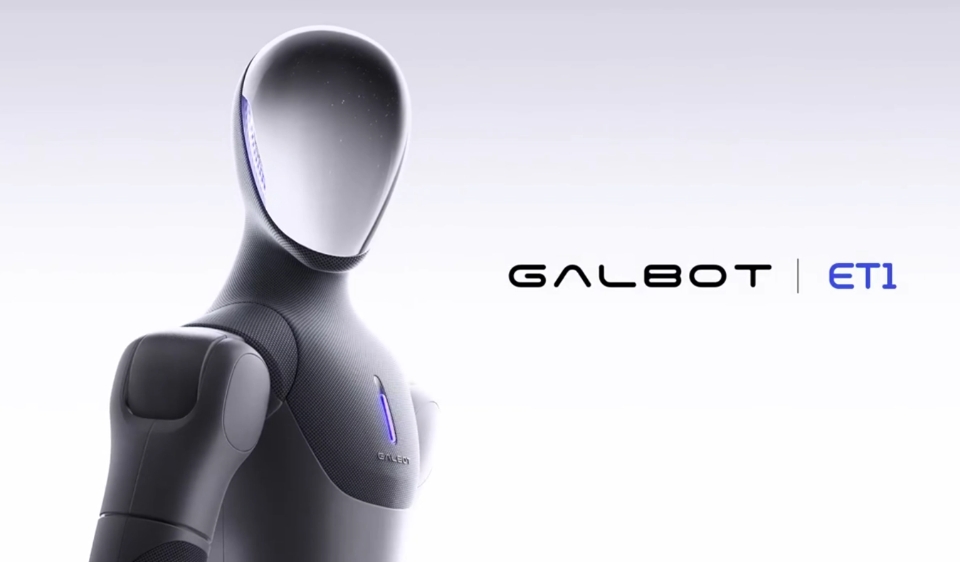
Galbot’s previous flagship products—the wheeled humanoid Galbot G1 and the heavy-duty humanoid Galbot S1—have already achieved scaled deployment in factory and retail environments, demonstrating mature experience in hardware and software engineering. As the brand’s first bipedal model, the ET1 marks Galbot’s entry into the bipedal humanoid sector and realizes the “One Brain, Multiple Bodies” technical vision: a single AstraBrain large model drives various robot forms—bipedal, wheeled, and heavy-duty—enabling the cross-hardware reuse of perception, planning, and motion control capabilities.
I. Hardware: Bipedal Configuration for Dynamic Interaction
While full hardware specifications have not yet been publicly disclosed at the WRC, the following core hardware features have been compiled based on live demonstrations and official materials:
- Bipedal Full-Body Motion Architecture: Designed for a wide range of dynamic full-body movements, the architecture supports actions such as airborne jumps, handstands, and sharp lateral turns, ensuring stable landings even from off-balance positions. It utilizes the proprietary AstraBrain WBC (Whole-Body Control) foundation model—acting as the robot’s “general-purpose cerebellum”—to manage balance regulation and full-body motion mapping. Trained on a dataset comprising 100,000 hours of human motion data, the system enables rapid translation from human poses to full-body robot movements. 2. Multimodal Perception and Interaction: Equipped with multi-camera vision and microphone arrays, it supports real-time environmental observation, natural language dialogue, and human pose capture. Head-based interaction features gaze tracking and subtle head movements, creating an anthropomorphic interaction experience that moves beyond the stiff, mechanical feel of traditional robots.
- Modular Design Philosophy: It continues Galbot’s mature modular approach, sharing the “AstraBrain” computing foundation with the G1 and S1 models. This facilitates unified developer access and secondary development, making it suitable for scenarios ranging from scientific research and validation to commercial demonstrations.
Regarding hardware choices, the ET1 does not prioritize industrial metrics like extreme payload capacity or ultra-long battery life; instead, its hardware configuration centers on dynamic interaction and motion generalization. Live demonstrations—such as handstands and airborne breakdancing moves—highlight that the robot’s hardware optimization focuses on joint response speed and real-time balance adjustment. Unlike purely industrial humanoids, the ET1 emphasizes human-robot interaction, making it ideal for showroom displays, commercial reception, and interactive motion demonstrations. As a first-generation model, it is primarily designed for demonstrations and algorithm validation; capabilities for long-term, all-day operation in home environments await future iterations.
II. Core Intelligence: AstraBrain + AstraBrain-Agent (Native Physical AI Agent)
Galbot ET1’s key differentiator lies in its proprietary, full-stack embodied AI system, which is also the technical core of this launch.
The system comprises three layers: AstraBrain (the “Brain”), AstraBrain-Agent (a native AI agent for the physical world), and AstraBrain WBC (a universal “Cerebellum” motion model).
- AstraBrain (WAM: World-Action Model)
It integrates visual understanding, environmental world-model prediction, and whole-body motion generation. By eliminating the separation of perception, planning, and control into independent modules, it achieves an end-to-end “Observe-Think-Act” closed loop. It supports the decomposition of complex, long-horizon tasks and dynamically handles environmental disturbances. A single model is compatible with various robot form factors—including wheeled, bipedal, and heavy-duty robots—embodying Galbot’s “One Brain, Multiple Capabilities” strategy. - AstraBrain-Agent (Native Physical AI Agent)
Unlike solutions that merely wrap general-purpose large models, this agent is purpose-built for real-time interaction within physical robotic systems. Eliminating the need for motion capture equipment or pre-recorded motion datasets, ET1 autonomously learns entirely new full-body movements simply by observing human actions and engaging in verbal interaction. It can replicate and fine-tune these movements, effectively turning “seeing” into “learning.” Traditionally, adding new movements to a robot required engineers to debug scripts and collect vast amounts of real-world data—a process spanning weeks; ET1’s interactive self-learning capability drastically reduces the cost of expanding its skill set. - “Brain + Cerebellum” Collaborative Architecture
The team identified a common industry pain point: an overemphasis on “brain” functions (task planning) at the expense of “cerebellum” functions (real-time motion control). ET1 assigns high-level task decision-making to the “Galaxy Star Brain” while delegating high-speed balancing and full-body posture adjustment to a general-purpose “cerebellum” model. A prime example is its fully autonomous tennis match demonstration: it autonomously predicts the ball’s trajectory, adjusts its stance, swings to hit the ball, and even employs tactics like lobs against human opponents—all while maintaining dynamic balance throughout, thereby validating the synergy between the “brain” and “cerebellum.”
III. Target Deployment Scenarios
The official roadmap outlines three initial application areas for ET1:
- Commercial Demonstrations and Human-Robot Interaction: Deployed in exhibition halls, cultural tourism centers, and brand stores to handle tasks such as welcoming visitors, performing physical routines, and engaging in impromptu conversations, thereby creating an anthropomorphic interactive experience;
- Research and Embodied AI Algorithm Development Platform: Designed for universities and AI R&D teams, this platform supports zero-shot learning for bipedal humanoids, multimodal interaction, and the validation of general motion models; by leveraging the unified “Galaxy Star Brain” ecosystem, it lowers the barrier to entry for development;
- Validation of Light-Duty Home and Retail Services: Serving as a technology validation model, it explores everyday tasks such as autonomous pick-and-place operations, companion interactions, and simple guidance services, gathering real-world scenario data to inform the future mass production of service-oriented bipedal robots.
In the short term, the focus remains on technology validation, interactive demonstrations, and scientific research/development; the initial model is not yet intended for mass-market home deployment, and complex household chores or heavy-duty industrial tasks are not among ET1’s core objectives at this stage. ## IV. Product Highlights
- Breakthrough in Interactive Self-Learning: Capable of learning entirely new full-body movements through visual observation alone—eliminating the need for motion capture or pre-recorded datasets. This drastically reduces the cost of skill iteration for humanoid robots, distinguishing the product from competitors that rely heavily on pre-scripted performances.
- “One Brain, Multiple Bodies” General-Purpose Embodied Framework: Leverages the extensive data accumulated from Galaxy General’s already deployed wheeled and heavy-duty robots to enable cross-form factor reuse of embodied models. Backed by proven engineering delivery experience, it is a practical product rather than merely a laboratory prototype.
- Fully In-House “Cerebrum-Cerebellum” Coordination Stack: Integrates high-level task planning with low-level real-time motion control to solve balance challenges during dynamic movement. It excels at executing highly dynamic actions such as jumping, handstands, and autonomous tennis matches.
- Anthropomorphic, Native Human-Robot Interaction: Features eye-tracking, subtle head movements, and motion generation driven by real-time speech. These traits reduce the “cold, mechanical” feel, making the robot better suited for long-term interaction scenarios with humans.
V. Current Limitations and Areas for Verification
- Incomplete Hardware Specifications: Key mass-production metrics—such as total height, degrees of freedom, battery life, payload capacity, dexterous hand configuration, pricing, and delivery timelines—were not fully disclosed at the launch event; long-term stability of the actual unit remains to be verified through testing.
- First-Gen Focus on Dynamic Interaction Demos: While excelling at full-body movement and spontaneous interaction, capabilities such as precision grasping, compliant manipulation, and handling complex, unstructured household chores remain targets for future iterations.
- Unknown Limits of Self-Learning Capabilities: Current public demonstrations focus on replicating physical movements; there is a lack of long-term, real-world testing regarding autonomous learning performance for complex, compound tasks or multi-step household chores.
- Unclear Commercialization Timeline: As the brand’s first bipedal model, the ET1 primarily serves to validate technology; a significant iteration period is still required before large-scale delivery to consumer households can be achieved. ## VI. Summary
In a landscape where humanoid robots compete primarily on metrics like running speed, jump height, and payload capacity, Galbot ET1 (Galaxy Star-Kid) has carved out a distinctive path. Rather than prioritizing extreme hardware specifications, it focuses on general-purpose embodied intelligence and interactive self-learning, aiming to solve the most challenging problem in the field: how a humanoid robot can autonomously learn new skills in the real physical world, much like a human.
Leveraging Galbot’s prior experience in the large-scale deployment of wheeled humanoid robots and its proprietary “Galaxy Star-Brain” embodied intelligence system, the ET1 demonstrates the feasibility of a “single brain driving multi-form robots.” Meanwhile, the AstraBrain-Agent native intelligent agent establishes a new technical paradigm for reducing the costs associated with humanoid robot development and skill iteration.
In the short term, the first-generation ET1 is best suited for commercial demonstrations and the validation of research algorithms, rather than replacing human labor in ordinary households. From a long-term perspective, however, if the technologies for interactive self-learning and the coordination between “cerebrum” and “cerebellum” systems continue to mature, the ET1 holds the potential to lower the barrier to entry for humanoid robot adoption and accelerate the real-world application of general-purpose embodied intelligence.
Leave a Reply