One-sentence verdict: NoonWake.AI’s three-layer funnel—Eastern metaphysics for acquisition, psychology for retention, hardware for lock-in—proves that AI emotional companionship need not follow the orthodox Western counseling path. Sometimes, users prefer to start with horoscopes before discussing their inner selves.
Introduction
In June 2026, the AI emotional companionship track secured another seed funding round. NoonWake.AI received nearly 10 million RMB from Yunqi Capital and Bianliang Capital, with Duowei Capital serving as exclusive financial advisor. Rather than copying Western psychological counseling chatbot models, the company chose a more localized path: constructing virtual personalities through Yin-Yang Five Elements and Ten Gods systems, allowing users to unconsciously process emotions while “checking their fortune.”
As of April 2026, its domestic product “Wanxiang Youling” has accumulated hundreds of thousands of users, with the overseas version Starot registering nearly 50,000 monthly users. For a newly founded startup, these numbers indicate genuine market demand for psychological services that “don’t feel like going to the doctor.”
Company Overview
NoonWake.AI positions itself as an “AI Native spiritual and personality companionship company.” This positioning deliberately avoids the red ocean of “AI psychological counseling”—which faces triple challenges of regulatory uncertainty, strong user stigma, and low payment willingness.
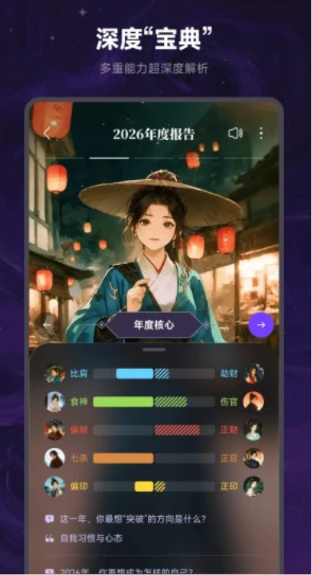
Core capabilities are summarized as “conversational interpretation systems” and “long-term connected virtual personalities.” Simply put: the system does not treat users as “patients” to diagnose, but as “confused individuals” to accompany. Through the Ten Gods system, human psychological structures are deconstructed into ten dynamic personality dimensions, each corresponding to a virtual character. When a user feels anxious today, the “Hurt Officer” character may respond; tomorrow when confused, the “Direct Resource” perspective offers advice. The same question receives multiple viewpoints from different characters, avoiding the mechanical feel of single-AI assistants.
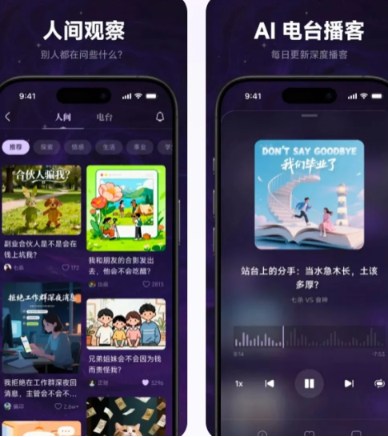
Its technical foundation is the self-developed “Wanxiang Youling Inference Model”, which combines multi-model routing with Multi-Agent collaboration. This means the system does not call a single general-purpose large model to perfunctorily handle all requests. Instead, it activates different specialized agents based on specific scenarios: emotional documentation has a dedicated personality profiling agent, relationship confusion has a communication analysis agent, and career decision-making has a long-term planning agent. These agents share user memory to create a continuous conversational experience.
Product Matrix: Three-Layer Funnel Design
| Product | Market | Core Function | Positioning |
| Wanxiang Youling | Domestic | Yin-Yang Five Elements virtual personalities, mood tracking, personality profiling, growth advice | Acquisition entry |
| Starot | Overseas | Emotional support, daily to-dos, relationship sorting, guided reflection | Emotional support |
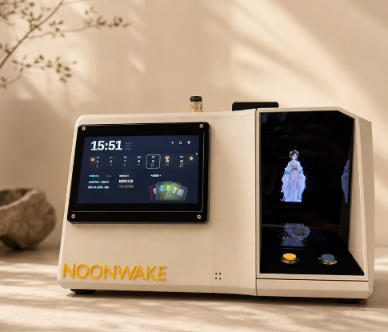
| Good Luck Calendar | Global | Daily fortune timing, AI reflection, printable ritual content | Hardware lock-in |
The design logic of this three-layer structure is clear: Wanxiang Youling uses “Five Elements fortune” to lower psychological barriers, getting users to open up; Starot uses Western “self-exploration” narratives to complete deep companionship; the Good Luck Calendar machine materializes virtual experiences, creating “daily visible” ritualistic moments.
The Good Luck Calendar machine deserves particular attention. This desktop AI hardware won second prize in the Xiaohongshu Hackathon hardware track, transforming daily fortunes, AI reflections, and printable content into a physical world “life entry point.” Hardware not only provides differentiated experiences but creates new monetization scenarios—users’ willingness to pay for “physical ritual” often exceeds that for “app subscriptions.”
Acquisition Strategy: Why “Astrology” Outperforms “Psychological Counseling”
NoonWake.AI’s market observations reveal a counterintuitive phenomenon: in C-end markets, “AI astrology/tarot” acquisition efficiency far exceeds “AI psychological counseling.” Three reasons explain this:
First, psychological barrier differences. Users more easily express real concerns around “fortune” and “tarot” rather than directly admitting “I have psychological problems.” Astrology serves as a “safe metaphor,” making confession less shameful.
Second, usage habit differences. Daily fortunes and status reminders can form stable usage habits, whereas psychological counseling tends to be one-time. Habit formation means higher retention rates and lifetime value.
Third, sharing propensity differences. AI-generated fortunes and personality analyses possess inherent sharing desire—”look at my monthly romance analysis” spreads more easily on social media than “look at my psychological counseling report.”
NoonWake.AI’s strategy essence: use “culturally accepted carriers across different regions” for acquisition, use “psychology” for retention. Domestically, Five Elements and birth charts; overseas, astrology and tarot—the underlying engine is the same personalized AI system.、
Industry Impact
NoonWake.AI’s funding and product validation offer three insights for the AI emotional companionship industry:
Cultural frameworks act as product moats. When Western AI-powered psychological counseling products enter the Chinese market, they often face “acclimatization”—the tension between CBT’s rational framework and Chinese users’ habits of emotional expression. NoonWake.AI demonstrates that repositioning AI psychological services with local cultural symbols allows companies to build more natural connections with users.
Hardware is the ultimate entry point for emotional companionship. When software services become homogenized, physical hardware creates irreplaceable “presence.” The Good Luck Calendar machine’s success suggests that the next competition in AI companionship may shift from “whose large model is stronger” to “whose hardware offers more ritual.”
Adopt separate strategies for user acquisition and retention. The layered design of “acquire via metaphysics, retain via psychology” solves the common dilemma faced by emotional companionship products: *”users come but do not stay.”* Low-threshold market entry secures stable traffic, while professional services drive user conversion.
Leave a Reply