One-sentence verdict: This is not a robot built to impress with specs—it is a machine willing to “bend down” and solve the most unglamorous problem. If it proves reliable in real home environments, it could rewrite the playbook for elderly care.
Introduction
The elderly care robotics market has long been dominated by two categories: emotional companions that chat, dance, and play music; and rehabilitation aids that assist with physical training. But one critical scenario has been severely overlooked—also the need that disabled elderly are least willing to discuss: toileting.
China has over 45 million disabled or semi-disabled elderly, with more than half requiring nighttime bathroom visits exceeding three times per night. Each attempt to get up carries a 28% higher fall risk compared to daytime. Existing solutions rely either on adult diapers (hot, prone to bedsores) or caregivers making multiple nighttime assists (with a national caregiver shortage exceeding 5.5 million). Yueban, a brand under Topband Co., Ltd., is addressing this “unspeakable but essential” problem with a mobile robot called Xiaoban, shifting the approach from passive response to active service.
Product Overview
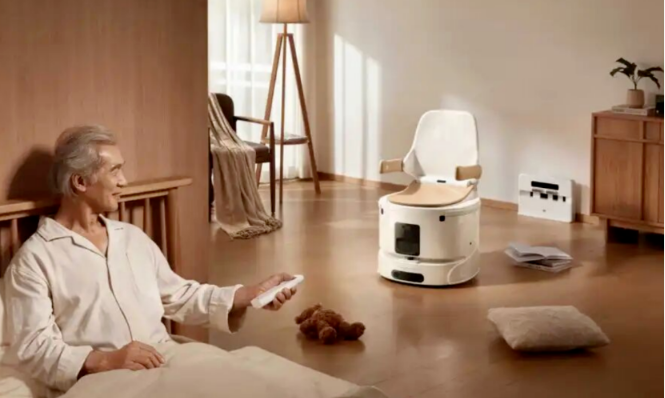
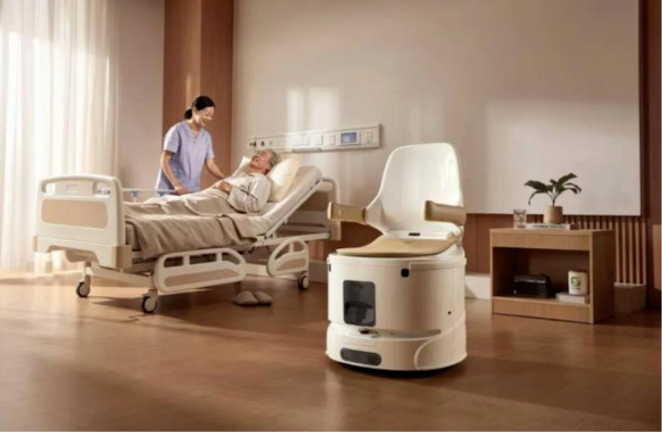
Xiaoban’s positioning is clear: an intelligent toileting device that moves autonomously within home environments, processes waste automatically, and eliminates manual emptying. Its exterior is deliberately shaped like a familiar armchair with handrails. The body retains only two colored physical buttons; the remote control is stripped down to four keys. This minimalism is not laziness—it reflects the cognitive characteristics of elderly users, including those with Parkinson’s and cognitive impairments. The simpler the interface, the more likely they are to use it.
The core interaction logic is “tool finds person.” Elderly users summon the robot via one-key remote control or offline voice commands (no Wi-Fi required). The device drives autonomously from its charging station to the bedside. After the user is seated, a triple-lock chassis fixes the unit in place to prevent tipping. Following use, an internal pulverization module processes waste into a pumpable state, and a telescopic discharge arm docks with the toilet for automatic transfer. The pipeline undergoes high-pressure washing and UV sterilization throughout, freeing caregivers from manual emptying, scrubbing, and odor control.
The price is set at 28,999 RMB (approximately $4,000). In the consumer electronics space this is not cheap, but in elderly care economics, it equates to roughly two to three months of a full-time caregiver’s salary. If the device operates reliably for over two years, the math works.
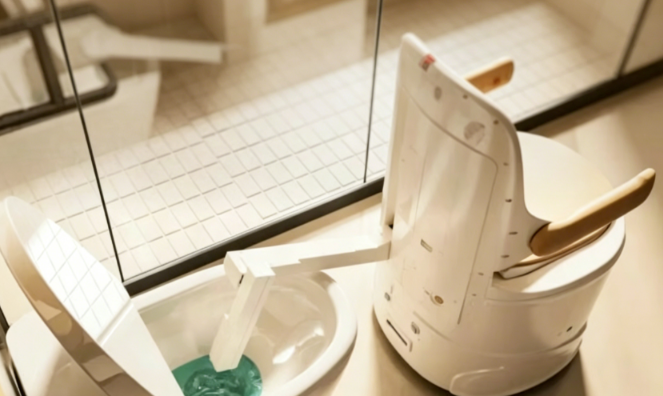
Technical Specifications and Functional Architecture
| Module | Technical Approach | Key Metrics |
|---|---|---|
| Mobility & Navigation | SLAM / Visual Fusion | Autonomous obstacle avoidance, path planning |
| Interaction | Offline Voice + Physical Buttons | No network dependency |
| Safety | Triple-Lock Chassis | Anti-tipping, fixed-point anchoring |
| Waste Processing | Pulverization Module + Telescopic Arm | Automatic toilet docking |
| Cleaning & Sterilization | High-Pressure Wash + UV | Full pipeline coverage |
| Comfort Functions | Warm Water Wash + Warm Air Dry | Diaper replacement |
| Privacy Design | Staged Visual Capture | Camera only activates briefly downward during docking |
The architecture’s intelligence lies in its restraint. Rather than trying to impress with “all-in-one” capabilities, resources are concentrated on four core stages: movement, seating, processing, and cleaning. Each stage has a clear engineering target rather than feature bloat.
Privacy Design: An Underestimated Competitive Edge
A common misconception in elderly care robotics is that more advanced technology equals greater user acceptance. In reality, elderly users are far more sensitive to “being monitored” than younger generations. Xiaoban’s privacy strategy is straightforward: the camera remains completely off during movement and standby, only activating briefly downward during waste docking to identify the toilet position.
This “staged capture” stands in sharp contrast to the industry’s common practice of full-time visual monitoring. For C-end purchasers (typically adult children), “parents won’t be watched 24/7” is a significant purchase trigger. For B-end institutions, it reduces privacy dispute risks. The design itself is not technically complex, but it demonstrates the product team’s depth of understanding for elderly care scenarios: technology should serve human dignity, not the reverse.
Competitive Landscape and Technical Route Divergence
The current market for disabled elderly toileting care offers three solution types:
| Solution Type | Representative Form | Core Limitation | Target Users |
|---|---|---|---|
| Traditional Consumables | Adult diapers, pads | Frequent replacement, bedsore risk | Fully bedridden |
| Wearable Devices | Smart diapers, sensor pants | Only covers bedridden scenarios, requires manual follow-up | Completely disabled |
| Fixed Equipment | Electric care beds, patient lifts | Requires environmental modification, poor mobility, high cost | Institutional settings |
Xiaoban’s differentiation lies in its mobile robot form factor covering the underserved “semi-disabled, conscious but mobility-limited” population. These individuals do not require full bedridden care, but face fall risks when getting up, and their pride makes them resist diapers. A robot that comes to the bedside solves the safety issue while preserving the user’s sense of autonomy.
From a technical route perspective, Xiaoban represents “active service type,” complementing rather than replacing “passive wearable type.” The former suits moderately disabled elderly with autonomous intent; the latter better serves severely disabled, fully bedridden individuals. Yueban’s choice effectively expands the target user base from “severe” to “moderate” disability, opening a significantly larger market.
Market Data and Industry Context
According to International Federation of Robotics (IFR) data, China’s elderly care robot market was approximately 3.8 billion RMB in 2020, projected to reach 10.5 billion RMB by 2026 and 18.3 billion RMB by 2030, with a CAGR of about 15%. Nursing robot growth rates hit 32%, while emotional companion robots grow at 42%.
The toileting care sub-segment has annual market potential exceeding 5.5 billion RMB, yet home penetration remains below 1.2%. This indicates genuine demand, severe supply shortage, and substantial growth headroom.
On the policy front, China’s Ministry of Civil Affairs issued the “Guiding Opinions on Further Promoting Civil Affairs Technology Innovation” in January 2026, explicitly encouraging scaled application of products for assisted dining, mobility, dressing, bathing, and transfer. This policy tailwind provides clear industrial direction for the elderly care robotics track.
Spokesperson Strategy: The Logic of Elderly-Appropriate Marketing
Yueban selected 92-year-old veteran artist You Benchang as brand collaborator. This diverges completely from the consumer electronics industry’s typical reliance on trending celebrities. The core purchase decision-makers for elderly care hardware are elderly users and their children; “a face parents know and trust” carries more persuasive power than “an idol young people worship.” Credibility and affinity trump traffic exposure. This choice itself externalizes the product’s positioning.
Pros and Cons
| Pros | Cons |
|---|---|
| Active service model fills market gap | 28,999 RMB pricing remains a barrier for average families |
| Privacy-first design reduces psychological resistance | Long-term reliability needs real-world validation |
| Offline voice eliminates network dependency | Navigation stability in complex home environments remains to be observed |
| Full-process automation reduces caregiver burden | Maintenance costs (consumables, cleaning) are not yet clear |
| Minimalist interaction lowers usage barriers | Brand recognition requires time to build |
Buying Guide
Recommended for:
- Adult children with semi-disabled elderly parents requiring frequent nighttime bathroom visits: addresses core pain points and reduces fall risks
- Small-to-medium nursing homes and rehabilitation centers: reduces nighttime staffing needs and improves service standardization
- Community-based home care service providers: enhances service competitiveness as part of care packages
Consider carefully if:
- Living space is cramped with complex furniture layouts: robot movement paths may be restricted
- Elderly users have extremely low acceptance of new technology: requires extended adaptation period and family guidance
- Budget-sensitive users unable to confirm long-term maintenance costs: advisable to wait for initial user feedback
FAQ
Q: Does it work without Wi-Fi?
A: Yes. Offline voice commands and physical buttons operate independently of network conditions, suitable for elderly households with poor connectivity.
Q: Does it require bathroom modification?
A: No structural modification is needed. The robot docks with existing toilets via its telescopic arm, but the toilet must be within the robot’s reachable range.
Q: Is maintenance complex? A: The pipeline features automatic high-pressure cleaning and UV sterilization, but maintenance intervals and costs for filters and pulverization modules should be confirmed with official support.
Conclusion
Yueban Xiaoban’s value lies not in cutting-edge technology, but in its selection of a long-neglected yet rigidly essential scenario, redefining the product form through “active service” rather than “passive wearing.” From diapers to wearables to mobile robots, the evolution of elderly care hardware is increasingly clear: technology should bend to accommodate people, not demand that people stretch to accommodate technology.
The pricing, the spokesperson choice, and the staged privacy design all point toward a single product philosophy—the core competitiveness of elderly care technology is not the spec sheet, but “whether the elderly are willing to use it, whether their children feel confident buying it, and whether caregivers are spared effort.”
If Xiaoban can prove its reliability and durability in real home environments, it may become the critical inflection point for elderly care robots transitioning from B-end pilots to C-end adoption. After all, when a robot is willing to come to the bedside, it solves not only a physical need but also the dignity that tens of millions of elderly find difficult to articulate.