One-sentence verdict: If Google can leverage its decade of Android ecosystem investment to make spatial computing feel as natural as using a smartphone, the Xreal Aura may be the first XR device that mainstream users actually want to wear—and not just for novelty.
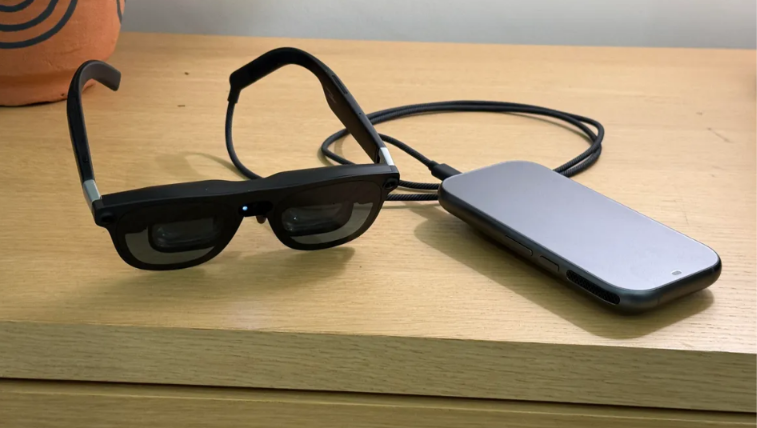
Xreal Aura眼镜和桌面计算单元
Quick Summary
On June 18, 2026, Xreal officially opened reservations for the Aura, the world’s first XR glasses powered by Android XR and Qualcomm’s Snapdragon Reality Elite chip. Co-developed with Google, the device features a 70-degree field of view, weighs 95 grams, and employs OST optical see-through technology. A dual-chip architecture pairs the Snapdragon Reality Elite for Android XR, Gemini, and spatial computing with Xreal’s self-developed X1S chip for display and sensor processing. The glasses support temple controls and ten-finger gesture input, with Gemini AI enabling multimodal interactions. Reservations opened at $99 deposit and $299 priority pre-order, with Fall 2026 launches planned for the US, UK, Japan, Canada, and South Korea.
What Happened
The XR industry has spent years in experimental phases, with various form factors emerging but few achieving genuine consumer viability. The Xreal Aura represents a potential inflection point: not another prototype or developer kit, but a product backed by two of tech’s most powerful ecosystems.
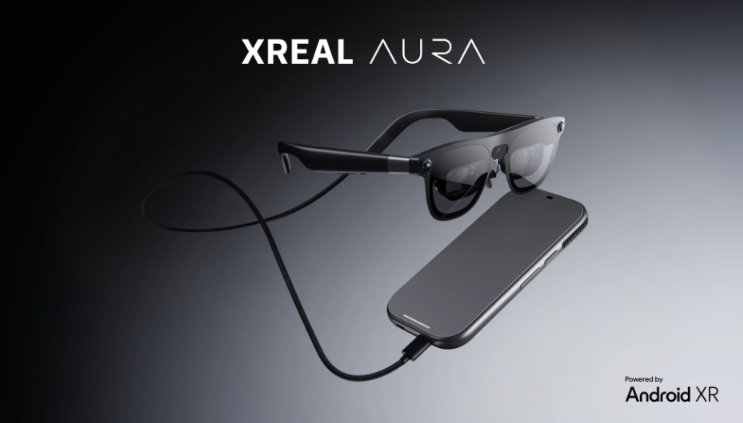
Project Aura consists of two components: the glasses themselves, responsible for display; and a wired compute unit roughly smartphone-sized, handling processing. Xreal, which built its reputation on lightweight AR glasses with industry-leading optics, designed the eyewear portion. The 70-degree field of view stands out in the AR glasses category, delivering an almost bezel-less experience within the wearer’s vision. At 95 grams, the glasses alone are lighter than most competing headsets, though the compute unit adds separate carrying burden.
Xreal Aura AndaR official product render
The dual-chip architecture merits attention. The Snapdragon Reality Elite handles Android XR, Gemini AI, and spatial computing workloads, while Xreal’s self-developed X1S chip manages display processing and sensor fusion. This division of labor suggests neither company fully trusted the other to handle their respective strengths—Google wanted control over the software and AI stack, Xreal insisted on owning the optical and display experience.
OST optical see-through represents a deliberate choice against camera-based passthrough. Rather than capturing the real world through cameras and displaying it on screens, Aura lets users see reality directly through transparent lenses with digital overlays. This reduces latency, preserves natural depth perception, and eliminates the uncanny valley effect that plagues video-passthrough headsets. The trade-off is lower immersion for fully virtual content, a compromise Xreal and Google clearly believe favors mainstream adoption.
Why It Matters
The Xreal Aura’s significance extends beyond hardware specifications. Three strategic elements distinguish it from existing XR devices.
First, the Android XR ecosystem. Unlike Meta’s Horizon OS or Apple’s visionOS, which launched with limited native applications, Android XR inherits over a decade of Android development. From day one, users can download millions of existing Android phone and tablet applications. Google Maps and YouTube already feature XR adaptations, with YouTube’s extensive panoramic video library particularly suited to glasses form factors. This ecosystem advantage eliminates the “app desert” problem that plagued early VR and AR platforms.
Second, Gemini AI integration. Early hands-on reports indicate Gemini operates as a genuine AI agent rather than a voice assistant. Commands like “find that video on YouTube” execute without manual browsing. Photo capture enables immediate AI-powered editing—removing unwanted objects, extracting ingredient lists from recipe photos, adding event schedules to Google Calendar. These actions synchronize across all Google-account-linked devices instantly. The multimodal capability—understanding vision, voice, and context simultaneously—transforms the glasses from a display device into an ambient intelligence layer.
Third, the content strategy. Rather than relying solely on third-party developers, Google and Xreal pre-installed flagship experiences: “Project Hail Mary: Interstellar Journey,” a holographic game developed with original author Andy Weir, and “Factions,” a 3D XR game from the Fallout franchise. These anchor titles demonstrate spatial computing’s potential while providing immediate value for early adopters who might otherwise face a content drought.
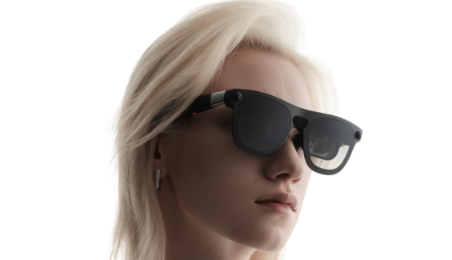
Xreal Aura lightweight glasses worn daily
Impact Analysis
Market impact: The Xreal Aura could accelerate XR’s transition from “enthusiast niche” to “mainstream computing platform.” Google’s Android ecosystem provides immediate software legitimacy that Meta and Apple needed years to build. If Aura achieves even modest sales volumes, it validates the “glasses + compute unit” form factor for competitors considering similar architectures.
Consumer impact: Users gain access to spatial computing without sacrificing social acceptability. At under 100 grams, Aura resembles oversized sunglasses more than cyberpunk headgear. The OST design means users maintain eye contact and environmental awareness—critical for public spaces where opaque headsets feel isolating. For existing Android users, the learning curve approaches zero; the interface extends familiar apps into three-dimensional space rather than inventing new interaction paradigms.
Industry impact: The dual-chip partnership model—one company handling software and AI, another managing optics and display—may become a template for XR collaborations. Few manufacturers possess excellence across all domains; Aura demonstrates that strategic specialization can yield superior products faster than vertical integration attempts. This could encourage more partnerships between optical specialists and platform giants.
What’s Next
Several variables will determine whether the Aura achieves commercial success beyond enthusiast circles:
First, the compute unit’s portability and battery life. A wired connection to a separate device, however smartphone-sized, introduces friction that fully integrated headsets avoid. Whether users accept this trade-off for lighter eyewear depends on typical usage scenarios and charging logistics.
Second, gesture latency and accuracy. Early reports describe “slight delay” in hand tracking—acceptable for prototypes, potentially frustrating for daily use. Google’s AI capabilities may compensate through predictive algorithms, but physical responsiveness remains critical for immersive satisfaction.
Third, pricing transparency. Current reservation options ($99 deposit, $299 priority pre-order) reveal nothing about final retail pricing. If the total package exceeds $1,000, mainstream adoption faces significant headwinds regardless of ecosystem strength.
Fourth, regional rollout speed. The initial five-country launch (US, UK, Japan, Canada, South Korea) excludes China and major European markets. Given Xreal’s Chinese origins and Google’s limited China presence, domestic availability timing remains uncertain and strategically significant.
Introduction: Google Is Finally Getting Serious About Smart Speakers
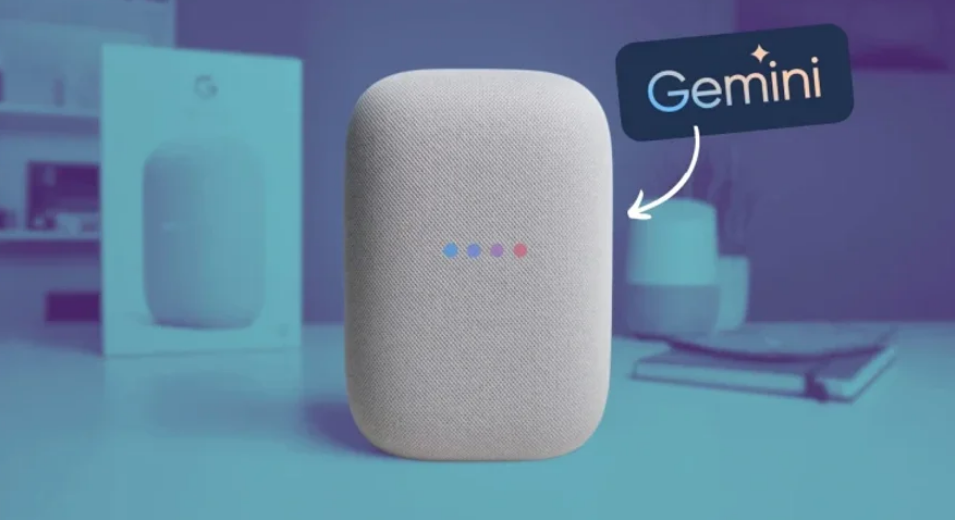
Google Nest speaker Gemini AI integration preview
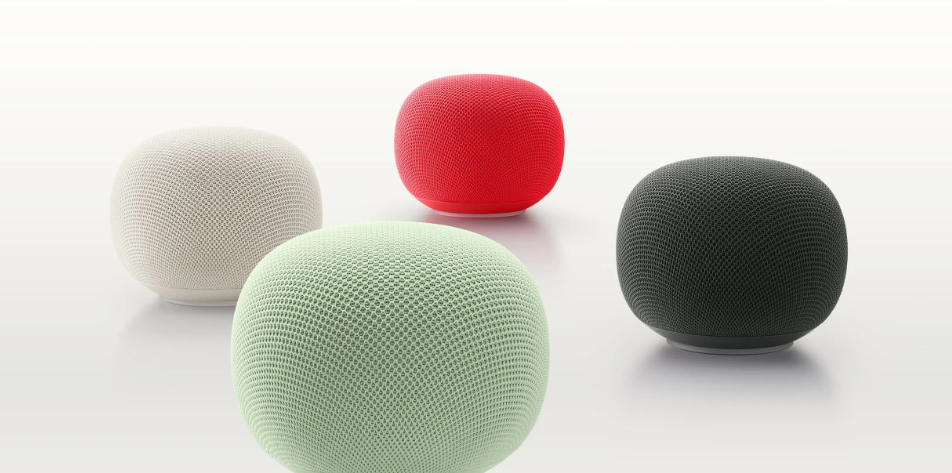
At the October 2025 hardware launch event, Google dropped a bombshell: the next-generation Google Home speaker will be powered by the Gemini large model. Not a patch for the original Google Assistant, but a complete brain replacement—from a rule-based voice assistant to a large model-based AI assistant. Scheduled for spring 2026 launch, estimated at $99, four colors available, 360-degree audio, 3D woven material.
This news matters because it signals a turning point for the smart speaker industry: voice assistants evolving from toys that “understand a few commands” to butlers that “comprehend complex intentions.” And Google’s choice to use Gemini—their strongest large model—shows they genuinely want to transform smart speakers from “smart home accessories” into “home AI hubs.”
But the question is: can Gemini in a speaker really change anything? Or is it just another “sounds cool, works dumb” upgrade?
Product Overview: Gemini Speaker, Not Google Assistant 2.0
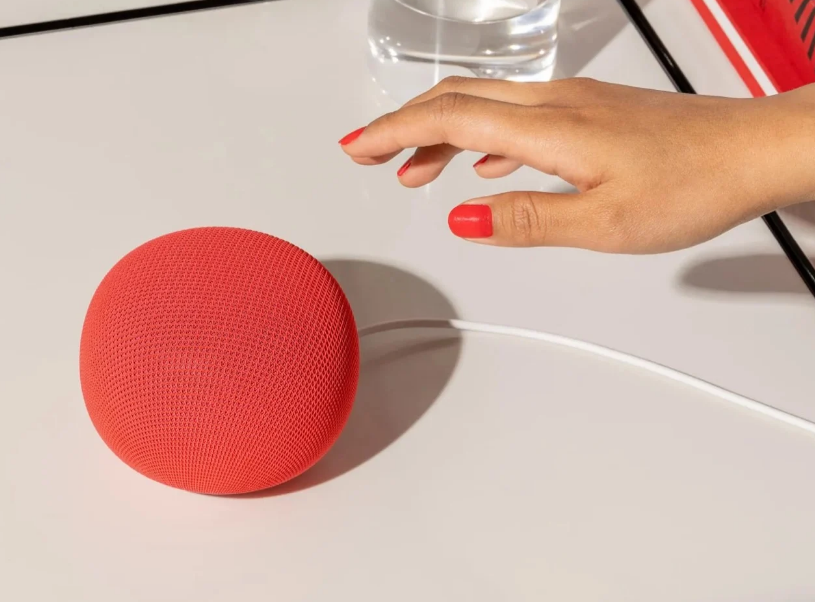
Google Home Mini red fabric speaker design
The Google Home series has been on sale for nearly a decade, from the original Google Home to Nest Mini, Nest Audio, and Nest Hub, covering entry-level to screen-equipped models across various price points. But the core voice assistant—Google Assistant—has always been a rule-based expert system: you say “turn on the light,” it matches the “turn on the light” command; you say “dim the living room light a bit,” and it might just get confused.
Gemini integration is not a simple “reskin” but an architectural reconstruction:
From Rule Matching to Intent Understanding: Google Assistant requires you to say exact command words; Gemini understands natural language. For example, you say “I want to watch a movie tonight, set the mood,” and Gemini can understand: dim lights → close curtains → turn on TV → launch Netflix → adjust volume to appropriate level → lower AC temperature slightly. In the Google Assistant era, this required writing a series of automation scripts.
From Single-Turn to Multi-Turn Continuous Dialogue: Gemini Live mode supports natural and fluent continuous conversation without needing to say “Hey Google” for every sentence. You can interrupt it, switch topics, add conditions—just like chatting with a real person. This requires the large model’s context memory and reasoning capabilities, which traditional voice assistants cannot achieve.
From Cloud Processing to Edge-Cloud Collaboration: Some Gemini capabilities will to the device side, enabling faster response and better privacy protection. For example, simple device control and local queries can be completed locally on the speaker; complex multi-step tasks require uploading to cloud processing.
Specifications: What Does the Gemini Speaker Actually Upgrade?
Gemini Live (requires Google One Premium subscription)
Ecosystem Protocols
Matter, Thread, Zigbee
Pairing
Can pair with Google TV Streamer for surround sound
Sensing
Sound Sensing (anomaly sound detection)
Estimated Price
$99
Estimated Launch
Spring 2026
Data source: Google October 2025 hardware launch event, 9to5Google, Android Police
360-Degree Audio: Not simply “speakers on all sides,” but algorithm-optimized to distribute sound evenly throughout the room. Regardless of which direction you stand from the speaker, the sound quality and volume remain basically consistent. This is far more practical than directional speakers for speakers placed in the center of the living room.
3D Woven Material: Google’s obsession with environmental sustainability. This material is made from recycled plastic bottles, with a fabric-like texture but acoustic wave transparency—sound can penetrate the material to propagate without distortion from blocking. The four-color design (Porcelain, Hazel, Berry, Jade) transforms the speaker from a “tech product” into a “home decoration.”
Bottom LED Ring: Status visualization design. Different colors represent different states: white = waking up, blue = processing, red = muted, yellow = notification. This is more intuitive than voice announcements, especially in noisy environments.
Gemini Live: This is the core selling point, but requires a Google One Premium subscription (approximately $20/month). Live mode supports natural conversation, interruptions, and topic switching, equivalent to installing a “real person assistant” in the speaker. But the question is: how many users are willing to pay an extra $20 per month for a speaker’s AI features?
Sound Sensing: Anomaly sound detection. The speaker can identify sounds like glass breaking, smoke alarms, and baby crying, automatically notifying users. This function does not rely on additional sensors but is purely achieved through AI audio analysis, demonstrating Gemini’s multimodal capabilities.
Google 2026 smart speaker four color lineup display
Deep Analysis: What Gemini Speakers Can and Cannot Change
The impact of Gemini integration on the smart speaker industry can be analyzed from three levels:
First, Interaction Experience: From “Commands” to “Conversations”
This is the most direct change. Current smart speakers work like this: you say “play Jay Chou’s songs,” it plays; you say “next song,” it switches; you say “lower the volume,” it adjusts. The entire process is a one-way “you issue command → it executes” flow.
In the Gemini era, interaction becomes bidirectional:
You: “Recommend some music suitable for working”
Gemini: “What style do you prefer? Light music, jazz, or electronic?”
You: “Jazz, but not too loud”
Gemini: “Okay, I’ll play Miles Davis’s ‘Kind of Blue’ for you, one of the most classic albums in jazz history. What volume would you like?”
You: “30% is fine”
Gemini: “Set. If you want to change styles later, just let me know.”
This conversational interaction transforms the speaker from a “tool” into a “partner.” But the premise is: Gemini’s understanding accuracy is high enough, response speed is fast enough; otherwise, the conversation’s fluency will be interrupted, and the experience will be worse than command-based interaction.
Second, Smart Home: From “Control” to “Orchestration”
Current smart home control is essentially “one-to-one”: you say “turn on the light,” the light turns on; you say “turn on the AC,” the AC turns on. Complex scenarios require users to set up automations themselves (such as Google Home’s Routines).
Gemini’s “orchestration” capability is “many-to-many”: you say “I’m leaving,” and Gemini automatically executes: turn off lights → turn off AC → lock door → start robot vacuum → set security system to away mode → send phone notification “Away, security activated.” More impressively, Gemini can dynamically adjust based on your habits: if you normally don’t turn off the AC when leaving (because you have pets at home), it remembers this exception and won’t turn it off every time.
This “learning + reasoning + execution” capability is the core advantage of the Gemini large model. But the challenge lies in smart home device compatibility. Google Home supports the Matter protocol, but domestic brands like Xiaomi, Huawei, and Haier have inconsistent Matter support. No matter how smart Gemini is, it cannot control devices that “cannot understand.”
Third, Business Model: From “Selling Hardware” to “Selling Services”
At a $99 hardware price point, Google basically makes no money (or possibly loses money). The real profit point is the Google One Premium subscription ($20/month) and control over the smart home ecosystem.
The Gemini Live subscription model is Google’s key shift from “one-time speaker sales” to “ongoing AI service sales.” If users become accustomed to Gemini Live’s natural conversation, it’s hard to go back to the free Google Assistant. This “habit lock-in” effect is the core of the subscription business model.
But risks are also obvious: if the Gemini Live experience is not good enough, users won’t pay; if competitors (such as Alexa+Claude, Siri+Apple Intelligence) offer free or cheaper alternatives, Google’s subscription model won’t stand.
Comparison: Google Home Gemini vs Amazon Echo vs Apple HomePod
Feature
Google Home Gemini
Amazon Echo (Alexa+Claude)
Apple HomePod (Siri)
AI Model
Gemini (self-developed)
Claude (Anthropic partnership)
Apple Intelligence (self-developed)
Conversation
Gemini Live (subscription)
Basic conversation (free)
Basic conversation (free)
Multi-Step Commands
Strong (native to large model)
Medium (requires Skills development)
Weak (rule-based)
Audio Quality
360-degree omnidirectional
Directional (varies by model)
360-degree omnidirectional (computational audio)
Smart Home
Matter+Thread+Zigbee
Matter+Zigbee+proprietary
HomeKit+Thread+Matter
Ecosystem Openness
High (Matter-focused)
Medium (strong proprietary ecosystem)
Low (closed ecosystem)
Privacy Strategy
Edge-cloud collaboration, optional local
Cloud-based primarily
Edge-side priority
Price
$99 (hardware) + $20/month (Live)
$50-200 (hardware, no subscription)
$299 (hardware, no subscription)
Content
YouTube Music, Spotify
Amazon Music, Audible
Apple Music, Podcasts
Three speakers, three paths: Google bets on “AI conversation capabilities + subscription services,” Amazon bets on “ecosystem richness + low-cost hardware,” and Apple bets on “audio quality + privacy + closed ecosystem.”
If you’re already in the Google ecosystem (Android phone, YouTube, Google Photos), the Gemini speaker is a natural extension. If you deeply use Amazon services (Prime, Audible, Amazon Music), Echo is more integrated. If you’re an Apple ecosystem user, HomePod’s audio quality and privacy are irreplaceable.
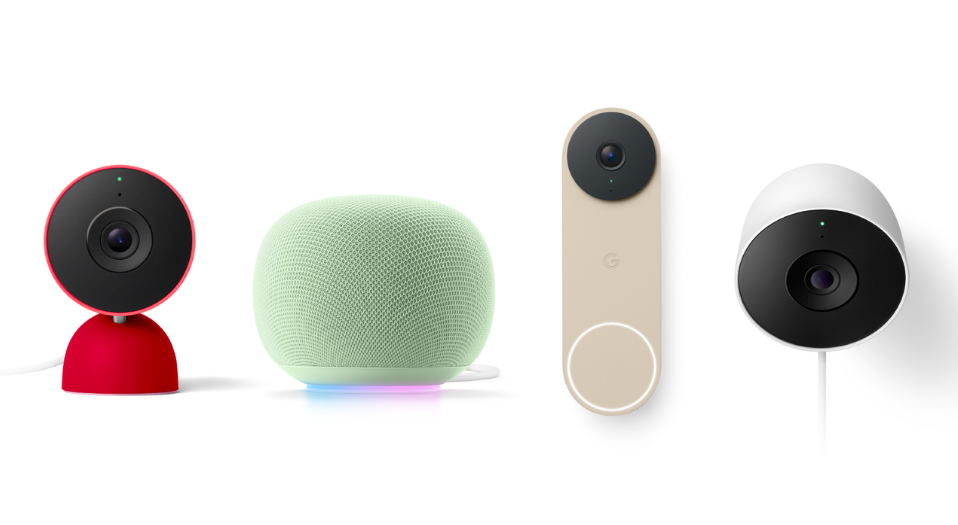
Google Nest ecosystem product lineup collection
Pros and Cons (Based on Preview Information)
Pros
Cons
Gemini large model understanding far exceeds Google Assistant
Gemini Live requires subscription ($20/month), increasing usage costs
Native multi-step complex command support, no scripting needed
Actual experience to be verified; large model latency may affect conversation fluency
360-degree audio, consistent quality from any room position
$99 hardware pricing may imply audio quality compromises
3D woven eco-friendly material, high home integration
Domestic users cannot directly use (requires VPN + US-region account)
Matter protocol support, high ecosystem openness
Low Matter support from domestic smart home brands, limited compatibility
Sound Sensing anomaly detection without additional sensors
Privacy concerns: microphone 24/7 listening, data uploaded to cloud
Can pair with Google TV Streamer for surround sound
Pairing with Google TV Streamer requires additional device purchase
Who Should Buy (Based on Preview Information)
Recommended for:
Overseas Google ecosystem users (Android, YouTube, Google Photos)
Users with high requirements for AI conversation capabilities willing to pay for Gemini Live subscription
Users with Matter-protocol smart home setups needing an open ecosystem hub
Tech enthusiasts wanting to experience large model voice interaction as early adopters
Not recommended for:
Domestic users (cannot directly use Google services)
Budget-sensitive users unwilling to pay monthly for AI features
Deep Apple ecosystem users (HomePod more integrated)
Deep Amazon ecosystem users (Echo more integrated)
Users extremely sensitive to privacy who reject cloud voice processing
FAQ
Q: Is Gemini Live subscription required to use the Gemini speaker?
A: Basic functions (device control, simple queries, music playback) are free, but natural conversation, multi-step commands, and context memory require Google One Premium subscription (approximately $20/month).
Q: Can it be purchased and used in China?
A: Google hardware products are typically not sold in mainland China. Even if obtained through overseas purchasing, VPN network environment and US-region Google account are required for normal full-function use. Domestic users recommend waiting for domestic versions or choosing domestic alternatives.
Q: Can the Gemini speaker control Xiaomi/Huawei smart home devices?
A: If devices support the Matter protocol, they can be directly controlled. But domestic brands’ Matter support is inconsistent; recommend confirming specific device compatibility before purchase. Devices not supporting Matter require third-party bridging or cannot connect.
Q: How is Sound Sensing privacy security? A: Google claims Sound Sensing processes audio locally without uploading to the cloud. But specific implementation details (such as which sounds trigger uploads, data retention policies) require confirmation from the privacy white paper after official release.
Q: Is audio quality improvement obvious after pairing with Google TV Streamer?
A: After pairing, stereo or surround sound effects can be achieved, but improvement degree depends on room acoustics and speaker placement. Single-speaker 360-degree audio is already good; pairing mainly expands soundstage rather than improving audio quality.
Conclusion
Google Home Gemini integration is the smart speaker industry’s key step from “voice control” toward “AI conversation.” The Gemini large model’s understanding capabilities, reasoning capabilities, and multi-step execution capabilities genuinely have the potential to upgrade smart speakers from “smart home accessories” to “home AI hubs.”
But this product faces three uncertainties:
First, experience uncertainty. Large model response latency, understanding accuracy, and conversation fluency in real home environments (with background noise, multiple people speaking, accent variations) need verification after official release.
Second, business model uncertainty. The $20/month Gemini Live subscription—will users pay? If the free version’s basic functions are already good enough, subscription conversion may be low; if the free version deliberately limits experience to force subscriptions, it will trigger backlash.
Third, ecosystem uncertainty. The Matter protocol is Google’s open strategy, but domestic smart home market dominance lies with local brands like Xiaomi, Huawei, and Haier. These brands’ Matter support progress directly determines Gemini speaker usability domestically—though domestic users couldn’t use Google services anyway.
For overseas users, Google Home Gemini is the most anticipated smart speaker upgrade of 2026. For domestic users, it’s more like a “technology”—showing us what large model voice interaction can achieve, then waiting for domestic manufacturers (Xiao Ai + Tongyi Qianwen, Xiaodu + Wenxin Yiyan) to follow.
Google is getting serious this time, but whether seriousness can win over users will be seen in spring 2026.