As artificial intelligence moves from data perception to embodied decision-making, sports technology is ushering in a new paradigm revolution. Golf, as one of the most popular sports among high-net-worth individuals globally, has long been plagued by industry pain points such as high barriers to professional training, fragmented data services, and insufficient intelligent decision-making capabilities. Recently, aicrunchx noticed a startup team from the University of Pennsylvania—PathFinder—which is leveraging cutting-edge robotics technology and deep motion cognition to integrate embodied intelligence, multimodal perception, and biomechanical analysis to launch BirdieSense, an intelligent agent terminal for golf scenarios.
I. Tech Geeks × Sports Experts: A Tech Dream Team with Expertise in Sports
The founding team of PathFinder is a hybrid team of “geeks + athletes” with top academic backgrounds and deep sports experience. Core founder Chen Yi (Steve) graduated from the GRASP Robotics Lab at the University of Pennsylvania and has more than 15 years of competitive sports experience, with a best golf score of 89. Co-founders Lin Zixuan and Xu Kaihan also graduated from the robotics major at Penn and have been playing golf for more than 20 years.
Over 95% of the team members are deeply involved in golf, spanning diverse backgrounds including professional players, course managers, and content creators. This “tech geek × sports expert” combination allows the team to be proficient in embodied intelligence and AI algorithms, while also possessing a deep understanding of North American golf culture, training pain points, and commercialization logic. They are not merely technology providers, but “tech people who understand golf,” possessing strong cross-cultural product definition capabilities and localization potential, making them an international entrepreneurial force tailored to reshape the golf AI ecosystem.
II. BirdieSense: The Smart Terminal for Golf, From Data Recording to Proactive Decision Making
BirdieSense (formerly BirdieCoach) is a golf-integrated intelligent agent terminal developed by PathFinder. Relying on its self-developed “integrated brain,” the product integrates multimodal visual perception, biomechanical analysis, and dynamic environment modeling technologies. It can capture swing trajectories, center of gravity distribution, and micro-topography of the course in real time, creating a complete closed loop of “data collection – intelligent diagnosis – strategy generation – training companionship.”
Unlike traditional rangefinders or wearable devices, BirdieSense is implemented as an “AI caddie + virtual coach,” supporting voice interaction, real-time motion correction, and long-term player ability graph construction, enabling AI to truly understand the scene and make proactive decisions.
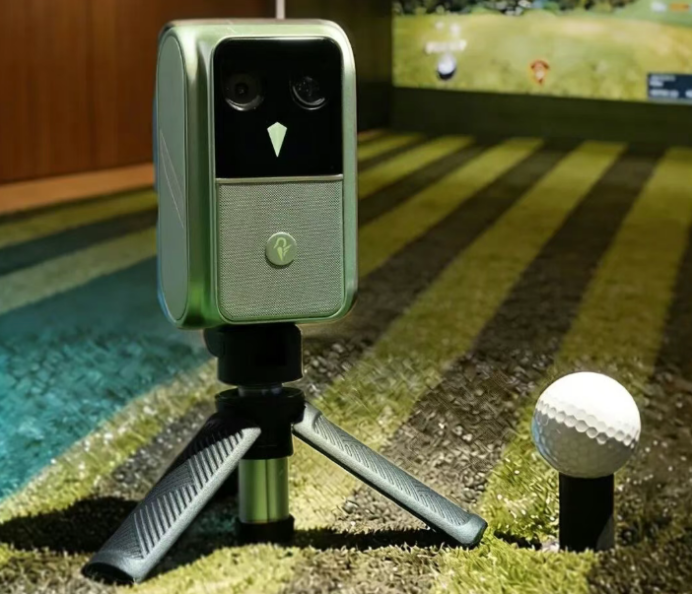
From an evaluation perspective, its core advantage lies in the deep integration of sports cognition and AI algorithms. The team has encoded professional training logic into the model, enabling the system not only to identify technical deviations but also to output personalized hitting plans based on wind direction, slope, and physical condition, significantly lowering the barrier to professional guidance. In the North American market, the product precisely addresses the essential skill advancement needs of 28 million active golfers, potentially breaking down the industry barrier of high-priced personal training.
In terms of user experience, its interactive design aligns with the habits of golf, seamlessly integrating into daily swinging rhythms without the need for complicated attire; the data visualization interface is clear and adaptable to users of all levels, from beginners to advanced. In terms of the business model, hardware sales combined with SaaS subscriptions offer high scalability, extending to scenarios such as youth training, course operation optimization, and tournament data services.
As an early-stage product, deployment still faces challenges: sensor stability in extreme weather, generalization capabilities across non-standard terrains, and data privacy compliance all require real-world stress testing. Furthermore, given the mature golf ecosystem in the US, AI needs to clearly define its collaborative role of “empowering coaches and optimizing the experience” to avoid conflicts with traditional systems. Simultaneously, it must be wary of homogeneous competition from existing data platforms like Arccos and ShotLink. BirdieSense must build its core competitive advantage through “embodied decision-making” rather than simply “data aggregation.”
Overall, BirdieSense marks a crucial leap for sports AI from “passive recording” to “active decision-making.” If Product-Market Fit (PMF) can be validated through algorithm iteration, hardware reliability, and channel integration, it has the potential to reshape North American golf training standards and become a key piece of the intelligent sports infrastructure puzzle.
III. Reconstructing Smart Sports Infrastructure Starting with Golf
Golf is undergoing a global return from a “niche social activity” to a “mass sport,” and AI technology is the core engine driving this process. The global AI + sports market is projected to exceed $10 billion by 2025, with capital and technology continuously flowing into training, data monitoring, and event operations.
Against this backdrop, PathFinder chose the United States as its initial market, precisely targeting its over 47 million participants, comprehensive 18-hole golf course network, and high user acceptance of technology. The company has secured tens of millions of yuan in angel investment from Jinqiu Fund, which will be primarily invested in algorithm optimization, hardware engineering, and pilot deployment at benchmark North American golf courses.
The team’s long-term vision extends far beyond golf hardware. Having validated its paradigm with BirdieSense, PathFinder will explore a collaborative system combining humans and AI agents, ultimately reconstructing the intelligent infrastructure of the sports industry. Its technical architecture boasts strong portability, allowing for future horizontal expansion to high-net-worth sports such as tennis and equestrianism, and even extending into mass fitness and sports rehabilitation.
Faced with global competition, PathFinder needs to continuously strengthen its localized operational capabilities, build an open data ecosystem, and form deep collaborations with coaching systems, stadium management, and sports brands. As AI evolves from an “auxiliary tool” to a “scenario-based decision-making terminal,” sports services will achieve a unification of standardization and personalization. Chinese innovation, with its core technologies and vertical scenario insights, is exporting a new paradigm in the global sports technology wave.
Leave a Reply