Sources familiar with the matter revealed that Robbyant, Ant Group’s embodied AI company, has abandoned the development of embodied intelligent hardware and is now solely focused on software, leading to the departure of many hardware testing staff.
Robbyant
At the end of 2024, Shanghai Robbyant Technology Co., Ltd., a wholly-owned subsidiary of Ant Group, was officially established. Moving beyond the traditional path of “self-developed humanoid hardware,” Robbyant chose to focus on a universal embodied large model as its core, creating a standardized intelligent base compatible with all robots, forging a new path of open-source technology and industry collaboration.
Unlike most companies that focus on developing their own humanoid robot bodies, Robbyant’s core strategy is very clear: it does not focus on manufacturing the hardware itself, but concentrates on developing a universal “brain” for robots.
The industry logic is clear: the future forms of robots in service, industry, home, and elderly care scenarios will vary greatly, with bipedal humanoids, wheeled chassis, single/dual-arm robotic arms, and quadrupedal inspection robots coexisting. If every piece of hardware has its AI control system trained from scratch, the industry’s iteration speed will be severely hampered by high customization costs. Robbyant aims to provide a cross-configuration, reusable vision-motion model, enabling hardware manufacturers to quickly endow their devices with autonomous perception, planning, and operational capabilities without investing massive amounts of algorithm development resources.
Robbyant has built a four-layer progressive embodied intelligence technology system, covering the entire process of robot perception, mapping, decision-making, and simulation inference. It is also one of the few embodied model stacks in China to achieve full-chain open source.
LingBot-VA, as an embodied world model, realizes a human-like thinking logic of “predicting before acting”: inputting the current scene, the model simultaneously predicts the next environmental change and corresponding action sequence, equivalent to the robot having a built-in virtual simulation laboratory.
In tests of flexible, high-precision tasks such as unpacking packages, folding clothes, and performing precise test tube operations, adaptation can be completed with only 30-50 sets of real-person demonstration data. The success rate of complex tasks is 20% higher than the international benchmark model Pi0.5, significantly reducing the training loss and data collection cost of real machines. The birth of Robbyant marks a significant step for a leading Chinese AI company, moving from online digital intelligence to a comprehensive entry into the physical world of embodied intelligence. Instead of focusing on creating a single blockbuster robot, it positions itself as “infrastructure,” empowering hardware across various industries with a universal LingBot model matrix.
With the full open-sourcing of LingBot-VLA 2.0, an increasing number of domestically produced humanoid robots, service robotic arms, and wearable smart hardware will be equipped with this independently developed universal brain. In the future, whether it’s home service robots, commercial catering equipment, industrial flexible production lines, or first-person AI imaging wearable devices, all will rely on Robbyant’s spatial perception and motion decision-making capabilities to truly achieve autonomous environmental understanding and the completion of complex tasks, freeing them from manual remote control and propelling the entire physical AI hardware industry into a new phase of large-scale deployment.
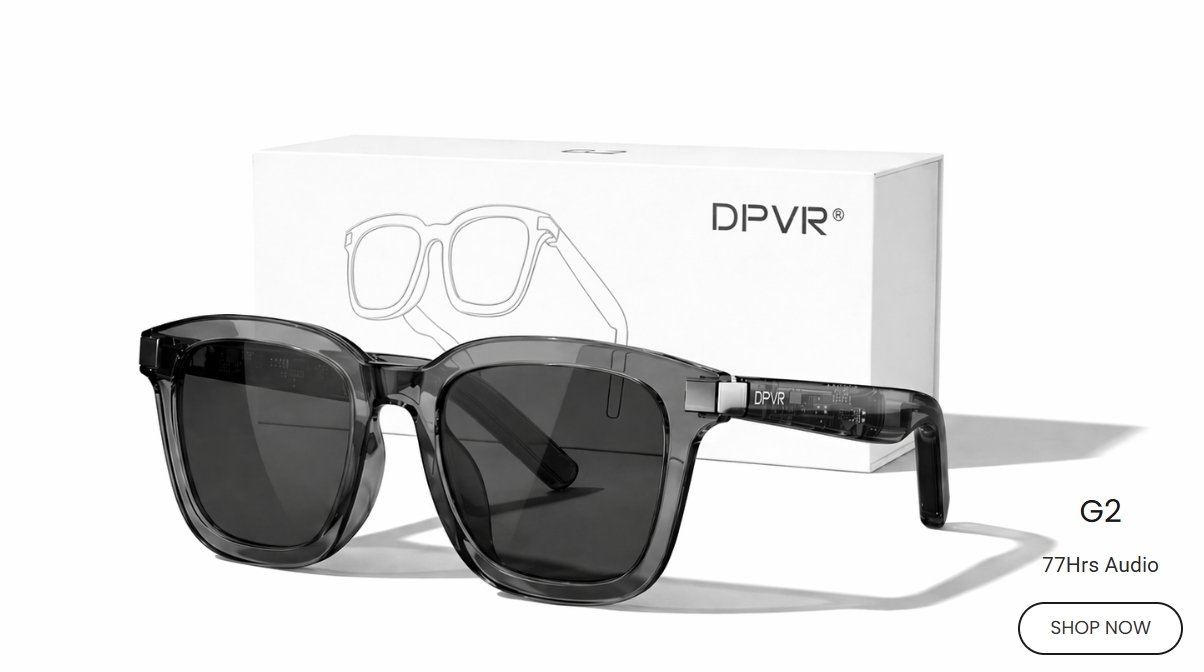
The 2026 outdoor portable imaging market welcomed a lightweight new product – the DPVR VisionRay Flow Pro, a wearable device that integrates sunglasses, a first-person view camera, an AI voice assistant, and Bluetooth earphones. Unlike bulky AR headsets and heavy action cameras, it enters the cycling, hiking, shopping, and everyday snapshot scenarios with its lightweight 46g sunglasses form factor, emphasizing hands-free immersive recording. After a week of outdoor multi-scenario testing, this article provides a complete breakdown of the real-world experience, covering appearance and wearing comfort, image capture, AI intelligent interaction, audio calls, battery life, advantages and disadvantages, and suitable user groups.
DPVR AI GLASSES
I. Appearance and Wearing Comfort: A Portable Camera Disguised as Ordinary Sunglasses
Lightweight Industrial Design The entire device, excluding lenses, weighs only 46g, almost indistinguishable from regular polarized sunglasses. It offers two frame options: black and sunset-coated. The trendy square frame design makes it completely indistinguishable from a smart device in everyday life, maximizing privacy.
IT Home • The frame is made of durable TR90 material with replaceable soft silicone nose pads, suitable for those with low nose bridges and wide faces; comfortable for extended cycling or hiking sessions of 2-3 hours without pressure on the nose or ears.
The left temple integrates a miniature shooting module with a slightly recessed lens that doesn’t protrude uncomfortably; the right temple has a built-in touch sensor for easy photo taking and video recording with a single touch.
IPX4 waterproof rating ensures the device won’t be damaged by light rain, water splashes during cycling, or outdoor sweat; perfect for daily commutes and short outdoor trips.
Practical Lens Design Comes with high-shield polarized sunglasses lenses to filter road reflections and glare; lenses are quick-removable, and prescription replacement lenses can be customized at offline stores, eliminating the need for double glasses for nearsighted users, providing both sun protection and vision correction.
Portable Storage Comes with a magnetic charging case that doubles as a storage bag and mobile charging case; easily tossed into a bag, saving space and solving the problem of easily lost small wearable devices.
II. Imaging System: What You See Is What You Get, First-Person View Exclusive “Eagle Eye” Image Engine
The Flow Pro features a Sony IMX681 12MP sensor, an F2.2 large aperture 5P optical lens, and a self-developed Eagle Eye AI image engine, specifically tuned for human eye-level perspective, perfectly reproducing what the naked eye sees, and completely solving the problems of wide-angle distortion and color cast in action cameras. (IT Home)
Video: 1080P 30fps stable recording, one-click switching to portrait mode in the app, compatible with Douyin and Xiaohongshu short videos;
Algorithm Support: Built-in EIS electronic image stabilization + real-time image distortion correction, ensuring smooth footage without tearing or noticeable shaking during running or cycling on bumpy roads;
Built-in Storage: 2GB RAM + 32GB local storage, no SIM card required, fully storing footage from a short trip.
Multi-Scene Real-World Testing
Daytime Outdoor Cycling/Hiking: Wide-angle framing closely matches the human eye’s field of vision, avoiding the exaggerated fisheye distortion of action cameras; HDR algorithm balances sky highlights and ground shadows, resulting in natural colors for mountain and coastal landscapes, eliminating the need for extensive post-processing color correction. 1. EIS Image Stabilization Tests: In real-world testing, during city road cycling and fast walking on mountain trails, the footage was smooth, effectively replacing handheld gimbal-based first-person perspective shooting.
Store Visits & Street Shooting: Whether you’re carrying food or browsing exhibitions, you don’t need to take out your phone. A simple touch on the temple allows for one-click snapshots. Vertical recording is directly compatible with short video platforms, and footage can be quickly transferred to your phone via Bluetooth for on-the-spot editing and publishing.
Low-Light Evening Scenes: The F2.2 aperture provides a significant advantage, with excellent noise control in twilight streets and indoor restaurants. AI noise reduction suppresses light halo effects, and streetlights and shop window lighting are clearly defined. While not suitable for long recording sessions in completely dark environments, it’s perfectly adequate for quick snapshots.
Shooting Controls: Two shooting modes, all without a phone:
Touch Control: Single-tap on the right temple to take a photo; long press to start/stop recording.
Voice Control: Wake up “Hey Sunny” to issue commands to take a photo, start recording, or stop recording. You can record anytime while riding with both hands on the handlebars.
III. Full-Link AI Capabilities: Voice Assistant + Image Recognition and Translation, a Portable Mobile AI Terminal
Powered by the Unisoc W517 domestic low-power computing platform, deeply integrating large AI models, the Hey Sunny voice assistant covers all scenarios including travel, photography, and office work, and can be used independently without relying on a mobile phone.
AI Shooting Assistance
AI Highlight Auto-Capture: Recognizes smiles and highlights in landscapes to automatically save high-definition photos;
Intelligent Segmented Editing: After recording, the camera identifies key moments, and the mobile app automatically generates short videos with transitions and background music;
Intelligent Image Optimization: Real-time AI brightening and skin tone optimization for clear and natural portraits.
Core Voice Interaction Functions
Real-time Translation of Over 140 Languages: Real-time voice translation for travel abroad and offline communication; image recognition translation can identify road signs and menu text, eliminating the need for handheld translation software.
On-the-Go AI Q&A: Ask for routes, weather, restaurant guides, and answer knowledge questions via voice; easily access information if you get lost while hiking or need to plan your trip.
Voice Memos & Meeting Minutes: Automatically transcribes and saves outdoor inspiration and offline conversations; small offline interviews require no additional recorder.
Global Voice Control: Play music, make and receive calls, and start recording—all done via voice.
Triple-Microphone Array Sound System: The temples feature a built-in three-microphone array with a reverse sound field anti-leakage algorithm:
Automatically suppresses wind noise during outdoor cycling, ensuring clear and prominent voices;
Eliminates background noise during calls in noisy environments such as shopping malls and streets;
Records stereo voices simultaneously in video recording, eliminating the need for additional recording equipment.
IV. Spatial Audio: A Bluetooth Headphone Replacement for Uninterrupted Commuting and Music/Talking The temples feature built-in open-back directional speakers that fit close to the ears without blocking the ear canal, balancing safety and sound quality:
3D spatial stereo sound effects create a strong immersive listening experience, sufficient for daily commutes, cycling, podcasts, and music;
Open-back design allows you to clearly hear vehicle horns while cycling or crossing the street, enhancing safety;
Stable Bluetooth 5.1 connection to your phone, with voice announcements for incoming calls and voice-activated answering and hanging up, eliminating the need to take out your phone.
V. Battery Life and Charging Tests Built-in 210mAh battery, real-world battery life test data:
Continuous video recording: 35–40 minutes, sufficient for recording a short hike or cycling trip;
Pure music/Bluetooth call: 2.5 hours, enough for all-day music listening during commutes;
AI voice standby: Can last for most of the day with light use.
Dual charging solutions:
Type-C direct charging: Charges to 60% in 15 minutes for quick, short bursts of charging;
Magnetic charging case: Provides backup power when out and about; automatically recharges when placed back in the charging case at night; supports simultaneous charging and shooting, allowing for continuous recording during long outdoor trips when paired with a power bank.
VI. Summary of Advantages and Disadvantages Based on Actual Testing
Core Advantages
Sunglasses + Camera in one, eliminating the need to carry a separate device; discreet and indistinguishable design for more natural privacy shooting;
Ultra-lightweight at only 46g, comfortable for extended wear; supports replaceable prescription lenses, suitable for a wider range of users;
First-person perspective EIS image stabilization + distortion-free wide-angle lens, providing an immersive shooting experience for cycling and hiking far exceeding that of a mobile phone;
Full suite of offline AI functions, including translation, image recognition, and voice memos, usable without a mobile phone;
IPX4 waterproof, open spatial audio, and three-microphone noise reduction, specifically optimized for outdoor scenarios;
32GB large-capacity local storage, allowing for high-speed Bluetooth transfer of footage back to your phone, resulting in high efficiency for short video creation.
Objective Shortcomings:
Video resolution is limited to a maximum of 1080P 30fps, with no 4K video option, insufficient for the maximum image quality for heavy professional video creators;
Continuous shooting time is only about 40 minutes, requiring a charging case for long-term outdoor shooting;
Noticeable noise in low-light night scenes, unsuitable for extended nighttime recording;
The sound quality of the open-back speakers is lower than that of over-ear headphones, requiring increased volume in noisy environments;
No screen preview, making it impossible to check composition in real-time during shooting, relying on visual judgment for framing.
VII. Suitable & Unsuitable Users
Highly Recommended:
Cycling, hiking, and mountaineering enthusiasts who want to record from a first-person perspective and need to maintain balance with both hands;
Shop review bloggers and street vlog creators who frequently capture candid moments and seek portable, low-profile shooting equipment;
Frequent short trips and international travelers who need real-time translation and a portable AI assistant;
Commuters who want to replace sunglasses and Bluetooth headphones for listening to music and answering calls;
People with nearsightedness who can change their prescription lenses, eliminating the need for double glasses.
Unsuitable Users:
Professional video creators who demand 4K high frame rate and cinematic night scene quality;
Those who need to record continuously for more than 2 hours at a time for long-distance all-day hiking and camping;
Heavy music enthusiasts who have high requirements for headphone sound quality;
Users who primarily shoot at night and document night scenes. VIII. Evaluation Conclusion The DPVR VisionRay Flow Pro eschews a complex AR screen, precisely addressing the essential need of ordinary users for first-person perspective recording, returning smart glasses to their core essence of “everyday wear.” It’s not a professional action camera, but a lightweight, lifestyle-oriented AI wearable device: a pair of sunglasses that can take photos and videos, features AI translation, and even play music and make calls.
If you’re tired of carrying your phone in one hand and holding your bike/bag in the other, and want to discreetly, conveniently, and anytime, anywhere record the scenery before you, while also needing a personal AI voice assistant, these AI smart sunglasses are an extremely practical choice among wearable imaging devices in the thousand-yuan price range.
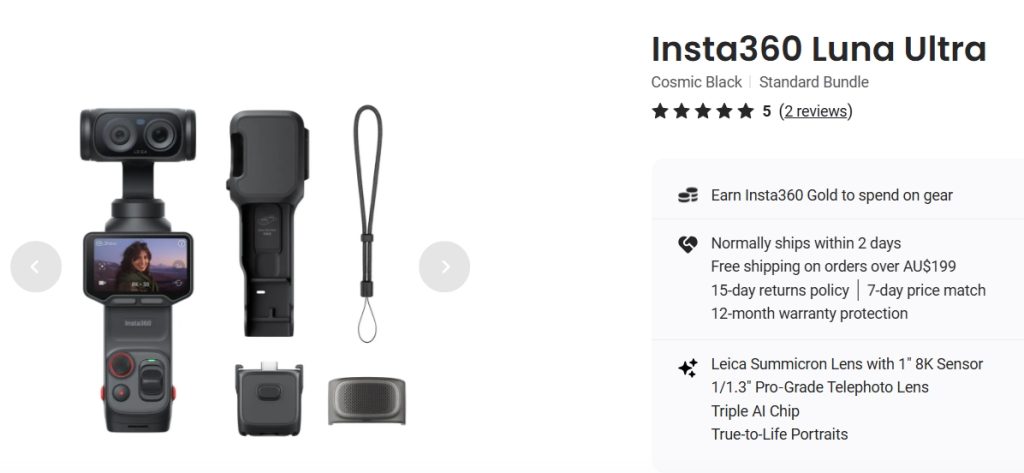
2026 saw a major new product launch in the gimbal camera market. Insta360, a company with years of experience in panoramic imaging, officially entered the handheld gimbal market with its first flagship model, the Luna Ultra. Unlike the compromised designs of many single-lens portable gimbal cameras on the market, this Leica-co-developed dual-lens AI camera features a detachable remote control screen, a 1-inch large-sensor dual-lens camera, and AI triple-core computing power, reshaping the logic of single-person vlog creation. After a week of comprehensive testing across various scenarios, this article provides a thorough analysis of this new product’s true capabilities, covering its appearance and hardware, Leica imaging, AI intelligent functions, real-world shooting scenarios, battery life and audio recording, advantages and disadvantages, and target audience.
Insta360 Luna Ultra
I. Appearance and Industrial Design: Detachable Screen is the Biggest Innovation
The Luna Ultra is available in Obsidian Black and Moonlight White. Its lightweight body offers a balanced grip, addressing the common problem of blind spots in composition for single-person selfies with traditional gimbal cameras. Its core differentiating design focuses on two points:
Industry-first detachable 2-inch OLED remote image transmission screen. The screen detaches from the gimbal via a magnetic clip and has a built-in independent 210mAh battery. It wirelessly transmits images in real time, eliminating the need for repeated camera adjustments for long-distance selfies, low-angle shots, and first-person perspective shots. A single person can accurately compose shots, start/stop recording, and adjust zoom parameters without having to repeatedly adjust the camera position. The screen supports one-click switching between portrait and landscape modes, touch-sensitive zoom, and excellent visibility in bright outdoor light.
Professional Three-Axis Physical Gimbal Architecture: The entire camera features high-precision three-axis mechanical stabilization, achieving shake suppression accuracy of ±0.005°. The gimbal’s maximum control speed is 210°/second, ensuring no loss of electronic image stabilization during running, cycling, and walking tracking shots. The gimbal offers ample range of motion across its tilt, pan, and roll axes, enabling complex shots such as low-altitude ground-level camera movements and low-angle landscape shots. A 1/4-inch screw mount is standard on the bottom of the camera, compatible with Insta360 accessories such as tripods, neck mounts, and backpack clips.
The camera’s control layout is simple, with clearly defined sections for the side recording button, zoom lever, and function joystick, allowing for effortless blind operation. The main unit has a built-in 1550mAh battery and 47GB of native storage, supporting Micro SD cards up to 1TB for expansion, eliminating the need for external memory cards for short shooting trips.
II. Leica Dual-Camera Imaging System: Say Goodbye to Focal Length Anxiety with Single-Camera Gimbals
As Insta360’s first Leica-branded gimbal camera, the Luna Ultra features dual Summicron lenses, covering a 20mm wide-angle main camera and a 60mm telephoto lens, achieving a complete zoom range of 1–12x. This completely solves the shortcomings of traditional single-camera gimbals, such as lack of telephoto capabilities and weak portrait bokeh.
1-inch Wide-Angle Main Camera (20mm, F1.8 Aperture)
1-inch large sensor, supporting 8K 30fps Dolby Vision recording and 14 stops of dynamic range;
Native support for 10-bit I-Log format, preserving ample light and shadow information, providing post-processing color grading space comparable to entry-level mirrorless cameras;
Still photos can be output up to 37MP, and panorama mode can synthesize 200MP wide-angle landscape photos, capturing full detail in landscape and street photography.
1/1.3-inch telephoto secondary camera (60mm, F2.0 aperture)
3x optical zoom, 6x lossless digital zoom, up to 12x hybrid zoom;
Outstanding telephoto macro capabilities, producing natural background blur when shooting flowers, accessories, and portrait close-ups, with Leica color tuning delivering a soft film-like texture;
In actual testing, there was no significant loss of sharpness at zoom up to 6x. In 8K mode, 1-6x lossless zoom and 6-12x switching to 4K output meet the needs of shooting distant portraits and urban landscapes.
Actual Image Quality Performance
Daytime Portraits: Leica’s exclusive portrait filter produces clear skin tones straight out of the camera. AI skin tone optimization automatically smooths skin, preserving skin texture without excessive beautification or a fake-looking effect. The telephoto lens provides excellent spatial compression, resulting in clean backgrounds and natural layered bokeh in outdoor portraits, far surpassing other single-lens gimbals in its class.
Landscape Shooting: The 1-inch sensor offers a significant dynamic range advantage, preserving details in both sky and cloud layers, as well as dark areas of the ground, during high-contrast sunrises and sunsets, preventing overexposure in highlights and complete darkness in shadows.
Low-Light Night Scenes: Equipped with AI triple-core collaborative computing power (dual image AI chips + 4nm main control), PureVideo’s night scene algorithm significantly suppresses noise, resulting in clean control of streetlights and city night scene lighting without severe haloing or blurring. Even in completely low-light environments, images can be clearly recorded using only streetlights. In extremely dark scenes, using a magnetic fill light can further enhance portrait image quality.
High Frame Rate Slow Motion: Supports 4K 120fps slow-motion recording. Playback of dynamic shots such as running, jumping, and flowing water is smooth, with no motion blur at the edges of moving subjects, ideal for creative travel videos.
III. Full Set of AI Intelligent Functions: A Productivity Tool Exclusively for Individual Creators
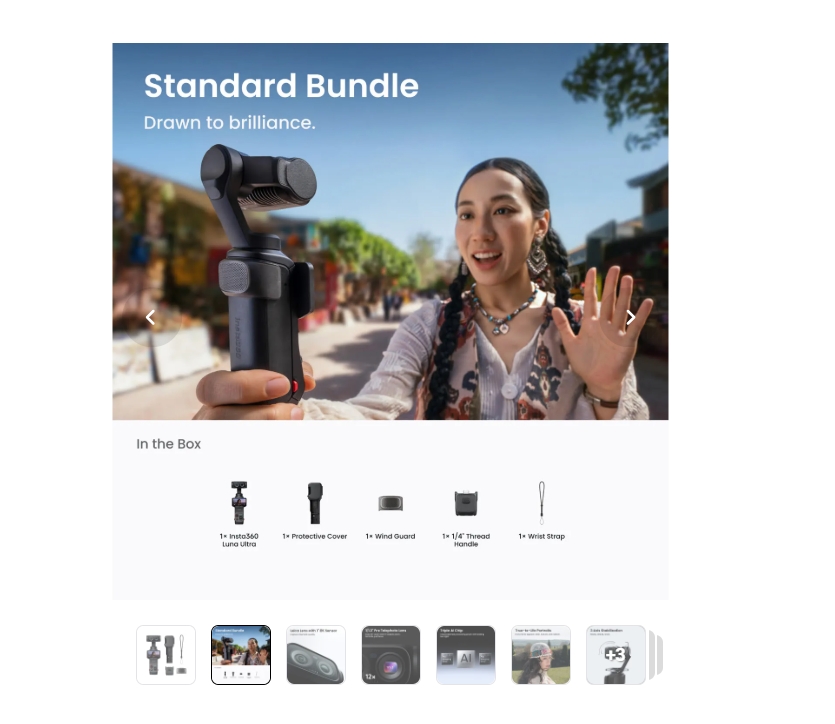
Standard Bundle
AI is the core competitiveness of the Luna Ultra. A full suite of algorithms is optimized for individual vlogs and travel recordings, automatically generating finished videos without complicated operations:
DeepTrack 5.0 Deep Intelligent Tracking: Supports single-person lock-on tracking, multi-person group tracking, and dynamic telephoto continuous tracking. Simply tap the screen to select the subject, and the gimbal automatically follows the person’s movement, preventing easy out-of-focus shots during running, cycling, or outdoor activities. It includes 9 built-in golden composition points, allowing you to pre-set the subject’s fixed position in the frame, automatically centering/using the rule of thirds, enabling even beginners to create professional Insta360-style shots.
AI One-Click Intelligent Editing: Real-time in-camera recognition of highlights, faces, and transitions. After shooting, it automatically matches background music, filters, and transition effects, exporting 15-second to 3-minute short videos, eliminating the need for computer editing and making it ideal for quick publishing on social media platforms.
AI Intelligent Noise Reduction and Quad-Microphone Acoustics: The camera features a quad-microphone array (3 gimbal microphones + a microphone at the top of the screen), with a built-in AI intelligent wind noise suppression algorithm. In windy outdoor environments, it effectively filters out airflow noise, ensuring clear and prominent vocals. Combined with the original wireless microphone, it delivers excellent audio quality for indoor store visits and outdoor interviews.
Expanded AI Shooting Functions: With an optional head-tracking module, it enables first-person perspective shooting, automatically synchronizing lens rotation when the user turns their head, providing an immersive recording experience for cycling and hiking. AI intelligent composition assistance, automatic highlight capture, and segmented time-lapse photography cover all creative needs across various scenarios.
IV. Battery Life, Charging, and Accessory Testing: Battery Life Performance: Official lab tests show 240 minutes (4 hours) of continuous recording at 1080P 24fps with the screen off. In everyday mixed 4K/8K shooting, with the screen always on and frequent zooming, real-world testing shows 2.5–3 hours of continuous shooting, sufficient for recording short trips throughout the day. The charging speed is impressive; 45W PD fast charging can charge it to 80% in just 23 minutes, allowing for a quick power-up during lunch breaks or short breaks, eliminating the need for long charging times with Insta360.
Accessories include a standard windscreen, wrist strap, and 1/4″ adapter. Optional accessories include a magnetic adjustable color temperature fill light, a head-tracking POV module, a neckband, and a wireless microphone. The magnetic fill light is easy to attach and detach, essential for nighttime portrait photography. The detachable screen allows for separate storage, making the entire device highly portable and free of unnecessary bulk.
V. Summary of Advantages and Disadvantages Based on Actual Testing
Core Advantages
Unique dual-camera setup + detachable screen; the only gimbal camera in its price range to support telephoto + remote control composition, significantly improving single-person shooting efficiency;
1-inch Leica sensor with superior image quality compared to competitors, crushing single-camera pocket gimbals in its class in night scenes, portraits, and landscapes;
AI tracking, one-click image creation, and four-microphone noise reduction provide intelligent end-to-end support, lowering the barrier to entry for short video creation;
8K Dolby Vision and 10-bit Log high-specification video, catering to both everyday recording and professional short film creation;
Fast charging + long battery life; built-in large-capacity storage eliminates the need for frequent use of spare cards and batteries when out and about. Objective Shortcomings:
Slight image quality degradation at 12x extreme zoom; 8K only supports 1-6x lossless zoom.
Slightly heavier than entry-level single-lens gimbals; prolonged handheld use may feel slightly burdensome.
A complete set of expansion accessories is relatively expensive; acquiring a POV sensor, microphone, and fill light is costly.
In low-light, pure night scene photography without a fill light, shadow detail smoothing is slightly intensified.
VI. Who is it suitable for? Who Shouldn’t Buy This Camera?
Recommended Buyers:
Independent bloggers and solo vlog creators who frequently travel alone, explore shops, and record outdoor activities.
People who prioritize video quality and find smartphones and entry-level gimbals unsatisfactory in low-light conditions and lack telephoto capabilities.
Short video creators who need quick footage, automatic editing, and intelligent tracking to reduce post-production costs.
Travel enthusiasts who value portability while wanting near-mirrorless quality in landscape and portrait photography.
Who Shouldn’t Buy This Camera:
Beginner users with a budget under 3000 RMB who only record casually.
Extreme sports enthusiasts who primarily shoot underwater and intense sports (more suitable for action cameras).
Users with heavy panoramic shooting needs; panoramic functionality is not the main focus of this camera. VII. Overall Evaluation Conclusion As Insta360’s first flagship gimbal camera, the Luna Ultra doesn’t follow a homogenized, compromise-driven approach. It precisely addresses three major pain points of traditional pocket gimbals: lack of telephoto capability, difficulty in composing selfies, and weak low-light image quality. It differentiates itself with a Leica dual-lens camera, a detachable remote control screen, and a full suite of AI algorithms.
If you’re tired of the insufficient video quality of mobile phones and the limitations of single-lens gimbals in composition, and are looking for a portable, high-quality, and intelligent creative device, the Luna Ultra is a highly competitive choice among current flagship gimbal cameras. It’s not just a portable recording device; it’s an all-in-one AI image productivity tool tailored for individual creators.
Sources familiar with the matter revealed that the CEO of UAES has joined Momenta.
Momenta
The century-old automotive industry is standing at a watershed moment of transformation. The wave of electrification has passed its period of rapid expansion, and industry competition has fully shifted to the second half of intelligentization. Price wars continue to squeeze profits across the industry chain, the bottlenecks of distributed electronic and electrical architectures are becoming increasingly apparent, and software-defined vehicles are moving from concept to core competitiveness for vehicle manufacturers.
Xiong Weiming has a keen insight into industry trends. He has repeatedly pointed out in public that with the increasing penetration rate of new energy vehicles and the determination of OEMs to “go all in” on intelligentization, the underlying logic of the automotive industry is undergoing a fundamental change. “Previously, software served hardware; now it is increasingly becoming clear that hardware is serving software.” This statement accurately summarizes the characteristics of the “software-defined vehicle” era.
Xiong Weiming spearheaded a major upgrade of UAES’s Electronic and Electrical Architecture (EEA). He proposed that the new infrastructure for intelligent vehicles should be based on a cross-domain integrated “centralized computing + regionalization + SOA (Service-Oriented Architecture)” solution.
In October 2024, the Taicang New Energy Vehicle Powertrain Project, facilitated by Xiong Weiming, was officially completed. With a total investment of 5.05 billion yuan, the project is designed to produce 1.2 million drive motors and 3.6 million power modules annually, and is considered a key node in the Yangtze River Delta’s new energy vehicle industry chain.
In July 2022, under his leadership, UAES and Neusoft Reach reached a strategic cooperation agreement to jointly develop automotive basic software solutions involving SOA middleware and automated testing technologies. In 2024, he also conducted a technical inspection with senior executives of the Bosch Group to further deepen supply chain collaboration in the new energy field.
Currently, digital AI has become a highly competitive market, while physical AI is just beginning. Digital AI (such as GPT) experienced initial explosive growth because internet data is readily available and testing costs are low; while physical AI faces difficulties in data acquisition and has long testing cycles. However, the physical world “may be a much larger part,” so the successful experiences of digital AI will inevitably migrate to the physical world.
Autonomous driving is the first real-world application of physical AI. Momenta has launched the Momenta R7 World Model, a foundational model for physical AI, comprising a three-layer architecture: world model pre-training, world model simulation, and world model reinforcement learning.
Currently, Momenta possesses data from 1 million mass-produced vehicles and 100 million data points extracted from over 12 billion kilometers of real-world driving mileage. It trains its model with all the knowledge of the digital world, compressing physical common sense and causal relationships into the foundational model through massive amounts of real-world driving data videos, enabling the system to form a basic understanding of the physical world.
It took Momenta two years to deliver its first 100,000 vehicles; now, it has shortened the delivery time to less than 40 days for a similar scale of delivery. From its launch in 2017 to mass production by the end of 2025, it took eight years, but the pace has significantly accelerated after the breakthrough. In 2024, Momenta acquired all of Mercedes-Benz’s electric and gasoline vehicle business.
The core of physical AI is the mutual driving force between data scaling and business scaling. Autonomous driving is currently the only physical AI field that can achieve both of these simultaneously, and Momenta has initially run this cycle through 1 million mass-produced vehicles.