Shanghai-based NAOYUN Technology recently launched the Veetra Alpha brain-computer interface (BCI) TWS earphones. This product, which integrates professional BCI technology with high-end earphone functions, is attempting to break through the industry bottleneck of smart wearable devices that “only quantify the body, not interpret the mind.”
For the past decade, the wearable market, dominated by smartwatches and fitness trackers, has focused on monitoring physical health data such as steps and heart rate. However, with increasing information overload, the need to manage “psychological indicators” such as focus and mental stress is becoming increasingly prominent. The consumerization of BCI technology is considered the core track for wearable devices in the next decade. The emergence of the Veetra Alpha is the first large-scale attempt in this trend—can it transform laboratory-level EEG monitoring into a practical function that ordinary people can use daily? This newspaper conducts an in-depth review from the dimensions of hardware, functions, and commercial value.
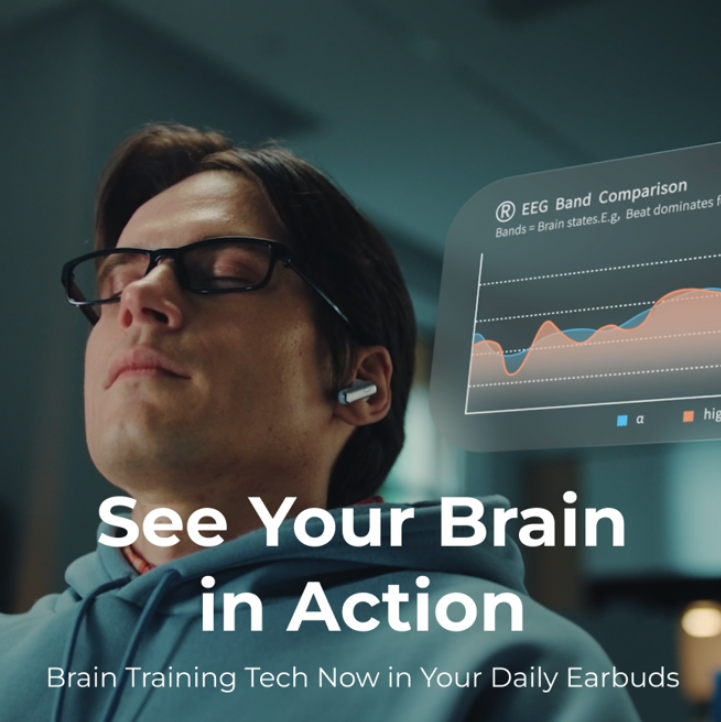
I. Hardware Breakthrough: Packing “Medical-Grade Technology” into 6-Gram Earphones
The pain points of traditional EEG devices are obvious: bulky helmets and electrodes requiring conductive gel have long confined them to the medical and research fields, making it difficult to enter the consumer market. The core breakthrough of the Veetra Alpha lies in making this technology “invisible” and “lightweight.”
Weighing only 6 grams per earbud, it is virtually indistinguishable from high-end TWS earbuds on the market in terms of appearance and wearing comfort, completely eliminating the “medical feel” of traditional EEG devices. Its key innovation lies in the built-in high-precision EEG dry electrodes—requiring no preparation; users can start EEG acquisition simply by wearing the earbuds, solving the core pain points of traditional devices being cumbersome to operate and inconvenient to wear.
Based on feedback from crowdfunding users, the in-ear design effectively solves the stability problem of electrode contact with the skin, avoiding the defects of traditional EEG headbands such as easy displacement and signal interruption. For users who value privacy and want to use it in public scenarios such as the office and commuting, this “invisible black technology” design has become its core competitive advantage.
II. Core Functions: More Than Just Headphones, a “Digital Coach” for the Brain
Compared to mainstream products like Apple AirPods and Sony noise-canceling headphones, the core difference of the Veetra Alpha lies in its “brain-reading” ability—it can capture four core brainwave patterns in real time: Theta (θ), Alpha (α), Beta (β), and Gamma (γ). Through a self-developed algorithm, it transforms abstract signals into interpretable data such as focus, stress levels, and fatigue levels, with an accuracy rate reportedly exceeding 95%.
Its “neurofacial feedback” function is a key highlight: when the device detects a user’s inattention or excessive stress, it provides subtle cues through headphone sounds or light effects, guiding the user to adjust their breathing and return to a focused state, achieving active training in “flow mode.” This function is not merely a simple data display, but forms a closed loop of “monitoring-feedback-adjustment,” distinguishing it from ordinary health monitoring devices.
In practical applications, it can be used for focus training during deep work, quantifying the effects of meditation for beginners, and real-time stress management for people under high pressure. “In the past, I relied entirely on intuition to determine if I was in a meditative state. Now, the app provides specific data on my relaxation level, significantly improving training efficiency,” commented one crowdfunding user.
III. Audio Essence: No Gimmicks, Maintaining Flagship Headphone Standards
Pioneer technology products often fall into the trap of prioritizing features over user experience, but the Veetra Alpha clearly avoids this problem—as headphones, their acoustic quality reaches flagship standards, ensuring a superior experience in core usage scenarios.
35dB Active Noise Cancellation (ANC) combined with ENC call noise cancellation is sufficient to handle typical noisy environments such as subways and offices, meeting daily needs for commuting and office work; 24-bit/192kHz Hi-Res lossless audio certification puts its audio performance on par with mainstream flagship TWS headphones in the $200 price range, providing a superior listening experience whether listening to music, podcasts, or making calls.
Battery life also meets daily usage needs: exceeding 30 hours of combined battery life, it supports all-day EEG data acquisition, avoiding the impact of frequent charging on data continuity—crucial for users requiring long-term mental state monitoring.
In other words, even disregarding its brain-computer interface function, the Veetra Alpha is a competent high-end noise-canceling headphone, lowering the barrier to entry for users.
IV. Software Ecosystem: Gamification Lowers the Barrier, Data Builds Long-Term Value
Hardware is the foundation, but the software ecosystem is key to retaining users. The Veetra Alpha’s companion app employs a “gamified training” logic, transforming tedious focus and relaxation training into interactive games like “Mind Blossoms” and “Mind Boats.” Users control the game’s progress by adjusting their own state, significantly reducing the learning cost of EEG training.
The EMG (electromyography) control function enhances practicality: by detecting electrical signals in the jaw muscles, users can easily perform actions like changing songs and answering phone calls by gently clenching their teeth. This design is highly advantageous in scenarios where hands are inconvenient, such as during exercise or typing.

Even more commercially promising is its “data assetization” strategy—the long-term accumulation of EEG data will form a personalized “mental health profile,” laying the foundation for subsequent personalized training courses, health advice, and other subscription services. This also gives the hardware itself a higher premium.
V. Price and Value: $200 to Tap into the Consumer Brain-Computer Interface Market
Price positioning is key to the widespread adoption of the Veetra Alpha. Currently, consumer-grade EEG headbands (such as the Muse series) are generally priced between $250 and $400 and lack high-quality audio features; medical-grade and research-grade EEG devices exceed $1000, making them extremely inaccessible.
The Veetra Alpha’s early bird price on Kickstarter is approximately $180-$200 (subject to official crowdfunding tiers), equivalent to getting “flagship headphones + entry-level brain-computer interface + meditation/focus coach” for the price of a high-end TWS earphone, offering significant value for money.
From an industry perspective, this price breaks down the consumer-level barrier to brain-computer interface technology, providing more ordinary users with the opportunity to access cutting-edge technology and opening up a new growth curve for the wearable device industry.
VI. Risks and Limitations: Learning Costs and Privacy Concerns
Despite its significant advantages, the Veetra Alpha still has some potential shortcomings that consumers should be aware of.
Firstly, the learning curve: Although the software has been gamified and simplified, understanding brainwave data and gaining actual benefits through neurofeedback training still requires patience and time, and not all users can adapt. Secondly, individual differences: Brainwave signals are easily affected by physiological states and environmental factors, and some users may need multiple calibrations to achieve optimal monitoring accuracy.
Most importantly, there are privacy risks—brain data is extremely sensitive personal privacy. Users need to carefully review the manufacturer’s data encryption policies, storage methods, and privacy protection clauses to avoid data leakage. Shanghai Brainwave Technology stated on its crowdfunding page that it will use on-device encrypted storage, but the actual implementation effect still needs to be tested by the market.
VII. Purchase Guide: Who Should Pay for This “Future Headphone”?
Veetra Alpha is not a mass-market consumer product; it’s positioned more towards a specific group of users. The following types of users should consider it first:
- High-pressure office workers and knowledge workers: Those who need to manage their energy, improve focus, and pursue a highly efficient work state;
- Meditation and mindfulness practitioners: Users who need quantifiable training effects to aid in advanced spiritual practice;
- Tech enthusiasts and early adopters: Those interested in brain-computer interface technology and willing to try next-generation human-computer interaction methods;
- Students: Those facing exam pressure who need to train their focus and alleviate anxiety.
However, for users who prioritize pure sound quality, are extremely sensitive to data privacy, or expect medical effects, blind purchase is not recommended—Veetra Alpha is essentially a consumer electronics product and cannot replace professional medical equipment or psychotherapy.
Conclusion: The consumerization of brain-computer interfaces has only just begun.
The successful crowdfunding of Veetra Alpha not only validates the potential of the consumer market for brain-computer interfaces but also marks the transformation of smart wearable devices from “quantifying the body” to “quantifying the mind.” It avoids the pitfall of “technology for technology’s sake,” instead focusing on user experience and combining cutting-edge technology with everyday needs, providing a low-cost entry point into brain-computer interfaces.
Of course, it’s not perfect—learning costs, privacy protection, and individual differences still need to be addressed in future iterations. However, it’s undeniable that Veetra Alpha has opened up a new direction for the wearable device industry. With the maturation of the technology and the improvement of the software ecosystem, brain-computer interfaces may become a core feature of future consumer electronics.
Currently, Veetra Alpha is still crowdfunding on Kickstarter, with limited early bird slots available. Interested users can secure their spot through the official crowdfunding page. Considering its functionality, price, and industry significance, this newspaper gives it a 4.5/5 recommendation rating.
Leave a Reply