One-sentence verdict: If xTool can replicate its laser engraver dominance in the heat press market, the WonderPress may become the next must-have desktop tool for makers and POD sellers—and at $279, it undercuts most single-function industrial machines by a factor of ten.
Quick Summary
On June 17, 2026, xTool officially opened domestic pre-orders for the WonderPress modular multi-function creative heat press workstation. The device integrates five capabilities through swappable modules: automatic flat heat pressing, 3D heat transfer, vacuum thermoforming, professional DTF curing, and multi-function baking. Built-in preset material parameters enable zero-experience operation. The product previously raised $4.61 million on Kickstarter from over 8,169 backers within days of launch. Domestic pricing starts at 2,799 RMB ($387), with early bird Kickstarter pricing at $279. xTool holds 47% market share in consumer laser engravers and filed for Hong Kong IPO in January 2026.
What Happened
xTool built its reputation by doing one thing exceptionally well: making industrial-grade laser engraving accessible to consumers. Its laser engravers command 47% of the consumer segment—six times the share of its nearest competitor. The WonderPress represents the company’s attempt to replicate this formula in an adjacent category.
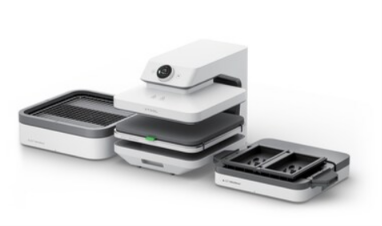
The product architecture centers on modularity. Five distinct functions occupy the same desktop footprint through interchangeable modules:
Automatic flat heat pressing handles T-shirts, bags, hats, mouse pads, and Perler beads. The machine automatically matches temperature and time parameters; users load items and retrieve finished products without manual calibration.
3D heat transfer extends capability to curved surfaces. A dedicated module presses patterns onto phone cases, mug exteriors, and irregular objects—functions impossible with conventional flat-bed machines.
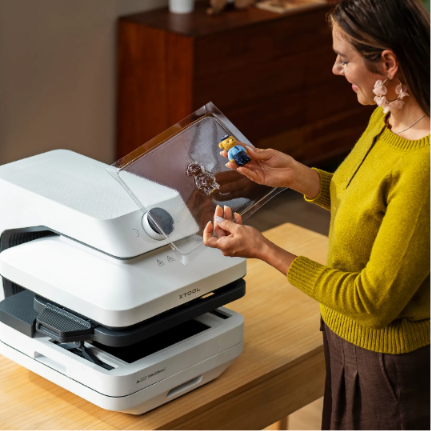
Vacuum thermoforming heats and softens plastic sheets, then vacuum-seals them against molds. The integrated heating-pressuring-shaping workflow produces custom packaging prototypes and small-batch molds within seconds.
Professional DTF curing completes the Direct-to-Film workflow. Users print patterns onto specialized film, then use the WonderPress to heat-cure and activate adhesive properties. This supports single-piece orders without plate-making—currently the hottest process in apparel customization circles.
Multi-function baking provides precise temperature-controlled heating for polymer clay curing, shrink plastic processing, and mug sublimation. The 80×398×158mm chamber accommodates three standard mugs simultaneously.
The unifying intelligence is a preset material parameter library. Load an item, the machine identifies material type, and automatically configures temperature, duration, and pressure. This “microwave simplicity” approach eliminates the traditional heat press learning curve where novices ruin dozens of garments calibrating settings.
Why It Matters
The heat press market suffers from a fundamental segmentation problem. Industrial machines cost thousands of dollars, occupy workshop space, and require trained operators. Consumer alternatives are typically single-function devices with crude temperature controls that frustrate beginners. The gap between “professional results” and “accessible price” has remained largely unbridged.
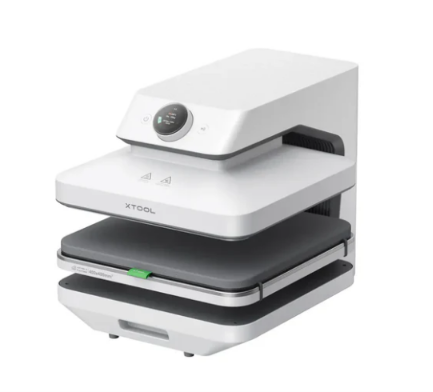
xTool’s WonderPress targets this gap directly. At $279-387, it costs roughly what a mid-range smartphone commands, yet replaces five separate pieces of equipment. For Print on Demand sellers—who list customized products on e-commerce platforms and produce only after receiving orders—this consolidation matters enormously. A typical POD operation might separately purchase a flat press ($300), mug press ($200), vacuum former ($500), DTF oven ($400), and polymer clay oven ($150). The WonderPress bundles equivalent capability at roughly one-third the combined cost and one-fifth the workspace.
The Kickstarter performance validates demand. Crossing $1 million within four hours and ultimately reaching $4.61 million indicates strong pre-market validation. For context, most hardware Kickstarter campaigns struggle to reach $100,000. The 8,169 backer count suggests this is not merely speculative investment but genuine purchase intent from makers and small business operators.
Impact Analysis
Market impact: China’s heat press market reached approximately 3.9-4.5 billion RMB in 2026 with 8-19% annual growth. The WonderPress could accelerate this expansion by expanding the user base from professional workshops to individual creators and small e-commerce sellers. If xTool achieves even 10% of its laser engraver market penetration in heat presses, it would capture significant share of a rapidly growing category.
Consumer impact: Individual makers gain access to production capabilities previously requiring industrial equipment. A hobbyist can now produce professional-quality custom apparel, promotional items, and prototypes without outsourcing. For POD sellers, the reduced equipment footprint and simplified workflow directly improve unit economics—less space rent, faster turnaround, lower defect rates from misconfigured parameters.
Industry impact: The “modular multi-function” approach may influence broader desktop manufacturing equipment design. Rather than purchasing separate machines for each process, users increasingly expect swappable modules that transform base hardware. This trend, already visible in 3D printing (tool changers) and CNC (spindle modules), now extends to thermal processing equipment.
What’s Next
Several variables will determine whether the WonderPress achieves sustained market traction:
First, module durability and interchangeability. Frequent module swapping must not degrade connection precision or heating uniformity. Early user reports on connector wear and temperature consistency will be critical.
Second, material library expansion. The preset parameter database currently covers common materials, but specialty substrates (metallic films, reflective fabrics, composite plastics) may require user calibration. How quickly xTool expands official library coverage affects the “zero-experience” promise.
Third, domestic versus overseas performance divergence. xTool generates 85% of revenue from Europe and America through direct-to-consumer channels. The WonderPress domestic launch tests whether Chinese consumers—who face different POD ecosystem maturity and e-commerce platform structures—respond equally strongly.
Fourth, IPO implications. With Hong Kong listing application submitted in January 2026, WonderPress sales performance becomes a narrative element for investor presentations. Strong numbers validate the “platform expansion beyond laser engraving” growth story; weak numbers raise questions about category extension capabilities.