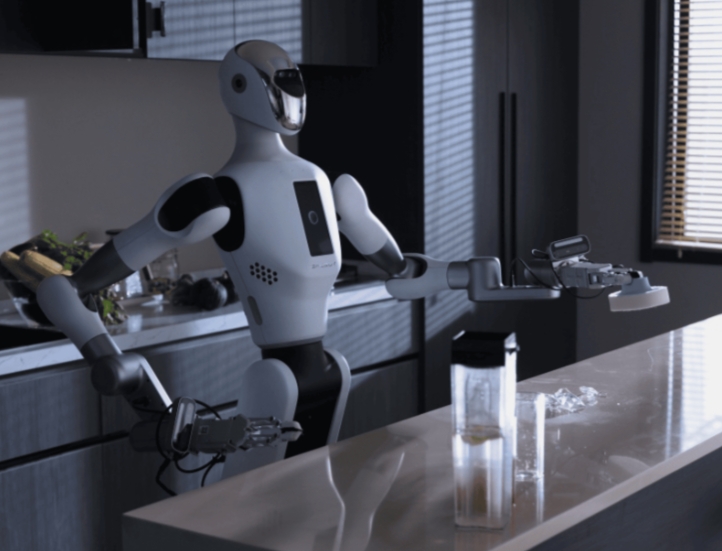
Sources familiar with the matter revealed that Robbyant, Ant Group’s embodied AI company, has abandoned the development of embodied intelligent hardware and is now solely focused on software, leading to the departure of many hardware testing staff.
At the end of 2024, Shanghai Robbyant Technology Co., Ltd., a wholly-owned subsidiary of Ant Group, was officially established. Moving beyond the traditional path of “self-developed humanoid hardware,” Robbyant chose to focus on a universal embodied large model as its core, creating a standardized intelligent base compatible with all robots, forging a new path of open-source technology and industry collaboration.
Unlike most companies that focus on developing their own humanoid robot bodies, Robbyant’s core strategy is very clear: it does not focus on manufacturing the hardware itself, but concentrates on developing a universal “brain” for robots.
The industry logic is clear: the future forms of robots in service, industry, home, and elderly care scenarios will vary greatly, with bipedal humanoids, wheeled chassis, single/dual-arm robotic arms, and quadrupedal inspection robots coexisting. If every piece of hardware has its AI control system trained from scratch, the industry’s iteration speed will be severely hampered by high customization costs. Robbyant aims to provide a cross-configuration, reusable vision-motion model, enabling hardware manufacturers to quickly endow their devices with autonomous perception, planning, and operational capabilities without investing massive amounts of algorithm development resources.
Robbyant has built a four-layer progressive embodied intelligence technology system, covering the entire process of robot perception, mapping, decision-making, and simulation inference. It is also one of the few embodied model stacks in China to achieve full-chain open source.
LingBot-VA, as an embodied world model, realizes a human-like thinking logic of “predicting before acting”: inputting the current scene, the model simultaneously predicts the next environmental change and corresponding action sequence, equivalent to the robot having a built-in virtual simulation laboratory.
In tests of flexible, high-precision tasks such as unpacking packages, folding clothes, and performing precise test tube operations, adaptation can be completed with only 30-50 sets of real-person demonstration data. The success rate of complex tasks is 20% higher than the international benchmark model Pi0.5, significantly reducing the training loss and data collection cost of real machines. The birth of Robbyant marks a significant step for a leading Chinese AI company, moving from online digital intelligence to a comprehensive entry into the physical world of embodied intelligence. Instead of focusing on creating a single blockbuster robot, it positions itself as “infrastructure,” empowering hardware across various industries with a universal LingBot model matrix.
With the full open-sourcing of LingBot-VLA 2.0, an increasing number of domestically produced humanoid robots, service robotic arms, and wearable smart hardware will be equipped with this independently developed universal brain. In the future, whether it’s home service robots, commercial catering equipment, industrial flexible production lines, or first-person AI imaging wearable devices, all will rely on Robbyant’s spatial perception and motion decision-making capabilities to truly achieve autonomous environmental understanding and the completion of complex tasks, freeing them from manual remote control and propelling the entire physical AI hardware industry into a new phase of large-scale deployment.