
Recently, Shuangpai Robotics, a company specializing in intelligent wheelchair robots, announced the completion of a tens of millions of yuan Series A financing round, led by Tiantu Capital. This financing, seemingly focused on “traditional assistive devices,” actually signifies a deep convergence of embodied intelligence and the silver economy. Driven by both accelerating aging and the spillover effects of AI technology, intelligent mobility is moving from “concept demonstration” to “essential real-world application,” becoming one of the most promising and certain high-potential tracks in the AI hardware field.
I. Demand Restructuring: From “Stigma Aids” to “Dignified Travel Terminals”
Data shows that the global population aged 60 and over has now exceeded 1.4 billion and is continuing to climb at an average annual rate of nearly 3%. The United Nations Population Division predicts that this number will double to 2.1 billion by 2050. With the combination of aging and chronic diseases, the proportion of elderly people with mobility impairments or who require daily assistance is constantly increasing, and the demand for mobility aids is experiencing a structural expansion.
However, the global wheelchair and smart mobility market has long been highly fragmented. While traditional manufacturers hold a basic position in the field of electric and mechanical mobility, they have not yet formed absolute leaders in intelligent sub-sectors such as embodied interaction and environmental perception, resulting in a low overall market concentration. Mainstream products are still in the “passive mobility” stage, which is difficult to match the upgraded demands of the global elderly for safe, dignified and autonomous mobility.
For contemporary seniors, transportation tools have long transcended basic functions, carrying the weight of dignity, safety, and social needs. Younger seniors resist being labeled, while older seniors crave “zero learning costs.” The pain points of traditional products—bulky, clunky to operate, and medical-looking—are creating enormous potential for experience upgrades.
This shift in demand provides a clear product definition direction for the age-friendly transformation of AI hardware: smart wheelchairs are no longer cold, impersonal rehabilitation devices, but rather “personalized smart terminals” that integrate mobility, environmental perception, and interactive decision-making.
II. Hardware Breakthrough: A Gradual Implementation Approach is Needed
The key to breaking the deadlock lies in truly integrating intelligence into wheelchairs, rather than simply piling up parameters and hyping up concepts. Companies, represented by industry upstarts, are moving away from the “technical show trap” and towards a technology route that prioritizes user experience and iterates incrementally.
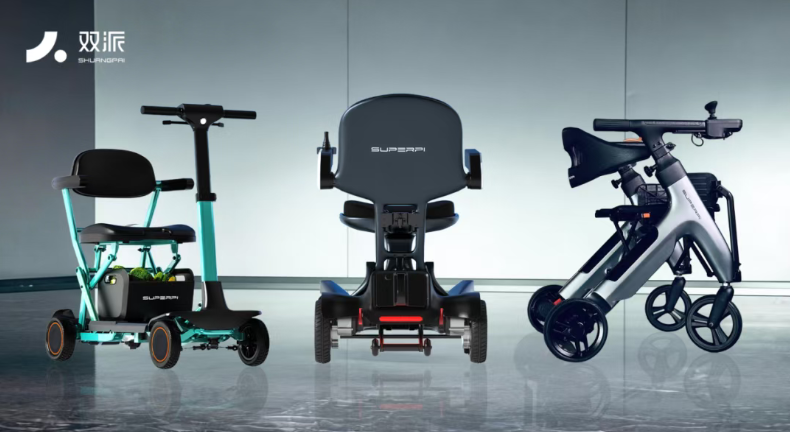
At the underlying hardware level, the self-developed core components have become a watershed moment in the user experience. By collaborating with leading supply chains to customize high-torque-density motors, and by developing lightweight folding structures and aerospace-grade carbon fiber materials, Shuangpai Robotics has effectively overcome engineering pain points such as range anxiety, storage challenges, and unstable vehicle center of gravity.
At the algorithm and control level, multimodal sensor fusion (ultrasound + vision + IMU) combined with edge AI computing power enables dynamic obstacle avoidance, slope anti-slip, fall warning, and adaptive speed adjustment. The introduction of large model capabilities makes voice interaction, rehabilitation guidance, and abnormal behavior recognition possible.
This strategy of “first achieving commercial viability, then adding AI capabilities” ensures product security and usability while also reserving architectural space for subsequent OTA upgrades and data closure. An industry consensus is gradually becoming clear: AI hardware for the elderly must adhere to the engineering logic of “mechanical reliability as the foundation, software experience as the wings.”
III. Business Closed Loop: Overseas Validation and Transformation into Service-Oriented Manufacturing
Verifying technological feasibility is inseparable from establishing a viable business model. The expansion of distribution channels and overseas presence for smart wheelchairs is reshaping the industry’s value chain.
Currently, leading companies have successfully established a three-dimensional distribution channel encompassing “B-end benchmarking + C-end retail + global distribution.” In China, Shuangpai Robotics ‘ products have already entered high-end senior living communities such as Taikang Home and offline senior shopping malls. Globally, its lightweight and easy-to-operate features have enabled it to rapidly penetrate nearly 30 markets, validating the product’s universality in meeting global aging needs.
More noteworthy is the evolution of business models: the industry is shifting from “one-time hardware sales” to “hardware + subscription service (HaaS)”. Real-time gait, heart rate, and environmental data collected by the devices can be extended to fall intervention, rehabilitation advice, and remote medical calls; combined with a “leasing + sharing” model, this effectively lowers the barriers to entry for elderly care institutions and hospitals. Hardware becomes the entry point, while data and services build long-term barriers to entry—this is the core logic behind the heavy investment from capital.
IV. Industry Outlook: The Next Hurdle and Breakthrough Point for AI-Powered Elderly-Friendly Hardware
Despite its promising prospects, AI-powered hardware for the elderly is still in its early stages of commercialization. The industry faces three core challenges:
First, data security and privacy compliance. The collection, transmission, and cloud processing of health and behavioral data must comply with medical-grade standards and the requirements of the Personal Information Protection Law. Data anonymization and localization processing under an edge-cloud collaborative architecture will become standard practice.
Secondly, there’s the “last mile” of age-friendly interaction. Voice recognition needs to adapt to language and speech rate decline, touch interfaces need to be designed to tolerate vision loss and decreased touch accuracy, and the integration of physical buttons and digital interaction still requires extensive user testing.
Third, supply chain mass production and cost control. While developing core components in-house can improve the user experience, it poses stringent challenges to startups in terms of yield control, cash flow, and large-scale delivery.
In the next 3-5 years, the banking sector will undergo a transformation from “single-product intelligence” to “ecosystem interconnection,” and from “usable” to “user-friendly.” Companies with a global perspective, deep expertise in underlying electromechanical algorithms, and a commitment to an age-friendly design philosophy are expected to establish long-term competitive advantages.

Conclusion
When AI has wheels, wheelchairs will no longer be passive means of transportation, but intelligent agents with the ability to perceive, make decisions, and provide companionship. The tens of millions of yuan Series A funding is just the beginning; it reflects the business logic of using technology for good and the genuine aspirations of an aging society.
Driven by the wave of smart hardware, senior citizen mobility is undergoing a paradigm shift from “assistive devices” to “life partners.” For smart hardware entrepreneurs, understanding the “dignity and freedom” of the elderly, refining details with engineering thinking, and creating value through data loops may be the best key to unlocking the next trillion-dollar market.