2026 World Robot Conference (WRC 2026) On August 19, Vita Dynamics Vbot officially released its first humanoid embodied intelligent terminal Vbot ATOM, which is open for pre-order at the same time. Delivery is expected to start at the end of 2026, and is divided into three major versions: personal version, enterprise version, and developer version.
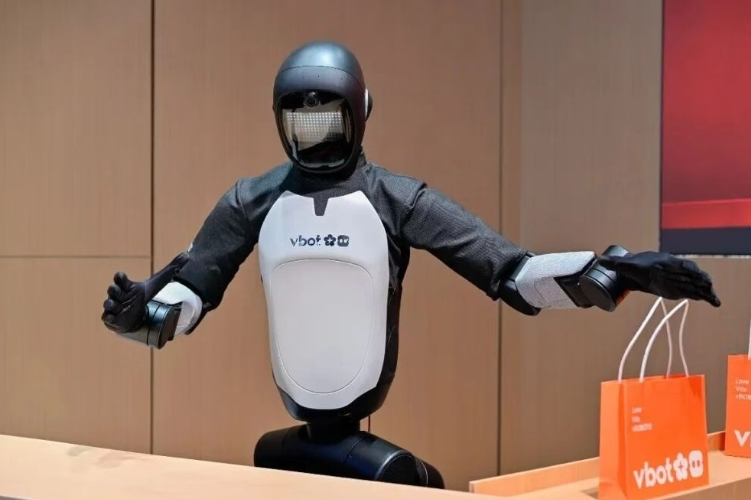
Different from the large number of humanoid robots in the industry that prioritize the development of factories and industrial heavy-duty scenarios, Vbot ATOM’s positioning is very clear: Humanoid embodied terminals built for living spaces such as homes, offices, retail, and public services. It is the core product of Vita Dynamics that has been extended to the humanoid track after the consumer-grade four-legged robot dog “Big Head” has obtained market validation. It is also one of the few humanoid hardware Xinhuanet that reversely defines the ontology configuration from real user scenarios.
- Ontology hardware: scale priority, adapt to human settlement environment
Core hardware parameters
- Overall height: 160cm
- Arm span: 180cm, effective operating radius of one arm 80cm, leg length 95cm
- Body degrees of freedom: 31 (2 for the head, 14 for the arms in total, 3 for the waist, 12 for the legs, excluding external dexterous hands)
- Appearance interaction: head interactive display, multi-channel microphone array, multi-view camera, color-changing ear light interaction; full body fabric covering, no sharp joint structure, silent sole design
- Positioning: First generation prototype display machine, mass production version will be delivered by the end of the year
Many humanoid robots in the industry choose small bodies under 140cm for movement performance, or tall bodies over 170cm that are close to those of adult men. Vbot ATOM’s choice of 160cm is the core choice in the definition of the entire set of products: if it is less than 140cm, it will be difficult to operate kitchen countertops and wall cabinets; if it is higher than 170cm, it will bring a sense of oppression to the home environment, and it will be easier to bump into furniture when passing indoors. With a 160cm body and a 180cm ultra-long arm span, it can complete daily operations such as picking up and placing items, organizing desktops, and delivering materials without modifying the home environment, adapting to the movement of ordinary people.
In terms of safety and home experience, the details of this product tend to be consumer-grade: the fabric-wrapped body weakens the cold feeling of the machine, and the silent soles inherit the noise reduction solution of the big-headed robot dog to avoid continuous noise interference when walking indoors; the head colored ear lamp + screen interaction visualizes the robot’s operating status, so that ordinary people can intuitively understand the robot’s intentions, lowering the threshold for human-computer interaction. It has 31 full body degrees of freedom, supports bending, sideways, and coordinated operation of both arms, adapting to life-oriented compound movements, rather than simply being used for dance demonstrations.
- Embodied intelligence: Relying on “embodied genome” and reusing four-legged closed-loop data
Vbot ATOM is equipped with Vita Power’s self-developed Vbot Embodied Genome technology system, which includes three core models and allows for cross-morphological intelligent migration between quadrupeds and humanoids. This is also the technical advantage that distinguishes this product from most new humanoid products.
Vita Dynamics has completed large-scale delivery with its four-legged robot dog head, accumulated massive real-life home and office scene interaction data, and verified its sensing, navigation, obstacle avoidance, and human-computer interaction capabilities through multiple OTA iterations. This mature set of perception planning and motion control algorithms does not need to be reconstructed from scratch and can be migrated to the ATOM humanoid body, forming a complete closed loop of “terminal delivery → user data collection → model iteration → OTA upgrade”.
This set of technical ideas is different from the “simulation training, real machine verification” route of many humanoid manufacturers: first use consumer-grade four-legged terminals to step into the real world, accumulate universal world models and multi-modal interaction capabilities, and then implement humanoid hardware, which greatly reduces the cost of real-machine debugging and accelerates the maturity of functions. The hardware ontology is deeply coupled with the self-developed embodied model, rather than simply connecting to a large external third-party model, to ensure the real-time nature of the robot’s autonomous navigation, environment understanding, and mission planning.
- Applicable scenarios: four major landing directions, taking into account C-side companionship and B-side services
Officially demarcated four core usage scenarios:
- Home Services: item delivery, desktop organization, home companionship, care assistance for the elderly and children, and basic housework assistance;
- Retail services: store welcome, shelf replenishment, product guidance, front desk reception;
- Office services: document delivery, conference room guidance, office environment inspection;
- Public services: Guidance and reception in hotels and exhibition halls, simple inquiry services.
Judging from the live demonstration, the first generation ATOM is better at moving, picking and placing, and human-machine dialogue in a structured environment. High-risk household chores such as complex slippery floors and delicate water and electricity operations are temporarily outside the scope of the first generation’s capabilities. The personal version focuses on family companionship and light services; the enterprise version is for commercial deployment in stores and office buildings; the developer version has open interfaces to support secondary development by scientific research institutions and AI teams for debugging of embodied intelligent algorithms.
- Advantages and Highlights
- Scenario-oriented ontology design: Prioritize adaptation to human living spaces, friendly human-computer interaction, safe and noise reduction design for long-term indoor coexistence, consumerized design ideas;
- Mature product closed-loop capabilities: Relying on the mass production delivery and OTA iteration experience of the big-headed robot dog, it has experience in mass production and delivery of consumer-grade hardware, and is not a pure laboratory prototype;
- Cross-modal embodied intelligence framework: The embodied genome realizes the reuse of algorithms from quadrupeds to humanoids, and real-world data continues to optimize intelligence capabilities;
- Multi-version layered delivery: Three versions for individuals, enterprises, and developers cover different users, lowering the entry threshold for developers and taking into account commercialization and scientific research innovation.
- Existing shortcomings and points to be verified
- First-generation prototype restrictions: The model on display at WRC is a first-generation prototype. The complete battery life, walking stability, load capacity, and dexterous hand options have not yet been fully announced, and the final delivery performance has yet to be tested by the end of the year;
- The price has not yet been officially announced, only industry information points to within 500,000, and the personal version is expected to drop to the 200,000 range. The final pricing directly determines the possibility of C-end popularity;
- Limited fine operation capabilities: The first generation does not include standard dexterous hands, and fine operation capabilities such as pouring water and grabbing small parts depend on subsequent accessories and model iterations;
- Boundaries of Embodied Large Model Capabilities: Independent decision-making, dynamic obstacle avoidance, and unexpected task processing in complex unstructured home scenes require long-term testing and verification by a large number of real users.
- Summary and evaluation
At a time when all humanoid robots are competing for running speed, jumping height, and extreme load, Vbot ATOM provides another feasible route: Humanoid robots do not necessarily have to enter factories first, but can also enter homes and offices first.
Its greatest value does not lie in the breakthrough of a single parameter, but in bringing the product thinking of consumer-grade hardware to the humanoid track: focusing on the safety of human-machine coexistence, noise reduction, size adaptation, continuous OTA iteration, and relying on the closed-loop data of four-legged terminals to accelerate the maturity of humanoids. For ordinary users, it represents an important step towards the commercialization of humanoid robots for civilian use; for developers, the open ATOM developer version provides a low-cost life-oriented embodied intelligence development platform.
In the short term, the first generation of Vbot ATOM is more focused on light service and companionship, and cannot fully replace manual housework; in the long term, if Vita Dynamics continues the iterative rhythm of “terminal implementation, data feedback model”, ATOM is expected to become the first batch of humanoid embodied terminals that can truly enter the lives of ordinary people.