On April 28, 2026, in Fuzhou, China — At the 2026 Digital China Construction Summit, Alibaba’s semiconductor subsidiary T-Head officially unveiled its first smart network card product, “Panmai 920.” Specifically designed for AI computing clusters with over 10,000 GPUs, this new product marks T-Head’s completion of a comprehensive “computing-storage-networking” chip layout.
Three Years in the Making: T-Head’s Networking Milestone
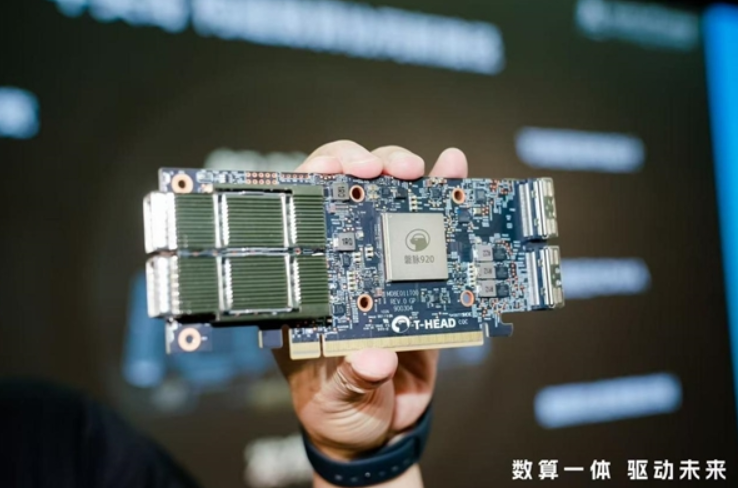
At the launch event, Li Xuhui, T-Head’s product director, showcased this smart network card developed over approximately three years. The Panmai 920 features T-Head’s self-developed network card chip and has achieved mass production, with initial deployment planned for Alibaba Cloud data centers. T-Head remains open to selling the product to external third parties.
From a product perspective, the Panmai 920 is not an isolated device. Its debut completes T-Head’s comprehensive “computing-storage-networking” triangle layout. The Zhenwu series AI chips handle computing tasks, the Yitian series server CPUs provide general computing power, the Zhenyue series storage controllers manage data reading and writing, while the Panmai 920 focuses on high-speed network transmission. The collaboration of computing, storage, and networking — the three core data center components — forms the foundation for building efficient data centers.
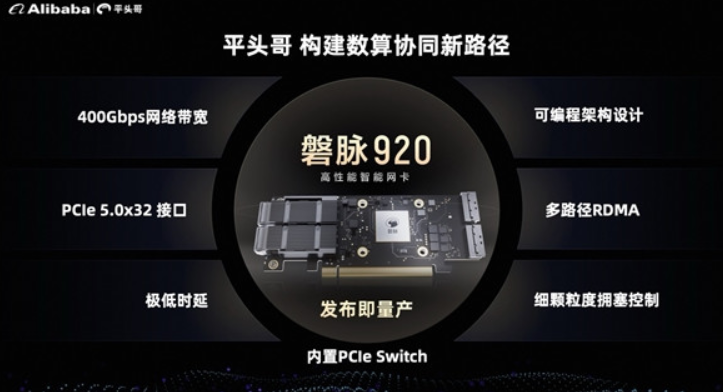
Breaking the “Communication Wall”: 400Gbps Bandwidth Breakthrough
In AI large model training scenarios, the “communication wall” represents a frequently discussed yet challenging problem. When GPU computing power continuously rises but network transmission capabilities fail to keep pace, significant computing resource idling occurs. Li Xuhui noted that many enterprise-grade network cards struggle to meet the high-performance demands of the large model era, resulting in only partial GPU computing power being effectively utilized.
The Panmai 920’s core breakthrough lies in elevating network throughput bandwidth to 400Gbps. Current mainstream domestic smart network cards remain at the 100-200Gbps level, making the new product a two to four times performance leap. Higher bandwidth enables faster data exchange between computing nodes in GPU clusters, significantly reducing wait times.
Beyond bandwidth improvements, the Panmai 920 introduces multi-path RDMA technology. RDMA is a high-speed network communication protocol allowing different servers to directly read and write each other’s memory. Traditional RDMA relies on single transmission paths, prone to congestion under high loads. The Panmai 920’s multi-path RDMA transmits data simultaneously across multiple physical paths, effectively breaking through this limitation. Li Xuhui stated that this technological upgrade can significantly shorten the completion time for model training and inference tasks.

Architectural Innovation: PCIe Switch Chip-level Integration
At the hardware architecture level, the Panmai 920 employs an innovative PCIe Switch internal integration approach. PCIe is a standard high-speed interface connecting computer motherboards with peripheral devices, while PCIe Switch functions as a traffic hub for expanding connectivity and allocating bandwidth.
Typically, PCIe Switch serves as a standalone device integrated on the motherboard. The Panmai 920’s breakthrough lies in directly integrating Switch functionality into the network card chip. This design delivers multiple advantages: it simplifies server motherboard design, reduces dependency on external switching chips, and more importantly, enables the network card to connect directly to GPUs and SSDs at ultra-low latency, eliminating performance losses from intermediate components. T-Head states this innovation reduces system costs by 30%.
From Single Chip to Vertical Solutions
Why did T-Head choose diversified layout rather than focusing on a single AI chip product? Li Xuhui explained that this strategic adjustment stems from in-depth understanding of actual AI infrastructure construction needs.
In his view, releasing only one AI chip might result in being constrained by shortcomings in other hardware components when building computing clusters. True efficiency improvement requires coordinated optimization across computing, storage, and networking dimensions. The Panmai 920 was developed based on this philosophy — it’s not merely a hardware device but a key component of T-Head’s vertical solution.
A Milestone for China’s AI Infrastructure
From an industry perspective, the Panmai 920’s launch holds profound significance. As large model parameter scales continue expanding, clusters with 10,000 or more GPUs are becoming standard for training top-tier models. In this trend, network transmission capability’s importance grows increasingly apparent.
The Panmai 920 addresses core challenges in ultra-large-scale clusters, enabling computing chips to fully release their potential. Its mass production marks a critical breakthrough in China’s AI infrastructure at the networking dimension, forming a synergy with already-progressed computing and storage products. It can be anticipated that with large-scale deployment of this product, domestic AI chips will possess stronger competitiveness in building high-performance, cost-effective data centers.