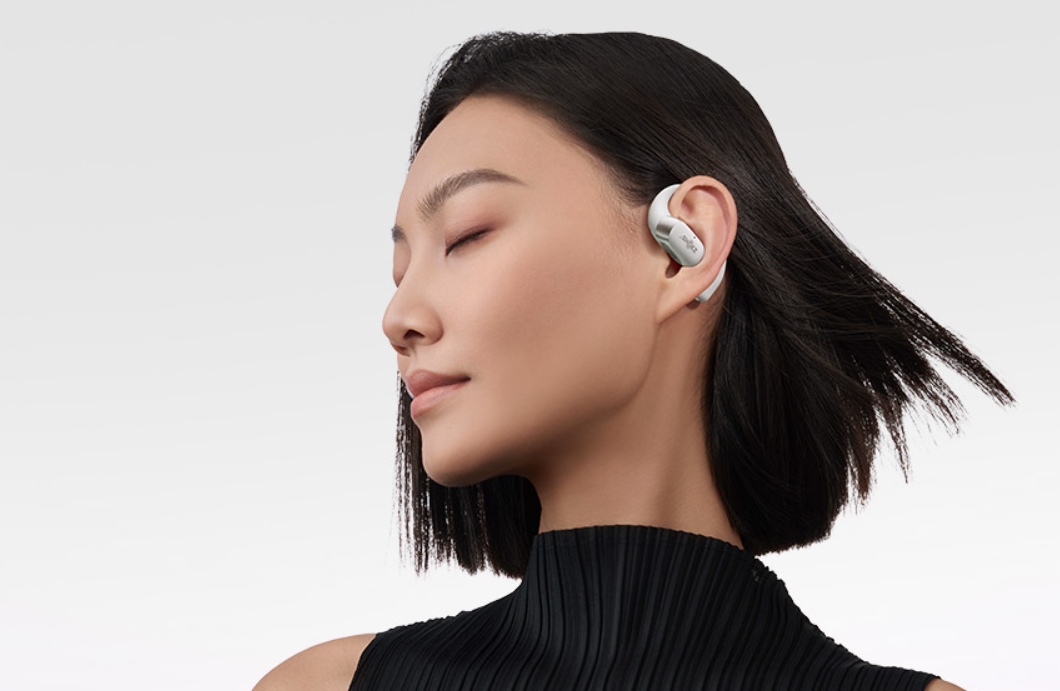
In recent years, the market has seen a surge of AI-enabled headphones, yet most treat AI merely as an add-on feature, resulting in a disjointed experience where sound quality, comfort, and AI capabilities feel disconnected. Launched for pre-sale on August 17, the Shokz OpenFit 2 AI deeply integrates open-ear acoustic hardware with the Qwen large language model. Moving beyond the role of a simple music player, it positions itself as an all-day AI productivity tool, catering to diverse scenarios ranging from listening to music during workouts and commutes to meeting recording, transcription, and translation.
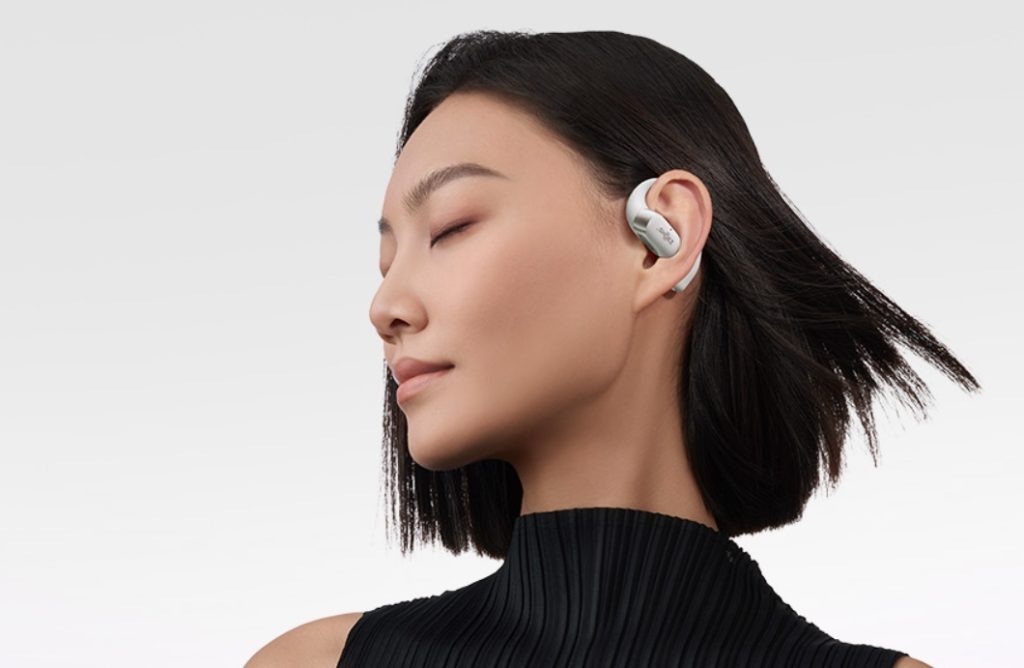
Design and Fit: Lightweight Ear-Hook Design for All-Day, Unobtrusive Wear
The OpenFit 2 AI retains the signature Dolphin Arc™ ear-hook structure. Each earbud weighs just 9.4g and features a flexible titanium wire core within the hook. The contact points utilize “2.0 Ultra-Zero-Degree” soft silicone; the device rests securely on the outer ear without inserting into the ear canal.
Real-World Wearability: During 4–6 hour stretches of office work or commuting, there is no sensation of pressure, pain, or stuffiness. It remains stable during walking and light exercise, resisting accidental dislodgement. A key advantage of the open-ear design is the ability to hear ambient sounds clearly while wearing the device—eliminating the need to remove the headphones for office interactions, crossing the street, or conversing with others—which is a major plus for professionals.
The unit boasts an IP55 dust and water resistance rating, making it fully capable of handling sweat, light rain, and everyday dust. The compact charging case fits easily into a bag without adding bulk, with a total system weight of approximately 75g.
Minor Drawback: Users with smaller ears may need to slightly adjust the wearing angle; if the fit shifts, the likelihood of sound leakage increases slightly—a physical limitation inherent to open-ear hardware.
Acoustic Performance: Balanced Audio in an Open-Ear Form Factor
The hardware features a 21×11mm composite diaphragm driver, complemented by DualBoost dual-engine audio, the OpenBass 2.0 bass algorithm, and DirectPitch™ 2.0 directional crossover technology for minimizing sound leakage. Low Frequencies: The common issue of weak bass in open-ear headphones has been significantly improved; pop and rock tracks deliver a solid sense of atmosphere, though there remains a gap in sub-bass depth compared to in-ear headphones at the same price point.
Vocals: Vocal clarity is excellent; voices of singers and podcasters sound crisp and clean, making them ideal for podcasts, audiobooks, and pop music.
Sound Leakage Control: At 60% volume or lower, music is barely audible from half a meter away in a quiet office; at volumes above 70%, slight leakage occurs at close range. It is recommended to moderate the volume in public spaces, as this is a physical limitation inherent to open-ear designs.
Connectivity: Features Bluetooth 5.4 with support for AAC/SBC codecs and seamless dual-device switching, allowing you to toggle audio between your phone and computer without reconnecting. It utilizes a four-microphone AI noise-cancellation array; during calls in noisy street environments, the other party’s voice remains clear while wind and background noise are suppressed.
Battery Life: Top-tier performance—11 hours of playback per charge and a total of 48 hours with the charging case. A 10-minute quick charge provides 2 hours of use, and the device offers a standby time of up to 270 days, eliminating the need for frequent charging during business trips or commutes.
Core AI Experience: Beyond simple transcription—a complete meeting workflow.
This is the key differentiator for the OpenFit 2 AI. Unlike many headphones on the market that merely use large language models (LLMs) for summarization, this model integrates deep optimization based on the Qwen LLM across the entire process—from audio pickup and transcription to translation and content summarization. It features 12 industry-specific vocabularies covering professional fields such as finance, law, technology, and healthcare, ensuring high accuracy in recognizing specialized terminology.
Three Recording Modes: Comprehensive scenario coverage.
On-Ear Recording: Start recording with a single press of the physical button while wearing the headphones—ideal for interviews and face-to-face conversations.
Closed-Case Recording: Place the headphones back in the case, keep the lid closed, and long-press the button on the side of the case to start recording immediately. You don’t need to wear the earbuds during meetings; simply placing the charging case on the table captures the audio. This is a standout, innovative design—discreet and unobtrusive—allowing for quick recording starts during spontaneous meetings.
App-based recording: Start recording via your phone; it supports recording both standard mobile calls and WeChat voice calls.
It supports up to 8 hours of continuous recording with 8GB of local storage; files are saved directly to the earbuds first. During a meeting, double-clicking the physical button on the earbud marks key moments. When reviewing the transcript later, you can jump straight to these markers without listening to the entire lengthy audio file, significantly boosting review efficiency.
After recording ends, the app automatically generates a transcript. It supports 30 languages and 19 dialects, accurately parsing even mixed Chinese-English conversations. AI automatically outputs meeting topics, full transcripts, and to-do lists; it can also generate mind maps with a single click, producing ready-to-use work documents and saving time on post-meeting summaries.
Translation capabilities include face-to-face translation and simultaneous interpretation modes, making them ideal for external communication and multilingual meetings. Additionally, the device holds Level 3 Security Protection certification, ensuring secure and controlled recording data—a crucial feature for professionals.
AI Limitations
AI transcription, summarization, and mind map generation require an internet connection; offline mode only saves the raw audio and cannot perform large-model processing. In noisy, chaotic meetings with overlapping voices, minor recognition errors may still occur—a common issue across the industry.
Target Audience & Drawbacks Summary
✅ Ideal for:
Professionals who frequently attend meetings or conduct interviews and need to compile meeting minutes;
Commuters or light exercisers who dislike the stuffy, painful sensation of in-ear buds and want to listen to music while remaining aware of their surroundings;
Those requiring frequent cross-language communication, translation, or dialect transcription;
Users who prioritize long battery life and dislike frequent charging.
❌ Not suitable for:
Those seeking ultimate immersive bass or Hi-Fi audio quality;
Those needing to block out external noise or looking for active noise cancellation (this device lacks ANC);
Budget-conscious buyers who only want headphones for music and have no need for AI recording or office-oriented features. Conclusion
The Shokz OpenFit 2 AI redefines the product logic for AI-enabled headphones: AI is not merely an added gimmick but an integral part of the workflow. It achieves this without compromising the core strengths of open-ear headphones—wearing comfort and acoustic performance—while packing a complete suite of functions—recording, tagging, transcription, summarization, and mind mapping—directly into the hardware.
Priced at 1,398 RMB, it sits in the mid-to-high-end tier of the open-ear headphone market. If viewed solely as a device for listening to music, the price might seem steep; however, for professionals who frequently attend meetings or conduct interviews, it functions as a portable recording assistant that also handles daily entertainment needs, allowing its full value to be realized.