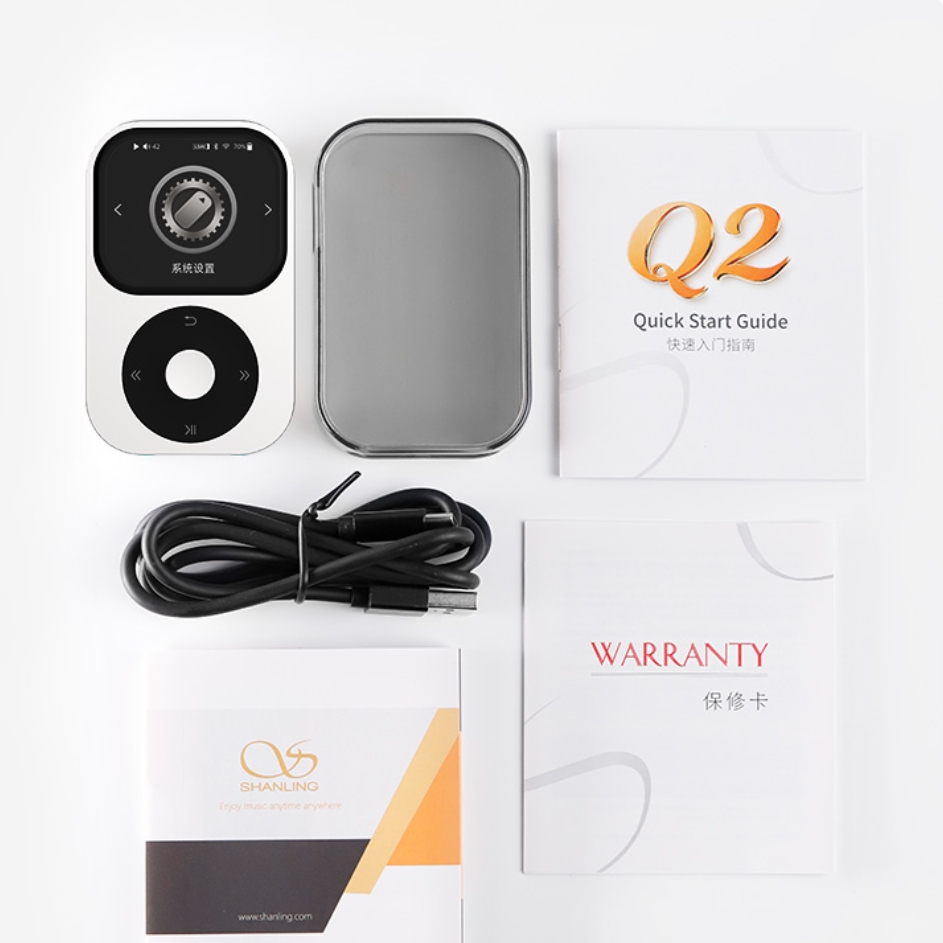
The Shanling Q2 is a portable Hi-Fi lossless music player (DAP) in the “thousand-yuan” price range, launched by Shanling in July–August 2026. Positioned as a compact, high-audio-quality “pocket player”—rather than a traditional multifunctional MP3/MP4 device—it focuses primarily on high-fidelity audio playback from both local storage and streaming services.
Introduction
The portable Hi-Fi market is currently sharply divided: Android-based players often feature bloated functionality, bulky bodies, and high power consumption, while entry-level compact players frequently struggle with insufficient driving power and compromised decoding capabilities. As the latest addition to the returning Q series, Shanling’s new Q2 packs four CS43131 DAC chips into a compact 83g body. Powered by the all-new MTouch OS and featuring AI audio gain and intelligent volume management, it strikes a balance between compact size, powerful decoding, and long battery life. Rather than being an AI player driven by large language models, it is a dedicated music-focused portable device that integrates AI audio algorithms into the Hi-Fi signal chain—ideal for commuting and travel. This review provides a comprehensive analysis covering design and build quality, hardware decoding, AI audio capabilities, sonic performance, system interaction, battery life and connectivity, pros and cons, and purchasing recommendations.


Design and Build: Palm-sized with Dual-Mode Interaction
Measuring 80 × 50 × 13.5 mm and weighing just 83 g, the Shanling Q2 fits easily into a jeans pocket. It is available in three colors—Moonlight Silver, Obsidian Grey, and Sunset Orange—and features a metal body with smooth, rounded edges that feel comfortable in the hand, avoiding any sense of cheap plastic.
ShanLing Q2
The device features a dual-interaction design combining a 2.09-inch fully laminated touchscreen with physical controls. The screen handles library browsing and settings adjustments, while the central rotary knob controls volume. Physical directional buttons manage track navigation and playback (play/pause), making "blind operation" while walking or running convenient—no need to stare at the screen.
Screen: A compact 2.09-inch touchscreen; while sufficient for displaying album art, lyrics, and track information, its limited size makes complex browsing difficult.
Storage: No internal storage; relies on TF card expansion (supporting up to 2TB), easily accommodating large local libraries of lossless music.

Interface Layout: USB-C port at the bottom; 3.5mm single-ended and 4.4mm balanced headphone jacks on the side. The 3.5mm port also supports coaxial output. It supports USB DAC mode, allowing it to function as an external sound card for computers and smartphones.
Hardware Decoding: A rare quad-DAC architecture in the sub-1,000 RMB price range.

The Shanling Q2's standout hardware feature is the inclusion of four Cirrus Logic CS43131 DAC chips within its compact body. It utilizes a dual-channel balanced architecture where two DACs are dedicated to each channel (left and right). This setup minimizes phase interference, achieves a 130dB signal-to-noise ratio, and enables native hardware decoding of high-spec audio files, including DSD512 and PCM 768kHz/32-bit.
AI Audio Capabilities: Lightweight Algorithms for an Enhanced Listening Experience Rather than featuring conversational AI based on large language models, the Shanling Q2 focuses its AI capabilities on the audio signal path. As a piece of smart hardware driven by audio algorithms, this represents a key upgrade distinguishing it from traditional dedicated audio players: AI Audio Gain: Automatically matches gain levels based on headphone impedance and sensitivity while identifying track signal levels. It dynamically optimizes output to prevent distortion in high-dynamic-range tracks and automatically boosts loudness for low-level tracks, eliminating the need for frequent manual switching between high and low gain settings. AI Smart Volume Management: Automatically normalizes loudness differences across tracks. Inconsistent recording volumes across albums and sources—causing sudden volume fluctuations when switching songs—are a common pain point with older players. This algorithm analyzes the loudness data of audio files to smooth out output volume, allowing for a consistent listening experience without constant knob adjustments. 3. Built-in digital filters offer multiple roll-off modes; combined with EQ settings, this allows users to fine-tune the sound signature, with AI algorithms and manual adjustments functioning simultaneously.
Objectively speaking, the AI here is not generative AI but rather AI for audio signal processing; it does not offer features like AI-generated playlists or voice-controlled song selection, as its core function is to deliver high-quality audio playback.
Listening Experience: Balanced, transparent, and versatile tuning.
The overall tuning is balanced and neutral with a warm, smooth character; free from excessive coloration, it is versatile enough to handle pop, vocals, jazz, and small-scale classical music with ease.
Vocals: The midrange is full-bodied with natural positioning; sibilance is well-controlled, and both male and female vocals sound natural without artificial coloration.
Low frequencies: Clean texture with deep extension and crisp, snappy decay—never bloated or boomy. For large-scale orchestral works, the quad-DAC architecture delivers superior instrument separation and precise imaging against a pitch-black background.
High frequencies: Smooth extension without harshness, faithfully reproducing the details of strings and other instruments.
The 3.5mm single-ended output suits the vast majority of standard in-ear monitors (IEMs), while the 4.4mm balanced output unleashes full driving power and expands the soundstage, making it ideal for balanced-cable IEMs and medium-impedance over-ear headphones.
Limitations: Due to its compact size, there remains a gap in dynamic range compared to desktop DACs costing ten thousand yuan or more; while it represents excellent performance for a portable player, it is not a substitute for a desktop system.
Mtouch OS Experience: Clean, Ad-Free, and Performance-Focused
Powered by the Ingenic X2000 processor, the all-new Mtouch OS is a dedicated audio-centric system—not based on Android. It is free from ads and bloatware, designed solely for music playback with a responsive interface that avoids the lag often associated with Android background processes.
Pros:
Robust local file management, supporting CUE splitting, album art, and lyrics display;
Simple switching between two-way Bluetooth and USB DAC modes;
Intuitive UI logic that is easy to pick up, allowing both seasoned audiophiles and newcomers to adapt quickly.
Current Limitations:
Lacks online streaming apps; playback is limited to local files on a TF card or Bluetooth input;
The control logic for the rotary knob leaves room for improvement; there is a lack of seamless integration between touchscreen and knob operations in certain scenarios, requiring refinement through future firmware updates;
No voice assistant support; lacks AI-based song search or voice control capabilities.