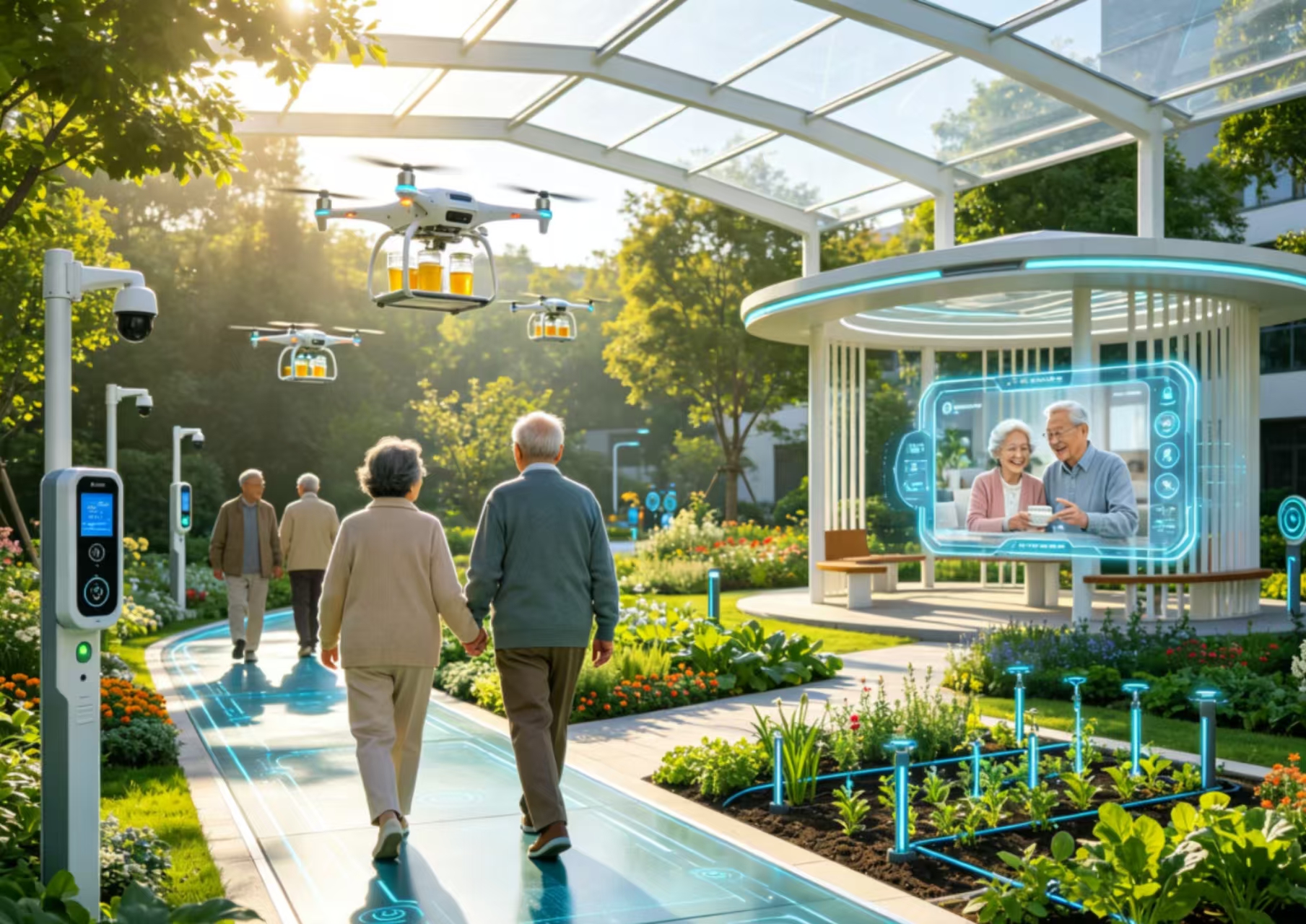
Caught between an accelerating aging population and a shortage of nursing staff, the elderly care industry is undergoing a silent revolution driven by technology. In March 2026, Sage, a rising star in elderly care technology, announced the completion of a $65 million Series C funding round led by Goldman Sachs, bringing its total funding to over $120 million. Behind this significant capital investment is not simply a collection of traditional management software tools, but rather the deep integration of AI healthcare and wearable smart hardware in complex care scenarios.
How does Sage reconstruct the profitability logic of institutions through “algorithms + sensor matrix”? What kind of commercialization model can its underlying technology provide for the Internet of Medical Technology (IoMT)? This article will analyze the industry value of this system from the dual perspectives of AI clinical decision-making and hardware architecture.
Product Overview: System Reconstruction from “Passive Response” to “Proactive Early Warning”
Sage 2.0 is an integrated nursing operating system specifically designed for elderly care institutions. Compared to the passive positioning of version 1.0 as a “digital call center,” version 2.0’s core upgrade is “AI prediction engine + multi-terminal hardware matrix + clinical data interoperability.” The system uses environmental sensors and lightweight wearable devices deployed in the home to capture elderly residents’ activity signals in real time; combined with the cloud-based Sage Detect algorithm, it enables proactive risk intervention.
Simultaneously, the system has achieved bidirectional integration with mainstream electronic health records (EHRs) such as PointClickCare and ALIS, seamlessly connecting hardware alerts, caregiver interventions, and clinical medical records. Real-world testing data shows that the system can reduce fall-related hospitalization rates by 75% and create over $250 in hidden revenue per bed per month for institutions.
AI in Healthcare: Algorithm-Driven Predictive Care and Value-Based Healthcare Loop
Traditional elderly care has long been hampered by reactive, reactive approaches. Sage’s technological advantage lies in upgrading AI from a “data dashboard” to “clinical decision support.” Its core Sage Detect engine does not rely on simple action threshold alarms, but rather on long-term time-series data modeling to accurately identify the “deviation” of behavioral patterns.
For example, a sudden increase in nighttime toilet visits, changes in gait rhythm, or fragmented sleep cycles can be cross-referenced by AI with past medical history and medication records, providing early warnings of potential infections or adverse drug reactions several hours in advance. This predictive care is the core application scenario of AI in elderly chronic disease management.
More importantly, Sage breaks the “one-way reading” limitation of medical data. Most elderly care SaaS can only capture basic EHR (Employment Health Record) files, while Sage achieves bidirectional writing of structured data: abnormal trajectories captured by sensors and intervention records from caregiver apps are automatically converted into clinical language that complies with medical compliance standards and written back to the EHR.
This not only builds a tamper-proof, compliant evidence chain but also quantifies the working hours for implicit services such as nighttime comforting and emergency cleaning. AI is no longer a black box replacing human labor but a transparent engine assisting institutions in transitioning from “extensive bundled pricing” to “value-based tiered pricing,” directly boosting net operating income (NOI).
Wearable Smart Hardware Dimension: A Collaborative Architecture of Seamless Sensing and Edge Computing
In the AI healthcare implementation chain, hardware is the “nerve ending” of data. Sage’s hardware strategy abandons the highly invasive traditional wristband solution, shifting to a “privacy-first seamless sensing matrix.” Its core sensor uses a fusion technology of millimeter-wave radar and low-power visual AI, accurately capturing fall risk, wandering patterns, and breathing rhythms while protecting the dignity of the elderly, without requiring continuous direct video recording.
The device incorporates a lightweight edge computing module, which can perform preliminary data cleaning, feature extraction, and false alarm filtering locally, encrypting and uploading only high-value abnormal signals to the cloud, significantly reducing network latency and privacy leakage risks.
This “edge AI preprocessing + cloud-based large model inference” architecture perfectly meets the stringent requirements of elderly care institutions for system stability and data compliance. The hardware no longer exists as an isolated device but is deeply embedded in the digital workflow of caregivers.
When environmental sensors trigger an alert, the system accurately dispatches tasks via mobile devices based on the caregiver’s real-time location and task load heatmap. Frontline staff no longer need to carry walkie-talkies or fill out paper handover forms; task assignment, execution feedback, and work hour recording are all completed in a single click on their mobile phones.
The core logic of hardware design has shifted completely from “monitoring and assessment” to “process reduction,” directly leading to a 20%-30% decrease in employee turnover in partner communities, validating the product philosophy that “excellent hardware should be invisible within the service.”
Industry Lesson: The Future Path of AIoT Reshaping Elderly Care Business Models
Sage’s rise provides a clear commercialization paradigm for the AI medical hardware sector: technology must be directly anchored to financial models and frontline experience, rather than remaining at the level of parameter demonstration. By quantifying hidden costs through AI algorithms and releasing caregiver productivity through seamless hardware, Sage proves that the core competitiveness of elderly care technology lies in the dual-engine drive of “clinical value + operational efficiency.”
With the maturity of multimodal large-scale models and flexible electronics technology, wearable devices for elderly care are evolving towards “continuous monitoring of multiple physiological parameters + early digital biomarker screening for cognitive impairment.”
However, aicrunchx believes the industry still needs to overcome three major hurdles: device interoperability, HIPAA/PIPL compliance review, and frontline adoption rates.
Only by adhering to a caregiver-centric interaction design and building open and interconnected medical data middleware can AI and smart hardware truly leap from being “optional add-ons” for institutions to becoming “digital infrastructure.” For teams deeply involved in AI healthcare and hardware innovation, Sage’s path has pointed the way: a system that is economically viable, readily used by caregivers, and trusted clinically is the ultimate answer to weathering the economic cycle.