With a wave of new smart hardware for children hitting the market this summer, parents’ core priorities when choosing a kids’ watch remain consistent: accurate positioning, clear communication, robust safety features, and controllable usage that prevents addiction. Recently launched, the Redmi Kids Watch Pro—Redmi’s flagship wearable for children—highlights two key features: “dual-chip offline positioning” and a “flip-style dual-camera system.” Priced at ¥1,199 at launch (and ¥888.25 after government subsidies), it competes directly in the premium (1,000-yuan range) kids’ watch market. Based on real-world testing across various scenarios, this article objectively breaks down the product’s highlights, user experience, and target audience.
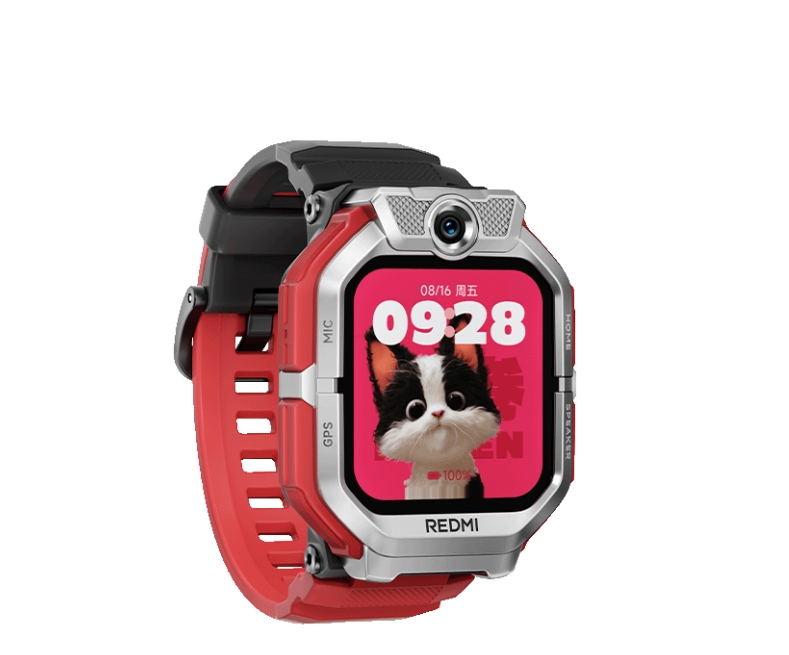
Flip-style side camera structure
I. Hands-on with the Design: A Flip Structure Balancing Utility and Aesthetics
The Redmi Kids Watch Pro features a distinctive hexagonal “mecha-style” design and comes in two colors—Vibrant Red and Energetic Purple—making it suitable for both boys and girls. The device utilizes rounded corners and edges to minimize the risk of bumps or scratches.
It sports a 1.68-inch, 360×390 HD touchscreen. This offers a larger viewing area than most watches in the same price range (which typically feature 1.4- or 1.6-inch screens) and remains clearly visible even in bright outdoor sunlight.
The standout feature is the flip-style camera module, equipped with 5-megapixel cameras on both the front and back. This highly flexible design allows for angle adjustments during video calls. Children can take selfies, capture scenery, or use AI object recognition without awkwardly twisting their wrists—solving the common issue of limited shooting angles found in standard fixed-camera watches.
The strap is made of skin-friendly liquid silicone with numerous ventilation holes, ensuring comfort and preventing sweat buildup during prolonged wear. It supports 20-meter swim-grade water resistance, meaning there is no need to remove the watch for daily activities like hand-washing, getting caught in the rain, or playing in the pool.
Hardware specs include a 1GB RAM + 8GB storage configuration, ensuring smooth system operation and app installation without significant lag.
The overall weight is well-balanced, making it comfortable for elementary school students to wear daily. A minor downside is the rugged “mecha” aesthetic; the watch may look somewhat bulky on very young children, so it is best suited for school-aged children between 6 and 14. II. Core Highlight: All-Scenario Positioning System – Addressing Parents’ Biggest Concerns
Positioning capability is the watch’s most competitive selling point and a key advantage distinguishing it from rivals in the same class. Many children’s watches on the market suffer from common flaws: location drift when entering underground garages, subways, or building interiors, and total loss of contact if the device goes offline or shuts down.
- Dual-Chip Architecture | Emergency Positioning Even When Powered Off
The watch employs an independent dual-chip design, with the positioning module featuring its own low-power chip. Leveraging the Xiaomi “Find My” distributed device network, it supports positioning for up to five days without network assistance—even when the watch is offline or has automatically shut down due to low battery.
Note on real-world testing: This feature requires the parent’s smartphone to run HyperOS 3.0 or later. It relies on nearby Xiaomi/Redmi devices to broadcast and receive location data. While it serves as an emergency fail-safe rather than a standard real-time tracking method, it significantly increases the chances of locating a child if they go missing. - AI Floor-Level Positioning 3.0 – No More Vague Location Points
Equipped with an upgraded AI positioning algorithm and “Smart Floor-Lock” technology, the watch can identify the approximate floor where the child is located within residential complexes, malls, or office buildings. Parents no longer see just a vague, flat map coordinate; the location data provides much greater utility when children take elevators alone or move between floors at school. - Safety Alerts for Specific Scenarios
Water Hazard Alerts: When enabled, the watch displays a local pop-up alert and sends a notification to parents if the child approaches dangerous bodies of water such as rivers, ponds, or reservoirs—an incredibly useful feature for summer outdoor activities and park visits.
Subway Route Tracking: Continuous positioning is maintained while traveling on underground rail systems, fully recording transit stations and routes—solving the common issue where watches lose signal immediately upon entering tunnels.
Standard features include geofencing, school-commute monitoring, one-touch SOS, and historical route playback, creating a multi-layered safety net.
III. AI Features, Communication, and Learning Experience
- On-Device AI Assistant for Children
Features a built-in voice assistant powered by a large language model (LLM) tailored for children. It supports voice Q&A, classical poetry recitation, Chinese-English translation, vocabulary lookups, and AI-powered object recognition via the camera. Unlike general-purpose LLMs, the content is filtered through safety controls designed for young users to prevent exposure to inappropriate information. Children can ask questions whenever they arise, turning the watch into a handy, on-the-go learning assistant. - HD Video Calling
Equipped with a flip-style dual 5MP camera setup, the video call clarity surpasses that of many entry-level watches with single cameras. It features a built-in pressure-relief speaker, ensuring sufficient volume for calls even in noisy outdoor environments. It supports standard voice calls and “Micro-chat” messaging; it also supports logging into the kids’ versions of WeChat and QQ, adding friends via a simple “tap-to-connect” action, and even adding friends across different brands of kids’ watches, offering greater social flexibility. - Learning and Health Monitoring
The watch integrates a dictionary, spoken language assessment tools, and synchronized audio learning resources. Built-in sensors monitor heart rate, blood oxygen levels, step counts, and sleep status around the clock, automatically generating weekly health reports sent to the parent’s phone. It includes 18 sports modes to track data from outdoor activities like running and cycling, making it easy for parents to stay informed about their child’s physical activity.
IV. Parental Control System: Balancing Freedom and Boundaries
Comprehensive management features are essential for families with school-age children:
✅ Class Mode: Scheduled deactivation of calls and entertainment functions to prevent classroom distractions;
✅ App Whitelist: Restricts app installations and automatically blocks games and short-video apps;
✅ Secure Pocket Money Payments: Supports Alipay/WeChat payments for kids with customizable daily spending limits set by parents to prevent excessive or unauthorized spending;
✅ Granular Permission Management: Manual control over allowed contacts, friend requests, and location sharing.
The control system is logically designed and easy to use, allowing even parents who aren’t tech-savvy to get up to speed quickly. V. Real-world Limitations and Things to Note
Reviews shouldn’t just focus on the positives; here are a few points to consider before purchasing:
Offline positioning has usage conditions: It relies on the network of other Xiaomi ecosystem devices. In remote suburbs or open areas lacking Xiaomi devices, the effectiveness of emergency positioning may decrease, so do not rely solely on this feature;
740mAh battery: Offers 1–2 days of battery life with normal daily use, but power drains faster with frequent video calls or continuous positioning; it is best to get into the habit of charging it every night;
System entertainment apps are moderate in number, leaning more towards utility; if you are looking for a vast library of children’s games or cartoons, the content ecosystem is somewhat limited compared to certain competitors;
The “mecha-style” casing is drop-resistant but prone to fine scratches; using a protective case is recommended.
VI. Who Is This For? Buying Summary
✅ Recommended for:
Primary school students aged 6–14 who commute to/from school or take public transport alone;
Parents who use Xiaomi/Redmi phones and want to utilize the offline emergency positioning feature (which works even when the watch is powered off);
Parents who prioritize outdoor safety and frequently take their children to parks, waterfronts, or shopping malls;
Those with a budget of 800–1100 RMB who want features like a flip-up dual-camera setup and precise floor-level positioning, and who seek a well-rounded overall experience.
❌ Not suitable for:
Toddlers under 3 years old; users seeking ultra-long battery life (e.g., a full week); users looking for a massive library of children’s entertainment content.
Conclusion
In the competitive market for children’s smartwatches priced around 1,000 RMB, the Redmi Kids Watch Pro avoids simply piling on gimmicky features; instead, it focuses squarely on safety and positioning—the aspects parents care about most. The flip-up dual-camera setup enhances daily communication, and robust parental controls make it well-suited for school environments. With a purchase price of around 888 RMB (after government subsidies), it offers highly competitive value for money.
For modern parents, a children’s smartwatch is essentially a “safety net tool” rather than an entertainment device. If your top priority is keeping track of your child’s location at all times and having multiple layers of emergency protection, the Redmi Kids Watch Pro—launched this summer—is an AI-powered device well worth considering.