Product Background: A concept prototype that debuted globally at the 28th Pet Fair Asia, developed by the POLARIX team (affiliated with Zhejiang University). Unlike traditional smart collars, it employs a split-design sensor system (chest and back) and focuses on collecting heart rate, body temperature, and heart rate variability (HRV) data, alongside AI-driven risk assessment for heatstroke and stress. It is expected to launch officially by the end of 2026 and is not yet available for sale. This review analyzes the pet health wearable—designed for outdoor walks—based on hands-on experience with the exhibition prototype and officially disclosed specifications.
Introduction
Most smart wearables for pets currently on the market are limited to activity tracking (step counting) and GPS positioning, making it difficult to capture internal physiological changes. When walking dogs in summer, heatstroke or stress-induced reactions often reach dangerous levels before any abnormalities become visible to the naked eye. Traditional collars worn around the neck struggle to accurately capture heart rate and body temperature. In contrast, the POLARIX AI Vital Sign Monitoring Harness takes a different approach: it places the sensor unit on the pet’s abdomen and the main control/battery unit on the back. This design aims to bring medical-grade vital sign monitoring into everyday pet walking routines, enabling real-time health risk alerts during outdoor activities.
Design: Appearance and Hardware Structure
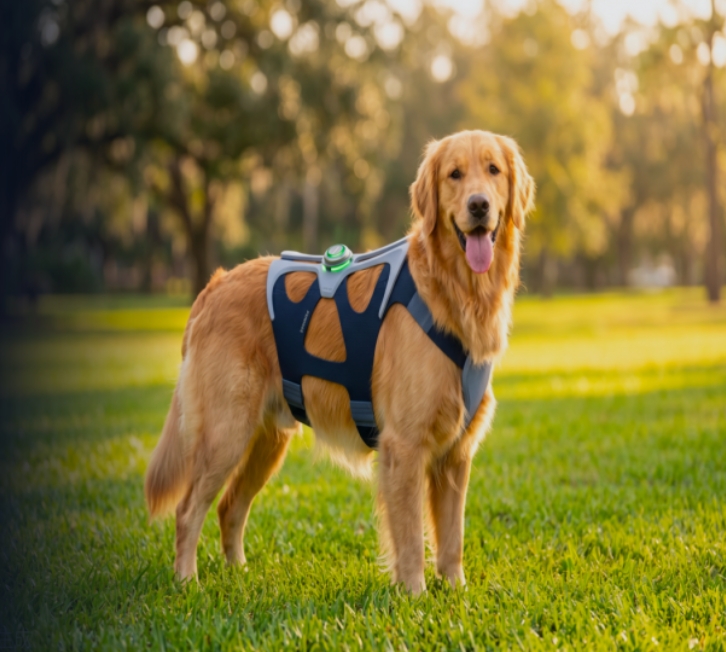
POLARIX moves away from the standard collar form factor, adopting a split-design sensor architecture consisting of two main components: a back-mounted control module and an ultra-thin abdominal sensor patch.
- The abdominal sensor is only 0.8mm thick; made of lightweight, flexible material, it conforms to the pet’s chest and abdomen without causing discomfort or chafing against the skin. It requires no shaving and is secured via the harness straps, utilizing proprietary optical sensing technology to collect physiological signals.
- The main control and battery module is positioned on the pet’s back, away from the chest cavity; this distributes weight effectively and prevents compression that could interfere with breathing.
- The harness itself is made of breathable mesh fabric and features multi-level adjustable buckles to fit dogs of various sizes.
- The entire unit is built for outdoor durability, offering protection against daily splashes and suiting the conditions of outdoor walks.
- Structural Logic: The abdominal unit handles vital sign data collection, while the back module manages processing, storage, and data transmission via Bluetooth/Wi-Fi. >
Prototype Limitations: Currently compatible only with dogs; cats are not yet supported. The fit must be precisely adjusted based on the pet’s size; if too loose, the sensor may detach or data may drift; if too tight, it may restrict the pet’s movement.
Core Functionality Analysis (Prototype Capabilities)
1. Multi-dimensional Vital Sign Monitoring: Heart Rate, Surface Body Temperature, and HRV (Heart Rate Variability)
This represents the product’s core competitive advantage. The hardware continuously tracks the dog’s heart rate, surface body temperature, and HRV. HRV is a crucial physiological indicator for assessing stress and fatigue—a metric rarely covered by standard pet wearables.
Data synchronizes with the app in real-time to generate dynamic graphs, recording physiological changes throughout walks and monitoring bodily fluctuations before and after exercise or in high-temperature environments.
2. AI-Driven Assessment: Heatstroke Risk and Stress Alerts
Powered by health algorithms specifically designed for dogs, the system integrates heart rate, body temperature, HRV, and ambient temperature data to assess heatstroke risk and stress levels, delivering tiered alerts via the app.
This is particularly valuable for summer walks: early-stage heatstroke in dogs often shows no visible external symptoms, yet heart rate and body temperature may show abnormal changes beforehand. The device aims to provide early warnings to prevent fatal heat-related incidents. It also monitors physiological fluctuations caused by stress—such as reactions to noise, strangers, or other dogs—and provides status insights.
Important Note: All AI outputs are for home reference only; this is not a medical diagnostic device and cannot replace veterinary examinations, nor should it serve as the sole basis for diagnosing medical conditions.
3. Behavioral and Health Profiles
Utilizing a 6-axis motion sensor, the device records exercise duration and activity intensity, correlating this with vital sign data. For instance, if the heart rate is abnormally high for a given exercise distance, the app flags the anomaly. Over time, this data compiles into a personalized health profile for the pet, which can be exported for a veterinarian’s reference.
4. Data Transmission and Battery Life
Supports both direct Bluetooth connection and Wi-Fi synchronization; it connects to the phone via Bluetooth during outdoor walks and automatically syncs to the cloud when at home. Exact battery life for the prototype has not been disclosed; consumption varies based on sampling frequency, with high-frequency continuous monitoring draining power more rapidly. ## Key Product Highlights
- Innovative Form Factor: Overcomes the limitations of neck collars. Neck collars struggle to accurately capture heart-related vitals; placing sensors on the chest/back positions them closer to the thoracic cavity, physically optimizing signal acquisition conditions.
- Targets High-Risk Scenarios: Features specialized algorithms for summer heatstroke and stress caused by going outdoors, addressing a major pain point for dog owners during outdoor activities.
- HRV Monitoring: Adds Heart Rate Variability (HRV) monitoring; goes beyond simple heart rate tracking to assess stress and fatigue levels, offering deeper data insights than standard wearables.
- Pet-Friendly Design: Uses flexible, ultra-thin sensors that require no shaving; weight is distributed across the back, placing zero load on the neck.
- Data-Driven Insights: Data can serve as supplementary material for veterinary consultations and help owners track long-term physiological trends in their pets.
Current Prototype Limitations and Constraints
- Concept Prototype: Currently a trade show concept prototype, not yet in mass production. Performance metrics—such as sensor interference resistance, accuracy during movement, and battery life—await verification in the final production model. Factors like a dog’s movement/shaking, fur thickness, and harness fit can affect data accuracy.
- Dog-Only: No version available for cats; requires precise fitting against the body, as improper wear directly impacts data validity.
- No GPS/Anti-Loss Features: Designed solely for health monitoring; cannot function as a GPS tracker.
- AI Risk Assessment: Provides alerts only; cannot diagnose conditions like heart disease or heatstroke. Veterinary attention is required if abnormalities are detected; users should not rely solely on device alerts.
- No Interactive Features: Lacks functions like treat dispensing, lights, or voice interaction; positioned strictly as a health monitoring tool.
- Pricing Undisclosed: Features a split chest-back harness design; estimated hardware costs are higher than standard GPS collars.
Competitor Comparison
- POLARIX AI Health-Monitoring Harness: Key strengths include monitoring of heart rate, body temperature, and HRV; early warnings for heatstroke and stress; chest/back placement; and a focus on outdoor health risk alerts. Limitations include no GPS tracking, prototype status (not yet on the market), and compatibility limited to dogs. – Standard GPS Smart Collars: Focus on location tracking/anti-loss and activity monitoring (step counting); most rely solely on accelerometers and lack genuine heart rate or body temperature sensing.
- PetPhone AI Pet Device: A collar-style wearable featuring robust positioning, Cloud-SIM connectivity, and AI audio interaction; focuses on communication and anti-loss rather than professional physiological monitoring.
Target Audience & Non-Target Audience
✅ Suitable for those who:
- Frequently walk their dogs in high summer temperatures and worry about heatstroke;
- Have dogs prone to stress or anxiety during outings to parks or pet shops;
- Own senior dogs or breeds at high risk for heart disease and wish to monitor physiological trends over time;
- Are willing to try cutting-edge pet health hardware and wait for the official market release.
❌ Not suitable for those who:
- Primarily need pet location tracking and anti-loss features;
- Mainly own cats;
- Expect the device to provide direct medical diagnoses;
- Want a mature, mass-produced product that is ready to use immediately upon purchase.
Summary
POLARIX represents a significant shift in smart pet hardware: evolving from merely recording “behavior” to sensing “internal physiological states.” It moves beyond the saturated market of basic step counting and GPS tracking, targeting real-world, life-threatening scenarios like heatstroke and stress. Its ultra-thin abdominal sensor and split chest-back design overcome the inherent positioning limitations of traditional collar-based physiological monitoring. Furthermore, the inclusion of HRV (Heart Rate Variability) analysis offers data depth far surpassing most pet wearables currently on the market.
However, a realistic perspective is necessary: the device is currently in the prototype stage. Factors such as movement-induced vibration, fur interference, and fit tightness can affect sensor accuracy, and key aspects—such as data stability, battery life, and pricing—remain unknown until mass production. It is a health-support tool with great potential, not a medical diagnostic device. For dog owners—especially those with senior dogs or those who walk their dogs frequently outdoors in summer—it is worth waiting to see its real-world performance once mass production launches at the end of the year.