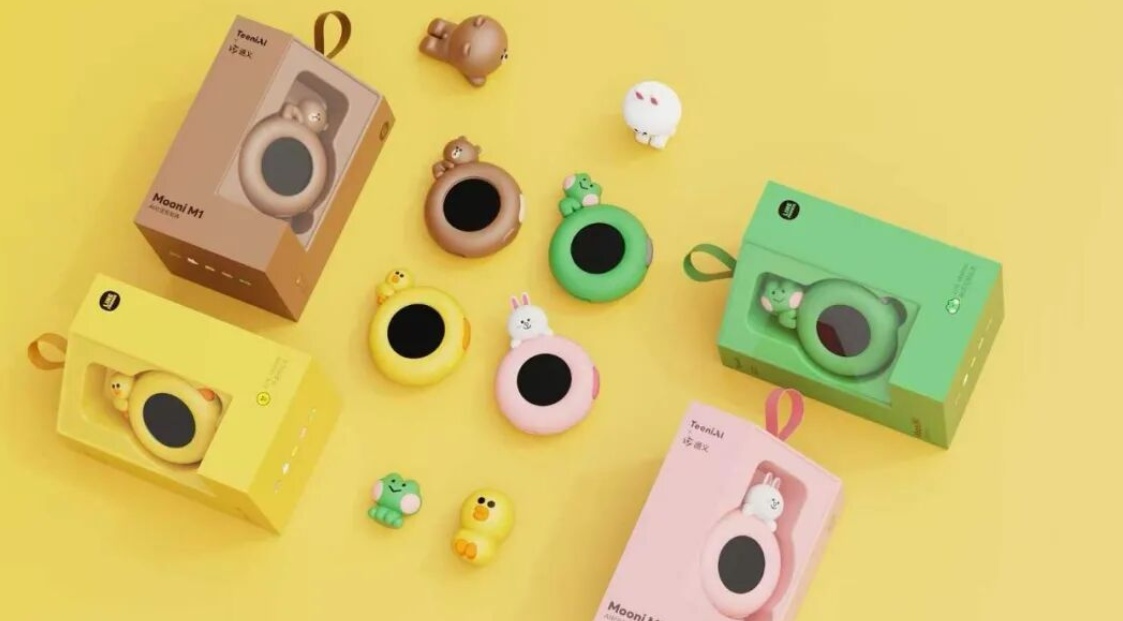
The market for smart hardware for children has flourished this summer, with a constant stream of smartwatches and large-screen learning tablets; however, most of these struggle to avoid the issue of excessive screen time. Developed by Teeni.AI in collaboration with Alibaba Cloud’s Tongyi Qianwen, the Mooni M1 AI Portable Learning Companion debuts in a lightweight, wearable “AI Pin” format. It emphasizes minimal screen time, all-day AI companionship, and learning during spare moments, targeting children aged 3 to 12 (spanning both preschool and school-age groups). Moving beyond the simple playback functions of traditional storytelling devices or audio players, it features conversational capabilities, emotional intelligence, and calling functions. Is it merely a novel toy, or a practical tool for child development? This article provides a comprehensive breakdown of this distinctive AI hardware based on real-world testing across various scenarios.
I. Design and Hardware: Rounded, Lightweight, and Built for Portability
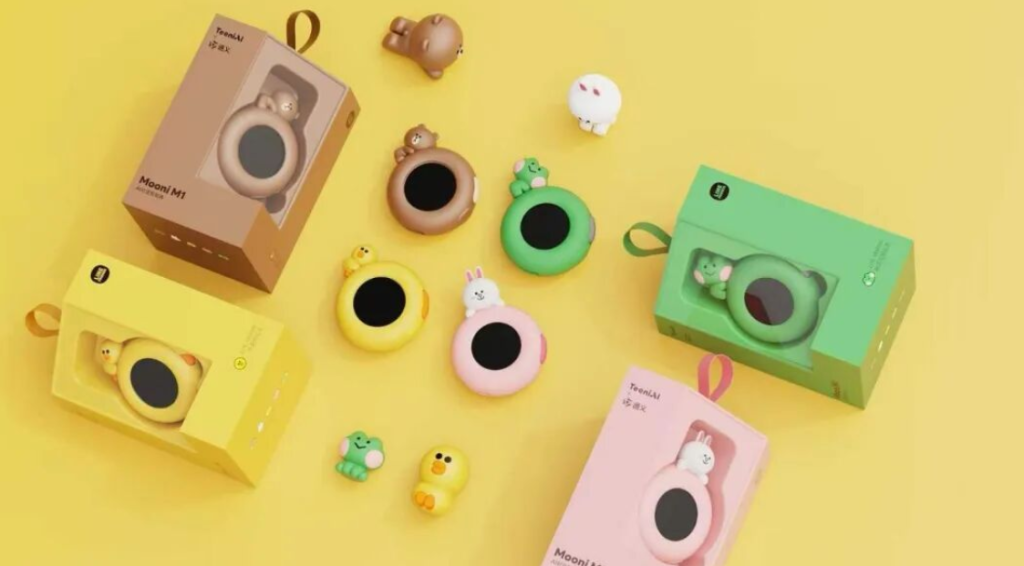
Actual photo of the Mooni M1
The Mooni M1 features a cute, rounded body adorned with cartoon accessories—such as Brown Bear or a rabbit—and comes in a variety of colors, including brown, pink, yellow, and green. Weighing just 130g—significantly less than standard children’s smartwatches—it comes with an adjustable lanyard and supports multiple carrying styles: worn around the neck, attached to a backpack, or clipped onto clothing. This ensures a hassle-free experience for children whether they are out playing or commuting to and from school. Material: The casing is wrapped in skin-friendly silicone with no sharp edges, meeting safety standards for children’s products; it features IP67 dust and water resistance, ensuring peace of mind during rainy weather or accidental splashes.
Screen: Equipped with a compact 1.2-inch color display used solely for showing the AI avatar and call interface; the screen size is intentionally limited to reduce the urge for children to stare at it.
Interaction Design: The device features distinct buttons for voice commands and power/screen locking, with differentiated sizes and tactile profiles to minimize accidental presses; a top-mounted four-microphone array enables 360° sound pickup, clearly capturing children’s voices even in noisy outdoor environments.
Connectivity: Built-in 4G Cat.1 module with included IoT data service; it operates independently of home Wi-Fi, ensuring continuous connectivity while outdoors or on the go.
Charging: Magnetic contact charging and a high-capacity battery provide 10–12 hours of daily use—covering continuous conversation and audio playback—sufficient for a full day out.
Overall Design Philosophy: It downplays the “digital gadget” aspect while emphasizing the feel of a “portable companion,” making it ideal for families who prefer not to give their children smartphones or smartwatches yet still desire AI companionship and simple communication capabilities.
II. Core Highlight: Alibaba Cloud’s Custom Large Language Model for Children—Beyond Q&A, It Understands Emotions
As a children’s AI device co-branded with Tongyi Qianwen, the Mooni M1’s greatest strength lies in its deep optimization for children’s language patterns—setting it apart from similar products that merely scale down general-purpose large models. The device features six virtual AI agents, each with a distinct personality, allowing children to freely switch between companions:
✅ Teeni (Curious Companion): Encyclopedia-style Q&A and general knowledge, answering imaginative questions;
✅ Polly (English Companion): Immersive bilingual conversation, vocabulary practice, and spoken language interaction;
✅ Mia (Storytelling Companion): Collaborative storytelling, allowing the child to co-write fairy tales;
✅ Hug (Emotional Companion): Recognizes emotions, offering comfort during low moods and helping process negative feelings;
✅ Bunny (Exploration Companion): Travel-related knowledge and tips for city outings;
✅ Curious Cat Box (Wonder Box): Educational quizzes and brain-teasing games. Hands-on Interaction Experience
Many traditional AI devices for children suffer from stiff dialogue, an inability to handle multi-turn conversations, and a rigid “one question, one answer” format. The Mooni M1 supports continuous dialogue with long-context awareness, accommodating the non-linear, imaginative thinking patterns of children.
Child: “What is the largest animal in the ocean?”
After receiving the answer, the child follows up: “Is it afraid of sharks?” The AI maintains the conversational thread and answers coherently without requiring the question to be repeated.
Furthermore, the voice synthesis moves away from robotic, electronic tones, employing a child-friendly, human-like voice that includes natural pauses and emotional inflection.
Regarding safety, the device features a multi-layered content firewall and a built-in hardware-level physical mute switch that cuts power to the microphone with a single press. All voice data is transmitted via end-to-end encryption, and content involving violence, sensationalism, or inappropriateness is automatically filtered out, giving parents peace of mind regarding the AI’s output.
III. Hands-on Testing of Three Core Scenarios: Integrated Study Companion, Communication, and Audio Immersion
- AI Study Companion for “Snackable” Learning Moments
It does not focus on intensive drills or rote practice; instead, it is designed for learning during spare moments—such as commutes, travel, or outdoor activities. It comes with built-in synchronized textbook audio, graded English picture books, traditional Chinese culture content, and “BoBo Radio” (featuring science and general knowledge programs).
Free from screen constraints, children can listen while walking and learn while playing. If a question arises, they can wake the AI with a single button press to ask in real-time, turning outdoor exploration into an interactive science lesson. - Simple Communication + Basic Location Tracking for Safety
Many parents of young children worry that smartwatches are overly complex, leading to addiction to social features or apps. The Mooni M1 makes strategic choices regarding functionality:
It supports two-way voice calls, with a whitelist configured via the parent app to ensure calls are restricted to family members;
It reports real-time location, allowing parents to check the child’s whereabouts remotely via their phones;
A note on limitations: The positioning accuracy is suitable for general reference within neighborhoods, parks, or streets, but it lacks the advanced safety features found in some smartwatches, such as floor-level positioning or water-hazard alerts.
With no social networking apps and no ability to freely add strangers, the risk of addiction is significantly reduced, making it an ideal transitional communication device before a child graduates to a full smartwatch. - Emotional Companionship: Bridging the Gap When Parents Are Away
When parents are busy and cannot be present, children can confide their worries or share interesting stories with the AI. Unlike cold, mechanical Q&A tools, this AI companion can listen and offer empathetic guidance, helping to cultivate a child’s communication skills. Its advantages are particularly evident during outings, camping trips, and long-distance travel.
IV. Parental Control System
Managed via the companion Mooni mobile app:
Remotely set usage hours and schedule device locks;
Customize content libraries to block topics unsuitable for children;
Manage contacts and monitor battery levels and online status;
Remotely push audio content, such as scheduled stories or English lessons.
The control logic is simple and intuitive—no complex settings—making it easy for grandparents to use as well.
V. Objective Limitations (Important to Know Before Buying)
This review aims for neutrality; please be aware of a few notable shortcomings:
Limited positioning capabilities: Provides only basic location data without geofencing, location history, or danger alerts; safety features fall far short of children’s smartwatches in the 1,000-yuan price range;
Magnetic charging is less convenient than universal Type-C; if you forget the proprietary cable while out, you cannot easily recharge;
No camera or AI image recognition; lacks hardware features like scanning text or photographing homework problems;
Continuous high-frequency conversation drains the battery quickly; connecting to a power source is recommended for long periods of nighttime listening;
Does not support large-scale local offline storage; heavy usage relies on a 4G network.
VI. Target Audience & Buying Summary
✅ Highly Recommended For
Preschoolers and early elementary students (ages 3–8) whose parents do not yet wish to buy a smartwatch;
Children who frequently travel, go camping, or commute to after-school care and need lightweight communication and AI companionship;
Parents wanting to limit screen time and seeking screen-free or small-screen learning hardware;
Families looking for English immersion (“ear training”) and general knowledge enrichment, valuing natural AI conversation.
❌ Not Recommended For
Students over 10 who specifically need to photograph homework or have AI grade their incorrect answers;
Those whose primary needs are high-precision tracking and comprehensive outdoor safety features;
Those wanting a single device that handles classroom communication, payments, and extensive social networking functions.
Conclusion
Current AI hardware for children tends toward two extremes: one category piles on screens and entertainment features, easily leading to addiction; the other sticks to traditional player designs, offering stiff, limited interaction. The Mooni M1 AI portable learning companion has carved out a unique niche: it serves as a “low-screen” growth companion, featuring a lightweight, wearable design and AI-driven, emotionally engaging conversations. While it is not an all-in-one learning device—and cannot replace dedicated learning tablets or high-end smartwatches for children—it fills a gap in the market for digital products aimed at younger children by offering early-stage companionship, audio-based learning during spare moments, and simple communication capabilities.
If you prioritize interactive companionship and reducing your child’s screen time—seeking a gentle, lightweight AI-powered early learning experience—the Mooni M1 is worth considering. However, if your primary needs are comprehensive safety tracking and homework assistance, it is best used in conjunction with a children’s smartwatch or a dedicated learning device.