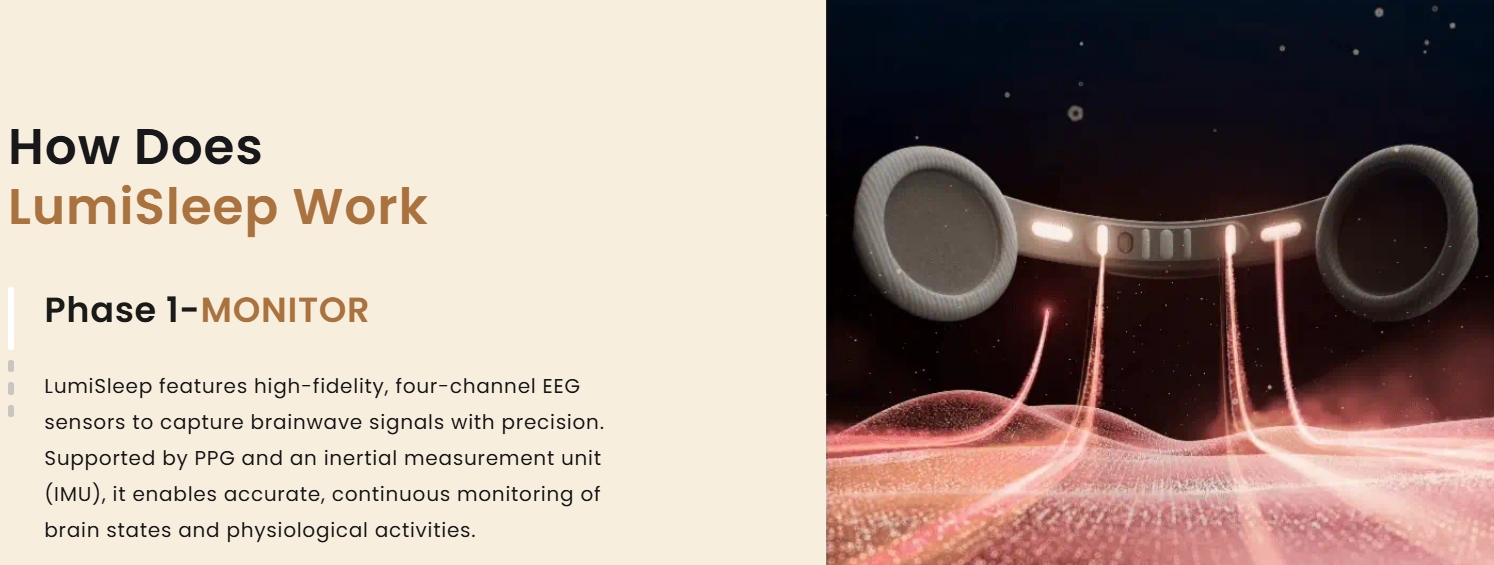
Core Positioning: A consumer-grade non-invasive EEG wearable device, the first domestically produced closed-loop AI sleep intervention device with Class II medical device certification, bringing hospital-grade EEG sleep monitoring into the bedroom.
Nighttime Wearing Scenarios
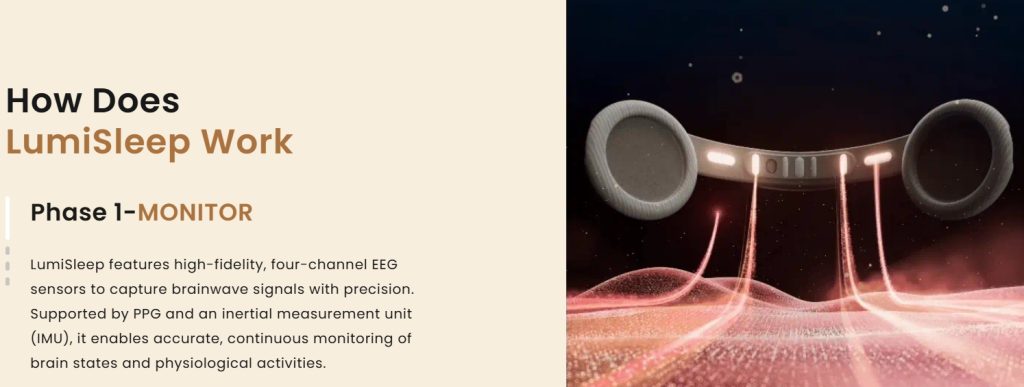
Internal Electrode Structure Diagram
I. Introduction: Overcoming the Inherent Shortcomings of the Sleep Wearable Industry
Currently, mainstream sleep hardware falls into two categories:
One is smartwatches and sleep rings, which rely on body movement and heart rate to indirectly estimate sleep depth, resulting in significant data errors and an inability to distinguish between light sleep, frequent dreams, and cortical excitation;
The other is ordinary white noise sleep aids, which play fixed sound effects in a loop, without dynamically adjusting to your brain state, offering little effect for insomniacs with cluttered thoughts and persistent brain arousal.
LumiMind takes a completely differentiated approach: directly reading prefrontal brainwaves, performing millisecond-level AI real-time decoding, and dynamically generating acoustic guidance sounds adapted to the current brain state, forming a complete closed loop of monitoring-analysis-intervention. Unlike bulky medical-grade wet electrode EEG devices, this device uses civilian-grade dry flexible electrodes, eliminating the need for conductive gel and allowing for overnight wear. It truly achieves “understanding the brain before aiding sleep.” This test involved seven consecutive nights of wear, comprehensively covering the user experience in terms of hardware fit, EEG recognition, AI control, sleep reports, and battery life advantages and disadvantages.
II. Hardware Appearance and Wearability Test: Lightweight and Flexible Design Solves the Feeling of Foreign Objects in Headwear
- Body Material and Weight
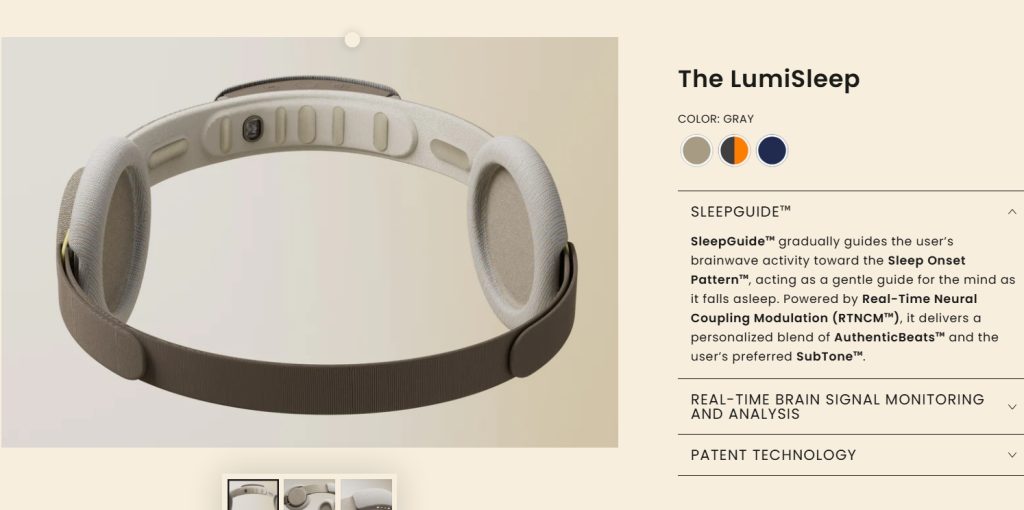
The device weighs only 92g. The main body uses medical-grade liquid silicone + breathable memory fiber headband. The two sides feature integrated closed acoustic earcups filled with slow-rebound foam, conforming to the ear without pressure. The headband supports stepless tightness adjustment, accommodating different head sizes for men and women, and is not prone to slipping even with short or long hair. - Core Hardware Sensor Array (Industry-Leading)
7-channel flexible dry EEG electrodes covering the frontal cortex; no gel or water required, simply wear before sleep for stable EEG acquisition;
Matching PPG heart rate sensor + IMU six-axis posture sensor, simultaneously acquiring heart rate, turning over, and limb movements, achieving dual data verification of EEG and physiological movement;
Local independent NPU low-power chip; all EEG signal decoding and AI acoustic calculations are completed locally offline, without constant connection to a mobile phone, ensuring privacy data is not forcibly uploaded to the cloud;
Dual-sided built-in lossless acoustic units; directional sound, confining sound only within the earcups, without disturbing your partner.
- Real Experience After 7 Nights of Wearing
The first two nights I felt a slight constriction on my head. After adjusting the tightness to fit snugly without compressing my scalp, I felt almost nothing on the third night. When sleeping on my side or turning over, the flexible silicone electrodes conformed to the shape of my head, without digging into my forehead or temples.
Compared to bulky EEG headbands on the market, its biggest advantage is its integrated earcup design. You don’t need to wear separate headphones; one device simultaneously performs EEG data collection and sleep-aiding audio. It’s portable for business trips and lunch breaks; the storage case is only palm-sized.
III. Core Technology Principles: Self-Developed RTNCM Real-Time Neural Coupling Regulation Closed-Loop (Core Highlight of the Evaluation)
LumiMind’s core competitive advantage comes from the self-developed RTNCM real-time neural coupling regulation technology of the Yansi Brain-Inspired Research Institute. The entire workflow consists of four millisecond-level closed-loop calculations, which is also the most fundamental difference from ordinary sleep aids:
Step 1: Real-Time Monitoring (Millisecond-Level EEG Capture)
Seven dry electrodes continuously capture four types of brain waves in the frontal lobe: alpha, beta, theta, and delta, clearly distinguishing four brain states: alertness/excitement, mild relaxation, light sleep, and deep slow-wave sleep. Blinking, thought fluctuations, and anxious overthinking are all reflected in the APP’s EEG waveform in real time.
Step 2: Local AI EEG Model Decoding
The device has a built-in lightweight sleep AI model that identifies the exclusive Sleep Onset Pattern waveform—the brain’s exclusive neural rhythm as it prepares to enter sleep, a signal that ordinary wristbands cannot capture.
Step 3: Dynamically Generate Personalized Guided Sounds (AuthenticBeats™ Adaptive Beats)
Unlike the unchanging loops of rain or white noise, the headband dynamically adjusts the low-frequency, soothing beats based on the current brainwave state:
High beta waves (anxiety, overthinking): Slows down the low-frequency beats, paired with gentle sub-tone background sounds to reduce brain excitability;
Entering the relaxation alpha wave zone: Gradually weakens the beats, guiding the transition to light sleep theta waves;
Detecting deep delta slow waves (deep sleep): Automatically lowers the volume, retaining only a faint background sound to avoid disrupting deep sleep.
Step 4: Gentle Neural Coupling and Regulation
The entire process involves no electrical stimulation, no pulses, and no drugs. It only uses acoustic rhythms to synchronize with the brain’s own neural fluctuations. The brand’s product philosophy is “following the brain, not forced hypnosis,” ensuring no dependency.
WAIC Exhibition Equipment Booth
IV. Real-world Testing Scenarios and Functions: Monitoring, Intervention, and AI Sleep Diagnosis in One
- Active Closed-Loop Sleep Aid: Significantly Shortened Sleep Onset Time
Test Subject Scenarios: People who work long hours, whose brains are highly active from scrolling through their phones before bed, and who take 30-60 minutes to fall asleep.
Test Data: After wearing the LumiSleep D1, the AI identified continuous high-frequency beta waves and dynamically matched them with low-frequency coupling beats, shortening the average sleep onset time to 12-18 minutes; For scenarios involving frequent dreams and nighttime awakenings: When frequent awakening waveforms are detected by nighttime EEG monitoring, the system automatically and gently adjusts soothing sounds to stabilize brain waves and prolong continuous deep sleep duration.
- Clinically-Grade Precise Sleep Cycle Analysis (EEG Gold Standard)
Ordinary fitness trackers rely solely on turning over to determine deep and light sleep, with an error margin of over 40%; while EEG is the standard medical basis for assessing sleep.
A complete sleep report is generated nightly, with AI automatically breaking down the data:
- Duration of each EEG band: percentage of deep sleep delta waves, light sleep theta waves, and awake beta waves;
- Number of nighttime awakenings and EEG characteristics corresponding to periods of vivid dreams;
- Analysis of the correlation between heart rate fluctuations, frequency of turning over, and brain excitability;
- AI-based cause diagnosis: Automatically identifies insomnia triggers—daytime mental tension, pre-sleep electronic screen stimulation, sleep-wake cycle disorders, and stress/anxiety.
- AI Sleep Improvement Plan (Long-Term Data Compounding)
- After wearing the device for 7 consecutive days, AI summarizes a week’s worth of EEG big data and generates a personalized sleep conditioning plan:
- Brainwave training suggestions: Recommends corresponding relaxation sound effects;
- Sleep-wake cycle adjustment reminders: Precisely identifies the best time to fall asleep and wake up;
- Daytime relaxation guidance: For individuals with consistently high beta waves, a 5-minute brain relaxation guided audio is provided;
- All reports can be exported and are certified as Class II medical devices. The reports can be provided to doctors as supplementary references for sleep disorders.
- Offline Independent Operation, Maximized Privacy and Security: No need for constant Bluetooth connection to your phone while sleeping at night; raw EEG data is stored locally, with the option to sync to the cloud. With privacy mode enabled, all data is stored locally on the device and never uploaded to servers, ensuring sensitive sleep data is not leaked.
- Additional Lightweight Function: Short-Term Relaxation Mode for Lunch Breaks
A 20-minute short-term nap mode quickly reduces brain activity, preventing post-nap drowsiness. Supports standalone use during commutes and naps, not limited to nighttime sleep scenarios.
V. Battery Life and Compatible Ecosystem Testing
Battery Life Performance: With full EEG monitoring and real-time acoustic intervention enabled overnight, a single full charge lasts for 8 nights. In the simple lunch break relaxation mode, battery life extends to 12 days. Type-C fast charging fully charges in 1.5 hours.
The accompanying app is comprehensive, with an interface divided into four main sections: real-time EEG waveforms, daily sleep reports, an AI-powered sleep improvement library, and device management. It includes dozens of built-in SubTone background sounds (forest, stream, low-frequency white noise, classical music, etc.) that can be freely combined with AuthenticBeats for adaptive tempo. It supports long-term data archiving, allowing users to view monthly sleep change curves and intuitively observe the treatment effects.
VI. Summary of Advantages and Disadvantages Based on Actual Testing
Core Advantages
Leading Technological Perspective: Directly collects brainwaves, with data accuracy far surpassing wristbands and sleep trackers, upgrading from “guessing sleep” to “reading the true state of the brain”;
Millisecond-Level Closed-Loop Dynamic Intervention: Sound effects change in real time with the brain, not fixed looping white noise, showing outstanding improvement effects for anxiety-induced insomnia;
Medical-Grade Safety Certification: Class II medical device certification, non-invasive acoustic modulation, no drugs, no electrical stimulation, and no risk of dependence;
**Breakthrough in the Civilian Application of Dry Electrodes: No gel required, no cleaning needed, overnight wear comfort significantly superior to medical EEG devices;
*Local Offline Computing:* Privacy controllable, sensitive EEG data self-management;
Lightweight Integrated Design: Portable and easy to store, suitable for home, travel, and nap scenarios.
Objective Shortcomings:
Priced at 3299 yuan, this is more expensive than typical sleep aids costing several hundred yuan, making it costly for users with limited budgets.
While the headband is lightweight, it may present an adjustment challenge for those who cannot tolerate any feeling of restriction on their head (those who completely reject head-mounted devices).
Deep AI monthly sleep analysis and customized brainwave training audio require a membership to unlock; the free version only provides a basic sleep report.
The acoustic unit has a limited volume limit; its effectiveness may slightly decrease in extremely noisy environments (such as bedrooms facing the street or roommate noise).
Users with long hair tied in a high ponytail need to adjust the headband position, which is slightly cumbersome.
VII. Target Audience and Purchase Recommendations
Highly Recommended for: Those who work long hours under high pressure, those who work overtime and stay up late, those who experience mental alertness, racing thoughts, and difficulty falling asleep before bed; those who experience frequent nightmares, wake up often in the middle of the night, and have insufficient deep sleep, and want to pinpoint the root cause of their insomnia; those who do not want to rely on melatonin or sleeping pills and seek a physical, non-invasive, natural way to regulate sleep; those who need precise sleep monitoring, have mild sleep disorders, and want clinical-grade sleep data; those who frequently travel for work or take naps and need a portable device that combines relaxation and sleep aid.
Not Recommended for: Those with mild light sleep, no difficulty falling asleep, who simply want basic sleep tracking, and have a limited budget; those who completely reject head-worn devices and cannot adapt to any headbands or head-mounted products; those who seek audio-visual entertainment and multifunctional smart wearables, and only need basic step counting and blood oxygen monitoring.
Not Recommended for: Those with mild light sleep, no difficulty falling asleep, who simply want basic sleep tracking, and who have a limited budget; those who completely reject head-worn devices and cannot adapt to any headbands or head-mounted products; those who seek audio-visual entertainment and multifunctional smart wearables, and only need basic step counting and blood oxygen monitoring. VIII. Evaluation Conclusion: A Practical Benchmark for Consumer-Grade Brain-Computer Wearables
The sleep industry is currently highly competitive, but most products remain at a superficial stage of “data monitoring” or “single audio soothing.” The LumiMind LumiSleep D1 truly establishes a complete closed loop of EEG acquisition, real-time AI decoding, and dynamic neuroacoustic intervention, bringing laboratory brain science technology to the ordinary person’s bedroom.
It’s not a gimmicky digital toy, but a professional sleep conditioning hardware with medical backing, accurate data, and scientifically sound intervention logic. If you suffer from difficulty falling asleep, frequent dreams, and light sleep, and are averse to medication-based sleep aids, and are willing to pay for cutting-edge non-invasive EEG technology, this newly released LumiMind EEG AI Sleep Headband at WAIC is an irreplaceable high-end choice among current consumer-grade sleep aids.