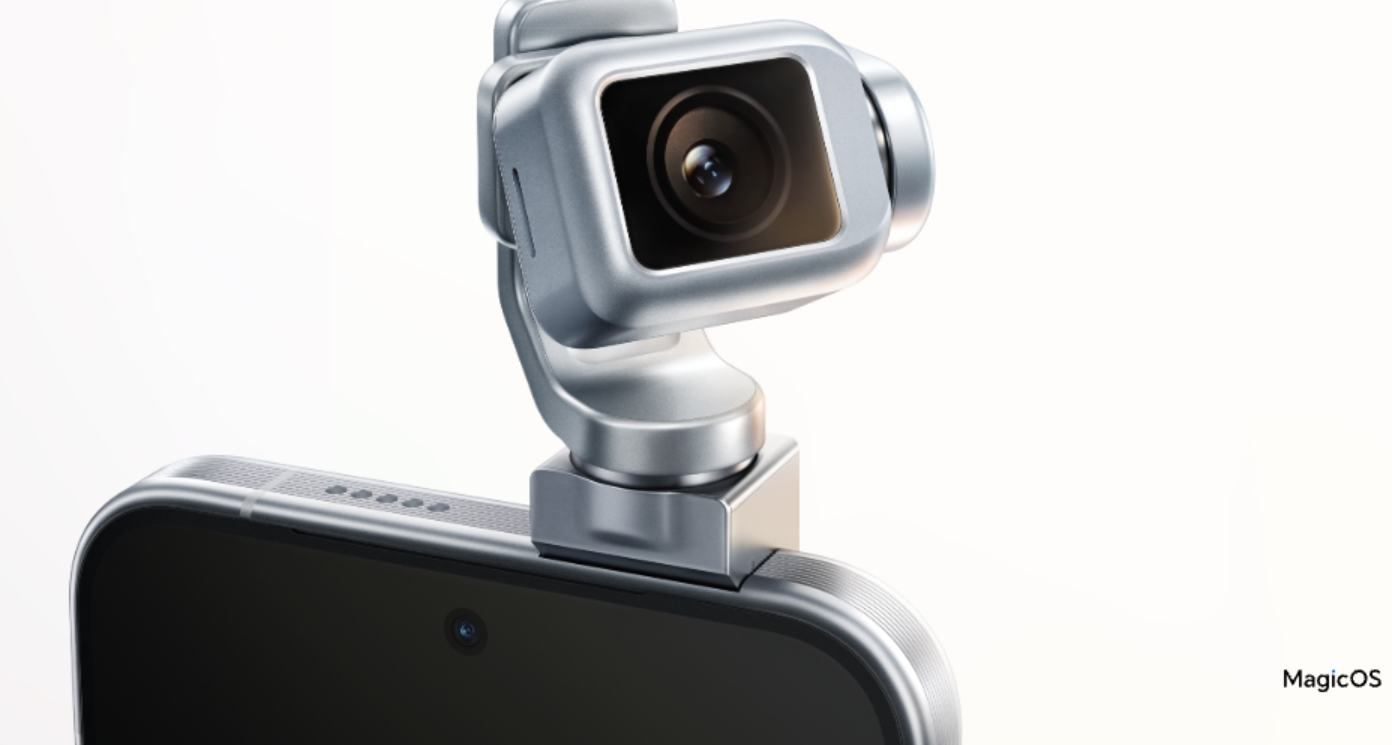
On August 12, 2026, Honor officially launched the industry’s first “Robot Phone”—a smartphone featuring an integrated, four-degree-of-freedom (4-DoF) titanium alloy gimbal. Priced at 9,999 RMB for the 12GB+512GB version and 12,999 RMB for the top-tier 16GB+1TB model, it goes on sale across all channels on August 18. Breaking away from the traditional smartphone limitations of fixed lenses and reliance on external stabilizers, it integrates three core capabilities: a miniature three-axis mechanical gimbal, embodied AI interaction, and ARRI-grade professional cinematic imaging. It functions simultaneously as a flagship daily smartphone and a portable, fully automated AI-tracking cinema camera. This hands-on review covers a full range of scenarios—including daily vlogging, outdoor travel photography, live streaming, portrait videography, and home-based AI interaction—while dissecting the device’s industrial design, AI gimbal imaging, system interaction, and real-world usage limitations.
I. Appearance and Industrial Hardware: Fitting a Professional Gimbal into a 9.59mm Body
Over more than a decade of smartphone evolution, imaging upgrades have largely remained confined to sensors and algorithms, with no disruptive innovations in physical form factor. The Honor Robot Phone’s greatest breakthrough is the mass production and implementation of a complete mechanical system featuring a miniature, agile, four-axis titanium alloy gimbal.
Basic Body Construction
The device measures 9.59mm in thickness and weighs 248g, available in two matte metal finishes: Moon Shadow Grey and Star Trail Silver. It sports a 6.3-inch LTPO flat display with a peak brightness of 6,800 nits, ensuring a glare-free viewfinder experience even in bright outdoor light. The back is flat; when retracted, the gimbal module sits flush with the body, eliminating awkward protrusions, and the device feels similar to a standard large-screen flagship in the hand.
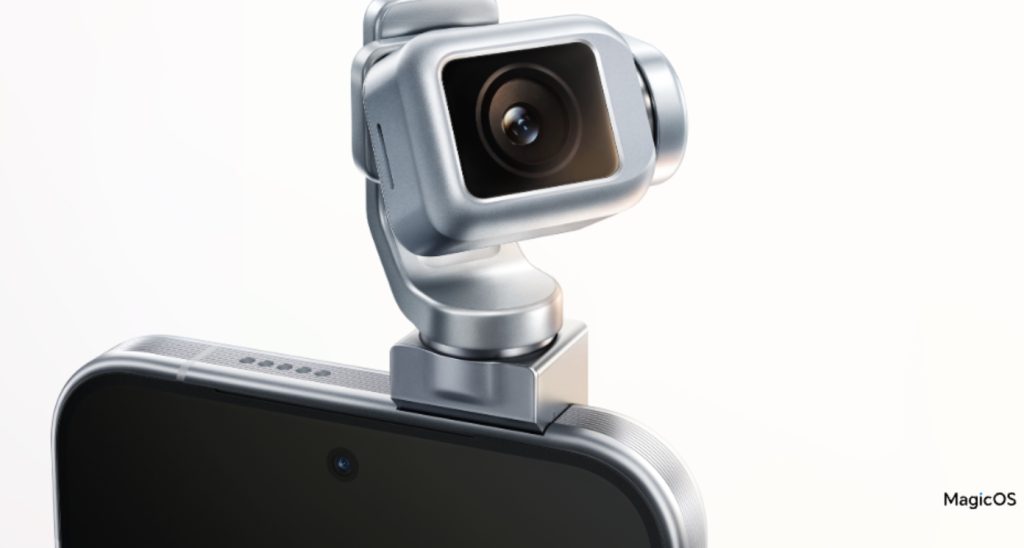
The gimbal assembly integrates over 100 precision components and undergoes 60 specialized manufacturing processes. Its self-developed miniature motor weighs just 2.6g, boasts a machining precision of ±0.005mm, and achieves rotation speeds of up to 360° per second. Backed by 140 proprietary structural patents, the motor delivers a torque density that far exceeds that of compact handheld gimbals. Gimbal Lift Mechanism Design
The device features a sliding lens cover on the rear side; manually sliding it open triggers the gimbal module to pop up automatically within 0.8 seconds. When not in use, a single-button press retracts the module, securing it with a magnetic closure. The system includes built-in collision protection logic: the gimbal automatically retracts upon detecting compression or a drop, minimizing the risk of impact damage. An official one-year worry-free gimbal replacement service is included to address after-sales concerns regarding the precision mechanical structure.
The gimbal supports multi-angle rotation—including upward tilting, low-angle downward shooting, and flipping the lens to use the rear main camera for selfies—breaking free from the limitations of standard phones restricted to fixed, eye-level shots. Users can capture low-angle, upward-facing, or top-down tabletop shots without needing to adjust the phone’s body angle.
Core Hardware and Battery Performance
It is powered by the flagship Snapdragon 8 Elite (Gen 5) chip, alongside three proprietary chips developed by Honor: the C1 (connectivity), E2 (energy efficiency), and H1 (imaging). It houses a massive 7060mAh “Qinghai Lake” battery supporting 120W wired and 50W wireless fast charging, effectively resolving battery life limitations during extended gimbal recording or live streaming. A four-microphone array works with the gimbal’s directional audio capabilities; AI automatically locks onto the subject’s sound source, ensuring cleaner audio capture even in noisy environments.
II. Imaging Hardware System: Dual 200MP Large Sensors + ARRI Cinematic Color
The “Robot Phone” does not compromise imaging specifications for the sake of the gimbal. The rear triple-camera setup utilizes high-end sensors across the board. Paired with the H1 imaging chip—custom-engineered for the mechanical gimbal—it enables a complete professional video workflow, covering RAW capture, real-time AI processing, and Log format recording. Triple-Camera Hardware Specifications
Gimbal-stabilized main camera (core): 200MP resolution, large 1/1.28-inch sensor, f/1.6 wide aperture, supports 4x AI lossless zoom, and features dual stabilization combining 3-axis mechanical OIS with chip-level AI stabilization;
2.7x Periscope Telephoto: 200MP resolution with a massive 1/1.4-inch sensor; supports close-up macro photography and delivers exceptional detail for both portraits and distant landscapes;
50MP Ultra-wide Camera: 122° ultra-wide field of view, ensuring distortion-free capture for landscapes and group photos.
ARRI Co-engineered Cinematic Imaging System (Exclusive Core Advantage)
This is the first product resulting from the strategic partnership between Honor and the professional cinema equipment manufacturer ARRI. It goes beyond simple filters to fully integrate ARRI’s native cinematic color system:
Native support for ARRI LogC3 gamma curve, AWG3 cinematic wide color gamut, 10-bit color depth, 4:2:2 color sampling, and 14 stops of cinematic dynamic range, preserving details in both bright skies and dark shadow areas;
Built-in 11 official ARRI cinematic LUTs for direct output of film-like imagery, with support for professional users to import custom 3D-LUTs for post-production color grading;
Comprehensive professional shooting tools: focus peaking, false-color exposure monitoring, exposure/white balance lock, 2.39:1 cinematic aspect ratio, and 4K 120fps AI slow-motion;
H1 imaging chip enables real-time RAW-domain noise reduction, improving the video signal-to-noise ratio by 8dB and delivering noise control in night and low-light indoor settings that far surpasses standard flagship smartphones.
III. The Core Soul: YOYO Embodied AI Gimbal System—A Truly “Thinking Lens”
Dubbed a “Robotic Phone,” the product’s essence lies not merely in its movable lens, but in the complete embodied AI closed-loop formed by the gimbal hardware and on-device large models. The lens possesses independent capabilities for perception, tracking, interaction, and creation—a key differentiator setting it apart from all other smartphones and portable cameras. 1. Fully Automated AI Tracking & Camera Movement (Core for Video Creation)
Powered by target recognition algorithms trained on millions of real-world samples, the gimbal and H1 chip work in millisecond-level synchronization to enable six professional cinematic camera movement modes with a single tap:
Double-tap to lock onto the subject: Continuously track people, pets, or vehicles, with rapid re-locking after brief obstructions;
Exclusive Spinshot mode: 90°/180° orbiting shots—capture cinematic-quality orbital footage while holding the device with just one hand;
Low-angle auto-tilt modes: Capture pets, food, or still-life objects without bending down, as the gimbal independently adjusts the angle;
Music-synced movement: Detects background music rhythms, automatically adjusting zoom, pan, and tilt speeds to match the beat for perfectly timed footage.
Real-world testing during walking and jogging shows that the mechanical 3-axis stabilization cancels out significant shaking—delivering stability superior to standard smartphone EIS. No need to carry a separate handheld gimbal; one device handles solo vlogs, outdoor reviews, and cycling footage.
- YOYO Pro Multimodal AI Robotic Interaction
The gimbal is more than just a camera tool; it acts as an “interactive body” for your phone, featuring multimodal interaction via voice, gestures, and music:
Voice command control: Simply say “Gimbal selfie,” “Follow me while I walk,” “Shoot a cinematic clip,” or “Do a dance,” and the camera automatically executes the corresponding action;
Anthropomorphic feedback: The gimbal responds with subtle nods or shakes during conversation and interacts proactively based on recognized outfits or environments, acting like a “cyber-pet”;
AI-assisted composition: Automatically detects composition flaws and makes micro-adjustments to optimize the frame, generating balanced shots with a single tap;
Smart tracking for video calls: Keeps the face locked in frame during video chats, ensuring the subject remains centered while moving or doing chores—solving the issue of the subject drifting out of frame during standard calls. 3. AI One-Stop Video Creation
Features a built-in on-device editing model that automatically analyzes footage after shooting—identifying highlights (people, scenery, dynamic shots) and matching them with ARRI cinematic filters, beat-synced music, and professional transitions. It supports natural language editing; simply input a prompt like “generate a 30-second atmospheric travel video,” and the AI selects the footage and produces the final clip, drastically reducing the time and effort required for post-production.
IV. Real-World Testing Across Scenarios
Scenario 1: Solo Vlogs & Content Creators
Traditional workflows require two devices—a phone and a handheld gimbal—but the Robot Phone integrates everything into one, allowing creators to travel with just a single device. Features like walk-and-track, 360° orbit shots, and low-angle overhead shots are executed with a single tap. It delivers direct ARRI cinematic color output and captures dynamic moments in 4K 120fps slow-motion. Automatic AI editing post-shoot doubles short-video production efficiency.
Scenario 2: Outdoor Travel & Landscape/Portrait Photography
Dual 200MP large-sensor cameras provide exceptional resolution, while 14 stops of dynamic range handle high-contrast scenes like sunrises and backlighting. The periscope telephoto lens captures distant snow-capped mountains and architectural details with clarity. The gimbal offers 360° perspective adjustment, enabling panoramic shots without moving the phone body, and LogC3 footage can be directly imported into software like Premiere Pro or CapCut for professional color grading.
Scenario 3: Family & Pet Moments at Home
AI automatically locks onto and tracks children and pets; the gimbal allows for eye-level shots of pets from a low angle without the need to crouch or lie on the ground. After casual daily recording, the AI automatically generates family videos in the background while the phone charges—perfect for everyday users to document their lives effortlessly.
Scenario 4: Live Streaming & Online Meetings
The gimbal locks onto the host in real-time, keeping them centered and stable while they move or showcase products. AI-powered directional audio filters out background noise; combined with cinematic color quality, the live stream visuals far surpass standard smartphones, eliminating the need for extra camera equipment for small-scale product showcases or knowledge-sharing sessions. V. Objective Shortcomings and Usage Limitations
Physical constraints of the gimbal mechanism
Rapid, wide-angle turns can trigger slight axis-movement limits; stability performance during high-speed running or intense movement falls short of professional handheld gimbals. Prolonged 4K 120fps recording combined with continuous gimbal operation causes noticeable device heating; magnetic cooling accessories are recommended for high-load shooting.
High device weight and price point
Weighing 248g, the device places significant strain on the wrist during extended one-handed shooting. With a starting price of 9,999 RMB, it targets high-end creators, offering lower value-for-money for casual users who primarily take snapshots or browse short videos.
Limited vertical video specifications
Vertical shooting mode tops out at 2.8K 60fps, meaning it cannot output 4K vertical video; short-form content creators face specification compromises when shooting high-definition vertical footage.
Slight impact on battery life due to the gimbal
Frequent deployment and continuous subject tracking reduce total battery life by approximately 15–20% compared to standard flagship phones; carrying charging accessories is recommended for heavy shooting sessions.
Maintenance requirements for the mechanical structure
Dust easily accumulates in the gimbal gaps, requiring simple cleaning after use in seaside or dusty environments; retracting the gimbal to protect the lens is recommended during long periods of inactivity.
VI. Comparative Analysis with Competitors
Comparison with Insta360 X6 Panoramic AI Camera
Robot Phone Advantages: Full smartphone communication capabilities, large-screen preview, native ARRI cinematic color science, and suitability for all daily scenarios. Shortcomings: No 360° panoramic shooting; lower water resistance rating.
X6 Advantages: Immersive panoramic recording, 20-meter waterproof rating (without a case), and optimizations specifically for outdoor sports. Shortcomings: Standalone camera only (no communication capabilities), small screen size, and lack of a professional cinematic color system.
Complementary Positioning: Choose the Robot Phone for daily content creation, live streaming, and portrait-focused short videos; choose the X6 for cycling, diving, and panoramic travel documentation. Comparison with Conventional Flagship Camera Phones
Standard smartphones rely solely on electronic image stabilization (EIS) and lack physical camera movement capabilities; they cannot perform automatic orbiting shots or low-angle tracking. They also lack professional ARRI Log formats and cinematic color pipelines, resulting in a clear gap in professional video creation capabilities—though they do offer lower prices and slimmer, lighter bodies.
VII. Target Audience Recommendations
Recommended for:
Vloggers, short-video creators, and streamers who want fully automated solo camera movements without carrying an extra gimbal;
Photography enthusiasts and creators of short films who require Log formats and professional cinematic color, while needing a phone that handles both daily communication and filming;
Families and pet owners who need AI-powered automatic tracking and one-tap lifestyle video generation;
Online instructors and live streamers who require automatic focus tracking and stable, high-definition live video feeds.
Not recommended for:
Those with limited budgets who only take casual photos and browse videos, rarely shooting video content;
Serious outdoor enthusiasts (e.g., diving, cycling) who require high water resistance and panoramic shooting capabilities;
Those who prioritize an ultra-slim, lightweight body and dislike the added weight of mechanical components.
Conclusion
The Honor Robot Phone is not merely a smartphone with an added movable lens; it represents a structural innovation in the smartphone category. By combining three core capabilities—titanium alloy micro-gimbal hardware, an ARRI cinematic imaging pipeline, and YOYO embodied AI—it bridges the gap between daily communication, fully automated AI camera movement, and professional filmmaking, redefining the upper limits of smartphone imaging.
For content creators and photography enthusiasts, it serves as an all-in-one, portable cinematic gimbal camera that also functions as a phone; for average users, features like AI auto-tracking and one-tap video generation significantly lower the barrier to creating video content. With a price point near 10,000 RMB, it is not intended for mass-market volume sales; however, it demonstrates that smartphone imaging is no longer confined to the “arms race” of software algorithms. The fusion of physical hardware innovation and on-device AI represents a crucial direction for the future of intelligent imaging hardware.