On May 8, 2026, AMD officially launched its next-generation AI accelerator — the Instinct MI350P. This product marks AMD’s important strategic positioning in the AI computing field and represents the company’s first Instinct series accelerator with a standard PCIe interface in four years. This release coincides with the critical transition point where the AI industry is shifting from training to inference applications, providing data centers and enterprise users with more flexible and efficient computing options.
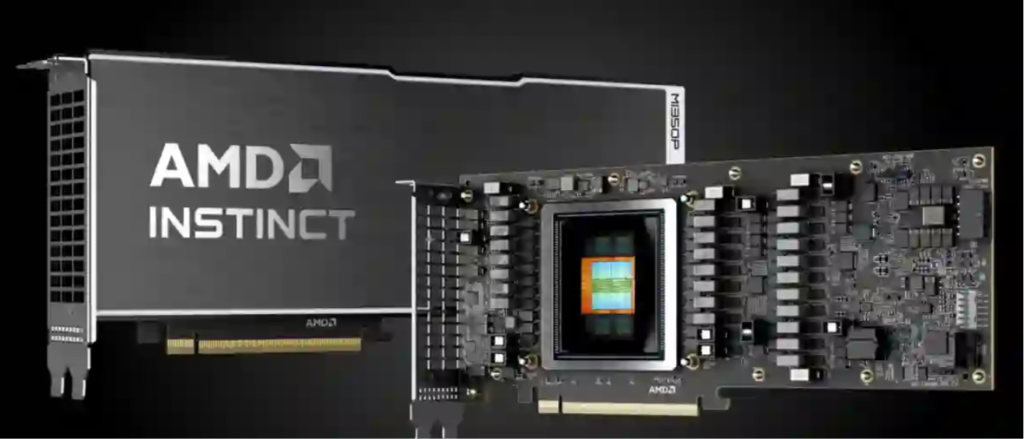
Hardcore Specifications: Half-Size Flagship, Uncompromised Performance
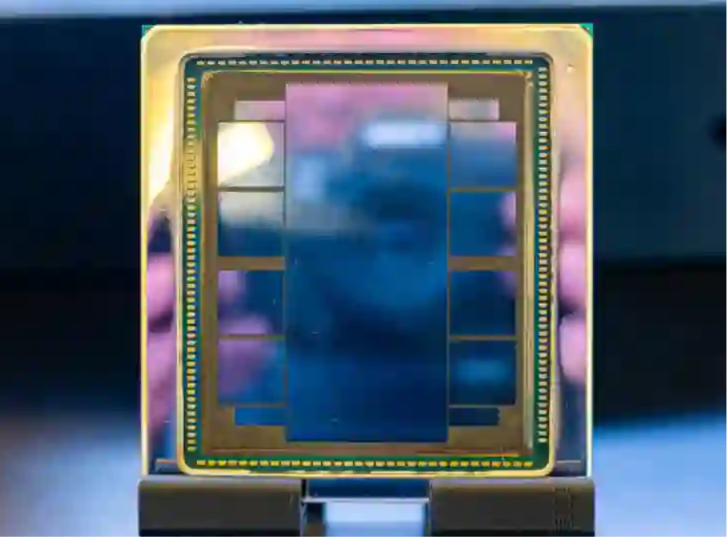
The MI350P can be considered a “half version” of the flagship MI350X in terms of hardware specifications, but this does not mean compromised performance. Built on AMD’s latest CDNA 4 architecture, it features TSMC 3nm process for XCD compute modules paired with 6nm IOD input/output modules. This heterogeneous integration approach achieves an excellent balance between performance and power consumption.
In terms of core configuration, the MI350P is equipped with 4 XCD chips, totaling 128 compute units, 8192 stream processors, and 512 matrix cores. These hardware units are specifically optimized for AI computing, especially matrix multiplication and tensor operations, with operating frequencies reaching up to 2.2GHz. This design ensures the accelerator maintains stable and efficient performance output when processing complex AI workloads.
The memory system represents a major highlight of this product. The MI350P features 144GB of HBM3E high-bandwidth memory with a 4096-bit interface, delivering an impressive 4TB/s bandwidth. It also includes 128MB of Infinity Cache, further reducing data access latency and improving overall computing efficiency. For running large language models, sufficient memory and high bandwidth mean supporting larger model parameter sizes while maintaining low inference latency.
Form Factor and Cooling: Designed for Data Centers
The MI350P adopts a dual-slot PCIe card form factor, a design that makes it compatible with the vast majority of standard server chassis, lowering deployment barriers for enterprise users. Compared to accelerators requiring customized hardware, the standard PCIe interface advantage means users can directly upgrade existing infrastructure without additional hardware investment.
For cooling, the MI350P uses a fanless passive cooling design, relying entirely on server chassis fans for air cooling. This design offers multiple advantages in data center environments: first, it reduces failure points on the accelerator itself, improving hardware reliability; second, it lowers overall power consumption, avoiding airflow conflicts between accelerator fans and system fans; finally, a unified cooling system facilitates data center thermal management and energy optimization.
Regarding power control, the MI350P has a typical power consumption of 600W but supports downgrading to 450W operation. This flexible power adjustment capability means users can adjust according to actual application scenarios and power budgets, finding the optimal balance between performance and energy efficiency. For large-scale data center deployments, this flexibility directly translates into cost savings.
AI Computing Power: Clear Advantages in Low-Precision Inference
In terms of AI computing performance, the MI350P features underlying optimizations for AI inference scenarios such as large language models and retrieval-augmented generation, particularly excelling in low-precision data formats. Official data shows that at MXFP4 and MXFP6 precision, the MI350P achieves peak computing power of 4.6 PFLOPS, a figure that leads among current mainstream AI accelerators.
MXFP formats are emerging low-precision floating-point formats specifically optimized for AI inference. Compared to traditional FP16 or FP32 formats, MXFP can significantly improve computational efficiency while maintaining model accuracy, making it an ideal choice for large model inference. The MI350P natively supports MXFP6 and MXFP4 formats, meaning users can achieve optimal performance without complex format conversions.
For sparse computing, computing power reaches 2.3 PFLOPS at MXFP8 and FP16 precision. Sparse computing represents an important AI acceleration technique that, by leveraging sparsity characteristics in neural networks, can further improve computational efficiency without losing accuracy. AMD’s continuous investment in this field enables the MI350P to better handle various complex AI workloads.
For traditional high-performance computing scenarios, the MI350P also delivers exceptional performance. Single-card computing power reaches 72 TFLOPS at FP32 precision and 36 TFLOPS at FP64 precision. This means the accelerator can not only handle AI inference tasks but also efficiently process traditional HPC workloads such as scientific computing and engineering simulation, achieving maximum value through multi-purpose utilization.
Scalability and Ecosystem: Flexible Deployment, Full-Stack Support
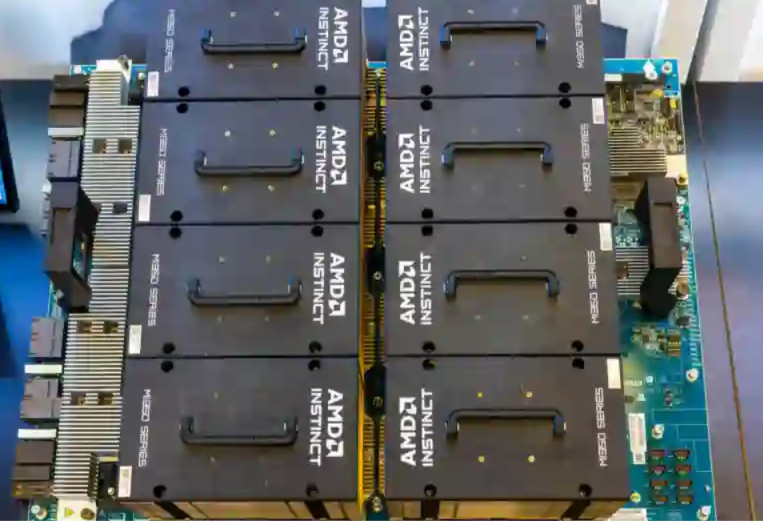
Regarding system scalability, a single server can support up to 8 MI350P cards working in parallel, achieving high-speed inter-card communication through the PCIe interface and AMD’s Infinity Fabric technology. This flexible expansion capability means users can start small and gradually scale computing capacity according to business needs, avoiding the risk of one-time large-scale investment.
Software ecosystem represents a critical success factor for AI accelerators. The MI350P comes with AMD’s complete ROCm open software stack, including the newly released ROCm 7.2.2 suite. As an open-source platform, ROCm supports all major deep learning frameworks including PyTorch, TensorFlow, and JAX, while featuring specialized optimizations for development-ready applications such as LM Studio, ComfyUI, and VS Code.
This software support means developers can work in familiar environments without learning new tools or APIs. AMD also promises Day 0 support for leading AI models, ensuring users achieve optimal performance on the MI350P when new models are released. Such timely software updates and model support are crucial for maintaining the long-term value of hardware investments.
Market Positioning: Filling the Mid-Range Inference Market Gap
From a product positioning perspective, the MI350P primarily targets the mid-range AI inference market, filling AMD’s gap in standard PCIe interface AI accelerators. Previously, AMD’s Instinct series primarily adopted the OCP Accelerator Module (OAM) form factor. While delivering powerful performance, this approach had higher deployment thresholds, limiting its penetration in broader enterprise markets.
As AI applications penetrate from the cloud to the edge, more enterprises need to deploy AI computing power in their own data centers. These users often value deployment flexibility and compatibility with existing infrastructure more than extreme single-machine performance. The MI350P’s PCIe interface design precisely meets this demand, providing enterprise users with a more accessible and deployable AI computing option.
In the current AI computing market, inference application growth has already surpassed training. As large model technology matures, enterprises are integrating AI capabilities into actual business processes, driving massive demand for inference computing power. The MI350P represents AMD’s strategic product launch targeting this market trend, aiming to capture inference market share.
Competitive Landscape: AMD Accelerates Deployment, Market Diversifies
AMD’s launch of the MI350P signals that competition in the AI accelerator market has entered a new phase. For a long time, NVIDIA has dominated the AI computing market with its CUDA ecosystem and product first-mover advantage. However, with continued investment from AMD, Intel, and numerous domestic manufacturers, the market landscape is changing.
The MI350P’s advantages lie in its standard PCIe interface, excellent energy efficiency ratio, and complete ROCm software stack support. Particularly for users seeking to avoid vendor lock-in and more flexible hardware options, AMD’s solution presents strong appeal. ROCm’s open-source nature also enables enterprise users to more deeply customize and optimize their AI applications.
For the domestic market, the MI350P launch also brings new possibilities. As AI localization accelerates, the market requires diversified computing supply. The addition of AMD products not only provides users with more choices but also helps promote healthy ecosystem development, driving technological innovation and cost optimization.
Outlook: AI Inference Market Enters Golden Development Period
The MI350P launch represents only part of AMD’s strategic layout in the AI computing field. It can be anticipated that with the full promotion of the CDNA 4 architecture, AMD will launch more AI acceleration products targeting different application scenarios, forming complete product line coverage. From high-end training to mid-range inference and edge computing, AMD is building a comprehensive AI computing solution ecosystem.
From an industry development perspective, the AI inference market is entering a golden development period. The maturation of large model technology, continuous expansion of application scenarios, and deepening enterprise digital transformation are all driving explosive growth in inference computing demand. Against this backdrop, flexible, efficient, and easily deployable products like the MI350P will gain broad market space.
For enterprise users, selecting appropriate AI computing infrastructure becomes increasingly important. Considerations must include not only hardware performance itself but also software ecosystem maturity, deployment flexibility, and long-term technical support. The MI350P demonstrates competitiveness in all these aspects, warranting serious consideration by enterprise users when planning AI infrastructure.
Looking ahead, as more manufacturers join the competition, the AI accelerator market will become more diversified. This competition will ultimately benefit end users, promoting AI technology popularization and reducing application costs. AMD’s MI350P is just the beginning of this transformation, with an even more exciting AI computing era on the horizon.