One-sentence verdict: If the “phone as brain” cost advantage and 9-level curriculum depth can withstand real classroom testing, the FX Navi may be the most cost-effective entry ticket in consumer quadruped educational robots—provided parents are comfortable with ongoing content fees.
Introduction
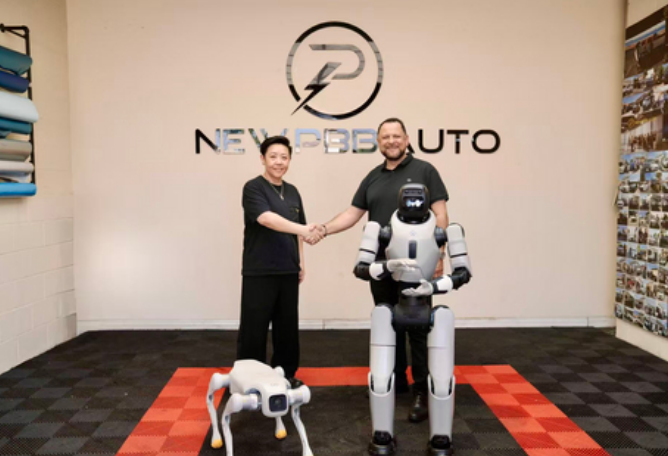
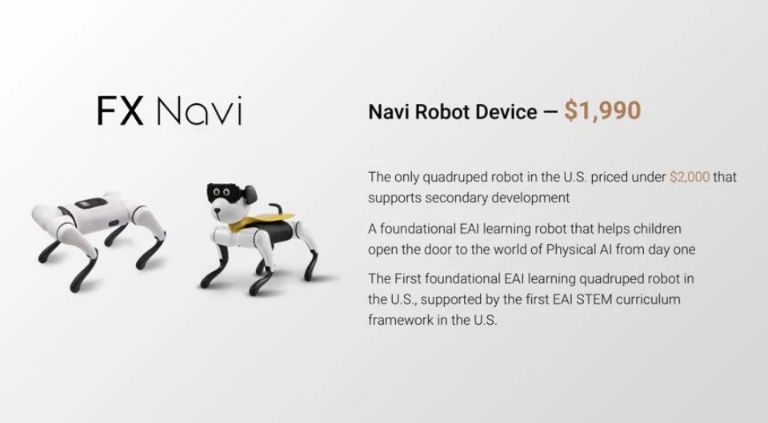
Educational robots have long occupied an awkward market position. Industrial-grade quadruped platforms like Boston Dynamics Spot cost $75,000, putting them out of reach for schools and families. Low-end programming toys like Sony toio are affordable but cannot deliver real robot interaction experiences. Faraday Future’s FX Navi attempts to break this deadlock—packing quadruped locomotion, STEM curriculum, and secondary development capabilities into a $1,990 base package.
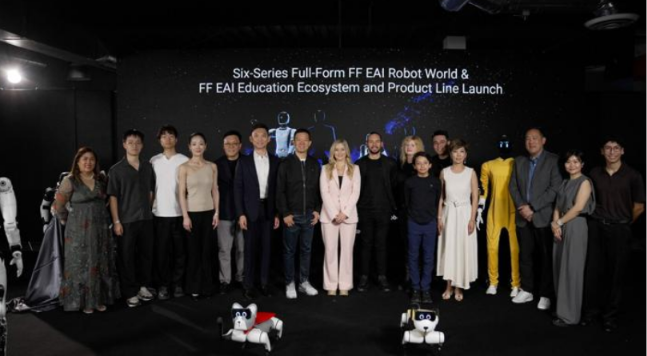
The FX Navi launched for immediate purchase on June 17, 2026, targeting families and schools with technology education needs. It features 12 joint motors, uses iOS/Android phones as the computing “brain,” includes a 9-level EAI STEM curriculum (annual fee $490), and offers a $390 permanent enhancement pack unlocking secondary development capabilities.
Product Overview
The FX Navi is Faraday Future’s first consumer-facing educational robot, and Jia Yueting’s latest attempt to cross over from electric vehicles to robotics. In stark contrast to the FF 91’s production struggles, the FX Navi chose a more pragmatic path: avoiding autonomous driving-level complexity to focus on “affordable embodied intelligence education.”
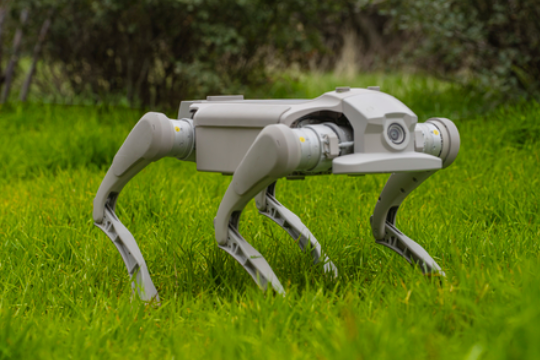
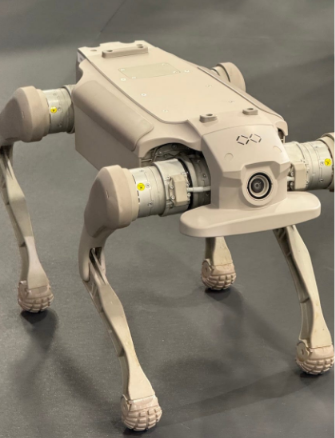
The core design trade-off is “phone as brain”: the robot dog body handles only mechanical execution and sensor acquisition, while computation and AI processing are entirely offloaded to the user’s iOS or Android phone. This architecture significantly reduces base hardware costs (no need for built-in high-performance processors) while leveraging devices users already own. Twelve joint motors enable basic locomotion—walking, turning, sitting, standing, and simple obstacle avoidance.
For battery life, the FX Navi includes a rechargeable battery delivering approximately 2 hours per charge, with support for use-while-charging. The lightweight plastic body keeps total weight under 3 kg, making it easy for children to carry and store.
Technical Specifications and Curriculum
The FX Navi offers a 9-level EAI STEM curriculum covering a complete learning path from kindergarten through high school:
| Level | Theme | Core Content | Age Range |
| Level 1-2 | Motion Control Basics | Forward, backward, turning, speed adjustment | 5-7 years |
| Level 3-4 | Sensor Cognition | Distance detection, sound recognition, light sensing | 8-10 years |
| Level 5-6 | Programming Logic | Conditional judgment, loop structures, event triggers | 11-13 years |
| Level 7-8 | AI Algorithm Introduction | Image recognition, voice commands, path planning | 14-16 years |
| Level 9 | Comprehensive Project | Self-designed tasks, team collaboration competitions | 17+ years |
The annual curriculum fee of $490 includes video tutorials, project assignments, and online Q&A. The $390 permanent enhancement pack unlocks secondary development capabilities: modifying walking algorithms, adding custom sensors, and integrating third-party AI services.
The intelligence of this curriculum design lies in transforming “playing with robots” into “learning engineering.” Each level has clear skill objectives and quantifiable learning outcomes, allowing parents to track their children’s progress rather than buying a toy that gathers dust.
“Phone as Brain”: Beyond Cost Cutting
The FX Navi’s “phone as brain” design is not merely a cost compromise but an expression of educational philosophy.
Traditional educational robots like LEGO Mindstorms suffer from fixed hardware and closed functionality, with students quickly hitting ceilings. The FX Navi achieves a “hardware-standardized, software-infinitely-extensible” architecture by using the phone as the computing hub. Users’ phones upgrade annually, and the robot dog’s “intelligence” upgrades along with them—meaning the FX Navi won’t become obsolete two years after purchase.
A deeper benefit is lowered secondary development barriers. Students can use familiar mobile app interfaces (rather than unfamiliar embedded systems) to program robot control, creating a gentler learning curve. Support for Python and JavaScript allows advanced students to directly call mainstream AI frameworks like TensorFlow Lite, enabling genuine machine learning projects.
Yet risks exist equally: phone performance varies enormously, with budget models potentially unable to run complex AI inference smoothly; Bluetooth/Wi-Fi connection stability directly impacts classroom experience; parents may be unwilling to let children occupy phones for extended periods.
Competitive Comparison
| Feature | Faraday Future FX Navi | Unitree Go2 Edu | Xiaomi CyberDog 2 | Sony toio |
| Price | $1,990 base | ~$1,400 | ~$1,800 | ~$280 |
| Curriculum | 9-level EAI STEM | No | Developer docs only | Basic programming |
| Annual Fee | $490 | None | None | None |
| Quadruped | Supported | Supported | Supported | Not supported |
| Secondary Dev | $390 unlock | Supported | Supported | Limited |
| Phone Dependency | Required | Optional | Optional | Not required |
| Target Age | 5-17 years | 12+ years | 14+ years | 6-10 years |
The FX Navi’s pricing strategy is particularly interesting. At $1,990 base + $490 annual + $390 skill pack, three-year total cost reaches approximately $3,850. Against Unitree Go2 Edu ($1,400, no curriculum) and CyberDog 2 ($1,800, developer-oriented), the FX Navi costs more but offers a more complete educational. Against Sony toio ($280, basic programming), the FX Navi delivers real quadruped robot experience rather than wheeled toys.
Pros and Cons
| Pros | Cons |
| $1,990 base lowers quadruped robot entry barrier | Must depend on phone, budget models limit experience |
| 9-level curriculum provides systematic learning path | $490 annual fee increases long-term cost |
| “Phone as brain” enables continuous compute upgrades | 2-hour battery insufficient for full-day classes |
| Secondary development cultivates advanced engineering thinking | Brand trust affected by FF 91 production struggles |
| Lightweight design suits child operation and storage | Plastic body durability remains to be validated |
Buying Guide
Recommended for:
- Middle-class families with tech education budgets: systematic curriculum + real robot experience proves more effective than fragmented online courses
- Private schools and training institutions: needing standardized STEM teaching tools, with 9-level curriculum ready to embed into teaching systems
- Students planning to enter robotics competitions: secondary development capabilities support custom projects with strong competition adaptability
- Tech enthusiasts curious about the FF brand: wanting to experience Jia Yueting’s “new story” product
Consider carefully if:
- Budget-sensitive and unwilling to pay annual fees: three-year total cost nears $4,000, far exceeding one-time programming toys
- Needing phone-independent operation: classroom phone management is complex, and occupies students’ personal devices
- Pursuing industrial-grade precision and performance: the FX Navi is an educational tool, not a research platform, with limited 12-motor locomotion capability
- Low trust in Faraday Future brand: FF 91 delivery history may affect purchase confidence
FAQ
Q: Does the FX Navi require phone connection to function?
A: Yes. The robot dog body handles mechanical execution; all computation and AI processing is completed through the mobile app. Offline mode only supports basic motion control.
Q: Can the 9-level curriculum be purchased separately?
A: No. The curriculum is bundled with hardware sales; the $490 annual fee begins counting upon device activation.
Q: What programming foundation is needed for secondary development?
A: Levels 7-8 require basic Python; Level 9 and the enhancement pack require familiarity with API calls and simple algorithms.
Q: Does it support multi-robot collaboration?
A: Yes. Through mobile apps on the same Wi-Fi network, up to 3 FX Navi units can achieve formation collaboration.
Q: Is the body waterproof?
A: No. Indoor dry environment use is recommended; avoid liquid splashing.
Conclusion
The Faraday Future FX Navi is not a perfect educational robot—battery life, phone dependency, and brand trust all have room for improvement. But it precisely targets a market gap: families and schools who want real quadruped robot experience without paying industrial-grade premiums; students who need systematic STEM learning rather than scattered programming toys.
The “phone as brain” architecture transforms this device from “a cheaper robot dog” into “an upgradeable education platform.” Behind the $1,990 pricing lies a bet that content monetization can sustain hardware innovation.